No trial has tested what makes a goldfish plant flower. The closest evidence comes from flowering trials on its relatives, and it points at temperature and light, not at a pot kept constantly wet or a fertilizer sold for blooms.
The goldfish plant comes from cool mountain forest and drops its leaves in heat. A relative set flower buds fastest at a steady 64°F, and cuttings from plants grown with 86°F days set none in the time tested. In two feeding trials, extra phosphorus gave fewer flowers, not more.
The question came from a thread on r/houseplants about a goldfish plant that flowers all the time. Asked for the secret, the grower first said they did not really know, and did not do much to it.
Further down, the details arrived: a south-facing window in full sun, partial sun outdoors in summer, a pot kept moist because the plant drops leaves when it dries, light feeding in the growing season, and water from a frog and fish pond.
Many of the replies came from people whose plants grow well and have never produced a single goldfish. They wondered about light, about keeping the mix constantly damp, about a different fertilizer balance, and about the pond water. One reader had buds that died within days.
Another reader grows the plant outdoors, where it all but melts in the shade during triple-digit heat and grows again once the weather cools. That reply comes closest to what the research suggests. This article checks each explanation against the sources.
A Plant That Flowers in Seasons, From Cool Mountain Forest
Goldfish plants belong to the genus Nematanthus. The Gesneriad Reference Web, run by the Gesneriad Society, describes about 30 species “found in the montane forests of southeastern Brazil,” mostly trailing or bushy plants suited to hanging baskets, whose orange flowers gave the genus its common name.
NC State Extension’s plant database calls the goldfish plant Nematanthus gregarius an epiphyte: a plant that grows on other plants, such as trees, for support, without feeding on them. It lists the flowers as appearing in summer.
The Gesneriad Reference Web is plain about the habit that frustrates owners. It says the plants’ “seasonal or sporadic blooming period may make them undesirable for some growers.” A goldfish plant resting between flushes of flowers is behaving as the genus is described.
A plant that has not flowered in years is a different question. One reply described a plant bought in flower years ago that has doubled in size without flowering since. No source we found explains why a shop plant flowers and then stops, so that case is not settled here.
The thread also asked whether the goldfish plant is related to the lipstick plant. It is, at the family level. NC State places the goldfish plant, the lipstick plant (Aeschynanthus radicans) and the African violet in the same family, Gesneriaceae: the gesneriads the Gesneriad Society documents.
The relation is distant. NC State gives the lipstick plant’s native range as Thailand, the Malaysian peninsula, Sumatra and Borneo, half a world from the goldfish plant’s Brazil. The genus Aeschynanthus matters here because it has the flowering trials the goldfish plant lacks.
Heat, the Cause Nobody in the Thread Named
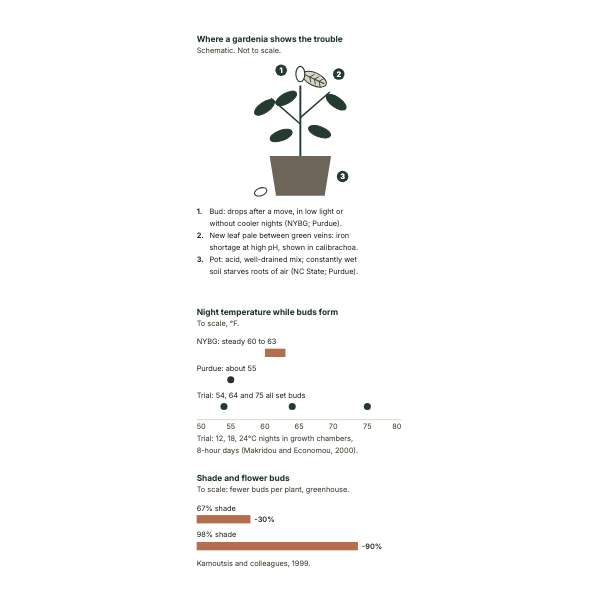
The Gesneriad Reference Web ties the goldfish plant’s temperature needs to where it comes from. “Because they come from cooler temperatures at higher elevations, they are sensitive to extreme heat,” it says. “At temperatures over 80°F (27°C), plants will rapidly lose their leaves.”
At the other end, NC State says the plant “cannot tolerate temperatures below 50 degrees F.” Neither source gives a temperature for flowering, and no trial on any goldfish plant was found that measured one.
The nearest measurements come from Aeschynanthus ‘Koral’. Brooks Whitton, Will Healy and Mark Roh grew it at three temperatures under 12-hour days and reported the results in 1990, in the Journal of the American Society for Horticultural Science (cited from the abstract).
After 8 weeks, only plants kept at a constant 18°C, about 64°F, had visible flower buds. Plants at 24°C, about 75°F, had buds by 18 weeks, but only after unfolding about two and a half times as many leaves first.
Warm stock plants, the plants kept to take cuttings from, did worst. Cuttings taken from plants grown with 30°C days, about 86°F, had not reached the visible bud stage after 86 days. The authors concluded that a constant 18°C under 12-hour days promotes rapid flowering in this plant.
A second report by the same group, in HortScience in 1991 (cited from the abstract), adds the swing. Flowering was inhibited, whatever the day length, when day and night temperatures differed by more than 10°C, a gap of 18°F.
Where the temperatures fall
What is said about the goldfish plant, and what a flowering trial measured in a relative, on one Fahrenheit scale.
No flowering trial on the goldfish plant itself was found. In its relative, the coolest steady temperature gave buds first, and the warmest gave none in the time tested.
None of this was measured on a goldfish plant. Aeschynanthus is a relative only at the family level, and whether goldfish plants respond to temperature the same way is untested.
What can be said is that the evidence nearest to hand points at heat, and that the goldfish plant’s own description warns against it.
The reply about triple-digit heat fits that description: a plant that collapses well above 80°F and grows again when temperatures fall. It fits, but one plant in one garden shows nothing on its own about flowers.
African violet, another gesneriad, is a reminder that the family does not move in step. In a 1991 growth-chamber study by James E. Brown-Faust and Royal D. Heins (a conference abstract), violet flowers developed faster as temperature rose from 15 to 25°C, about 59 to 77°F, and slower above that.
That measured how fast flowers developed, not when buds formed, so it does not contradict the ‘Koral’ result, but it does show that warmth is not bad for every gesneriad.
Day Length and Light
Light gets much of the blame in the thread, and the relatives’ trials support it, with a twist: the length of the day mattered as well as its brightness.
Ulla E. Gertsson, in the Journal of Horticultural Science in 1987 (cited from the abstract), found Aeschynanthus speciosus flowered only in long days. It did not flower in short days, so the study classed it as a long-day plant.
Gertsson also reported evidence “that flowering may be affected by the light quantity or quality received during the main light period,” so how bright the day was may count as well as how long.
Whitton’s group found the two factors tangled together in ‘Koral’. At 18°C the plant was day-neutral, flowering regardless of day length; at 24°C it “responded as a long-day plant.” Of the two temperatures, day length mattered only at the warmer one.
For brightness, the clearest figures are again from African violet. In the Brown-Faust and Heins study, flowers developed faster as daily light rose from 1 to 4 moles of light per square meter per day, a measure of the total light a plant receives in a day. More light than that brought no significant further gain.
That study measured how fast flowers developed, not how many formed, and it was on violets. No light level for goldfish plant flowering was found. The guidance for the plant itself is written in words, and NC State’s own entry pulls in two directions.
Its description says the plant “likes light shade” and should sit “near a south-facing window, but not in full sun for extended periods of time,” in “bright, filtered light.” Its list of growing conditions, a few lines further down, gives full sun or partial shade.
There is a reason to take the caution seriously. Qiansheng Li and colleagues grew Aeschynanthus longicaulis, an understory relative, for six months at two light levels (The Scientific World Journal, 2014, cited from the abstract). The brighter level caused “significant light stress and photoinhibition,” a loss of photosynthetic efficiency.
The study measured no flowers, and its light levels were not translated into anything like a window. It shows that more light is not always better for a gesneriad, not where the limit sits for a goldfish plant.
The thread’s grower keeps a flowering plant in a south window in full sun. That is one plant, and NC State advises against long hours of full sun, so the grower’s window is not a rule for yours.
The Gesneriad Reference Web also says goldfish plants can be grown “under fluorescent lights with two or four lamps.”
If you add a lamp, what a grow light label tells you explains which number on its box describes light a plant can use, and which numbers describe light for human eyes.
A Wet Pot Is Not a Flowering Switch
One reader in the thread was sure the plant must stay continuously damp to flower. No source we read connects constant moisture to flowering in a goldfish plant or in any of its relatives.
The flowering plant in the thread is kept moist, but it is also kept bright, fed and watered from a pond, so one plant cannot separate them.
What the sources do connect to water is leaf loss, in both directions. The Gesneriad Reference Web says goldfish plants “will also lose their leaves due to overwatering.”
The thread’s grower reports losing leaves when the plant dries out. That is one plant’s report, but it sits with NC State’s listing of the plant’s soil as both well drained and moist: not left to dry out, and not left sitting wet.
For the mix, the Gesneriad Reference Web recommends “a well-draining soilless mix,” and NC State lists the plant’s soil needs as good drainage and moist. NC State also suggests “peat-free potting compost” and watering “with soft water.” Neither gives a watering schedule, and none is given here.
Bloom Fertilizer and Pond Water
One reader wondered whether a different fertilizer balance would bring flowers. The usual candidate is a “bloom booster,” a fertilizer with more phosphorus, the middle number on the label, than nitrogen. Two trials on potted ornamentals tested more phosphorus, and neither found more flowers.
Yin-Tung Wang switched flowering-size moth orchids to a low-nitrogen, high-phosphorus feed from the start of September, during their flowering season (HortScience, 2000, cited from the abstract). The switch did not change when flower stems appeared or how big the flowers were.
It did change the count: “All plants treated with the high P fertilizer had fewer flowers (15 to 19) than the controls (24 flowers).” In a separate experiment, stopping fertilizer early also cut the count. Wang concluded that steady, adequate nitrogen “appears to be more important than low N and increased P for optimal flowering.”
Donglin Zhang, Renae E. Moran and Lois B. Stack fed fanflower (Scaevola aemula) a range of phosphorus levels (HortScience, 2004, cited from the abstract).
Flower numbers did not change across the lower half of the range and fell in the upper half, possibly from the phosphorus or from the mix turning more acidic.
Extension advice agrees. Esther E. McGinnis of North Dakota State University Extension writes that commercial greenhouses feed with less phosphorus than nitrogen “because studies show that high phosphorus rates do not increase the number of flowers.” The column is written for outdoor gardens, and the trials were on an orchid and a bedding plant, not a goldfish plant.
So a bloom formula has no support as a fix. Use a houseplant fertilizer and follow its label for how much and how often. Wang’s orchids flowered less when feeding stopped early, which argues against starving a plant in the hope of shocking it into bloom.
The grower’s pond water is harder to judge. No source on pond water for houseplants was found, so it cannot be credited with the flowers. The nearest question, watering houseplants with fish tank water, is covered separately, and a tank is not a pond.
What to Do With a Goldfish Plant That Will Not Flower
Each step below comes from a source named in this article. Where a figure comes from a relative rather than the goldfish plant itself, the step says so, because that is where the evidence is weakest.
- Keep it out of heat. The Gesneriad Reference Web says goldfish plants lose their leaves rapidly above 80°F (27°C). In the relative Aeschynanthus ‘Koral’, buds came first at a steady 64°F and not at all within 86 days from plants grown with 86°F days; for the goldfish plant itself, that is untested.
- Keep it above 50°F. NC State says it cannot tolerate colder temperatures.
- Give it bright, filtered light. NC State places it near a south-facing window, but not in full sun for long periods; the Gesneriad Reference Web says it can also be grown under fluorescent lights. In the relatives, long days helped flowering, especially when warm.
- Water for steady moisture, not a wet pot. Use a well-draining soilless mix; overwatering costs leaves, and so, by the thread grower’s account, does drying out.
- Feed by the label, and skip the bloom formula. In two trials, extra phosphorus gave fewer flowers or none extra, and stopping feeding early cost flowers too.
- Expect seasons. The Gesneriad Reference Web calls flowering in the genus seasonal or sporadic, and NC State lists summer bloom. A plant that rests is not necessarily failing.
Local Regulations and Safety Advisory
If you use fertilizer products, follow the label. Rules on them vary by country and locality, and your agriculture department can say what applies where you live. This article is general information, not legal advice.
Authorities to consult:
- Local agriculture department
What Remains to Be Explored
No flowering trial on any Nematanthus was found. The cultivation research found on the genus, a 2022 Russian study of Nematanthus strigillosus cuttings by E.A. Kozlova and colleagues (cited from the abstract), measured roots and shoots, not flowers.
Whether goldfish plants need long days, respond to cool temperatures the way Aeschynanthus ‘Koral’ does, or have a light level below which they will not flower, has not been measured.
A trial setting goldfish plants at a few temperatures and day lengths would settle more than any care guide can.
Several things readers raised have no source behind them. Buds that form and die within days were not explained by anything we read.
Pinching stem tips and keeping the plant snug in its pot are also offered as routes to more flowers, and no test of either on a goldfish plant was found.
Pond water is unstudied as a houseplant water, and why a plant that flowered in the shop stops flowering at home is not explained by any goldfish plant source we read. Each of these would change the advice above if measured.
Sources
- Nematanthus — Gesneriad Reference Web editorial team (editor contact Alcie Maxwell). Gesneriad Reference Web (The Gesneriad Society). Undated. A reference page from the Gesneriad Society; it cites no trial for its figures.
- Nematanthus gregarius (Goldfish Plant) — North Carolina Extension Gardener Plant Toolbox, NC State University. Undated.
- Flowering of Aeschynanthus ‘Koral’ at Fluctuating and Constant Temperatures — Brooks Whitton, Will Healy, Mark Roh. Journal of the American Society for Horticultural Science 115(6):906-909. 1990. Cited from its abstract. A related gesneriad, not the goldfish plant.
- Flowering of Aeschynanthus ‘Koral’ — Brooks Whitton, Will Healy, Mark Roh. HortScience 26(7):858-859. 1991. Cited from its abstract. A related gesneriad, not the goldfish plant.
- Flowering of Aeschynanthus ‘Koral’ Under Different Photoperiod and Temperature Regimes — Brooks Whitton, Will Healy. HortScience 25(9):1103 (conference abstract). 1990. A conference abstract.
- Influence of Light on Flowering in Aeschynanthus speciosus Hook. — Ulla E. Gertsson. Journal of Horticultural Science 62(1):71-74. 1987. Cited from its abstract. A related gesneriad.
- Modeling Saintpaulia ionantha Temperature and Irradiance Driven Leaf Unfolding and Flower Development Rates — James E. Brown-Faust, Royal D. Heins. HortScience 26(6):744 (conference abstract). 1991. A conference abstract, on African violet.
- Morphological and Photosynthetic Response to High and Low Irradiance of Aeschynanthus longicaulis — Qiansheng Li, Min Deng, Yanshi Xiong, Allen Coombes, Wei Zhao. The Scientific World Journal 2014:347461. 2014. Cited from its abstract; no flowering was measured.
- Impact of a High Phosphorus Fertilizer and Timing of Termination of Fertilization on Flowering of a Hybrid Moth Orchid — Yin-Tung Wang. HortScience 35(1):60-62. 2000. Cited from its abstract; a moth orchid trial.
- Effect of Phosphorus Fertilization on Growth and Flowering of Scaevola aemula R. Br. ‘New Wonder’ — Donglin Zhang, Renae E. Moran, Lois B. Stack. HortScience 39(7):1728-1731. 2004. Cited from its abstract; a fanflower trial.
- Dakota Gardener: The Myth of High Phosphorus Fertilizers for More Flowers — Esther E. McGinnis, Horticulturist, NDSU Extension. North Dakota State University Extension. August 15, 2023.
- Studying the Effect of Substrates, Growth Regulators and Fertilizers on the Growth and Development of Rooted Nematanthus — Е.А. Козлова, Х.В. Шарафутдинов, Е.Е. Орлова, И.Н. Зубик, В.Д. Богданова, М.В. Воробьев, А.А. Шевцова. Естественные и технические науки (Natural and Technical Sciences) 9(172). 2022. Cited from its abstract.
- Aeschynanthus radicans (Lipstick Plant) — North Carolina Extension Gardener Plant Toolbox, NC State University. Undated.
- Streptocarpus ionanthus (African Violet) — North Carolina Extension Gardener Plant Toolbox, NC State University. Undated.
- Goldfish Plant Always Flowering — multiple community members. Reddit, r/houseplants. Undated.