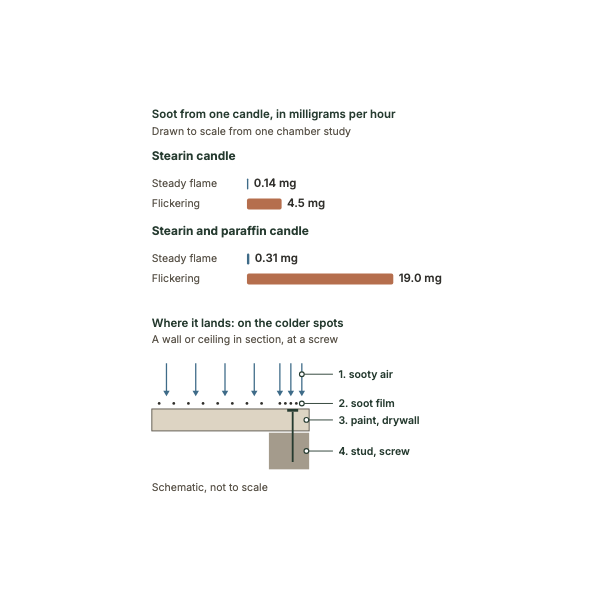
If the smell is rotten egg or sulfur, treat it as a possible gas leak and leave first. For anything else, find the source before you buy anything. Damp, tobacco residue and dry drain traps each leave a different smell and need a different fix, and machines that treat the air come last.
No study we found has measured odor in an older home before and after any treatment, and “old house smell” appears in no agency page or paper we read.
So this sorts the smell by source, using what has been measured on each one. Your own nose is the starting tool, with limits covered below.
The question gets asked in plain words: how do I get old house smell out of my house? EPA’s first answer applies. The most effective way to improve indoor air, it says, is usually “to eliminate individual sources of pollution or to reduce their emissions.”
Sort the Smell First
The table is a way to start, not a diagnosis. More than one row can apply to one house. Gas sits at the top because it is the one row where you stop reading and leave.
What the smell points to
A way to start, not a diagnosis. No study has measured odor in older homes, and more than one row can apply.
| The smell | First check | Where it stops |
|---|---|---|
| Rotten egg, sulfur
Could be natural gas
|
Leave first. Call the gas utility or 911 from outside | Do not hunt for it, and do not open windows |
| Sewer, rotten egg, near a drain
Dry trap or failed seal
|
Run water into unused drains and floor drains | A smoke test can find hidden leaks (Kerrville) |
| Musty, earthy
Damp and microbes
|
Humidity, leaks, then the EPA guide | A health signal, not only a nuisance |
| Stale, smoky
Tobacco residue
|
Dust, carpet, hard surfaces | Cleaning helps in part; it did not last in dust |
| Damp air from below
Crawlspace or basement air
|
Whether the crawlspace is vented: in one study, vented ones gave about 40 percent of house air | Closing a crawlspace can raise radon there |
Treat the source, then the air. A smell you stop noticing has not necessarily gone.
If It Smells Like Rotten Eggs
Natural gas is odorless until suppliers add mercaptan, which Indiana’s utility regulator describes as similar to rotten eggs or sulfur. Its advice is to leave and move a safe distance away, then call your gas provider’s emergency number and 911.
It says not to open windows to “air out” the house, and not to flip switches or look for the leak.
Kansas’s commission adds not to use electrical devices, phones or vehicles nearby, and not to go back in until a gas company employee says it is safe. Indiana warns the odor may fade or be hard to detect. Treat even a faint gas smell the same way.
Sewer Smell and Dry Traps
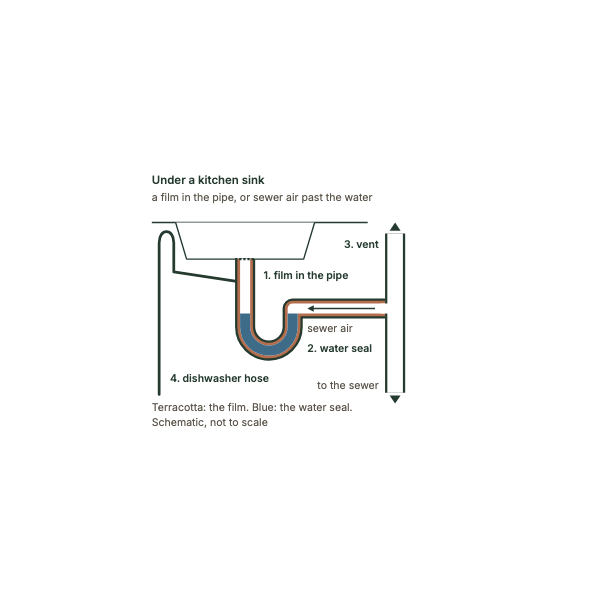
If the gas utility has ruled that out, look at the traps. A trap is the water-filled bend that seals a drain. Illinois public health says sewer drains with dry traps can let hydrogen sulfide into a home, and older houses often have drains nobody uses.
The fix is simple. The City of Kerrville, Texas, says a dry trap is “a frequent cause for inside odors”, and that “pouring a quart of water into all sinks, showers/tubs and floor drains may correct this problem.” It adds that a rarely used basement floor drain loses its water to evaporation over time.
If water does not cure it, the problem is probably in the pipes. Kerrville lists an old house trap that has cracked, and rusted drain pipe that may never leak liquid but “will leak sewer gas.”
Kerrville also names a smoke test for finding hidden leaks. That handout is an unsigned city sheet, so treat it as practical guidance and not as research.
Do not take a fading smell as good news. CDC’s toxic substances agency says hydrogen sulfide smell is not a reliable indicator, because your nose tires of it. Illinois says the lethal levels it describes would not be expected in a home.
Musty and Earthy Smells
A musty smell has real chemistry behind it. Researchers T. J. Ryan and C. Beaucham measured microbial compounds in 23 US homes that nobody considered a problem, and noted musty odors in 12 of their 23 basements.
Lab work on molds links compounds such as 1-octen-3-ol to a “musty” smell and geosmin to an “earthy” one.
Those compounds are not confined to the basement. In Ryan and Beaucham’s homes, those found downstairs were “typically detected in living areas at similar concentrations and frequencies”.
That does not prove the air moved upstairs, but it fits what people notice: a smell that seems to belong to the whole house. The study does not give home ages.
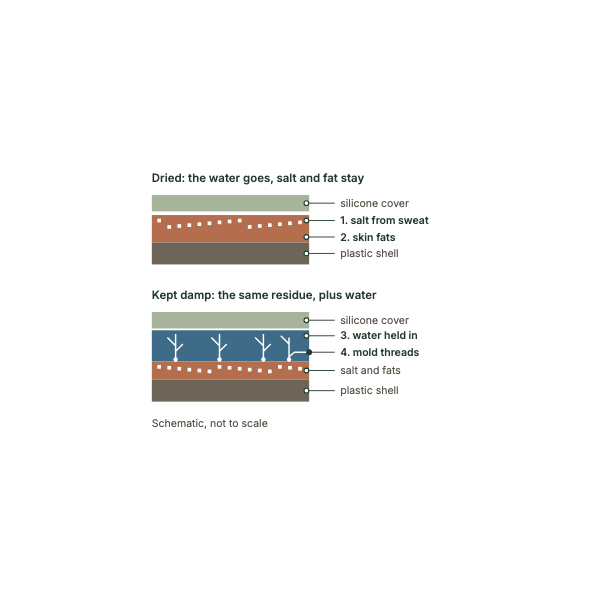
Take a musty smell seriously. An editorial by J. M. Cox-Ganser calls mold odors “the best surrogate of exposure to fungal contamination, or at the very least a good indication of excessive dampness”. Home surveys link musty odor with asthma and allergy. Those are associations, not proof of cause.
“The key to mold control is moisture control,” EPA says. It advises indoor humidity below 60 percent, ideally 30 to 50, and CDC says no higher than 50, using an air conditioner or dehumidifier.
CDC also says to fix leaks in the roof, walls and plumbing. If you can see or smell mold, use EPA’s guide from this point, as this article gives no cleanup procedure.
Testing is rarely the next step. CDC does not recommend mold testing, and a major review by M. J. Mendell and colleagues says current evidence does not support measuring specific agents to guide what to do. If you know it smells moldy, the moisture is already your job.
Stale Smoke: The Smell That Stays
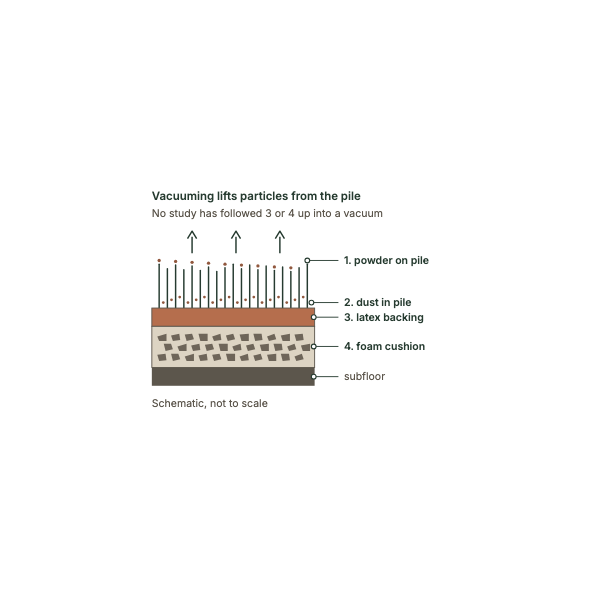
If anyone smoked in the house, tobacco residue may be the smell, and it persists. G. E. Matt and colleagues followed homes after smokers moved out.
Nicotine fell after the change of occupancy, yet they report that residue “persists when smokers move out even after homes remain vacant for 2 months and are cleaned and prepared for new residents.”
A 2026 review by the same group puts typical surface nicotine at 4.57 micrograms per square meter in previously smoked-in homes, against 0.97 in homes of nonsmokers with long-term bans. That is about five times, by our arithmetic.
California now requires disclosure of such residue in home sales, from January 2026. These are nicotine measures, not odor.
Cleaning helps, partly. In 48 low-income apartments, Matt’s team found surface nicotine 53 percent lower three months after cleaning, cited here from the abstract. Dust nicotine fell 60 percent, then returned to precleaning levels by three months.
“Used separately, dry/damp and wet cleaning methods showed limited benefits”, the authors say, and they point to remaining reservoirs.
Carpet is one such reservoir. In X. Tang’s 2023 Berkeley Lab work, a home-aged carpet kept giving off nicotine in a room-sized chamber. Those apartments could also receive smoke from neighbors, which a detached house does not share.
Painting is less certain than people hope. The 2026 review says paint “may trap” pollutants but “does not present a permanent barrier”, though the studies it cites are not smoke-odor tests. We found no controlled test of a primer or sealer on smoke smell. Treat any product promise there as unproven.
Air Coming up From Below
Warm air rises, and a house can act like a chimney, drawing air in at the bottom. Florida’s radon training material calls this the stack effect.
In a study of four new homes in the Pacific Northwest, roughly 40 percent of house air came from vented crawlspaces. A power-vented, closed crawlspace cut that to about 5 percent, only while the fan ran.
That study comes with warnings. The homes were new, only four, and in one climate. No odor was measured. The closed crawlspaces also averaged 12.9 pCi/L of radon, about nine times the vented ones.
So a sealed crawlspace is a real change to a house; the advisory below says who to consult.
The widely repeated claim that half a home’s air comes from the crawlspace has no measured source that we could find. It may be right in some houses. For how the whole house uses energy, which the same air leaks affect, see why your electric bill went up.
Fans, Carbon and Other Air Treatments
Ventilation is EPA’s second strategy, and CDC says kitchen and bathroom fans should vent outside. It dilutes what is in the air, but the 2026 review warns that ventilation, masking and ozone can make odors undetectable “even though the reservoirs from which they are emitted remain.” So fans belong after the source, not in place of it.
Most air cleaners are built for particles. EPA says they “are generally not designed to remove gaseous pollutants”, and the California Air Resources Board says carbon filters depend on how much carbon they hold, with thin ones doing little.
EPA also says a filter will not resolve a mold and moisture problem. We have no field result for carbon on smell in a home.
Why Not an Ozone Machine?
Ozone generators are the product most worth avoiding. EPA says that at levels that do not exceed public health standards, ozone “is not effective at removing many odor-causing chemicals”, and that it can harm health. The same page warns that the absence of a smell does not guarantee a safe level.
Berkeley Lab’s work shows a mixed picture. Fresh residue on fabric was depleted in a 2021 chamber test, though formaldehyde and other irritants rose afterward.
On aged carpet, a commercial generator run up to 10,000 parts per billion did not significantly reduce nicotine, per the 2023 abstract. No study we read measured smell. EPA’s advice stands, and professional ozone jobs deserve the same questions.
Do not mix cleaning products to chase a smell, either. This article gives no recipe, because mixing household chemicals can be dangerous. EPA also says there is no evidence that a reasonable number of houseplants removes significant pollutants, as whether houseplants clean indoor air sets out, which is a blow to anyone hoping to solve an old house with a fern.
Why Your Nose Is a Poor Instrument
Your nose is a poor instrument for checking the result. The 2026 review says people’s odor thresholds for tobacco constituents vary by two or more orders of magnitude.
And it says smelling stale tobacco indicates a reservoir, but not smelling it proves nothing. So one person can find a room clean that another cannot stand.
Regular residents also stop noticing. Where a measurement exists, keep it: a humidity reading, or a professional surface test for smoke residue.
Local Regulations and Safety Advisory
If you use household chemicals, follow the label. Rules on them vary by country and locality, and your hazardous waste service can say what applies where you live. If mold in your home raises a health concern, your public health department or a qualified mold inspector can advise. Your local building department can say which permits and inspections apply. This article is general information, not legal, medical or professional safety advice.
Authorities to consult:
- Public health department or hazardous waste service
- Public health department or qualified mold inspector
- Local building department
- Licensed gas professional
Leave gas work to licensed professionals, and call emergency services if there is an immediate hazard.
What Remains to Be Explored
The central gap is a measured odor study in older homes, before and after a treatment. We searched for one and found none. We also found no measured share of crawlspace air in old houses, no controlled test of primers or sealers on smoke smell, and no home field result for carbon.
We have no ventilation rate that clears a smell, no time for airing out, and no measured rate at which a trap dries out. Ozone on musty odor, measured, is also missing.
A small trial of stale-smelling houses, with a trained odor panel before and after each step, would change this article more than any further product claim.
Sources
- Improving Indoor Air Quality — US Environmental Protection Agency. August 3, 2026.
- A Brief Guide to Mold, Moisture and Your Home — US Environmental Protection Agency. February 18, 2026.
- Ozone Generators That Are Sold as Air Cleaners — US Environmental Protection Agency. February 19, 2026.
- Mold — CDC. September 26, 2024.
- Learn to Recognize the Signs of a Gas Leak — Indiana Utility Regulatory Commission, Pipeline Safety Division. Undated.
- Natural Gas Safety — Kansas Corporation Commission. Undated.
- Hydrogen Sulfide Gas — Illinois Department of Public Health. Undated.
- Medical Management Guidelines for Hydrogen Sulfide — ATSDR, CDC. October 21, 2014.
- Why Do I Have Sewer Odor In My Home? — City of Kerrville, Texas. August 16, 2015.
- Dominant Microbial Volatile Organic Compounds in 23 US Homes — Ryan and Beaucham. Chemosphere 90(3):977-985. January 2013.
- Determination of Unique Microbial Volatile Organic Compounds Produced by Five Aspergillus Species — Gao, Korley, Martin and Chen. AIHA Journal 63(2):135-140. 2002.
- Indoor Dampness and Mould Health Effects — J. M. Cox-Ganser. Clinical & Experimental Allergy 45(10):1478-1482. October 2015.
- Respiratory and Allergic Health Effects of Dampness, Mold, and Dampness-Related Agents — Mendell, Mirer, Cheung, Tong and Douwes. Environmental Health Perspectives 119(6):748-756. 2011. Cited from its abstract.
- When Smokers Move Out and Non-Smokers Move In — Matt et al. Tobacco Control 20(1):e1. 2010. Cited from its abstract.
- Remediating Thirdhand Smoke Pollution in Multiunit Housing — Matt et al. Nicotine & Tobacco Research 23(2):364-372. 2021. Cited from its abstract.
- Quantitative Reference Levels for Thirdhand Smoke Residue — Matt et al. Journal of Exposure Science & Environmental Epidemiology. 2026.
- Chemical Changes in Thirdhand Smoke Associated With Remediation Using an Ozone Generator — Tang et al. Environmental Research 198:110462. July 2021.
- Remediation of Thirdhand Tobacco Smoke With Ozone — Tang et al. Environmental Science & Technology 57:9943-9954. June 2023. Cited from its abstract.
- Vented and Conditioned Crawlspace Performance in Marine and Cold Climates of the Pacific Northwest — Hales, Lubliner and Gordon. ASHRAE Buildings XI, 2010. 2010.
- Unit 2. Radon Entry and Behavior — Florida Department of Health. Undated.
- Indoor Air Cleaners for Removal of Odors and Gases — California Air Resources Board. Undated.
- Guide to Air Cleaners in the Home — US Environmental Protection Agency. October 1, 2026.
- How Do I Get Old House Smell Out of My House? (R/HomeImprovement Thread) — multiple community members. Reddit, r/HomeImprovement. Undated.