A bed with root-knot nematodes is not lost for good. The extension sources agree the nematodes rarely vanish, but say a weed-free fallow year lowers their numbers enough to grow a susceptible annual crop, and that summer solarization, resistant varieties and solid stands of the right marigolds also bring them down.
The neighbor’s blue passionflower is a weak suspect. In the one study found that inoculated it, its roots galled but scored the lowest in the trial for egg masses, and the authors rated it highly resistant.
The question comes from a thread on r/gardening. The poster pulled up a tangle of knotted roots, blamed a neighbor’s blue passionflower whose roots had crept into the bed, and declared the bed finished, retreating to a smaller one level with the lawn. Replies took the photos for garlic bread.
Then came the remedies: oyster mushroom spores, marigolds grown and tilled in, crab or shrimp meal, red wigglers, a trench with a root barrier, solarizing, lining the bottom of the bed, replacing the soil, a sample sent to an extension office, and spraying the vine. The poster added that the soil is somewhat sandy.
What This Article Covers
This article covers a garden bed where root-knot nematodes are suspected: how to confirm them, whether a neighboring blue passionflower is a likely source, how long the nematodes last, and what each of the thread’s remedies is known to do. It does not identify the roots in the photo, and it names no product or rate.
First, Be Sure It Is Root-Knot
Root-knot nematodes are microscopic roundworms of the genus Meloidogyne that feed inside roots and make them swell into galls. UC IPM’s pest note on nematodes says the galls are true swellings that cannot be rubbed off, unlike the nitrogen-fixing nodules on bean and pea roots.
UC IPM’s landscape page on root-knot nematodes adds a thumbnail test: a nail presses easily into a bacterial nodule but not into a gall. NC State Extension’s guide for bedding plants says nodules are hollow or milky pink inside, while galls are firm with a white or gray center.
Look-alikes exist. NC State lists clubroot on cabbage-family plants, crown gall on woody plants, and the normal root swellings of plants such as daylily and liriope. Above-ground signs, it says, cannot diagnose root-knot on their own, because the wilting, yellowing and stunting look like those of other root injuries.
UC IPM, NC State and Mississippi State point to a laboratory for certainty. UC IPM says a lab can name the species from root and soil samples.
Mississippi State’s home garden guide sends samples to its diagnostic lab and says summer and fall, when numbers peak, are the best times to check.
UC IPM also gives a home test. Melons seeded in pots of moist garden soil and kept near 80°F show galls in about 3 weeks if root-knot nematodes are present, while melons in heat-sterilized soil do not.
Did the Passionflower Bring Them?
One study has tested blue passionflower, Passiflora caerulea, against a root-knot nematode. Klein, Ferraz and de Oliveira grew seven passionflower species in greenhouse pots at Jaboticabal, São Paulo state, gave each plant 5,300 eggs of the southern root-knot nematode, M. incognita, and scored the roots 80 days later.
Galls formed on every species, but faintly on three. Blue passionflower scored 3.0 of 5 for galls, against 4.5 to 5.0 for the four susceptible species.
At 30 days its roots held only juvenile nematodes, and at 80 days it scored the lowest in the trial for egg masses, as did passion fruit (P. edulis and its yellow form). The authors rate all three highly resistant.
That is one nematode species, one population, in pots. UC IPM warns that more than one root-knot species can live at a site, and that a plant resistant to one may host another. No study read tested blue passionflower against the northern species, M. hapla, or against M. arenaria or M. javanica.
A perennial host’s roots can carry the pest through winter. Johnson and Potter found the southern species overwintered in Ontario on the woody roots of peach in a moderate winter, but not in a severe one (cited from the abstract).
Whether blue passionflower roots do the same was not tested; the 1984 trial found it a poor host.
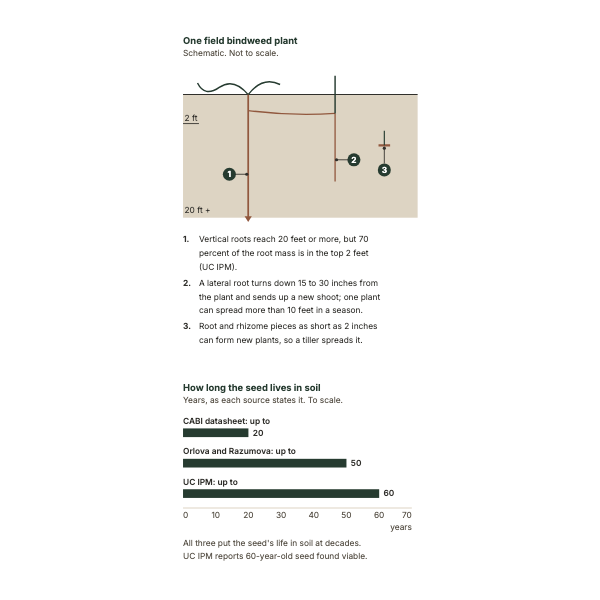
The vine is a weed problem in its own right. New Zealand’s Department of Conservation weeds database says blue passionflower spreads by seed and by suckers from its roots, and that root suckers give rise to new plants after disturbance; it is listed as an unwanted organism there.
Missouri’s guide says root-knot reaches a garden only in soil or plant roots, naming transplants, tools, boots, tires and poorly composted material.
Why the Bed Is Not Lost
The sources are frank that the nematodes stay. NC State says that once root-knot is diagnosed it is safe to assume it will persist for many years, its numbers rising and falling but rarely disappearing.
Mississippi State calls ridding soil of them practically impossible, but says they can be brought down to numbers that do no damage.
The mechanism is starvation. UC IPM says root-knot nematodes survive from season to season mainly as eggs in the soil, and the young that hatch must find a living root to feed on. In a bed kept moist and bare, with no weeds, the eggs hatch and the young die.
UC IPM puts a time on it: fallowing for one year lowers root-knot numbers enough to grow a susceptible annual crop, and two years lower them further. Weeds have to go too, because, as Missouri notes, most weeds are hosts.
Winter helps in cold places. Missouri says a deep soil freeze usually kills root-knot nematodes in its region. The northern species is tougher: Johnson and Potter found it survived well under all three crops in both winters, at depths from 0 to 90 cm, about 35 inches.
The poster’s sandy soil bears on the damage. UC IPM says injury is most serious in warm, irrigated, sandy soils, and that compost, manure and peat raise the soil’s water-holding capacity, so plants suffer less, though the number of nematodes stays the same.
Shallow Fixes, Deep Worms, and a Poor Host
The soil fixes reach the top foot or less, while root-knot nematodes can live deeper; and the one test of blue passionflower found galls on its roots but the lowest score for egg masses.
Panel A: NC State Extension (replacing the top 6 to 8 inches); UC IPM (solarization controls nematodes best in the upper 12 inches, and they move deeper to escape); Johnson and Potter, northern root-knot nematode survived winter at depths from 0 to 90 cm in Ontario. Panel B: Klein and colleagues, one nematode species in greenhouse pots; galls were seen on every species, faint on the three resistant ones.
By UC IPM’s account the fixes work in the top foot and last about a year, so they are repeated; in the one trial, blue passionflower galled but scored lowest for egg masses.
What Works, and How Far It Reaches
Solarization. UC IPM’s pest note on soil solarization covers moist soil with clear plastic for 4 to 6 weeks in the hottest part of summer, longer in cool, windy or cloudy places.
Root-knot eggs and young die when soil passes 125°F for 30 minutes or 130°F for 5 minutes, the nematode note says.
Its reach is shallow. UC IPM says control of nematodes is greatest in the upper 12 inches and that nematodes can move deeper to escape the heat, then return.
The nematode note adds that fallowing, rotation and solarization are effective for only about a year. The solarization note says it works on raised beds as well as flat ground, and the soil should be wet to at least 12 inches first.
Lower heat held longer has also worked in trials. Ploeg and Stapleton found that holding soil at 40°C (104°F) for 10 days generally eliminated infestation of melon in a glasshouse (cited from the abstract).
Nico and colleagues cut egg hatch by more than 95 percent in soil piles solarized for 3 weeks in July and August in southern Spain (cited from the abstract).
Solarization alone has also failed. In two years of field trials on a Florida flower farm, Kokalis-Burelle and colleagues solarized for 4 weeks ending in mid-October; nematodes in the soil increased under solarization alone, and galling was worse than under every other treatment (cited from the abstract).
Resistant varieties. Tomatoes marked VFN, or N, on the packet resist the common root-knot species. UC IPM reports that in garden-type trials on infested soil, resistant tomatoes yielded almost 6 times as much as a similar susceptible variety, and that nematode numbers decline under them.
Mississippi State adds that on resistant varieties the population starves if weed hosts are absent, and lists resistant varieties of tomato, bean, pea, pepper and sweetpotato.
Heat weakens the tomato gene: Devran and colleagues state that it breaks down in soil above 28°C (82°F), and Abdul-Baki and colleagues found it held at 31°C and was lost at 37°C in cut roots grown in culture (both cited from the abstracts).
Timing. UC IPM says most root-knot nematodes cannot get into roots when soil is below 64°F, so fall crops such as lettuce, spinach and peas can wait for cooler soil, and summer crops can go in early.
UC IPM adds that pulling annual crops, roots and all, right after harvest stops the nematodes feeding and breeding on them.
Marigolds. Certain marigolds suppress root-knot nematodes, but only as a solid planting. UC IPM names French marigolds as most effective, advises against signet marigolds, on which nematodes feed and reproduce, and says marigolds work poorly against the northern species. Planted among vegetables, it says, control usually is not good.
NC State and Missouri agree that a few marigolds tucked among susceptible plants do not work; Missouri adds that the nematodes simply feed on the vegetables.
The University of Hawaii’s marigold guide, by Wang, Hooks and Ploeg, departs on one point: its table rates signet marigold (T. signata) resistant to four root-knot species.
The thread’s advice to till marigolds in at season’s end runs into the Hawaii guide. It says only living marigold roots show significant nematicidal activity, that residues worked into the soil did not suppress root-knot as well, and that a stand should grow 3 to 4 months, until fully established, before it is turned under.
Replacing the soil. NC State describes removing the top 6 to 8 inches of an annual bed and refilling it with nematode-free mix.
It does not eliminate them, the guide says: infection is only delayed, because roots grow out of the new mix into the infested soil below, and nematodes move deeper to protect themselves. The more soil removed, the longer the delay.
Chemicals. UC IPM and Missouri say no nematicide is available to home gardeners; NC State says no effective chemical product is available to homeowners.
Mississippi State lists one nematicide for home vegetable gardens, used only on ground for transplants and only as its label directs. This article names no product.
The Thread’s Other Remedies
Oyster mushroom. The fungus does attack nematodes. Thorn and Barron reported in 1984 that ten gilled fungi, the oyster mushroom among them, attack and consume nematodes, and suggested these wood-decay fungi use them to supplement the low nitrogen in wood (cited from the abstract).
The garden evidence is thin. In a 2024 pot trial by Nyangwire and colleagues, eggplants grew in 3 kg pots of sterilized soil mixed with oyster mushroom grown on millet; galling scored 0.95 and 0.70 against 2.4 without it, on a 0 to 5 scale.
The trial used living mycelium on grain, not spores, in sterilized soil, and no field trial was found.
Crab or shrimp meal. Chitin, the shell material in these meals, has split results. Pasche and colleagues cut root-knot egg counts on tomato by up to 66 and 84 percent with chitin or collagen in a greenhouse, with shifts toward soil microbes that break down chitin (cited from the abstract).
Bélair and Tremblay found the opposite with the northern species: chitin with urea did not reduce it, and egg numbers rose with the dose, though tomato shoots grew more (cited from the abstract). Neither test was in a garden bed.
Worms, stevia, barriers, liners and fire. No source read tests red wigglers against root-knot nematodes, stevia as a suppressive plant, a root barrier’s depth against passionflower suckers, a liner under a bed, or burning a bed’s organic matter. Missouri reports that commercial microbial products against nematodes have had limited success.
What to Do With This Bed
1. Confirm it. Pull a plant, wash the roots, and try the thumbnail test; for certainty, send roots and soil to a diagnostic lab, as UC IPM, NC State and Mississippi State advise, which also names the species and so whether marigolds and resistant tomatoes will help.
2. Clear the roots. Take out finished crops, roots included, right after harvest (UC IPM), and destroy galled roots rather than composting them, because Missouri warns that home compost piles often do not get hot enough.
3. Starve or heat the soil. Keep the bed bare, moist and weed-free for a year (UC IPM), or solarize it under clear plastic for 4 to 8 weeks in the hottest part of summer, wetting it to 12 inches first. Missouri and UC IPM suggest rotating sections of a garden through these treatments.
4. Replant smart. Grow resistant varieties, plant cool-season crops after the soil drops below 64°F, and put summer crops in early (UC IPM). For a marigold year, grow French marigolds as a solid stand for the whole season, mowing them before the flowers open to keep seed out of the soil (UC IPM).
5. Keep it from spreading. Clean soil off tools and boots, do not move soil from the bed elsewhere, and do not let water drain from it onto other beds (UC IPM). Expect to repeat the cycle when galls return, which UC IPM says can happen in a single season.
The vine’s suckers are a separate job, a weed that regrows from its roots. For how a vine that returns from its roots is cleared, see a porcelainberry vine that overran a yard; for refilling a weedy raised bed with new soil, see a raised bed overrun by weeds after new soil. Galls also turn up in a tomato dying one branch at a time.
Local Regulations and Safety Advisory
If you use pest control products, follow the label. Rules on them vary by country and locality, and your pesticide regulator can say what applies where you live. Whether blue passionflower is a listed weed is set by national, state or regional rules, so check the weed list where you garden. This article advises no spray on a neighbor's plant. This article is general information, not legal advice.
Authorities to consult:
- Pesticide regulatory authority or environmental protection agency
- State, provincial or regional weed or biosecurity agency
What Remains to Be Explored
Blue passionflower has been tested against one root-knot species, in one greenhouse trial from 1984. Whether it hosts M. hapla, M. arenaria or M. javanica, whether field plants behave as potted ones did, and which species is in the thread’s bed are all unknown.
No garden or field trial was found for oyster mushroom against root-knot nematodes, and the chitin results point both ways.
No source read gives a depth for a root barrier against passionflower suckers, or tests a liner under a bed, worms or stevia. No measurement was found of how long eggs last in a bare bed beyond UC IPM’s one to two fallow years.
Sources
- Looks Like My Garden Bed Is Permanently Out of Commission — multiple community members. Reddit, r/gardening. Undated.
- Pest Notes: Nematodes, UC ANR Publication 7489 — E.J. Perry, A.T. Ploeg. University of California Statewide IPM Program. July 2010.
- Root Knot Nematodes (Home and Landscape) — University of California Statewide IPM Program. Undated.
- Pest Notes: Soil Solarization for Gardens and Landscapes, UC ANR Publication 74145 — J.J. Stapleton, R.H. Molinar, C.A. Wilen. University of California Statewide IPM Program. May 2019.
- Management of Root-Knot Nematodes in Bedding Plants — Michelle Henson, Adrienne Gorny, Inga Meadows, Suzette Sharpe. NC State Extension. April 25, 2025.
- Nematode Control in the Home Garden (P483) — Revised by Clarissa Balbalian from an earlier edition by Frank Killebrew. Mississippi State University Extension. Undated.
- Be Aware of a Potential Enemy in the Family Garden — Robert Heinz, Manjula Nathan. University of Missouri Integrated Pest Management. April 1, 2008.
- Protecting Crops From Nematode Pests: Using Marigold as an Alternative to Chemical Nematicides (PD-35) — Koon-Hui Wang, Cerruti R. R. Hooks, Antoon Ploeg. University of Hawai’i at Mānoa, College of Tropical Agriculture and Human Resources. July 2007.
- Comportamento De Diferentes Maracujazeiros Em Relação Ao Nematóide Formador De Galhas (Behaviour of Different Passionfruit Plants Related to the Root-Knot Nematode) — Aldo Luiz Klein, Luiz Carlos Camargo Barbosa Ferraz, João Carlos de Oliveira. Pesquisa Agropecuária Brasileira. February 1984.
- Passiflora caerulea (Weeds Database) — New Zealand Department of Conservation. Undated.
- Winter Survival of Root-Knot Nematodes (Meloidogyne incognita and M. hapla) Under Selected Host Crops in Southern Ontario — P. W. Johnson, J. W. Potter. Canadian Journal of Plant Science. 1980. Cited from its abstract.
- Glasshouse Studies on the Effects of Time, Temperature and Amendment of Soil With Broccoli Plant Residues on the Infestation of Melon Plants by Meloidogyne incognita and M. javanica — Antoon Ploeg, James Stapleton. Nematology. 2001. Cited from its abstract.
- Solarization of Soil in Piles for the Control of Meloidogyne incognita in Olive Nurseries in Southern Spain — A. I. Nico, R. M. Jiménez-Díaz, P. Castillo. Plant Pathology. 2003. Cited from its abstract.
- Evaluation of Steam and Soil Solarization for Meloidogyne arenaria Control in Florida Floriculture Crops — Nancy Kokalis-Burelle, Erin N. Rosskopf, David M. Butler, Steven A. Fennimore, John Holzinger. Journal of Nematology. 2016. Cited from its abstract.
- Temperature Effects on Resistance to Meloidogyne spp. in Excised Tomato Roots — Aref A. Abdul-Baki, Sanaa A. Haroon, David J. Chitwood. HortScience. 1996. Cited from its abstract.
- Mapping of the Gene in Tomato Conferring Resistance to Root-Knot Nematodes at High Soil Temperature — Zübeyir Devran, Tevfik Özalp, David J. Studholme, Mahmut Tör. Frontiers in Plant Science. 2023. Cited from its abstract.
- Carnivorous Mushrooms — R. G. Thorn, G. L. Barron. Science. 1984. Cited from its abstract.
- Pleurotus ostreatus Is a Potential Biological Control Agent of Root-Knot Nematodes in Eggplant (Solanum melongena) — Betty Nyangwire, Walter Ocimati, Anthony Fredrick Tazuba, Guy Blomme, Alfred Alumai, Francis Onyilo. Frontiers in Agronomy. October 25, 2024.
- Underground guardians: How Collagen and Chitin Amendments Shape Soil Microbiome Structure and Function for Meloidogyne enterolobii Control — Josephine M. Pasche, Roshni Sawlani, Victor Hugo Buttrós, Johan Desaeger, Karen A. Garrett, Samuel J. Martins. Microbiome. 2025. Cited from its abstract.
- The Influence of Chitin-Urea Amendments Applied to an Organic Soil on a Meloidogyne hapla Population and on the Growth of Greenhouse Tomato — G. Bélair, N. Tremblay. Phytoprotection. 2005. Cited from its abstract.