For a eucalyptus close to a house, the sources read say more about fire, size and wind than about roots breaking foundations. Gums shed bark that catches fire and carries it into the crown, and one common species gains most of its height within ten years.
Young, fast trees are unsteady in wind, and on clay they can rock loose. A eucalyptus that is cut down usually sprouts again from the base or roots. Planting it deeper is not shown to steady it and has killed other trees.
Two threads ask versions of the same question. In a post on r/gardening, a homeowner in a semi-arid region of Africa had a eucalyptus under two years old about 2 meters from the house, beside wooden and woven fences, and had read that the roots are invasive.
Replies there argued that fire was the bigger danger, with oily leaves and strips of bark as kindling, against others who said the tree does not burst into flame by itself.
They argued over limbs dropping without warning, shallow roots and wind-throw, sewer lines and foundations, and whether a cut tree simply grows back.
In a post on r/GardeningUK, a gardener’s eucalyptus had gone in 2.5 years from a few feet to a top-heavy tree in a raised bed by a fence, held up with hooks and cords because it kept blowing over.
The plan was to replant it deeper and cut it back. Replies split between removing it now and keeping it coppiced.
What This Article Covers
This article covers how big eucalypts get and how fast, what the sources say about their fire behavior, roots and soil, wind and planting depth, what happens when one is cut back or cut down, and growing one in a pot or indoors.
The species in both threads is unknown, and this article judges no house, gives no safe distance and no cutting or removal method.
How Big, How Fast
Size comes first in the sources. The National Park Service’s newsletter on Tasmanian blue gum in the San Francisco Bay Area puts the species at 98 to 180 feet tall, up to 260 feet in California, and says it usually reaches 60 to 70 percent of its total height by age 10.
Worked through, that is roughly 59 to 126 feet by about age 10, a span computed from the Park Service’s two ranges, not measured. Replies in both threads said the species matters; these figures are for blue gum only.
Forest Research in the UK calls cider gum, Eucalyptus gunnii, probably the safest eucalypt to plant in Britain and says it is often seen dominating small urban gardens.
North Carolina State Extension’s gardener handbook says mature size, rooflines and sidewalks should decide where a tree goes, so it can grow without being cut back to fit.
What is close to the house
Where the sources place the risks of a young eucalyptus beside a wall, and how tall one common species gets.
Panel A: National Park Service, Point Reyes and Golden Gate; Gilman, 1990; Sun and Li, 2023, from its abstract; Forest Research, cider gum. Panel B: National Park Service; the age-10 span is computed from its two ranges.
The sources say most about fire, size and wind. By the Park Service’s figures, a blue gum would stand roughly 59 to 126 feet by about age 10.
Fire
The fire replies have support. The Park Service says gums shed their bark constantly, and that this is part of what makes them a fire hazard: the bark catches fire readily, and the loose strips tend to carry fire up into the crown and cast embers outward.
The same newsletter is more measured about the leaves. Despite their volatile oils, green blue gum leaves are rated intermediate in fire resistance, and juvenile leaves highly resistant to flaming. The especially flammable part is the litter, the dead, dry, oily leaves and debris that build up underneath.
Bark type matters. Fuller and colleagues, mapping 12 eucalypt bark types across New South Wales, describe stringy-barked and ribbon-barked eucalypts as notorious for piling up bark fuel, while smooth-barked species occur under a range of fire intensities.
Eucalyptus is not alone. Almeida and colleagues burned mostly young trees in a laboratory, and two oaks released more firebrands than the eucalyptus, mainly burning leaves able to start spot fires tens of meters away. No source read supports the idea that a eucalyptus ignites by itself.
Roots and the House
The root worry has less direct evidence behind it. No study read measured eucalyptus roots damaging a foundation or a pipe. What the sources describe is how roots spread and how much water a tree takes from the soil around it.
Gilman’s review of tree roots describes lateral roots concentrated in the top 30 centimeters or so of soil and spreading well beyond the branches.
Sun and Li monitored the soil beside two street trees in Melbourne for up to 45 months: beside one of them, Corymbia maculata, the tree dried the soil to a depth of 1.1 meters.
The same study found the soil itself made a large difference in how much water each tree used, and that roots stopped taking water once the soil was dry enough. No source read ties that drying to damage to a particular building.
The Park Service adds that rapid growth in blue gum comes with rapid water uptake, which is why it was once planted to drain wetlands.
For a magnolia set close to a house and the foundation questions that raises, see a magnolia planted too close to the house.
Wind, Clay and the Raised Bed
The blowing-over problem fits the forestry sources. Forest Research says cider gum does not tolerate wind exposure when young, because fast early growth can be damaged, and that on clay soils the trees can rock and socket, leading to instability or poor stem form.
Forest Research recommends cultivating the soil before planting to improve root growth and stability.
Moore and colleagues, reviewing young radiata pine in New Zealand, describe the same problem in plantations: fast-growing trees under two to three years old topple to a lean of more than 15 degrees without blowing completely over. That work is on pine, carried here only as a parallel.
The plan to replant deeper has no support in what was read. Wells and colleagues found that half the cherry trees planted 6 or 12 inches deeper than grade died within two years, while none planted at grade did. No study read tested a eucalyptus planted deep, but none found deeper planting steadying a tree.
Cutting It Back or Taking It Out
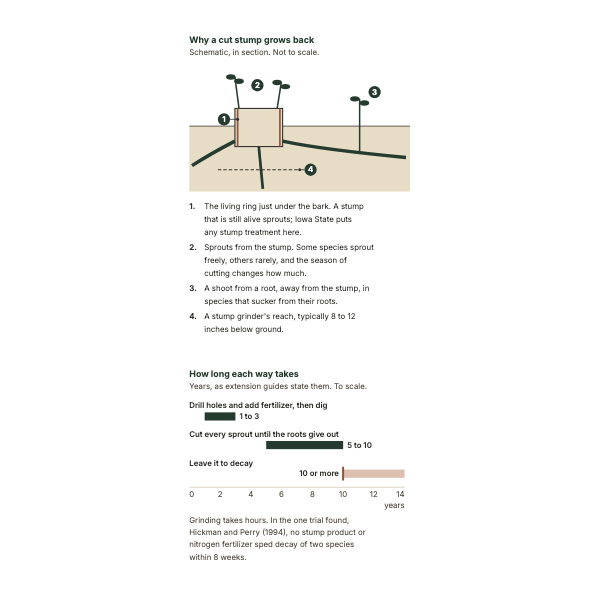
The reply that a cut eucalyptus grows back is broadly right. The Park Service says blue gum responds to cutting by mass sprouting from the base, from the trunk and even from the roots underground.
Smith and colleagues cut 14-year-old Eucalyptus obliqua back to the base or removed its crown, and measured how the regrowth drew on carbohydrate reserves in stem, lignotuber and roots.
It is not universal. In a Eucalyptus globulus trial, Whittock and colleagues found 67 percent of felled trees coppiced at 14 months, so about a third did not.
Forest Research adds a caution for coppiced cider gum in the UK: the new shoots are frost tender and the stumps are susceptible to decay.
Cold hardiness differs by species and seed source. Forest Research reports that some cider gum provenances withstood winter cold down to -18°C, and it warns that eucalypts have no resting bud, so their hardiness depends on hardening off in autumn and unseasonal frosts can damage them.
For eucalypts cut to tall trunks and what grows back from them, see eucalypts cut to tall bare trunks, and for a large old gum with a hollow, a hollow backyard gum.
Growing a Eucalyptus in a Pot or Indoors
A eucalyptus can live in a pot for a while, but the garden answers read treat it as a temporary arrangement.
The New York Botanical Garden’s plant information service calls eucalyptus a challenging houseplant: a young plant will swiftly become a large tree, and cider gum (Eucalyptus gunnii) will probably outgrow a home in a few years.
The garden adds that some dwarf cultivars and species can grow indoors for as little as a year and up to about five.
Light is the first need. It asks for strong direct light, full sun for at least 6 hours a day from a southern exposure, and warns that in low light the plant will deteriorate quickly.
Water thoroughly until it drains from the hole, then let the mix nearly dry before watering again. A pot without a drain hole, or a saucer left full, keeps the roots too wet, and the garden says the plant then declines rapidly. Normal home temperatures of 65 to 75°F suit it, away from heating and cooling vents and drafts.
Winter is the hard part indoors. For many eucalyptus sold as houseplants, cider gum among them, the garden advises a rest from November through February at about 45 to 50°F, with very little water.
In a second answer, Leslie Coleman adds that plants kept at normal indoor temperatures through winter lose vigor, and that a cool greenhouse can serve.
Coleman also notes that cider gum is relatively hardy outdoors in USDA zones 8 to 10, but risks severe dieback in cold snaps, and that a plant in a container outdoors is at greater risk because its roots are exposed.
Repotting comes often. The garden repots every spring, some faster growers twice a year, into a pot one or two sizes larger with a drain hole, in equal parts organic potting soil, perlite or sharp sand, and peat moss.
The leaves can change as the plant ages. Carolyn Vlasveld and colleagues describe how many eucalypts grow leaves on seedlings, young saplings and regrowth shoots that differ strikingly from the leaves of mature plants.
The University of Hawaii’s eucalyptus foliage guide says that in some species the round foliage is found only on juvenile branches, though the species it tested did not change leaf shape with age.
To keep that foliage and a manageable size in its field plantings, the Hawaii guide prunes trees after at least two years to 3 to 4 feet, leaving an open rosette of about three branches at the top, and cites work showing yearly pruning raised the number of harvestable branches. That is outdoor production practice, not a houseplant trial.
Local Regulations and Safety Advisory
This article judges no house and gives no safe planting distance. A crack or movement in a foundation is for a structural engineer or home inspector on site. Rules on tree removal and on vegetation near buildings in fire-prone areas are set locally, and felling or climbing a tree is work for a qualified arborist. This article is general information, not legal advice.
Authorities to consult:
- Local fire authority, for vegetation rules near buildings; structural engineer or home inspector, for any foundation question
What Remains to Be Explored
No study read measured eucalyptus roots damaging foundations or pipes, or gave a distance that is safe from a house. No source read measured how often eucalypts drop limbs, so the limb replies stand untested here.
No study read measured how long a eucalyptus lasts in a pot indoors, or tested a cool winter rest against a warm room.
The fire evidence comes from groves and laboratory burns, not single garden trees. No trial read tested coppicing or root barriers on a garden eucalyptus, and the species and soil in both threads are unknown.
Sources
- How Do I Care for a Eucalyptus Plant Indoors? — NYBG Plant Information Service. The New York Botanical Garden, LuEsther T. Mertz Library. March 21, 2025.
- Will Eucalyptus Trees Over-Winter Safely in a Greenhouse? — Leslie Coleman. The New York Botanical Garden, LuEsther T. Mertz Library. November 1, 2024.
- Eucalyptus Production Guidelines (OF-65) — James Keach; Russell Galanti; Hannah Lutgen; Alberto Ricordi; Joanna Bloese; Teresita Amore. University of Hawaii at Manoa, College of Tropical Agriculture and Human Resources. October 2024.
- Leaf Heteroblasty in Eucalypts: Biogeographic Evidence of Ecological Function — Carolyn Vlasveld; Benjamin O’Leary; Frank Udovicic; Martin Burd. Australian Journal of Botany. 2018. Cited from its abstract.
- Is Planting Eucolyptus Tree 2Meters Away From My Main House Building Dangerous? — multiple community members. Reddit, r/gardening. Undated.
- Eucalyptus Tree Advice — multiple community members. Reddit, r/GardeningUK. Undated.
- Cider Gum (EGU) — Forest Research (UK), Tree Species Database. Undated.
- Eucalyptus: A Complex Challenge – Fire Management, Resource Protection, and the Legacy of Tasmanian Blue Gum — National Park Service, Golden Gate National Recreation Area and Point Reyes National Seashore. Undated.
- Bark Type as an Indicator of Pyro-Ecological Strategy in the Eucalypts — Kathryn J. Fuller, Rachael H. Nolan, Michael J. Aspinwall, Mark G. Tjoelker, Kim Calders, Matthias M. Boer. Journal of Biogeography. 2025. Cited from its abstract.
- Characterization of Firebrands Released From Different Burning Tree Species — Miguel Almeida, Leonardo Porto, Domingos Xavier Viegas. Frontiers in Mechanical Engineering. 2021. Cited from its abstract.
- Tree Root-Soil Interaction: Field Study of the Effect of Trees on Soil Moisture and Ground Movement in an Urban Environment — Xi Sun, Jie Li. Plant and Soil. 2023. Cited from its abstract.
- Trees Use More Non-Structural Carbohydrate Reserves During Epicormic Than Basal Resprouting — Merryn G. Smith, Stefan K. Arndt, Rebecca Elizabeth Miller, Sabine Kasel, Lauren T. Bennett. Tree Physiology. 2018. Cited from its abstract.
- Wind Effects on Juvenile Trees: A Review With Special Reference to Toppling of Radiata Pine Growing in New Zealand — John R. Moore, Tombleson Jd, James Alan Turner, Mina van der Colff. Forestry. 2008. Cited from its abstract.
- Effects of Planting Depth on Landscape Tree Survival and Girdling Root Formation — Christina Wells; Karen Townsend; Judy Caldwell; Donald Ham; E. Thomas Smiley; Michael Sherwood. Arboriculture and Urban Forestry (International Society of Arboriculture), abstract through the Crossref API. 2006. Cited from its abstract.
- Woody Ornamentals, Chapter 11, North Carolina Extension Gardener Handbook, 2Nd Ed. — Lucy Bradley; Barbara Fair. NC State Extension. February 1, 2022.
- Tree Root Growth and Development. I. Form, Spread, Depth and Periodicity — Edward F. Gilman. Journal of Environmental Horticulture (Horticultural Research Institute), abstract through the Crossref API. 1990. Cited from its abstract.
- Genetic Control of Coppice and Lignotuber Development in Eucalyptus globulus — S. P. Whittock, L. A. Apiolaza, C. M. Kelly, B. M. Potts. Australian Journal of Botany. February 18, 2003. Cited from its abstract.