A candle gives off soot when its flame stops burning cleanly. A steady flame burns up nearly all the soot it makes; a flickering one lets it escape, and in chamber tests that meant many times more soot.
The soot rides the warm air up and out, and particles settle more readily where a surface is colder than the air. That fits the thread’s explanation for dots over the screws, though no one has measured a screw.
To clean it, start dry: conservation research says this kind of soot grips less firmly than soot from a house fire and can be removed with a vacuum or a dedicated soot sponge.
Then wash what is left with mild soap. A shadow that survives both may have worked into the paint, and then painting, not a stronger cleaner, is the next step.
And the fire service’s first rule, as the Illinois State Fire Marshal words it: blow out all candles when you leave the room or go to bed.
No test of cleaning candle soot off household paint was found. The cleaning steps here rest on conservation research and on an extension sheet written for wildfire smoke; the reasons for the soot rest on chamber studies of candles and on research into how particles settle on surfaces. Each finding is labeled with what it was measured on.
The question comes from a thread on r/CleaningTips.
A candle burned all night in a bathroom with the door shut. By morning there was soot through the bathroom and black spots across the hallway walls, and the poster wanted the walls white again.
In later replies they described a cheap three-wick candle from a supermarket, a room that felt hot, and air that was thick and smelled of burning.
The replies agreed that the poster had been lucky, and on little else. Some said soapy water would do it, others that wiping wet would smear soot everywhere and a dry soot sponge should come first.
One warned that soapy water turns soot into acid. Others suggested an eraser sponge, an alkaline cleaner, ammonia, vinegar, or simply repainting.
Several asked why the spots sat exactly over the drywall screws. Others blamed cheap paraffin and said soy or beeswax would have made far less. Those questions are taken in turn below, starting with where so much soot came from.
How One Candle Blackens a Room Overnight
A candle flame makes soot all the time. Soot forms in large quantities where the flame is rich in fuel, and the yellow light is that soot burning; in a steady flame nearly all of it burns away before it leaves. That is the account given by Joakim Pagels and colleagues (2009, Journal of Aerosol Science), read in full.
When air moves across the flame, as from an open window, the flame flickers and some soot escapes before it can burn. Pagels’s team called this the sooting burn, and measured it.
They burned tapered candles in a room-sized test chamber of 21.6 cubic meters (about 760 cubic feet), with the flames either shielded inside metal tubes or left in the air currents of a mixing fan.
For a pure stearin candle, soot rose from 0.14 to 4.5 milligrams per hour when the flame flickered. For a candle of stearin and paraffin, it rose from 0.31 to 19.0. Those are roughly 30 and 60 times more, by our arithmetic, though the steady figures varied a lot between repeats.
A flickering flame makes the soot; cold spots collect it
In one chamber study a flickering flame gave off many times the soot of a steady one. On the wall, soot settles where the surface is colder than the air.
| Bars | Elemental carbon (soot) per candle, Pagels and others 2009: flames shielded from air currents against flames left to flicker in a fan-mixed chamber. The steady values varied widely between repeats. Tapered candles, not jar candles. The two candles differed in more than wax, so the gap between them is not a test of wax. In a second chamber study, soot dominated the particles from all five candles under fluctuating air (Andersen and others 2021). |
| 1. Room air | Candle soot follows the rising warm air, so walls and ceilings blacken (Yang and others 2025, reviewing earlier work). |
| 2. Soot film | Particles are driven toward surfaces colder than the air, a recognized cause of soiling in studies of historic interiors (Strojecki 2023; Héritier 2022). |
| 3. Paint | Fine particles can work into an emulsion paint surface; deposits left for two months on artists’ acrylic paint could not be fully cleaned (Héritier 2022). |
| 4. Screw | That the screw heads were the colder spots is one reply’s explanation. It fits the mechanism; no source measured it. |
Bars to scale, one linear axis; blue: steady flame, terracotta: flickering. The wall section is schematic, not to scale; dot spacing shows only where soot is denser.
Blow out all candles when you leave the room or go to bed, and keep a burning one out of drafts. On the wall, try a dry method first: candle soot can often be lifted by vacuuming or a dedicated soot sponge.
A second chamber study points the same way. C. Andersen and colleagues (2021, Indoor Air, cited from the abstract) burned five kinds of pillar candle in fluctuating air, and soot made up most of the particle mass from every one. Measured right above the flame, it came in short, strong bursts.
Where that soot goes is the next part. Candles, oil lamps and incense that burn poorly typically blacken walls and ceilings, with the deposits following the warm air as it rises. That is from a review section by N. Yang and colleagues (2025, npj Heritage Science), read in full, which summarizes earlier conservation work.
No source read measured soot from a three-wick candle or from a jar candle, so how much the extra wicks added is not known.
One reply said soot rises as a candle burns down to the bottom. No study read tested that. The Illinois State Fire Marshal’s advice, for fire reasons, is not to burn candles all the way down, and to put one out before it gets close to the holder or container.
Why the Dots Line up With the Screws
The reply that explained the dots said the screw heads were the coldest spots on the wall, and the soot, carried in humid air from the bath, stuck there first.
The temperature half of that has real physics behind it. Particles in air are pushed toward a colder surface, an effect called thermophoresis.
M. Strojecki (2023, Science of the Total Environment, cited from the abstract) built a model of how particles settle on surfaces in historic buildings. It treats thermophoresis as an important cause of surface soiling wherever the air and a surface differ in temperature, alongside air movement and roughness.
Pierre-Antoine Héritier (2022, Polymers), read in full, also lists thermophoresis among the forces that move dust, driving it toward colder zones. And Yang’s review notes that soot from a fire tends to stick to any surface cooler than its source.
No source read measured the temperature of a drywall screw, so the reply’s explanation fits the mechanism but has not been tested. The same goes for the bath’s humidity: no source read says whether damp air made the soot stick harder.
One reply wondered whether the marks were mold rather than soot. The thread ties the marks to the night of the candle, but this article cannot identify mold from a description. Marks that come back with no candle burning are a different question, and the advisory below says who can advise on mold.
First, Lift What You Can Without Water
The dry-first replies have conservation practice on their side. Yang’s review groups candle soot with soot from coal, tobacco and diesel: all high in elemental carbon, the black, carbon part of soot.
It says most such particles grip a surface less strongly than soot from a house fire, and can be removed by vacuuming or with dedicated sponges.
Soot from a house fire, by contrast, is often greasy, and after one gallery fire the review describes, it was sticky and left yellow or brown stains even after cleaning. By that account, candle soot is the easier case.
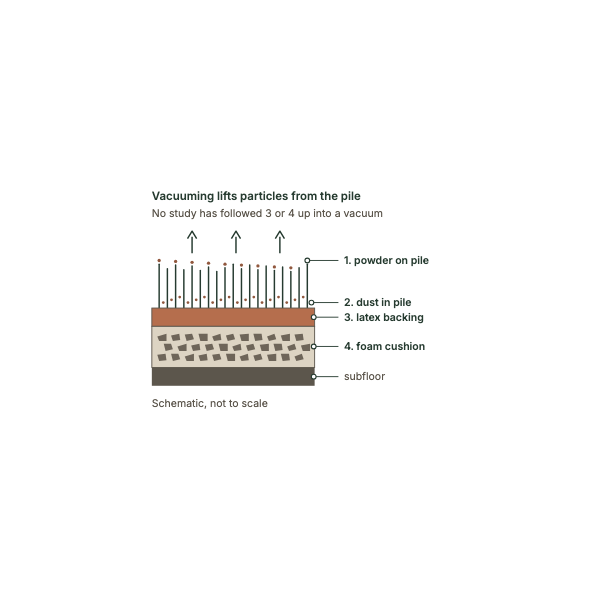
The sponge the replies meant is a dry cleaning sponge sold for soot, used without water. Work over the wall and ceiling with it, or with a vacuum’s brush, before anything wet goes near the marks.
No source read tested whether wiping wet first smears candle soot on a painted wall. Several replies said it did for them, and that is reader experience, not a measurement.
What the sources support is that dry methods work on this kind of soot, and that conservators commonly combine dry and wet methods, according to Yang’s survey of the literature. No source read sets the order for a wall. One conservator’s cleaning trial, described below, ran dry first: vacuuming, then gentle surface cleaning, then a water-based solution.
Protect yourself while you do it. The University of Tennessee Extension’s sheet on cleaning up smoke, written for wildfire, says to wear N95 masks and gloves, and to change heating and air conditioning filters after smoke.
One reply made the same point about the air filter. No source read says whether to clean the ceiling or the walls first, so no order is given here.
Then Wash With Mild Soap
For what the dry pass leaves, the Tennessee sheet says to wash interior walls and hard surfaces with mild soap, and that a white vinegar solution should handle most areas. That sheet is for wildfire smoke, not candles, and it gives no dilution for painted walls, so none is given here.
The warning that soapy water turns soot into acid has no support in anything read for this article. In Pagels’s measurements, elemental carbon made up most of the particles from a flickering candle, with inorganic salts and a little organic matter, and no source describes water turning it acidic. Nothing read disproves the claim either; it is simply untested.
Stronger cleaners came up often, and each has a cost. Ammonia, according to the NIOSH Pocket Guide, irritates the eyes, nose and throat and can cause breathing difficulty.
Health Canada warns that bleach reacts with any product containing ammonia or an acid, vinegar included, to make toxic gases that can be deadly, and that it is never safe to mix bleach with other cleaning products.
So one cleaner at a time, rinsed off before the next, as the article on a burnt glass dish sets out for a different mess.
No source read tested an alkaline cleaner, trisodium phosphate (TSP), baking soda or a melamine eraser sponge on soot or on house paint. Replies themselves warned that an alkaline cleaner may damage paint and that a melamine eraser can wipe the paint off. If you use any of them, the label governs.
When the Marks Will Not Wash Out
Some of the replies’ expectation of repainting has a basis. Héritier describes how the soft surface of emulsion paint, the acrylic and vinyl kind, can trap fine particles so that they anchor in it rather than resting on it.
In mock-ups of artists’ acrylic paint, pigment powders were left for two months. After vacuuming, gentle surface cleaning and a water-based cleaning trial, traces stayed in the paint, which Héritier likens to a tattoo. Carbon black, left on another mock-up for a few weeks, was found as particles trapped in the surface.
That is artists’ paint, not wall paint, so it is carried to a house wall by inference.
It suggests what to expect. A gray shadow that survives a dry pass and a wash may be inside the paint film. Héritier writes that particles anchored this way can make cleaning hazardous or even damaging to the paint, so painting is then the remaining step.
Paint over loose soot, though, and one reply found the soot mixed into the new paint and turned it gray. That is one person’s experience, not a test.
Replies also recommended a primer that blocks stains and smells, especially for a bathroom that might hold the smell. No test of a primer over candle soot was found. The sources in the article on old house smell found that paint may trap residues but is not a permanent barrier against them.
Paraffin, Soy, Beeswax and the Candle Itself
Several replies were sure that paraffin was the culprit, and that soy or beeswax candles make far less soot. What the wax is made of does matter: Andersen’s team found that wax and wick composition strongly changed how much soot their candles gave off. Their abstract does not say which waxes made more.
Pagels’s stearin and paraffin candle made more soot than the pure stearin one, but the two also differed in maker, price and color, so that comparison does not isolate the wax. No source read ranks soy, beeswax and paraffin against each other.
The clearer lesson from both studies is about the flame. In Pagels’s tests, the same candle gave off many times more soot when it flickered, and Andersen’s team concluded that preventing that kind of burning can reduce exposure. For both of Pagels’s candles, shielding the flame from moving air cut the soot to a small fraction.
The Illinois State Fire Marshal’s candle tips, which the thread’s fire worries come back to, are these.
- Think about using battery-powered flameless candles.
- Light candles carefully, and keep hair and loose clothing away from the flame.
- Keep candles at least 1 foot (about 30 cm) away from anything that can burn.
- Do not burn candles all the way down; put one out before it gets close to the holder or container.
- Blow out all candles when you leave the room or go to bed, and avoid candles in bedrooms or anywhere people might sleep.
- Never leave children alone in a room with a burning candle, and use sturdy holders that will not tip over easily.
- Never use a candle if oxygen is used in the home.
The same page gives NFPA figures for 2015 to 2019: candles caused 2 percent of reported home fires and 3 percent of home fire deaths, and falling asleep was a factor in 10 percent of home candle fires. Three of every five started when something that can burn was too close to the candle.
Why the Smoke Alarm Stayed Quiet
The poster’s smoke alarms did not sound, and they guessed the closed door was why. The U.S. Fire Administration makes a related point: a closed door may slow the spread of smoke, heat and fire, and it gives that reason beside its advice to put smoke alarms inside and outside each bedroom and sleeping area.
It also says to put alarms on every level of the home and to interconnect them, so that when one sounds they all sound.
Test them monthly, and replace each alarm 10 years from its manufacture date. No source read says whether a sooting candle would set off any particular alarm.
Breathing It
Some replies described black soot in their noses after burning candles, and one urged the poster to see a doctor.
The evidence on short exposures is limited. K. R. Laursen and colleagues (2023, Particle and Fibre Toxicology, cited from the abstract) exposed 36 young adults with mild asthma to candle smoke for five hours, at about 90 micrograms of fine particles per cubic meter.
They found slight effects on the small airways and weak or no signs of inflammation through the body, and concluded that candle smoke caused mild inflammation.
That was a controlled chamber, not a night in a sealed bathroom, and Pagels’s team wrote that how much candle soot people actually breathe is poorly known. Questions about symptoms belong with a clinician.
Local Regulations and Safety Advisory
If you use household chemicals, follow the label. Rules on them vary by country and locality, and your hazardous waste service can say what applies where you live. Never mix cleaners. For candles and smoke alarms, follow your local fire service. If mold in your home raises a health concern, your public health department or a qualified mold inspector can advise. This article is general information, not legal, medical or professional safety advice.
Authorities to consult:
- Public health department or hazardous waste service
- Your local fire department, and each cleaner's label
- Public health department or qualified mold inspector
What Remains to Be Explored
No test was found of cleaning candle soot off household paint, so the dry-then-wash order rests on conservation research on heritage objects and on an extension sheet written for wildfire smoke. Whether wiping wet first smears candle soot on a wall has not been measured.
No measurement was found of soot from three-wick or jar candles, or of how soot changes as a candle burns down. The chamber figures here come from tapered and pillar candles, and their steady-flame values varied widely.
No source measured the temperature of a drywall screw head or the part that bathroom humidity plays, so the explanation for the dots fits the physics but has not been tested in a home. No study ranks soy, beeswax and paraffin by soot.
No test was found of TSP, alkaline cleaners, melamine erasers or stain-blocking primers on candle soot, and the claim that water turns soot into acid has neither support nor a test against it. A controlled cleaning test on painted drywall, or a measured comparison of waxes in drafts, would change parts of this answer.
Sources
- Left Candle Burning All Night, Please Help — multiple community members. Reddit, r/CleaningTips. Undated.
- Chemical Composition and Mass Emission Factors of Candle Smoke Particles — Joakim Pagels, Aneta Wierzbicka, Erik Fors, Christina Isaxon, Andreas Dahl, Anders Gudmundsson, Erik Swietlicki, Mats Bohgard. Journal of Aerosol Science 40(3):193-208. 2009.
- Emissions of Soot, PAHs, Ultrafine Particles, NOx, and Other Health Relevant Compounds From Stressed Burning of Candles in Indoor Air — C. Andersen, Y. Omelekhina, B. B. Rasmussen, M. Nygaard Bennekov, S. N. Skov, M. Køcks, K. Wang, B. Strandberg, F. Mattsson, M. Bilde, M. Glasius, J. Pagels, A. Wierzbicka. Indoor Air 31:2033-2048. 2021. Cited from its abstract.
- The Reproduction of Fire-Born Soot for Comparative Cleaning Tests on Heritage Objects — N. Yang, M. Cremonesi, T. Markevicius, A. Del Favo, K. Shumikhin, E. Ducoli, C. Rocha Pires, R. Fontana, P. Van Der Voort, K. Leus, G. Nuyts, G. Pastorelli, S. W. Jensen, I. Bonaduce, K. J. van den Berg, R. Morent, A. Nikiforov, G. Van der Snickt. npj Heritage Science 13:593. 2025.
- Modelling Particle Deposition Onto Surfaces in Historic Buildings — M. Strojecki. Science of the Total Environment 896:165205. 2023. Cited from its abstract.
- The Impact of Particulate Matters and Nanoparticles on Thermoplastic Polymer Coatings and Paint Layers — Pierre-Antoine Héritier. Polymers 14(12):2477. 2022.
- Airway and Systemic Biomarkers of Health Effects After Short-Term Exposure to Indoor Ultrafine Particles From Cooking and Candles – A Randomized Controlled Double-Blind Crossover Study Among Mild Asthmatic Subjects — K. R. Laursen, N. V. Christensen, F. A. Mulder, J. Schullehner, H. J. Hoffmann, A. Jensen, P. Møller, S. Loft, A. C. Olin, B. B. Rasmussen, B. Rosati, B. Strandberg, M. Glasius, M. Bilde, T. Sigsgaard. Particle and Fibre Toxicology 20:26. 2023. Cited from its abstract.
- Smoke Removal and Fire Cleanup In the Home — Martha Keel (contact). University of Tennessee Extension, Family and Consumer Sciences. 2021 (upload path).
- Candle Safety — Illinois Office of the State Fire Marshal. Undated.
- Smoke Alarms — U.S. Fire Administration, FEMA. Undated.
- NIOSH Pocket Guide to Chemical Hazards, Ammonia — National Institute for Occupational Safety and Health, CDC. Undated.
- Reduce Your Risk of Toxic Gases: Never Mix Bleach With Other Cleaning Products — Health Canada, Recalls and safety alerts. last updated 2021-02-08.