Turkeys that come back to one patch of lawn day after day are getting something from it, most likely food. Grubs are the first thing to check for, because birds and mammals dig for them.
But a patch that was dead, scalped and seeded may be drawing them for other reasons, so look under the sod before you buy anything.
If you find grubs in late October, no grub product will do much now. Treatments work in two windows, before the eggs hatch in summer and against grubs found in August or September, and the next one opens next summer.
Until then, scare the birds off with devices you move around so they do not get used to them, never feed them, and plan to reseed once the soil is too cold for seed to sprout, or lay sod.
No study was found of wild turkeys in home lawns. What follows rests on extension guidance on white grubs from Indiana, Iowa and Vermont, field studies of grubs and their natural enemies, research on what wild turkeys eat, and a Canadian provincial guide to living with turkeys.
The question comes from a thread on r/lawncare. A homeowner in Minnesota had spent years improving a lawn. After a harsh summer and a busy stretch, a small patch in the middle died, and they mowed it very low to overseed.
That, in their telling, was the opening the neighborhood’s wild turkeys needed, and their video shows the birds on the torn-up patch. They now came one to three times a day, the area they dug kept growing, and the owner wanted something permanent to keep them out.
Reply after reply gave the same diagnosis: grubs. Let the turkeys finish, one said, then put down milky spore and a grub insecticide with the new seed.
Others suggested nematodes in early spring, waiting until May, motion-activated sprinklers or reflective tape. One reply doubted grubs were the point at all, since every lawn has some. Plenty mentioned the date on the calendar.
Are the Turkeys Digging, or Eating What Is Already Loose?
Purdue Extension’s guide to white grubs lists raccoons, skunks, armadillos and turkeys among the animals that forage for grubs in turf. That digging, which it calls secondary damage, can be the first obvious sign of an infestation (Richmond 2022).
Iowa State’s grub page names raccoons, skunks and crows, which turn over large patches of loose turf to reach grubs. Purdue’s insect diagnostic lab adds that birds leave peck holes when they forage for grubs (Gibb 2013).
A second Purdue publication, about wild turkeys rather than grubs, is more doubtful. It says lawn damage done by raccoons and skunks digging up grubs is often blamed on turkeys. Turkeys, it says, are much less likely to scratch up undisturbed turf (MacGowan, Humberg and Rhodes 2006).
What they will do, the same guide says, is feed in plain view on grubs other animals have exposed, and on insects in lawns and fields. They are drawn to browned, turned-over ground, and in July in Indiana they feed readily on Japanese beetles. The guide also records turkeys dust-bathing in bare dirt on ball fields.
The guide’s research comes from farms. In crop fields in north central Indiana, researchers recorded over half a million cases of wildlife crop damage across two growing seasons, and wild turkeys caused no measurable damage to corn or soybeans.
The authors’ explanation is visibility. Turkeys feed by day and are easy to see; deer and raccoons, which did most of the damage, feed at night and are easy to overlook.
None of that says turkeys never dig, and the owner watched these ones at it. But the patch in this thread was not undisturbed turf.
It had died, been cut to the ground and been sown with seed. That is close to the browned, broken ground the Purdue guide says draws turkeys, and to the bare dirt it saw them dust in, though no source describes a scalped lawn patch.
Grubs may not be the only food on offer either. In droppings from seven national forests in northern California and central Oregon, insects turned up in every forest and grasses in all but one. Seeds were a small part of the diet in most forests and the majority in one (Wengert and colleagues 2009, cited from its abstract).
Those are forest birds, not suburban ones, and no study was found of turkeys eating lawn seed. Carried to a lawn by inference, sown seed and insects in bare soil could draw turkeys as well as grubs. The way to tell is to look.
Look Under the Sod First
The University of Vermont gives the least damaging way to check. Cut three sides of a square about 6 inches on a side and 3 to 4 inches deep, then fold the flap back and count the grubs.
Put a few aside if you want them identified. Then fold the flap back down, press it in place and water it (Skinner 2023).
Repeat that in several places to get a fair sample, Vermont advises; Purdue adds that areas already damaged are likely to be infested again. A 6-inch square is a quarter of a square foot, so multiply each count by four to compare it with the numbers below.
White grubs are C-shaped and white, with a chestnut-colored head and three pairs of clearly visible legs (Richmond 2022). Where grubs have done real damage, Iowa State says the dead turf can be rolled back like a loose carpet, because the roots have been eaten off beneath it.
Timing matters for the count. Vermont advises sampling after heavy rain or a deep watering, because grubs move down in dry soil and can be missed.
They also move down as the soil cools in late fall, below the frost line for the winter. A count in late October can miss grubs that have already gone deeper.
How many grubs is a problem? Purdue says densities of 5 to 10 per square foot are usually needed to cause significant damage. Up to 5 is not uncommon and rarely needs treatment, and 20 may not cause noticeable damage.
Japanese beetle grubs, in Purdue’s experience, usually take 10 or more per square foot before damage shows (Richmond 2022).
Iowa State says healthy turf can sometimes take 20 or more before showing injury. Vermont puts a well-kept lawn’s tolerance at about 10 and a struggling lawn’s at 4 or 5, with 5 to 10 warranting action.
The figures are close, and each source ties them to the health of the turf. Purdue adds the grub species and how the lawn is kept.
That makes the doubting reply partly right. A few grubs under a lawn are normal, and Purdue’s numbers say so.
But Vermont adds that even a small number of grubs can attract rodents that do major damage foraging for them. A lawn can be torn up by grub numbers that would not have hurt the grass on their own.
The harsh summer in the post fits more than one story. Grub damage first looks like drought stress, and steady rain or watering can hide it until dry weather arrives (Iowa State).
Yet drought also kills grub eggs and larvae (Skinner 2023). A dead patch after a dry summer could be either, and the count is what separates them.
Why Late October Is the Wrong Time to Treat
The advice to let the turkeys finish and then treat runs into the grub’s calendar. Annual white grubs, the Japanese beetle and the masked chafers, take one year from egg to beetle.
Where they are in the soil, and whether they are still feeding, decides what a product can reach.
The grub’s year, and when a treatment can reach it
Annual white grubs feed near the surface from midsummer into fall, go deep for the winter and come back up in spring. Grub products work in two windows, and late October is in neither.
| 1. Preventive | Long-lasting grub insecticides go down before the eggs hatch: late May to early August in Iowa State’s guidance, watered in. Purdue names early to mid-July as the usual best timing. Applied after mid-August, they come too late (Iowa State). |
| 2. Curative | Faster-acting products against grubs already found, in August or September. Iowa State and the University of Vermont both advise against grub treatments after early October. |
| 3. Spring | The grubs come back up full-grown. Iowa State calls spring insecticide almost never warranted: big grubs are hard to kill, and fast-growing grass hides what they eat. |
| 4. Now | Late October, around when the thread was posted. The grubs are large and moving down to spend the winter below the frost line (Vermont). Their damage can show into fall, and animals digging for them are often the first sign (Purdue; Iowa State). |
Terracotta: grubs, larger as they grow; blue: the preventive window; terracotta bar: the curative window; dashed: advice against. Timing is for annual white grubs such as Japanese beetle and masked chafers, from Indiana, Iowa and Vermont guidance, and it moves with soil temperature. May and June beetle grubs take two to three years and keep a different calendar.
A patch dug up in late fall is a reason to look for grubs, not to treat them. If you find them, the next window that works opens next summer. Whatever you use, the label sets the rate and timing.
Iowa State says curative grub treatments after early October are not effective and are not recommended, and Vermont gives the same cutoff. Purdue explains why: a late treatment’s effect is greatly reduced once grubs have stopped feeding or moved deeper to overwinter.
Spring is not much better. Iowa State calls spring insecticide almost never warranted, because the grubs are full-grown and hard to kill, control rates are usually low, and fast-growing grass hides what damage they do.
There are exceptions. Purdue notes that overwintered grubs can damage turf in spring, especially where European chafer or Asiatic garden beetle grubs are present, and that May and June beetle grubs take two to three years to mature, doing most harm in their second season.
So if the count does find grubs, the useful decision now is what to do next summer. Preventive insecticides go down from late May to early August in Iowa State’s guidance and must be watered in. Purdue names early to mid-July as the usual best timing.
Iowa State’s page reports Cornell studies finding that over 70 percent of grub treatments were applied where there were no grubs. Its advice is to treat the hot spots you found, not the whole lawn, and grubs tend to return to the same areas in later years.
Whatever product is used, its label sets the rate, the timing and the watering, and that is the only place to take them from. Vermont advises mowing the lawn before a chemical insecticide goes down, to limit pollinators’ exposure to it.
One reply suggested bifenthrin. It is not among the active ingredients Purdue lists for white grub control. Iowa State lists it only as the second ingredient in two commercial mixtures, each paired with a grub insecticide.
Milky Spore and Nematodes, the Slower Options
Milky spore is a bacterium, Paenibacillus popilliae, that causes milky disease in grubs. The strain sold commercially infects only Japanese beetle grubs (Cornell University’s biological control guide; Richmond 2022). Purdue says the commercial products have not proven effective as a single, stand-alone application.
Cornell’s guide summarizes a Kentucky field study, which it lists as Redmond and Potter 1995, in which the commercial formulations infected only 39 to 44 percent of grubs, infected grubs ate as many roots as healthy ones, and lower grub numbers could not be linked to infection.
Vermont calls milky spore’s effectiveness not definitively confirmed. It adds that some think Vermont’s summers are too short for the bacterium to build up in the soil, which is a theory, not a finding.
There is a second problem. Iowa State says the annual white grubs that damage lawns in Iowa are Japanese beetles or masked chafers.
On Kentucky golf courses, masked chafers made up about 73 percent of grubs in an autumn survey, and Japanese beetle about 26 (Redmond and Potter 2010, cited from its abstract). A product that infects only one of them leaves the other.
Telling them apart takes the pattern of hairs and spines under the tip of the grub’s abdomen, seen with a hand lens or microscope (Richmond 2022). No source read gives the mix of grub species in Minnesota lawns.
Nematodes have a mixed record. Purdue’s guide names Heterorhabditis bacteriophora, a nematode that kills grubs, and says larger grubs are the best targets, so it fits curative use.
Nematodes are alive. Purdue says to refrigerate them on arrival, apply them early in the morning or in the evening, out of strong sun, and water them in at once.
The reply’s early-spring timing would meet full-grown grubs. On two school soccer fields in New York, two nematode species released against full-grown Japanese beetle grubs did poorly in loam and modestly in loamy sand, with one significant result over untreated plots (Helmberger and colleagues 2018, cited from its abstract).
Over a longer run the picture is better. On two New Jersey golf courses, mixes of nematodes freshly collected from local turf were applied in early June 2020.
Sampled through October 2022, plots given H. bacteriophora had 67 percent fewer white grubs on the fairway side (Koppenhöfer and Sousa 2024, cited from its abstract).
Those were nematodes collected from local golf courses, not a bought product, and the authors say periodic reapplication may still be needed. No study read compared a home lawn treated with store-bought nematodes against one left alone.
Grub populations also fall on their own. In Michigan, Japanese beetle grubs on nine golf courses declined by 78.6 percent from 1999 to 2018, while infection of adult beetles by a microsporidian pathogen rose from 0.39 percent in 2000 to 29.5 percent (Smitley and colleagues 2022, cited from its abstract).
The authors read the decline as consistent with the pathogen. It took nearly twenty years, not a season.
Keeping the Turkeys Off the Patch
The Manitoba government’s guide to living with wild turkeys lists motion-activated lights, water sprayers and noisemakers. It also lists effigies of turkey predators, and streamers or reflective tape tied to stakes set at a slight angle so the strands move in the faintest air.
Its warning is the important part: turkeys get used to a device’s presence, noise or movement, so the effect can be short-lived. Manitoba advises changing the type of device or moving them around the property regularly, and being considerate of neighbors when choosing.
Netting or fencing can keep turkeys out of a small area, such as a garden, but the guide warns that over a large area they may just fly over. No source read tested netting over a patch of lawn.
Do not feed them. Birds used to handouts lose their fear of people, and bird feed can raise turkey numbers, Manitoba says. Purdue adds that many confirmed nuisance turkeys turned out to be pen-raised or hybrid birds, while truly wild ones are wary and flee when people approach.
For a bold bird, Manitoba suggests loud noises, swatting motions with a broom, or water sprayed from a hose. A dog on a leash can deter turkeys, but letting a dog chase them is illegal there. Its law also forbids killing a wild turkey to protect property.
Rules on wild turkeys differ by state and province, and so do local rules on scare devices and noise. Check with your state or provincial wildlife agency before doing more than scaring them off.
Several replies offered their own remedies. No source read tested a whistle, a recorded turkey call or a burlap cover against turkeys.
Getting Grass Back
Purdue’s turf researchers found that seeding as late as October can severely reduce establishment before winter, and that perennial ryegrass sown in November germinated but did not survive the winter (Reicher 2007). The trouble is seed that sprouts with too little time left.
Their answer is dormant seeding: sow after the soil has cooled, so the seed does not germinate until spring. In their studies it usually did better than spring seeding and only slightly worse than September seeding.
In Indiana, Purdue advises waiting until after Thanksgiving and says it works better in the colder north of the state, where warm spells are less likely to sprout seed in midwinter (Reicher 2007; Reicher and colleagues).
Minnesota is colder still. Carried there by inference, dormant seeding fits, but the right date depends on local soil temperature, and no Minnesota date is cited here. Purdue’s best window for fall seeding in northern Indiana, for comparison, is August 15 to September 15.
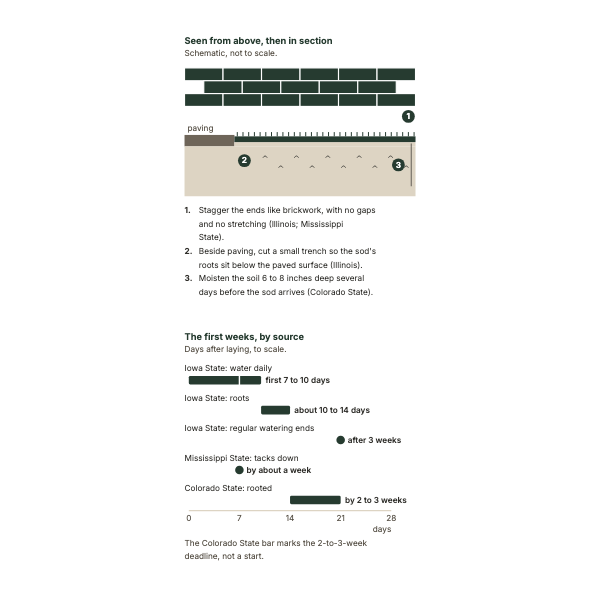
Sod can go down at almost any time, Purdue says, though sod laid in winter will not root much until spring and needs watering then. Watering new sod has its own pitfalls.
Where grass has been torn up and is dead, Purdue’s diagnostic lab says to rake it up and replant or lay sod. Grass that was not torn up will survive and gives an overseeding a head start (Gibb 2013).
For thin spots next year, Purdue’s seeding guide favors late summer, and seeding gaps in late summer covers how.
Purdue suggests a light straw mulch on new seed to hold water and prevent erosion, spread thin enough that about half the soil still shows. It says nothing about birds, and no source read tested straw, burlap or netting against turkeys eating seed.
Local Regulations and Safety Advisory
If you use pest control products, follow the label. Rules on them vary by country and locality, and your pesticide regulator can say what applies where you live. Rules on feeding, scaring, trapping or killing wild turkeys come from state or provincial wildlife law, and local rules on scare devices differ, so check with your wildlife agency before doing more than scaring them off. This article is general information, not legal advice.
Authorities to consult:
- Pesticide regulatory authority or environmental protection agency
- State or provincial wildlife agency
What Remains to Be Explored
No study was found of wild turkeys feeding in home lawns: how often they dig turf themselves rather than feed where it is already broken, whether they take sown grass seed, or whether grub control reduces their visits. The evidence that they rarely scratch up undisturbed turf comes from Indiana farm fields.
The calendar here is Indiana, Iowa and Vermont guidance carried north; no Minnesota data on grub species, grub timing or dormant seeding dates is cited. In a colder state, the grubs may go down and come up on a different schedule.
No test was found of any turkey deterrent on a lawn, of how long turkeys keep returning once grubs have gone deep for winter, or of a cover that keeps birds off seed. The milky spore field study is known here only through Cornell’s summary.
What would change the answer: a count that finds no grubs under the dug patch, which would point to seed or other food; a study of urban turkey foraging; or Minnesota timing data that moves the treatment windows.
Sources
- Caught Turkeys Destroying My Lawn — multiple community members. Reddit, r/lawncare. Undated.
- Managing White Grubs in Turfgrass (E-271-W) — Douglas S. Richmond. Purdue University Extension, Department of Entomology. June 2022.
- Truths and Myths About Wild Turkey (FNR-264-W) — Brian J. MacGowan, Lee A. Humberg, and Olin E. Rhodes, Jr. Purdue University Extension, Department of Forestry and Natural Resources. June 2006.
- Guess Who Came to Dinner? — Tim Gibb. Turfgrass Science at Purdue University. May 20, 2013.
- How Late Can You Seed? — Zac Reicher. Turfgrass Science at Purdue University. October 25, 2007.
- AY-3: Establishing Turfgrass Areas From Seed — Zac Reicher, Cale Bigelow, Aaron Patton, Tom Voigt. Purdue University Extension. Undated.
- White Grub Control in Turfgrass — Iowa State University Extension and Outreach, Yard and Garden. September 1, 2016.
- Paenibacillus popilliae (Milky Disease) — Cornell University, College of Agriculture and Life Sciences, Biological Control. Undated.
- White Grubs: A Serious Lawn Pest — Margaret Skinner. University of Vermont Extension. June 2023.
- Coexisting With Wild Turkeys — Government of Manitoba, Wildlife Smart. 2024.
- Food Habits of Wild Turkeys in National Forests of Northern California and Central Oregon — GRETA M. WENGERT, MOURAD W. GABRIEL, RYAN L. MATHIS, THOMAS HUGHES. Western Birds 40(4):284-291. October 1, 2009. Cited from its abstract.
- Long-Term Suppression of Turfgrass Insect Pests With Native Persistent Entomopathogenic Nematodes — Koppenhöfer AM, Luiza Sousa A. Journal of Invertebrate Pathology 204:108123. 2024. Cited from its abstract.
- Entomopathogenic Nematode Performance Against Popillia japonica (Coleoptera: Scarabaeidae) in School Athletic Turf: Effects of Traffic and Soil Properties — Helmberger MS, Thaler JS, Shields EJ, Wickings KG. Biological Control 126:177-184. 2018. Cited from its abstract.
- Incidence of Turf-Damaging White Grubs (Coleoptera: Scarabaeidae) and Associated Pathogens and Parasitoids on Kentucky Golf Courses — Redmond CT, Potter DA. Environmental Entomology 39:1838-1847. 2010. Cited from its abstract.
- Gradual Decline of Japanese Beetle (Coleoptera: Scarabaeidae) Populations in Michigan Follows Establishment of Ovavesicula popilliae (Microsporidia) — Smitley D, Hotchkiss E, Buckley K, Piombiono M, Lewis P, Studyvin J. Journal of Economic Entomology 115:1432-1441. 2022. Cited from its abstract.