Some honeysuckles are invasive and some are native. The invasive ones in the guides read are the Asian bush honeysuckles, shrubs such as Amur, Morrow and Tartarian honeysuckle and their hybrids, and the Japanese honeysuckle vine. Native honeysuckles have solid stems, and in Missouri, for one, the native kinds are all vines.
Bush honeysuckle comes back from cut stumps, from its roots and from seed birds carry away. Young plants can be pulled whole.
Cutting a shrub alone usually leaves it alive: in one Kentucky study most clipped shrubs were alive a year later, which is why the guides pair cutting with a stump treatment and plan for follow-up.
What This Article Covers
It covers which honeysuckles are invasive and how to tell them from native ones, why bush honeysuckle is a problem, pulling small plants, why cutting alone fails, larger shrubs, and what happens after removal. It names no herbicide product, strength or rate.
A vine that climbs and girdles trees is covered in a vine wrapped around a tree trunk, and another invasive woody plant that resprouts from its roots in tree of heaven between a house and a driveway.
Which Honeysuckles Are Invasive
The guides name the same shrubs. The Missouri Department of Conservation lists Amur honeysuckle and the bella hybrids as nonnative invasive shrubs up to 15 to 20 feet tall.
Ohio State Extension’s fact sheet F-68 adds Morrow and Tartarian honeysuckle, introduced from Europe and Asia in the mid to late 1800s for ornament, wildlife and erosion control.
Missouri says Amur honeysuckle was still planted for hedges, screens and erosion control through the mid-1980s, when its invasive potential was first realized, and Virginia Cooperative Extension calls the Asian honeysuckles perhaps the most widespread exotic invasive in the United States, found in at least 38 states.
The vine is the second invader. The Wisconsin Department of Natural Resources classes Japanese honeysuckle as Prohibited and describes a semi-evergreen woody vine up to 80 feet long that girdles shrubs and young trees.
Virginia Cooperative Extension says it covers the ground or climbs trees, eventually girdling and killing them. Brendon M. H. Larson and colleagues trace it to Japan, Korea and eastern China, introduced worldwide as an ornamental, and note it has been prohibited in some regions.
Several features separate them from native honeysuckles. Ohio State, Illinois Extension and Purdue Extension all say the invasive shrubs have hollow older stems, while native honeysuckle has a solid stem. Missouri notes that its other honeysuckles, native and nonnative, are twining vines, not bushes.
For the vines, Wisconsin says native honeysuckle vines have red or orange berries, flowers at the tips of the stems, and leaves fused around the stem below the flowers, against Japanese honeysuckle’s purple-black berries in the leaf axils.
Why Bush Honeysuckle Is a Problem
The sources agree on the timing advantage. Bush honeysuckles leaf out earlier in spring and hold their leaves later in fall than most native plants, Missouri and Ohio State say, shading spring wildflowers and seedlings and forming dense thickets where little else grows.
The birds that spread them get poor food. Ohio State and Missouri say the berries are rich in carbohydrates but lack the high fat of native fruits that migrating birds need. Missouri adds that birds nesting in the low branches suffer higher nest predation.
Kathi L. Borgmann and Amanda D. Rodewald, following 188 cardinal and robin nests in 12 riparian forests along a rural to urban gradient, found the effect of nesting in exotic shrubs, honeysuckle and multiflora rose, depended on how urban the surrounding land was.
A review by Rachel E. McNeish and Ryan W. McEwan describes Amur honeysuckle as a highly successful invader of eastern North American forests, with effects on species, community structure and ecosystem function that vary from place to place.
Small Plants
Young plants are the easy part. Ohio State says bush honeysuckles have shallow roots, so a few small plants can be pulled or dug fairly easily, best after a rain.
Christopher Enroth of Illinois Extension says to pull the young shrub, shake off the soil and leave the roots in the air to dry, piled or hung on a branch.
The whole root has to come. Missouri says seedlings should be pulled when the soil is moist, with all of the root removed, or they resprout.
Iowa State Extension suggests a tool with good grip, since the bark of young woody plants slips when pulled. Jayde Grisham of Purdue Extension warns that some small plants are suckers from a larger shrub and will not come up easily.
Why Cutting Alone Fails
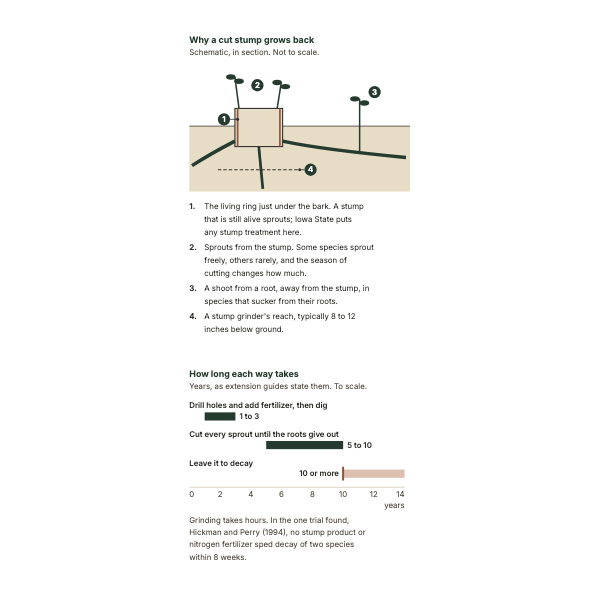
The guides read agree that a cut stump comes back. Ohio State says cutting a shrub at the base causes prolific sprouting and more stems, Missouri that cut stems resprout with more branches, leaves, flowers and fruit, and Iowa State that the regrowth is often bushier and harder to manage. Enroth calls cutting alone often unsuccessful unless repeated multiple times a year, for many years.
Cutting bush honeysuckle alone usually leaves it alive
Pulled young plants die if their roots dry out. A cut shrub sprouts back, and most clipped shrubs in one Kentucky study were still alive a year later.
Illinois Extension (Enroth); Ohio State F-68; Missouri Department of Conservation; Purdue Extension (Grisham, 2025); Boyce (2024), Journal of the Torrey Botanical Society.
Pull small plants whole; a cut alone has to be repeated for years, so the guides pair cutting with a stump treatment.
One study measured it. Richard L. Boyce clipped Amur honeysuckle shrubs in forest and open sites in northern and central Kentucky. After a year, 62 percent of the forest shrubs and 75 percent of the open shrubs were still alive. Clipping alone, the paper says, is usually ineffective unless repeated over several years.
Repeated cutting can work on small plants. Ohio State says cutting or mowing is most effective begun in early summer, when food reserves are lowest, and small shrubs can be eliminated once those reserves are exhausted. Iowa State adds that most gardeners lack the time to keep it up.
Larger Shrubs
For established shrubs, the guides kill the roots as well as the top. Ohio State says this is done most effectively with herbicides.
Missouri cuts the stem at the base and treats the stump right away, Virginia Tech’s sheet gives stump treatment from July to October, and Grisham pairs cutting with a systemic herbicide for large groups. Missouri, Purdue and Iowa State all stress the product label.
The timing advice centers on fall, with different windows. Missouri calls late fall the best time, because honeysuckle stays green after natives go dormant, and lists late summer, early fall or the dormant season for stump work. Grisham also favors fall, for the same reason.
Machines are not a shortcut. In Indiana forests, Graham S. Frank and colleagues found a forestry mulching head left more honeysuckle regrowth after two seasons than cut-stump treatment. Ohio State says any machine removal needs follow-up on the sprouts, and Missouri expects some resprouting after stump treatment too.
For the vine, Wisconsin pulls or mows it repeatedly and follows up, and cuts climbing vines near the soil before treating the stem.
After Removal
Recovery takes time. In central Ohio, Rebecca M. Swab found that one season after honeysuckle was cleared, the understory had not yet improved.
In Louisville’s Cherokee Park, Elihu Levine found by 2013 that native herb cover and richness, vines and tree saplings had increased where honeysuckle was removed in 2009, though the invasion’s legacy still showed. Both are theses, not peer-reviewed papers.
In a central Kentucky trial, Marvin E. Ruffner and colleagues found removal with a stump treatment raised herb cover and species richness over time, while planting native grasses and spicebush did not hold honeysuckle back any better. Missouri suggests native shrubs in its place, such as American beautyberry, American hazelnut, buttonbush and elderberry.
Local Regulations and Safety Advisory
If you use pest control products, follow the label. Rules on them vary by country and locality, and your pesticide regulator can say what applies where you live. Some states list invasive honeysuckles in rules that restrict selling, moving or planting them, so check your state's invasive plant list before you plant or move one. This article is general information, not legal advice.
Authorities to consult:
- Pesticide regulatory authority or environmental protection agency
- State department of natural resources or agriculture, or your state's invasive plant council
What Remains to Be Explored
No trial in a home yard was found; the studies read were in forests and parks. The best season for stump treatment varies by source, and no trial read compared seasons.
No study read measured control of the Japanese honeysuckle vine in a garden.
Sources
- Bush Honeysuckles — Missouri Department of Conservation. Undated.
- Bush Honeysuckle Control — Missouri Department of Conservation. Undated.
- Controlling Non-Native Invasive Plants in Ohio Forests: Bush Honeysuckle (F-68) — Kathy Smith. Ohio State University Extension. March 11, 2024.
- Identify and Manage Invasive Bush Honeysuckle — Christopher Enroth. University of Illinois Extension, Good Growing. November 29, 2024.
- Managing Weedy Woody Plants — Iowa State University Extension and Outreach. Undated.
- Kill the Shrubs: A Guide to Fall Removal of Invasive Honeysuckle — Jayde Grisham. Purdue Extension, Marion County. September 29, 2025.
- Invasive Exotic Plant Species: Honeysuckle (Lonicera Spp.) (420-323) — Matthew Yancey. Virginia Cooperative Extension. Undated.
- Japanese Honeysuckle (Lonicera japonica) — Wisconsin Department of Natural Resources. Undated.
- Effect of Clipping and Honeysuckle Leaf Blight (Insolibasidium deformans, Platygloeaceae) on Resprouting of Amur Honeysuckle (Lonicera maackii, Caprifoliaceae) Shrubs — Richard L. Boyce. The Journal of the Torrey Botanical Society. 2024. Cited from its abstract.
- Short-Term Vegetation Responses to Invasive Shrub Control Techniques for Amur Honeysuckle (Lonicera maackii [Rupr.] Herder) — Graham S. Frank; Michael R. Saunders; Michael A. Jenkins. Forests. 2018. Cited from its abstract.
- Managing Invasive Amur Honeysuckle (Lonicera maackii) in Central Kentucky: Can Native Species Release and Restoration Plantings Hold Their Ground? — Marvin E. Ruffner; Madeline Cox; Ewing Wiley; Abigail Morton Garland; Wilson D. Shafer. Invasive Plant Science and Management. 2026. Cited from its abstract.
- A Review on the Invasion Ecology of Amur Honeysuckle (Lonicera maackii, Caprifoliaceae) a Case Study of Ecological Impacts at Multiple Scales — Rachel E. McNeish; Ryan W. McEwan. The Journal of the Torrey Botanical Society. 2016. Cited from its abstract.
- Nest Predation in an Urbanizing Landscape: The Role of Exotic Shrubs — Kathi L. Borgmann; Amanda D. Rodewald. Ecological Applications. 2004. Cited from its abstract.
- The Biology of Canadian Weeds. 135. Lonicera japonica Thunb. — Brendon M. H. Larson; Paul M. Catling; Gerald E. Waldron. Canadian Journal of Plant Science. 2007. Cited from its abstract.
- Plant Community Responses to the Removal of Lonicera maackii From an Urban Woodland Park — Elihu Levine. University of Louisville, ThinkIR (thesis). 2016. A thesis, not peer reviewed; cited from its abstract.
- Effectiveness of Lonicera maackii Removal From a Bottomland Hardwood Forest in Central Ohio — Rebecca M. Swab. OhioLINK ETD Center (thesis). 2005. A thesis, not peer reviewed; cited from its abstract.