Harvest butternut squash when the rind is too hard to dent with a thumbnail and has gone dull, and the stem is firm.
That takes about 60 to 70 days from pollination in warm weather, by Iowa State Extension’s count, and longer when it is cool. Cut each squash with about an inch of stem left on.
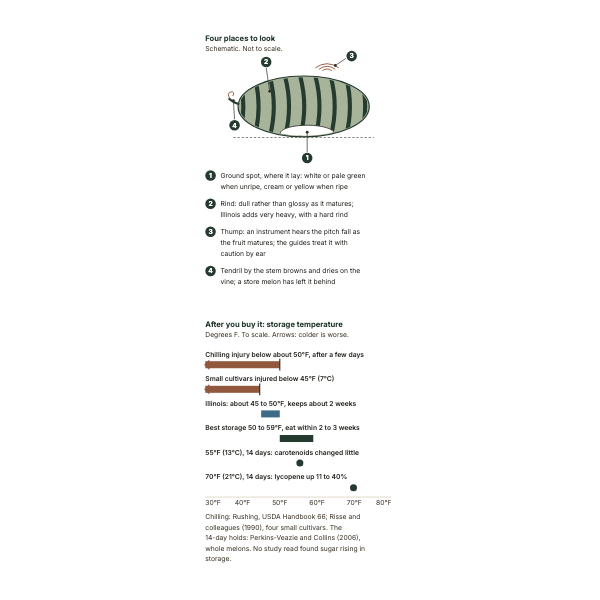
In acorn squash, full size and color arrive weeks before the sugar does, so a big squash is not necessarily a ripe one. Unlike the melons in the storage studies read, butternut in one trial kept gaining sucrose in storage as its starch fell.
What This Article Covers
It covers the signs a butternut is ready, how long it takes, picking too early, curing, and storing. It leaves aside growing the vines.
Butternut’s species relative grown as a summer squash is covered in tromboncino squash and when to pick it, and a fruit that did not gain sugar after picking, in the studies read, in how to tell if a cantaloupe is ripe.
Signs It Is Ready
The guides agree on the rind. Iowa State says mature winter squash have very hard skins that cannot be punctured with the thumbnail, and dull-looking surfaces. Natalie Hoidal of Minnesota Extension gives the same test with a fingernail: the rind should not dent.
A butternut is ready when its rind won’t dent
Butternut takes about 60 to 70 days from pollination in warm weather. A hard, dull rind and a firm stem show it is ready; cut it with an inch of stem on.
Iowa State Extension, Harvesting and Storing Vine Crops (Jauron, Fillius and Steil); University of Minnesota Extension (Hoidal, 2021); Loy (2005), HortScience.
Leave it on the vine until the rind is hard; in acorn squash, full size and color came weeks before the sugar.
The plant gives signs too. Hoidal says the vines usually begin to decline when squash are ready, and the stem should be firm. Iowa State says to leave a 1-inch stem when cutting, because fruit with no stem remaining will not store well.
How Long It Takes
Counting days helps. Iowa State’s harvest guide puts butternut at about 60 to 70 days after pollination, acorn squash at 55 to 60 and hubbard at 80 to 90, all in warm weather, with cool weather slowing growth and delaying maturity.
Researchers use the same clock.
Jennifer Bonina Noseworthy and colleagues, working with two butternut cultivars and other winter squash in Madbury and Durham, New Hampshire, from 2007 to 2009, harvested fruit at 40 or 60 days after pollination for their storage trials.
Picking Too Early
Size fools people. J. Brent Loy, working with acorn squash, a different species, says premature harvest is widespread because fruit reach maximum size and color within about 20 days after pollination, well before peak dry matter and sugar.
In his trial, sugar measured as Brix was 5.9 to 7.2 at 25 days and near its maximum, 13 to 15, at 45 days in three hybrids, and 12 at 55 days in another.
Storage can make up part of the gap. Loy says acorn squash picked at 25 to 40 days and stored two weeks or more may reach acceptable sugar, but reserves moved into the developing seeds, lowering the flesh’s dry matter and eating quality.
His advice for acorn squash is not to harvest before at least 50 days after pollination. Acceptable acorn squash, he says, needs a Brix of 10 or more and flesh dry weight above 16 percent.
Gladys Karungari and colleagues found the same trade in a sweet acorn squash picked from 15 to 60 days after flowering. Fruit reached their greatest weight and dry matter at 40 days, but those picked at 40 days had about 9 percent soluble solids, a measure of sugar, against 18 at 60 days, when they were also firmer and held more sucrose and antioxidants.
After long cold storage, the 40-day fruit reached about 17 percent, but lost up to 13 percent of their weight. No study read tested an early-picked butternut this way.
The change is built in. Lindsay E. Wyatt and colleagues found that in acorn squash, the activity of genes for carotenoid, starch and sucrose building tracked the build-up of those compounds as the fruit developed.
The Closest Butternut Evidence
One trial on butternut’s own species looked at harvest age, for seed. K. K. Vinod and colleagues grew a hybrid pumpkin of butternut’s species at New Delhi and picked fruit at 50, 60 and 70 days after flowering, some left to ripen 10 or 20 days more after picking. Fruit picked at 70 days were the heaviest, at 3.77 kilograms.
The best seed came from fruit picked at 60 days and left to ripen 10 days more, with 93.44 percent germination. The trial was of a different variety and climate from a home butternut.
Ripeness changes more than sugar in that species. Meriem Mokhtar and colleagues found the phenolic compounds in a pumpkin of the same species depended on its stage of ripeness, with the most, 97.4 milligrams per 100 grams measured as gallic acid, in mature fruit.
Rind color also varies with variety. Harry S. Paris found two genes decide whether acorn-type squash stay dark green to maturity or turn orange before it, so the color a squash shows at maturity is partly bred into it.
Curing
Curing comes first. Iowa State cures winter squash at 80 to 85°F and 80 to 85 percent relative humidity, which hardens the skin and heals cuts and scratches. Acorn squash is the exception: Iowa State says curing reduces its quality and storage life.
In a butternut trial, Vuvu D. Manseka and J. R. Hicks cured squash for 10 days at 26°C, about 79°F, at 80 or 95 percent humidity.
The more humid curing kept weight loss below 15 percent, the level they took as the limit of consumer acceptance, after 144 days of storage. Maturity at harvest did not change weight loss, but it did change dry weight.
Storing, and Why It Sweetens
The guides agree on cool, not cold. Iowa State stores winter squash at 50 to 55°F in a cool, dry, well-ventilated place and gives butternut a storage life of about 2 to 3 months, against 5 to 8 weeks for acorn and 5 to 6 months for hubbard.
Hoidal gives 50 to 55°F at about 50 percent humidity, and 1 to 6 months depending on the variety.
Storage changes the squash. Manseka and Hicks found starch in butternut fell by 26 percent over 144 days while sucrose rose, and beta-carotene more than doubled.
Noseworthy and colleagues found carotenoids in butternut-type squash ranged 42 to 145 micrograms per gram at 60 days after pollination and 84 to 239 after 60 days in storage at 14°C.
Texture shifts too: Virginia K. Corrigan and colleagues found starch and dry matter strongly linked to how trained tasters rated texture in eight winter squash cultivars of a different species, Cucurbita maxima, tested 4 to 5 and 9 to 10 weeks after harvest.
Hoidal says squash are non-climacteric and should ripen fully on the vine, and most are not sensitive to ethylene, though ethylene may make the stems of immature fruit break off. Even so, the butternut in Manseka and Hicks’s trial gained sucrose in storage as its starch fell.
What Remains to Be Explored
No sugar threshold for butternut itself was found; the early-harvest trials read were on acorn squash. How a light frost on the vine affects butternut was not covered in what was read.
How long a ripe butternut can stay on the vine before its quality falls was not tested in what was read.
No home storage trial of butternut was found; the storage results come from controlled rooms.
Sources
- Harvesting and Storing Vine Crops — Richard Jauron; Dan Fillius; Aaron Steil. Iowa State University Extension and Outreach. August 2023.
- A Quick Guide to Harvesting and Storing Melons, Squash, and Pumpkins — Natalie Hoidal. University of Minnesota Extension, Fruit and Vegetable IPM blog. September 2021.
- Postharvest Factors Affecting Quality of Butternut Squash During Storage — Vuvu D. Manseka; J. R. Hicks. HortScience. 1996. A meeting abstract, not a full paper.
- Carotenoid Concentration and Composition in Winter Squash: Variability Associated With Different Cultigens, Harvest Maturities, and Storage Times — Jennifer Bonina Noseworthy; J. Brent Loy; Joanne Curran‐Celentano; Rebecca Grube Sideman; Dean A. Kopsell. HortScience. 2016. Cited from its abstract.
- Improving Eating Quality and Storage Life in Acorn Squash — J. Brent Loy. HortScience. 2005. A meeting abstract, not a full paper.
- Interaction of Harvest Time and Storage on Attributes of Eating Quality in Acorn Squash — J. Brent Loy. HortScience. 2006. A meeting abstract, not a full paper.
- Changes in Physical, Carbohydrate, and Antioxidant Properties of Sweet Acorn Squash During Development and Cold Storage — Gladys Karungari; Ayobami Adeeko; Ginat Raphael; Yelena Yeselson; Sharon Alkalai‐Tuvia; Elazar Fallik; Arthur A. Schaffer; Harry S. Paris; Carmit Ziv. The Journal of Horticultural Science and Biotechnology. 2025. Cited from its abstract.
- Effect of Stage of Harvest and Post-Harvest Ripening of Fruits on Hybrid Seed Yield and Quality in Pumpkin (Cucurbita moschata) — K. K. Vinod, B S TOMAR, Girish Kaddi, Sanjay Kumar. The Indian Journal of Agricultural Sciences. 2014. Cited from its abstract.
- Genes for Retention of Green Fruit Color Through Maturity of Acorn Squash — Harry S. Paris. HortScience. 1996. A meeting abstract, not a full paper.
- The Influence of Ripeness on the Phenolic Content, Antioxidant and Antimicrobial Activities of Pumpkins (Cucurbita moschata Duchesne) — Meriem Mokhtar, Bouamar Sarah, Arianna Di Lorenzo, Caterina Temporini, Maria Daglia, Ali Riazi. Molecules. 2021. Cited from its abstract.
- Winter Squash (Cucurbita maxima) Texture: Sensory, Chemical, and Physical Measures — Virginia K. Corrigan, Paul L. Hurst, JF Potter. New Zealand Journal of Crop and Horticultural Science. 2001. Cited from its abstract.
- Comparative Analysis of Cucurbita pepo Metabolism Throughout Fruit Development in Acorn Squash and Oilseed Pumpkin — Lindsay E. Wyatt, Susan R. Strickler, Lukas A. Mueller, Michael R. Mazourek. Horticulture Research. 2016. Cited from its abstract.