Where the yellow sits on a columnar cactus points to the cause. University of Arizona Cooperative Extension ties yellowing on the sun-facing side to sunburn, and portions that yellow and die after a severe freeze to cold.
An even yellow over a whole stem has no single cause in what was read.
Arizona’s guides add that cacti planted outdoors generally need little or no fertilizer, and warn that feeding in fall makes them more open to freeze injury. Urine does carry nitrogen, but in the trials read it raised soil salt at higher doses, and much of its nitrogen was lost as ammonia.
The question comes from a thread on r/cactus. Tall columnar cacti in a garden bed north of San Francisco were turning evenly yellow over time, their stems firm, with younger stems in the center greener, by the poster’s account.
The poster fed them now and then with a low-nitrogen powder and asked whether a soil test was needed and when to act. Replies named nitrogen, magnesium or iron, too much sun, ordinary winter color, and urine as a free nitrogen source, applied neat, diluted, or not at all.
What This Article Covers
This article covers the yellowing patterns the sources describe in cacti, what is known about feeding cacti outdoors, and what trials found urine does to soil. It does not name the cacti in the thread, and it gives no rate or dilution for any fertilizer or for urine.
Where the Yellow Sits
Arizona’s guide to problems in agave, aloe, cactus and yucca, by Jack Kelly and Mary W. Olsen, says sunburned plants turn yellow, then the skin turns straw yellow and dies. Barrel and columnar cacti are very susceptible, and a sunburned plant usually lives but is scarred for good.
Cold shows differently. The same guide says that in a severe freeze, portions of columnar cacti yellow and then die completely, and in barrel cacti the rib edges turn straw yellow.
In succulents generally, freeze damage first shows as blackened exposed parts that dry and turn crisp within a few weeks. Unless the freeze was long or exceptionally cold, the guide says, the damage may be only cosmetic and the plant grows out of it, over several years after a brief freeze that hurt only the skin.
Water shows a third way. Iowa State University Extension’s guide to succulent problems, by Aaron Steil, ties yellowing from too much water to soft, mushy stems, and yellowing from too little to shriveled, wrinkled ones. Firm stems, as the thread describes, do not match the soft stems Iowa State links to overwatering.
Where the yellow sits on the stem narrows the cause
Arizona Extension ties yellowing in columnar cacti to sunburn and freeze; an even yellow over a whole stem has no single sourced cause.
University of Arizona Cooperative Extension AZ1399 (2011); Boh and Sauerborn (2014).
Urine carries salt as well as nitrogen: in one greenhouse trial, more urine raised soil salt at every salt level tested.
Sun and Shade Cloth
Arizona’s guide says sunburn is common in plants grown in greenhouses or nursery shade and then planted in open sun. It recommends 30 percent shade cloth or cheesecloth over newly bought plants, and notes that many species benefit from partial or dappled shade.
The guide writes for new arrivals. No source read tested shade cloth on established cacti that have yellowed slowly in place, as the thread’s have.
Arizona’s landscape guide adds a step for moving a cactus: mark its north side and replant it facing the same way, and, to help prevent sunburn, cover a new transplant with shade cloth until it shows new growth.
A Winter Color That Comes Back?
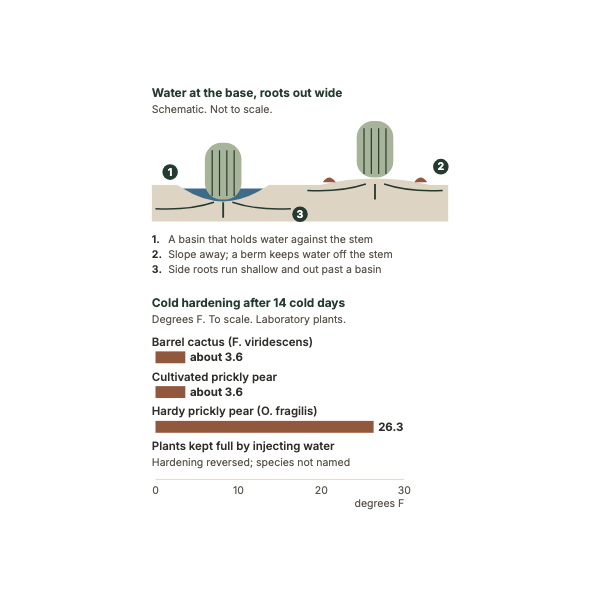
Cold and light together stress a cactus in winter, and the stress can reverse. Taly Dawn Drezner and Norman P. A. Hüner measured photosynthetic efficiency on prickly pear pads in Canada from April to December; it held high through summer and began to fall more than a month earlier on sun-facing sides than shaded ones.
Some shaded faces still read high in December, and when they turned a pad in late November, the newly shaded face recovered. They tie the decline mainly to low temperature and secondarily to light, and call it dynamic and reversible.
Their study measured photosynthetic efficiency, not color, and used a prickly pear, not a columnar cactus, so whether a winter yellow greens again in spring is not shown by it.
Nitrogen, Magnesium or Iron
Cacti do respond to nitrogen when grown as a crop. In three species of pitaya, a climbing cactus grown for fruit, Deilson de Almeida Alves and colleagues found nitrogen raised yield, fruit quality and the nutrient content of the stems over three production cycles.
No source read describes the color pattern of nitrogen, magnesium or iron shortage in a cactus, so the replies’ list cannot be sorted by eye from what was read. Arizona’s landscape guide, by Jack Kelly and Rob Grumbles, says fertilization of cacti is generally not necessary.
Where it is used, the same guide advises limited, cautious feeding with a balanced fertilizer early in the growing season. Jeff Schalau’s Yavapai County guide goes further and says cacti planted outdoors do not need fertilization.
What Urine Adds to the Soil
Urine carries most of the nitrogen people excrete; Manon Rumeau and colleagues put it at 85 percent, with 65 percent of the phosphorus. A 2026 review by Mohamed Roshan Abu Firnass Mustaffa and colleagues found urine-based fertilizers gave crop yields 10 to 70 percent above unfertilized controls and comparable to urea at equal nitrogen.
It carries salt too. Michael Yongha Boh and Joachim Sauerborn grew maize in a greenhouse mix and found soil salt, measured as ECe, rose by 7.3, 5.3 and 7.6 dS per m from no urine to the higher dose, at each of three salt levels.
They also saw a tendency toward sodic soil as urine increased, and concluded that the salt level and the amount of urine both shape the soil’s chemistry.
Rumeau’s group grew spinach in a calcareous soil in a greenhouse. Only the excessive dose raised soil conductivity, by 183 percent, and lowered pH by 0.2 units. Ammonium in the soil appeared to turn to nitrate within about 10 days, and their models estimated more than half the nitrogen was lost to the air as ammonia.
Arizona’s problem guide makes a related point about manure: uncomposted manure should not be used as a soil amendment because its high salt content harms root development. No source read tested urine on cacti, neat or diluted.
The review also lists pharmaceutical residues among urine’s open problems. Franziska Häfner and colleagues fed cabbage with nitrified urine fertilizers, a processed product, and got yields like a commercial organic fertilizer in sand, loam and silt.
The cabbage took up more nitrogen in sand than in loam. Uptake of a drug residue, measured in treatments that included fecal compost, was also higher in sandy soil than in loam.
Soil, Season and a Test
Season matters to cacti in particular. Arizona’s landscape guide says growth stimulated in the fall by fertilizer or water makes cacti more likely to suffer freeze injury, and that no water or fertilizer is needed in winter.
To replace the top soil would disturb the ground Schalau advises leaving alone: he says not to cultivate within several feet of a cactus’s base, because the roots are shallow. He adds that heavy clay is generally too poorly drained for cacti.
No source read gives a soil test interpretation for cacti or ties a test result to a yellowing stem. Cacti swollen and leaning after rain are covered in a swollen cactus after rain, and color inside a cut stem in pink inside a cut cactus.
Yellowing patterns in houseplants, read by which leaves turn first, are covered in yellow leaves on a houseplant.
Local Regulations and Safety Advisory
If you use fertilizer products, follow the label. Rules on them vary by country and locality, and your agriculture department can say what applies where you live. Urine and homemade feeds carry no label and no tested rate for cacti; this article gives none. This article is general information, not legal advice.
Authorities to consult:
- Local agriculture department
- Your local extension office or a soil testing laboratory
What Remains to Be Explored
No source read describes nutrient shortage in a columnar cactus by color, tests urine on cacti, or follows a winter yellow through to spring.
The urine trials used maize, spinach and cabbage, and the cold study a prickly pear in Canada; none used a columnar cactus in a garden bed like the thread’s.
Sources
- Getting More Yellow as Time Goes By — multiple community members. Reddit, r/cactus. Undated.
- Problems and Pests of Agave, Aloe, Cactus and Yucca (AZ1399) — Jack Kelly, Mary W. Olsen. The University of Arizona Cooperative Extension. March 2011.
- Cactus, Agave, Yucca and Ocotillo (AZ1225) — Jack Kelly, Rob Grumbles. The University of Arizona Cooperative Extension. April 2009.
- Outdoor Cactus Culture (Backyard Gardener 181) — Jeff Schalau. The University of Arizona Cooperative Extension, Yavapai County. June 11, 2024.
- Common Problems and Issues of Succulents — Aaron Steil. Iowa State University Extension and Outreach, Yard and Garden. August 2023.
- Seasonal Photoinhibition of Photosystem II in a Cold-Climate Canadian Cactus (Opuntia cespitosa) — Taly Dawn Drezner; Norman P. A. Hüner. Haseltonia. 2022. Cited from its abstract.
- Productive Potential and Quality of Pitaya With Nitrogen Fertilization — Deilson de Almeida Alves; Maria do Céu Monteiro da Cruz; João Esdras Lima; Núbia Cassiana Santos; Josimara Mendes Rabelo. Pesquisa Agropecuária Brasileira. 2021. Cited from its abstract.
- Human Urine as a New-Gen Fertilizer for Sustainable Agriculture: A Review Towards a Circular Nutrient Economy — Mohamed Roshan Abu Firnass Mustaffa; Kannan Pandian; Vijayakumar Shanmugam; Sridevi Govindaraj; R. Anandham. Frontiers in Soil Science. 2026. Cited from its abstract.
- Fate of Nitrogen and Phosphorus From Source-Separated Human Urine in a Calcareous Soil — Manon Rumeau; Claire Marsden; Nassim Aït-Mouheb; David Crevoisier; Chiara Pistocchi. Environmental Science and Pollution Research. 2023. Cited from its abstract.
- Effect of NaCl-Induced Salinity and Human Urine Fertilization on Substrate Chemical Properties — Michael Yongha Boh; Joachim Sauerborn. Open Journal of Soil Science. 2014. Cited from its abstract.
- Recycling Fertilizers From Human Excreta Exhibit High Nitrogen Fertilizer Value and Result in Low Uptake of Pharmaceutical Compounds — Franziska Häfner; Oscar Rodrigo Monzón Díaz; Sarah Tietjen; Corinna Schröder; Ariane Krause. Frontiers in Environmental Science. 2023. Cited from its abstract.