No. The citronella plant sold in garden centers is a scented geranium whose leaves smell of citronella when crushed, and Iowa State University Extension says the plant itself does not repel mosquitoes. The University of Wisconsin’s mosquito site reports that field tests found no drop in bites near the plants.
Citronella oil is a different matter: it repels mosquitoes on the skin, but for less time than DEET, and candles reduced bites only a little. As for coming back, the plant is a tender geranium that frost kills outdoors, so it returns only if brought indoors over winter.
What This Article Covers
This article covers which plant is sold as the citronella plant, what tests found when people stood near it, how citronella oil and candles compare, and whether the plant comes back every year. It names no repellent product.
For another plant often said to keep mosquitoes away, see whether lavender repels mosquitoes; for another tender plant kept over winter, see whether dahlias are perennials.
Which Plant Is the Citronella Plant?
Iowa State calls it a scented geranium: the widely marketed “mosquito geranium” releases a citronella fragrance when its leaves are rubbed or crushed. Scented geraniums are kinds of Pelargonium, grown for fragrant leaves rather than flowers, and make good container plants and houseplants, Iowa State says.
It is not the plant citronella oil comes from. Studies of citronella oil, such as Uopasai and colleagues (2024), use oil from citronella grass, Cymbopogon nardus. The field trials the University of Wisconsin cites tested the geranium, sold as Pelargonium × citrosum ‘van Leenii’ or the citrosa plant.
Does the Citronella Plant Repel Mosquitoes?
The sources agree that it does not. The University of Wisconsin’s mosquito site says tests of the citrosa plant failed to show any reduction of mosquito bites in areas near the plant, citing three field studies: one in Florida (Cilek and Schreiber, 1994), one in upper Michigan (Cummings and Craig, 1995) and Matsuda and colleagues (1996).
Iowa State reaches the same verdict from the other side: the leaves release a citronella smell when crushed, but the plant itself does not repel mosquitoes.
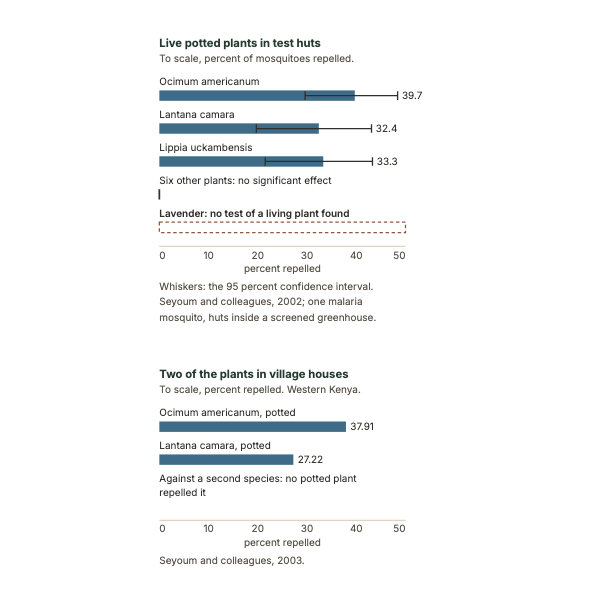
Living plants of other species have shown some effect in one setting. In semi-field huts in Kenya, Seyoum and colleagues (2002) found potted plants of three other species repelled about a third of one malaria mosquito, while six other plants did not repel significantly.
A 2003 follow-up in western Kenyan houses found none of the potted plants repelled a second mosquito species.
Heating released more. In the same 2003 study, leaves of three other plants heated on traditional stoves repelled 44.54 to 48.71 percent of one malaria mosquito, more than the potted plants did. None of those plants was a citronella geranium, and none was tested in an American yard.
The citronella plant is a scented geranium, and it does not keep mosquitoes away
The sources agree that the living plant did not reduce bites in field tests. Citronella oil does repel, but briefly, and candles reduced bites only a little.
Iowa State University Extension; University of Wisconsin-Madison, Wisconsin Mosquitoes and Mosquito-Borne Diseases (area repellents; repellents for skin).
Crushing the leaves releases the scent, but the plants did not cut bites near them in three field tests (Wisconsin).
What About Citronella Oil and Candles?
The oil does repel, for a while. A meta-analysis of laboratory studies by Kongkaew and colleagues (2011) found citronella oil protected against Aedes mosquitoes for a shorter time than DEET, by 253 minutes on average in cage tests, and that adding vanillin may lengthen protection.
Room tests looked better: in those, citronella oil, alone or with vanillin, gave complete repellency for at least 3 hours. The authors conclude that citronella products protect for less time than DEET products.
The University of Wisconsin reports citronella-based skin repellents protecting for 20 minutes or less in one laboratory study and 30 minutes to 5 hours in another, and says a wristband with citronella failed to prevent bites.
In one small laboratory test of oils in humidifier vapor, citronella repelled mosquitoes best over 20 minutes, ahead of lavender and rosemary (Mitasari and colleagues, 2024).
Candles help a little. The University of Wisconsin says candles and other devices emitting citronella gave relatively small reductions in biting mosquitoes, while geraniol candles protected better indoors close to a person and gave moderate protection outdoors within about a meter.
Formulation matters. In a 2026 cage test of six types of essential-oil candles labeled as repelling mosquitoes, Lopez and colleagues found three types repelled strongly and three did not, with the effective ones holding more essential oil.
For reliable protection, the University of Wisconsin says DEET provides good protection with very low risk when used as directed, and to check labels, since a product with the same name can change its active ingredient from year to year.
What Does Reduce Bites on a Patio
Some devices have field evidence. The University of Wisconsin says studies that counted mosquitoes landing on people inside a protected area found that devices releasing small doses of allethrin, a pyrethroid insecticide, can reduce bites, citing two field trials in Illinois and Louisiana.
Sprays have limits. Wisconsin says insecticides applied to vegetation can temporarily cut biting for an outdoor event, but that daily or weekly spraying without checking mosquito numbers is bad practice, and should be done by people who understand the risks and wear protective clothing.
Why Citronella Products Are Not Rated Like DEET
Registration is the difference. The U.S. Environmental Protection Agency says registered skin repellents have been evaluated and approved for human safety and effectiveness when used as the label directs, and that the Centers for Disease Control and Prevention recommends products with EPA-registered active ingredients.
Citronella oil sits in another group. EPA lists citronella oil and geranium oil among ingredients exempt from registration: they were evaluated for safety in the 1990s, but products made from them have not been evaluated for effectiveness.
Registered products state a protection time, EPA says, so you can pick one that fits the length of time you will be outside.
Effectiveness varies with the person and the day. EPA says sweat, physical activity, water, air temperature and how attractive a person is to mosquitoes all change how long a repellent works.
EPA also says repellent goes only on exposed skin or clothing, never under clothing or over cuts, and on a child’s skin from your own hands.
How to Grow a Citronella Plant
Grow it like other garden geraniums. Iowa State says geraniums do best in moist, fertile, well-drained soil and full sun, at least 6 hours a day, and flower less with less sun; scented kinds are grown mainly for their leaves, with smaller flowers than common geraniums.
Pots need more care. Iowa State says container geraniums often need water two to three times a week in hot, dry weather, and to avoid wetting the leaves. Indoors over winter, Purdue says geraniums grow best with night temperatures of 55 to 60°F, and warmer homes give spindly plants.
Does the Citronella Plant Come Back Every Year?
Not outdoors where it freezes. Iowa State says the first hard frost kills outdoor geraniums, and Purdue HO-85 (Dana and Lerner) says geraniums form no bulb or tuber, so they live through winter only as stems kept growing or dormant indoors.
You can keep one, as with any garden geranium. Iowa State, Illinois Extension (Johnson, 2024) and University of Wisconsin-Madison Extension describe potting the plant up before frost and growing it in a bright window, rooting 3- to 4-inch tip cuttings, or storing the plant bare root in a cool, dry place at about 45 to 55°F.
UF/IFAS in Charlotte County (Mitchell, 2020) says geraniums grown where there is no frost are considered perennials.
Scented geraniums make good houseplants, Iowa State says, so a citronella plant can spend the winter on a sunny windowsill and go back out after frost danger has passed.
Local Regulations and Safety Advisory
If you use pest control products, follow the label. Rules on them vary by country and locality, and your pesticide regulator can say what applies where you live. This article is general information, not legal advice.
Authorities to consult:
- Pesticide regulatory authority or environmental protection agency
What Remains to Be Explored
The three field tests of the citronella plant are reported here as the University of Wisconsin summarizes them. No test read placed several plants close around a seated person, or tested crushed leaves rubbed on skin.
No study read compared a citronella geranium with citronella grass growing in a yard, or measured how much citronella-type scent either plant gives off without being disturbed.
Sources
- Area Repellents (Wisconsin Mosquitoes and Mosquito-Borne Diseases) — University of Wisconsin-Madison. Undated.
- Repellents for Application to Skin (Wisconsin Mosquitoes and Mosquito-Borne Diseases) — University of Wisconsin-Madison. Undated.
- Growing Annual Geraniums — Cynthia Haynes; Aaron Steil. Iowa State University Extension and Outreach. September 2026.
- Winter Storage of Geranium, Canna, Gladiolus, Caladium, and Begonia (HO-85) — Michael N. Dana; B. Rosie Lerner. Purdue University Extension. Undated.
- How to Overwinter Geraniums for Next Year’s Garden — Ken Johnson. University of Illinois Extension. October 11, 2024.
- Now Is the Season for Geraniums — Ralph E. Mitchell. UF/IFAS Extension Charlotte County. November 24, 2020.
- Effectiveness of Citronella Preparations in Preventing Mosquito Bites: Systematic Review of Controlled Laboratory Experimental Studies — C. Kongkaew; I. Sakunrag; N. Chaiyakunapruk; A. Tawatsin. Tropical Medicine & International Health. 2011. Cited from its abstract.
- The Efficacy of Commercially Available Essential Oil-Based Candles as Spatial Repellents Against Aedes Aegypti Mosquitoes — April D. Lopez; Claudia J. Galvan; F. Omar Holguin; Christopher J. Sroka; Immo A. Hansen. Frontiers in Insect Science. 2026. Cited from its abstract.
- In Vivo Mosquito Repellency Effect of Citronella (Cymbopogon nardus (L.) Rendle) Essential Oil Bath Bomb Formulation in Dogs — Suwit Uopasai; Ketmanee Senaphan; Glenn Neville Borlace; Eakachai Thongkham; Jareerat Aiemsaard. Veterinary World. 2024. Cited from its abstract.
- Repellency of Live Potted Plants Against Anopheles gambiae From Human Baits in Semi-Field Experimental Huts. — Aklilu Seyoum, Ephantus W Kabiru, Wilber Lwande, Gerry F Killeen, Ahmed Hassanali and Bart G J Knols. The American Journal of Tropical Medicine and Hygiene. 2002. Cited from its abstract.
- Field Efficacy of Thermally Expelled or Live Potted Repellent Plants Against African Malaria Vectors in Western Kenya — Aklilu Seyoum, Gerry F. Killeen, Ephantus W. Kabiru, Bart G. J. Knols and Ahmed Hassanali. Tropical Medicine & International Health. 2003. Cited from its abstract.
- The Effectiveness of Various Essential Oils on the Market as Aedes Aegypti Mosquito Repellent — Army Mitasari, Aris Santjaka and Iqbal Ardiansyah. Jurnal Kesehatan Lingkungan. 2024. Cited from its abstract.
- Regulation of Skin-Applied Repellents — US Environmental Protection Agency. June 25, 2026.
- Using Insect Repellents Safely and Effectively — US Environmental Protection Agency. November 3, 2026.
- Find the Repellent That Is Right for You — US Environmental Protection Agency. September 8, 2026.
- Overwintering Tender Geraniums — University of Wisconsin-Madison Extension. University of Wisconsin-Madison Extension (Wisconsin Horticulture). 2024.