Published waits for a new houseplant run from 7 days to six weeks, and we found no trial of any of them. Near room temperature, a pest that arrives as an egg takes about two weeks to grow up if it is a spider mite and more than six weeks if it is a mealybug, so no date clears a plant.
What the sources do give is a routine: check before you buy, look every week where pests hide, and, in UC IPM’s advice to nurseries, check the roots.
Readers quarantine new plants for very different lengths of time. In an r/houseplants thread about buying rules, readers’ waits run from under a week to six weeks, some skip the wait because they have nowhere to put the plant, and others treat or rinse every new plant instead.
Each of those readers is working without a basis, because the guidance they might check has none either. The useful question is not which number is right. It is what has to show itself during the wait, how long that takes, and what you are doing with the time.
What the Published Waits Say
Mark Shour, writing for Iowa State in 2004 about mealybugs, says to “Quarantine new plants for 7-10 days in an isolated spot”, checking for pests before the plant joins the others.
University of Illinois Extension suggests keeping a new plant apart for 2 to 3 weeks, to protect the others from insects “you might have missed”.
Washington State’s gardener’s handbook says “a few weeks” for a new plant. UF/IFAS says to isolate it “for at least a month before placing it with other plants”.
Clemson’s houseplant factsheet, updated in 2021, says “six weeks”, with a look “on a regular basis of about once a week”.
Six weeks is 42 days, six times Iowa State’s shortest figure. None of these pages explains where its number comes from or cites a test, and between them they disagree by more than a month.
Washington State’s spider mite page offers something different. Writing about plants moved indoors, it says to keep them apart for about a month, inspect them regularly, and “continue isolation until the plants are ‘clean’ for at least one full month”.
That rule ends on a result, not a date, and a pest found during it starts the clean month again.
Why a Plant Can Look Clean and Not Be
A wait exists because the stages that matter are out of sight on the day you buy. Western flower thrips lay eggs “inserted into plant tissue”, Wisconsin Horticulture says, and the larvae later “drop into the soil or other growth medium to pupate”, the resting stage before adulthood.
Not every thrips goes to the soil. UConn Extension notes that thrips “may also pupate in open flowers”, and in one Australian study of gerberas, chrysanthemums and roses, cited here from its abstract, only 5 to 28 percent emerged from the soil, depending on the crop.
Stuart Reitz’s 2009 review describes the species’ “tendency to reside and feed in concealed areas of flowers”.
Fungus gnats lay their eggs “in cracks and crevices in the media surface”, UConn says. Its mealybug sheet lists midribs, leaf axils (the joints where a leaf meets the stem), stem tips, the base of the plant, and the tape holding a plant to a stake as hiding places, and some species feed on the roots.
For one of those root feeders, the European Food Safety Authority’s plant health panel says every life stage lives in the soil, so potted plants carry eggs, nymphs and adults with them.
Individuals can stay attached to the roots even when the growing medium is removed, and interceptions in the EU have usually been on bonsai.
Spider mites are so small that, as Clemson puts it, “plant damage is typically the first sign of their presence”. So a careful first look tells you about the insects that are showing, and little about the ones that are not.
This is not only a houseplant worry. Andrew Liebhold and colleagues, cited from their abstract, estimate that nearly 70 percent of damaging forest insects and pathogens established in the US between 1860 and 2006 most likely arrived on imported live plants. Live plants are a known route for pests.
Published waits against how long pests take to grow up
Days for each pest to grow from egg to adult (for the gnat, one generation), beside the waits extension services publish.
Ten days ends before any of these five grows up. Six weeks outlasts the mite, thrips and gnat, and not the two mealybugs. We found no trial of any of these waits.
How Long the Hidden Stages Take to Show
Extension pages give pest life cycles at whatever temperature their writers had in mind: 7 to 14 days for thrips at a fluctuating 68 to 98°F in greenhouses, and 8 to 12 days for spider mites at 85 to 90°F in Virginia Tech’s orchard guide.
Those cannot be compared row by row, so the chart uses laboratory studies run near 20 to 21°C (68 to 70°F).
Twospotted spider mites are fastest. H. J. Herbert’s 1981 study, cited from its abstract, gives females 139.8 degree-days above 10°C from egg to adult at 21°C. A degree-day is a unit of accumulated warmth, and that works out to about 13 days, which is our arithmetic.
Western flower thrips took 19 days from egg to adult at 20°C in a 1992 study by Lowry and colleagues, on peanut, cited from its abstract. The same abstract reports that the thrips population barely grew on peanut, and how fast they develop on a houseplant is not known.
For the fungus gnat Bradysia impatiens, Wang and colleagues fitted a model across eight rearing temperatures in a 2026 paper, cited from its abstract. At 20°C it gives about 28 days for one generation, again by our arithmetic. The abstract does not say whether that generation ends at adult emergence or at egg laying.
Mealybugs are slower. Madeira mealybug females, a greenhouse pest of ornamentals, took about 46 days from egg to adult at 20°C on chrysanthemum, in a study by Chong, Oetting and van Iersel cited from its abstract.
UC IPM puts one generation of ground (root) mealybugs at “about 2 to 4 months” at common soil temperatures.
So ten days ends before any of the five grows from egg to adult. A month clears the spider mite and the thrips, and only just clears the gnat’s 28 days. Six weeks outlasts those three and falls short of both mealybugs.
The rows are fairer than greenhouse figures but still not houseplants in homes. The hosts are peanut, chrysanthemum and unstated, the temperatures are constant, and other species of each pest differ.
A cooler room stretches all of it: UConn and Wisconsin both say thrips do not develop at all below about 50°F.
Why No Wait Clears a Plant
Time alone proves nothing, because generations overlap instead of finishing together. UConn says so for both fungus gnats and mealybugs.
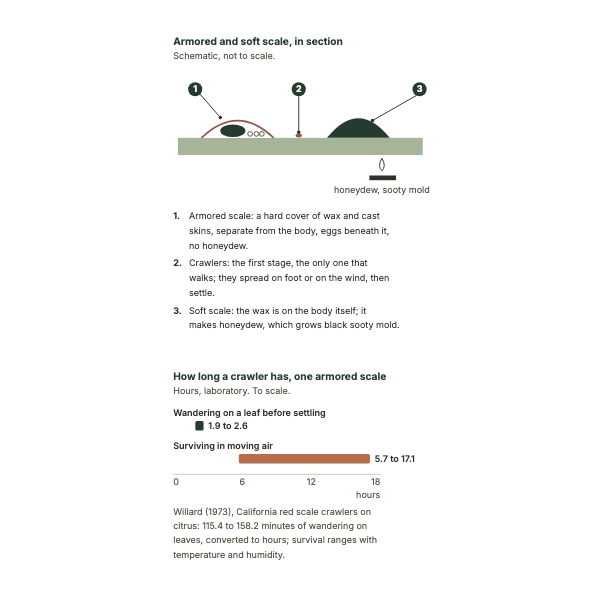
In warmer weather, brown soft scale females produce young for 30 to 65 days of their lives, by the University of Hawaii’s account, which also says scale nymphs take about two months to reach adulthood in cooler weather.
UConn adds that mealybug crawlers, the mobile young, “can continue to emerge for up to 45 days”, three days past six weeks, in a passage about how long mealybugs persist without a host plant. They can also survive two weeks on benches and in cracks with no plant at all.
Low numbers are the other limit. UConn says early mealybug infestations “can be easily overlooked” because of where the insects hide. Wisconsin says thrips “are difficult to detect before severe feeding damage is evident”. A plant that passes six weeks has given you good evidence, not a guarantee.
That is why the looking matters more than the date. A quarantine buys repeated inspections with nothing nearby to infest. Without the inspections it is only a plant in another room, and the end date tells you nothing about what is on it.
What to Do With a New Plant Today
- Check it before it comes home. Iowa State’s advice is to check plants being considered for purchase “and reject any infested plants”. Washington State’s handbook says to check the undersides of leaves and where leaves meet the stem, and to look for distorted leaves, a shiny or sticky coating, or webbing.
- Give it a separate room if you have one. Washington State’s handbook says new plants should be kept “in a separate room of your house away from your other plants” and monitored. Its spider mite page gives a spare bedroom as the example.
- Look once a week where pests hide. Clemson’s interval is about once a week, and it singles out the undersides of leaves as the place “where pests are most often found”. UConn’s list for mealybugs adds midribs, leaf and stem axils, stem tips, the base of the plant, and under stake tape.
- Use a magnifying lens, and blow into the flowers. Clemson says adult thrips are “very difficult to see without a magnifying lens”. UConn’s tip for plants in bloom: “Gently blowing into open flowers agitates the thrips so they are easier to see.”
- Lay a yellow sticky card flat on the mix. UConn says yellow sticky cards “placed horizontally at the soil surface” detect fungus gnat adults. They are no help for mealybugs: only the short-lived males fly, so UConn says not to rely on cards for them.
- Check the roots on arrival. UC IPM tells nurseries that root mealybugs “commonly are introduced with new stock”, and to remove a portion of each new plant from its container and look for “white, powdery wax” and slow, oval, whitish insects. There is more on reading roots in what to check before you repot.
- Keep tools and mix clean. UConn names workers, tools and ants as the way mealybug crawlers move through a greenhouse. Washington State’s handbook says to use clean tools, containers and potting mix when repotting.
If You Find a Pest During Quarantine
Keep the plant apart and deal with the pest. Washington State’s spider mite page, written for plants moved indoors, says to “Treat pest problems as necessary and continue isolation until the plants are ‘clean’ for at least one full month”. UC IPM’s advice to growers for root mealybugs is to discard infested plants or treat them effectively.
Which pest it is decides what works. See telling spider mites from spiders, why thrips survive the treatment, why mealybugs keep coming back and what controls fungus gnats.
If You Have No Spare Room
The sources describe how these pests move, and contact comes first. Washington State says spider mites move “primarily by leaf contact, walking, or drifting in the air on strands of webbing”. Iowa State says mealybugs crawl from plant to plant, “especially when leaves or branches overlap”.
Air is the harder route. UConn says thrips adults are weak flyers but are carried through greenhouses on air currents, and that mealybug crawlers spread on air currents too.
We found no published distance that stops any of these pests, so how far apart is far enough is not known. Keeping leaves from touching answers the route both pages name, and leaves the air route open.
If It Is Already Sitting Next to Your Other Plants
This is the common case, and no source we read addresses it directly. The closest is Washington State’s spider mite page, which says to quarantine and monitor “newly purchased plants or plants from your collection which have become infested”, treating an infested old plant the same as a new one.
Plants coming back indoors after summer outside are the other way pests arrive, Clemson says, and for them it adds a step: take the plant out of its pot, because “Most pests are found on the exterior of the rootball”. There is more in moving a houseplant outdoors and back.
Each source gives a wait for those plants too, and the figures spread as widely as for purchases. Washington State’s handbook says a week apart “is normally enough to discover any potential threats”, while Washington State’s spider mite page asks for about a month for plants moved indoors. Neither page cites a test for its figure.
Can You Spray or Wash Instead of Waiting?
Washington State’s handbook says washing a plant and its pot with tepid water before it comes indoors “also helps to control pests”, and adds that “Some experts recommend a chemical treatment”, without naming them or citing a test. A rinse reaches what is on the surface.
Wisconsin places thrips eggs inside plant tissue and their pupae in the growing medium. Raymond Cloyd’s 2019 review, cited from its abstract, says insecticides aimed at larvae and adults “are minimally effective against the pupal stages” in the growing medium or soil.
Spraying a plant with no pests found on it is a different question from waiting. Washington State’s wording is to “Treat pest problems as necessary”, which is conditional on a problem.
If you use any product, the label is the binding instruction on which plants, how much and how often, and we give no product or rate here.
Local Regulations and Safety Advisory
If you use pest control products, follow the label. Rules on them vary by country and locality, and your pesticide regulator can say what applies where you live. This article is general information, not legal advice.
Authorities to consult:
- Pesticide regulatory authority or environmental protection agency
What Remains to Be Explored
The central gap is that we looked for a trial of any quarantine period, in extension pages and the scholarly record, and found none. Every wait here is advice, and none of the sources shows the working behind it. A study that held infested plants and logged when each pest was first found would settle the question.
The development times are borrowed. They come from laboratory studies on peanut, chrysanthemum and unstated hosts at constant temperatures, and two of them are our arithmetic from published constants.
We found no times measured on these pests on houseplants in ordinary homes, and no room-temperature figure for brown soft scale.
We also found no figure for how many insects a plant can carry before a careful person sees one, no published isolation distance, and no comparison of pest rates on plants bought online and in shops. Washington State’s clean-month rule was written for plants moved indoors, not for new purchases.
Sources
- Mealybugs: A Common Houseplant Pest — Mark Shour. Yard and Garden, Iowa State University Extension and Outreach. February 27, 2004.
- Get Started (Houseplants) — University of Illinois Extension. Undated.
- Chapter 14: Houseplants. The Pacific Northwest Gardener’s Handbook: Growing for the Future — Washington State University Extension. Undated.
- Caring for Houseplants — UF/IFAS Gardening Solutions, University of Florida. Undated.
- Common Houseplant Insects & Related Pests (HGIC 2252) — Janet McLeod Scott, revised by Joey Williamson. Clemson Cooperative Extension, Home & Garden Information Center. September 10, 2021.
- Spider Mites — Pestsense, Washington State University. January 22, 2026.
- Managing Thrips in Greenhouses — R. Chris Williamson. Wisconsin Horticulture, University of Wisconsin-Madison Division of Extension. April 25, 2004.
- Managing Western Flower Thrips on Greenhouse Crops — Leanne Pundt. UConn Extension Integrated Pest Management Program. 2018.
- Managing Fungus Gnats in the Greenhouse — Leanne Pundt. UConn Extension Integrated Pest Management Program. June 2024.
- Managing Mealybugs in the Greenhouse — Leanne Pundt. UConn Extension Integrated Pest Management Program. June 2024.
- Twospotted Spider Mite, Tetranychus urticae Koch — D.G. Pfeiffer, L.A. Hull, D.J. Biddinger and J.C. Killian. Virginia Tech Department of Entomology. Undated.
- Coccus hesperidum (Linnaeus), Soft Brown Scale — Jayma L. Martin Kessing and Ronald F.L. Mau. Crop Knowledge Master, University of Hawaii. April 2007.
- Ground (Root) Mealybugs – Floriculture and Ornamental Nurseries — UC IPM Pest Management Guidelines, UC ANR Publication 3392. UC Statewide Integrated Pest Management Program, University of California ANR. January 2022.
- Biology, Life Tables, and Innate Capacity for Increase of the Twospotted Spider Mite, Tetranychus urticae (Acarina: Tetranychidae) — H. J. Herbert. The Canadian Entomologist. 1981. Cited from its abstract.
- Life-Fertility Tables for Frankliniella fusca (Hinds) and F. occidentalis (Pergande) (Thysanoptera: Thripidae) on Peanut — V. K. Lowry, Jacqueline Smith, Forrest L. Mitchell. Annals of the Entomological Society of America. 1992. Cited from its abstract.
- Identification, Physiological Time and Reproductive Potential of Bradysia impatiens (Diptera: Sciaridae) From Liuba, Shaanxi, With a Review Pertaining to Its Occurrences in China — Qi Wang, Limin Zhao, Sun Ya. Biology. 2026. Cited from its abstract.
- Temperature Effects on the Development, Survival, and Reproduction of the Madeira Mealybug, Phenacoccus madeirensis Green (Hemiptera: Pseudococcidae), on Chrysanthemum — Juang-Horng Chong, Ronald D. Oetting, Marc W. van Iersel. Annals of the Entomological Society of America. 2003. Cited from its abstract.
- Biological Control of Western Flower Thrips, Frankliniella occidentalis (Pergande) (Thysanoptera: Thripidae), in Gerberas, Chrysanthemums and Roses — Andrew Manners, Brock R Dembowski, Madaline A Healey. Australian Journal of Entomology. 2013. Cited from its abstract.
- Biology and Ecology of the Western Flower Thrips (Thysanoptera: Thripidae): The Making of a Pest — Stuart R. Reitz. Florida Entomologist. 2009. Cited from its abstract.
- Effects of Predators on the Belowground Life Stages (Prepupae and Pupae) of the Western Flower Thrips, Frankliniella occidentalis (Thripidae: Thysanoptera): A Review — Raymond A. Cloyd. Advances in Entomology. 2019. Cited from its abstract.
- Live Plant Imports: The Major Pathway for Forest Insect and Pathogen Invasions of the US — Andrew M. Liebhold, Eckehard G. Brockerhoff, Lynn Garrett, Jennifer L. Parke, Kerry O. Britton. Frontiers in Ecology and the Environment. 2012. Cited from its abstract.
- Pest Categorisation of Ripersiella hibisci — EFSA Panel on Plant Health (PLH). EFSA Journal, European Food Safety Authority Panel on Plant Health. 2020. Cited from its abstract.
- What Are Your Personal Rules Regarding Purchasing Houseplants? — r/houseplants. Undated.