The pale squares and circles left where magnets sat on a stainless hood may not be damage at all. A magnet held flat on the steel keeps its patch out of the kitchen air, while the steel around it collects what cooking leaves in that air. The duller steel may be the part that changed.
So wash one dull patch first, with warm soapy water and a soft cloth wiped along the grain, then dry it.
If it comes up to match a pale shape, the marks were the clean steel and the job is cleaning, not repair. Stronger cleaners and anything abrasive come after that test.
No study of magnet marks on appliances was found. What follows rests on studies of the film cooking leaves on kitchen surfaces, and on the stainless steel industry’s cleaning handbook, and it says where a finding is carried from glass to steel.
The question comes from a thread on r/CleaningTips. Its poster had kept magnets on a seldom-used chimney hood for a few years, although their partner had called the idea a stupid one, and taking them off revealed a ghost of every magnet.
The poster wanted the marks gone before the partner could enjoy being right for years to come. The replies offered plenty of help, much of it pulling in opposite directions, from a gentle wipe to chemicals and power tools.
One strand of replies said grease and dust had built up around the magnets, so the shapes were simply clean steel. Others said the steel itself had oxidized or taken a patina; one blamed ultraviolet light, and another argued for oxide grown by repeated heating that only resurfacing would remove.
Remedies ran from soapy water to lye, oven cleaner, oil, sandpaper and an orbital sander.
What Collects on a Kitchen Hood
Cooking leaves something behind on the surfaces around it. Or and colleagues (2022, Environmental Science & Technology, cited from the abstract) examined glass exposed to kitchen cooking and found organic particles and thin films, spread unevenly, that could largely be represented by oxidized oleic acid and other fatty acids.
A second study collected a film in a kitchen over three cumulative weeks of HOMEChem, a campaign studying indoor chemistry. O’Brien and colleagues (2021, Environmental Science: Processes & Impacts, cited from the abstract) found it resembled the cooking aerosol measured in the air, but in larger, more oxidized molecules than fresh cooking emissions.
Its texture matters for cleaning. Extracted with a solvent, the film material was a soft semisolid; removed by hand, it appeared highly viscous.
A magnet changes one thing. Held flat against the steel, it keeps its patch out of that air for as long as it stays, so when it comes off years later, that patch has missed years of film.
These studies measured glass or a surface their abstracts do not name, not stainless steel, so the reading is carried to a hood by inference.
Where the magnets sat
A magnet held flat on the steel keeps its patch out of the kitchen air, so a film from cooking can build up only around it.
| Film | Glass exposed to kitchen cooking carried organic particles and thin films much like oxidized oleic acid and other fatty acids (Or and others 2022). A kitchen film collected over three weeks was more oxidized than fresh cooking aerosol (O’Brien and others 2021). Neither study tested steel. |
| Oxide | Stainless steel’s own oxide film is about 2 nm thick on 316L steel (Wang and others 2019). It is invisible and forms in ordinary air (Nickel Institute). |
| Heat | Heat color on stainless has been studied by heating it in furnaces (Casaroli and others 2022) and is known from welds (Higginson and others 2015). No measurement of a hood’s surface temperature was found. |
| Sunlight | No source found describes sunlight coloring stainless steel. |
Schematic, not to scale. No film thickness on a hood was measured. Terracotta: the film; pale band: the steel; dark blocks: magnets.
Wash one dull patch with soapy water, along the grain. If it comes up to match a pale shape, the shapes were the clean steel.
Could It Be Oxidation, Heat or Sunlight Instead?
Stainless steel does carry an oxide, but not one you can see. On 316L, one grade of stainless steel, Wang and colleagues (2019, Journal of The Electrochemical Society, cited from the abstract) found the native oxide film about 2 nanometers thick.
The Nickel Institute’s cleaning handbook calls it invisible and says it forms on clean stainless in ordinary air.
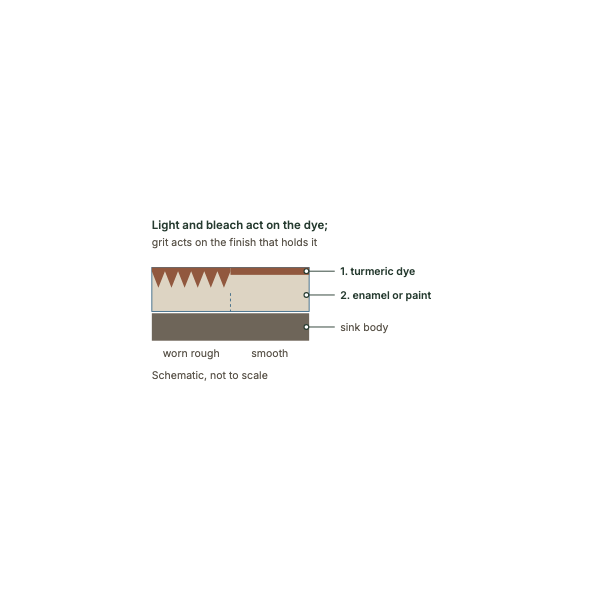
Stainless can also take on color when it is heated, which is the kind of change the repeated-heating reply had in mind. The studies that describe that color work at furnace and welding heat, and they tie the color to an oxide that grows with temperature and time.
Casaroli and colleagues (2022, Fire Technology, cited from the abstract) heated 316 stainless sheet in a laboratory furnace at temperatures up to 1,050°C (about 1,920°F) and tied each temperature to changes in surface color.
Higginson and colleagues (2015, Materials at High Temperatures, cited from the abstract) traced heat tint, best known from welds, to oxide that thickens with time at temperature.
No measurement of a range hood’s outside surface temperature was found, and the poster’s hood was seldom used. No source found describes sunlight or ultraviolet light coloring stainless steel. Neither explanation can be ruled out from a photo, and a film and a heat tint could both leave shapes where magnets sat.
What separates them is what cleans them. In the Nickel Institute’s own table, soap or detergent and water is the routine step for dirt, while heat tint and heavy discoloration sit in a separate row that calls for a stainless steel cleaner.
So if soapy water brings the dull steel up to match, the dull layer was something that washes off, which is what the handbook treats as dirt. If soap leaves it untouched, the steel itself may have changed, and the later steps apply.
The Test, One Patch at a Time
Start with your hood’s manual, because finishes differ: the handbook warns that even the finest powders can scratch or burnish some finishes and dull highly polished ones. Then find the grain, the fine polish lines in the steel’s finish. The handbook’s rule is to rub in the direction of those lines, never across them, and every step below follows it.
- Wet a clean, soft cloth or a sponge with warm water and a little mild soap or detergent, the handbook’s routine step for dirt.
- Choose one dull patch beside a pale shape, and wipe it along the grain.
- Rinse with clean water, as the Nickel Institute advises after every cleaning.
- Dry the steel completely with a dry towel or soft cloth. The handbook advises wiping it completely dry wherever the water carries minerals that leave spots.
- Compare the patch with the pale shape beside it in the same light.
If the washed patch now matches, the marks were the clean steel, and the rest of the hood needs the same wash.
If it is better but not there yet, repeat before stepping up: the handbook’s first rule is to use the mildest method that does the job. If nothing changes at all, the next steps come in order.
When Soap Is Not Enough
The handbook’s next step for stubborn spots is a mild, nonscratching household cleanser on a damp cloth, rubbed in the direction of the polish lines and rinsed off thoroughly.
It warns that such powders may scratch or dull highly polished finishes, and that many contain chlorine bleach, which could lead to corrosion if left on the steel.
For burnt-on food and grease, the same table lists oven cleaner as satisfactory on all finishes, used strictly as its package directs. That table dates from 1982 and was written for bare stainless steel. It says nothing about any clear coat or color an appliance’s steel may carry.
The handbook adds that before any commercial metal cleaner is used, it is important to make certain it can be used on stainless steel. So read your hood’s manual before an oven cleaner or any other strong product goes near it, and follow the product’s label if it does.
A coated or colored finish is outside the handbook altogether, and this article gives no method for one. If your hood’s steel was sold as fingerprint-resistant or black stainless, or has any clear coat or color, its own manual is the guide for every step after soapy water.
Lye, which the thread offered as a cure for any stainless, is sodium hydroxide. The NIOSH Pocket Guide lists it as causing eye and skin burns and as incompatible with aluminum, tin and zinc, and none of the cleaning guidance cited here mentions it. This article does not recommend it.
Solvents dissolve grease that water leaves behind, and the handbook names alcohols and acetone among them.
It also warns that their vapors are toxic in closed spaces: use them only with good ventilation, never while smoking, with rubber gloves, and keep them off your skin. Lighter fluid, offered in the thread for sticky residue, appears in none of the guidance.
Whatever you try, use one product at a time, rinse it off before the next, and never mix cleaners. Bleach mixed with vinegar or other acids can release a toxic gas, as the article on fruit fly traps sets out from a state health department’s warning.
Oil, another favorite in the thread, is not one of the handbook’s cleaning steps. It appears only in a note that some companies wipe stainless with oil-impregnated cloths to remove water spots and improve its look. Whether an oiled hood then catches more dust, as one reply warned, no source found addresses.
Before You Reach for Steel Wool or Sandpaper
Abrasion removes the surface rather than what sits on it, and what it takes off cannot be put back. The handbook warns that ordinary steel wool and carbon steel brushes can leave particles embedded in the steel that later rust, and that even the finest powders can scratch or burnish a mill-rolled finish.
Sanding or buffing is refinishing. The handbook says some marks, such as finger marks burned in during heat treatment, can be removed only by grinding and polishing. No source found gives a method for refinishing a hood, so it belongs after a wash has failed to change the dull steel, not as a first answer.
The same order, clean first and abrade last, runs through the article on marks on a glass cooktop, where what looks like damage is sometimes material sitting on top.
Keeping the Film Off
To stop the hood getting marked again, stop the film building up. The hood can catch some of what makes it, but only when it runs. One reply asked why this hood was seldom used, and laboratory work bears on the question. Delp and Singer of Lawrence Berkeley National Laboratory (2012, Environmental Science & Technology, cited from the abstract) tested seven new hoods.
The hoods captured anywhere from under 15 percent to over 98 percent of burner exhaust, depending on the hood, its airflow and the burner, and more from back burners than front. Open hoods captured more than those with grease screens and metal-covered bottoms.
For cooking particles, Lunden, Delp and Singer (2014, Indoor Air, cited from the abstract) found capture of fine particles mostly above 80 percent when a hamburger was pan-fried over medium heat on a back burner.
A wok stir-fry on a front burner fared far worse: 3 to 11 percent on the low fan setting and 16 to 70 percent on high.
So run the hood when you cook, use the back burners where you can, and turn the fan up for high-heat cooking on the front. None of these studies measured film on a hood’s own outside, so how much less would build up there is not known.
Then wash the hood body now and then with warm soapy water along the grain, rinse it and dry it. The handbook counts accumulated dust and dirt among the deposits that come off easily with warm water, with or without detergent. How often a hood needs it, no source found says.
By the same reasoning as the magnets, anything left flat against the steel for months will keep its own patch clean while the film builds around it. Keep the hood clean, or keep it bare.
Local Regulations and Safety Advisory
If you use household chemicals, follow the label. Rules on them vary by country and locality, and your hazardous waste service can say what applies where you live. Use one cleaner at a time and never mix them, and check your hood's owner's manual before using anything stronger than soapy water on its finish. This article is general information, not legal or medical advice.
Authorities to consult:
- Public health department or hazardous waste service
- The hood maker's owner's manual
What Remains to Be Explored
No study of magnet marks on appliances was found. The film reading rests on kitchen studies of glass and of a surface their abstracts do not name, carried to stainless steel by inference, and on the photo matching the magnets. All seven journal papers are cited from their abstracts.
How much of a hood’s film is cooking material and how much is dust, how thick it grows in a year, and how it changes as it ages on steel were not measured in any study found.
A test comparing household cleaners on a real hood film would settle which step is needed when soap is not enough.
No measurement of a range hood’s outside temperature was found, and the heat-tint abstracts give no temperature at which color first appears, so heat cannot be ruled out by a number. No source found describes sunlight coloring stainless steel, which leaves that reply’s explanation unsupported rather than disproved.
Whether a flexible magnet’s backing leaves a residue of its own, or scratches the steel when it is slid, is not known from any source found. Neither is whether oil wiped onto stainless catches more dust.
Coated and colored stainless finishes are not covered by the handbook or by any other source cited here, so this article leaves them to each hood’s own manual.
What would change the answer: a dull patch that soapy water and a stainless steel cleaner leave unchanged, which would point back to the steel itself, or a study of what builds up on hoods.
Sources
- Nanoscopic Study of Water Uptake on Glass Surfaces With Organic Thin Films and Particles From Exposure to Indoor Cooking Activities: Comparison to Model Systems — Victor W. Or, Michael R. Alves, Michael Wade, Sarah Schwab, Richard L. Corsi, Vicki H. Grassian. Environmental Science & Technology 56(3):1594-1604. 2022. Cited from its abstract.
- Emerging Investigator Series: Chemical and Physical Properties of Organic Mixtures on Indoor Surfaces During HOMEChem — Rachel E. O’Brien, Ying Li, Kristian J. Kiland, Erin F. Katz, Victor W. Or, Emily Legaard, Emma Q. Walhout, Corey Thrasher, Vicki H. Grassian, P. F. DeCarlo, Allan K. Bertram, Manabu Shiraiwa. Environmental Science Processes & Impacts 23(4):559-568. 2021. Cited from its abstract.
- Passivation-Induced Physicochemical Alterations of the Native Surface Oxide Film on 316L Austenitic Stainless Steel — Zuocheng Wang, Francesco Di Franco, Antoine Seyeux, Sandrine Zanna, Vincent Maurice, Philippe Marcus. Journal of The Electrochemical Society 166(11):C3376-C3388. 2019. Cited from its abstract.
- How to Use Metallurgical Analysis for Fire Investigation: The Case of AISI 316 Stainless Steel — Andrea Casaroli, Marco Virginio Boniardi, Riccardo Gerosa, B. Rivolta. Fire Technology 58(5):2641-2660. 2022. Cited from its abstract.
- Effect of Thermally Grown Oxides on Colour Development of Stainless Steel — Rebecca L. Higginson, C. P. Jackson, E. L. Murrell, P. A. Z. Exworthy, Roger J. Mortimer, David R. Worrall, Geoffrey D Wilcox. Materials at High Temperatures 32(1-2):113-117. 2015. Cited from its abstract.
- Performance Assessment of U.S. Residential Cooking Exhaust Hoods — William W. Delp, Brett C. Singer. Environmental Science & Technology 46(11):6167-6173 (Lawrence Berkeley National Laboratory authors). 2012. Cited from its abstract.
- Capture Efficiency of Cooking-Related Fine and Ultrafine Particles by Residential Exhaust Hoods — Melissa M. Lunden, William W. Delp, Brett C. Singer. Indoor Air 25(1):45-58 (Lawrence Berkeley National Laboratory authors). 2014. Cited from its abstract.
- Cleaning and Descaling Stainless Steels (Designers’ Handbook Series No 9001) — Nickel Institute (originally American Iron and Steel Institute, 1982), via worldstainless.org. 1982, republished 2020.
- NIOSH Pocket Guide to Chemical Hazards – Sodium Hydroxide — Centers for Disease Control and Prevention, NIOSH. Undated.
- We’ve Tried Nothing and We’re All Out of Ideas. — multiple community members. Reddit, r/CleaningTips. Undated.