Soap and dish detergent both kill only the mealybugs they wet, so what is in the bottle matters less than where the liquid lands. In one trial, detergents killed whitefly nymphs better than insecticidal soap, but they injure plants more and vary by bottle.
On a parlor palm, rinse first, then work into the leaf bases and the new growth, and expect to repeat. A badly infested palm is also where several extension services say throwing the plant out is a reasonable answer, not a failure.
The question came from a post on r/plantclinic, in which a newer plant owner asked what the white stuff on their parlor palm was. The replies agreed it was mealybugs, and the poster hauled the palm into the shower for a thorough rinse.
After that the replies agreed on very little. Neem, rubbing alcohol on a swab, a dish soap spray, diatomaceous earth in a sealed bag and a spell outdoors in the rain were all offered, and several replies said to throw the palm away.
The sharpest exchange was about soap. One reply said only true soap, made from fats, would work, and not dish detergent. Another answered with a Cornell fact sheet that says the opposite: a mild dish detergent, not soap.
Each side has an extension service behind it, which is why the argument never settled. The trials show what each side gets right, and the palm itself explains why the spray so often misses.
Is It Mealybugs?
The University of California’s IPM program describes mealybugs as soft, oval, wingless insects covered in white wax. Signs of a colony include cottony egg masses, sticky honeydew on the leaves below, black sooty mold on that honeydew, and ants.
UC IPM notes that cottony cushion scale, woolly aphids, some soft scales and whiteflies also make wax and honeydew, so look at the insect under the wax.
Brown, shell-like bumps that do not move may be scale, which our article on brown bumps on a pothos stem covers.
Palms are on UC IPM’s list of houseplants that often have mealybug problems. A University of Hawai‘i pest sheet names parlor palm, and its genus Chamaedorea, among the hosts of the palm mealybug, whose adults grow to about 8 mm (5/16 inch).
Soap or Detergent? What the Trials Found
The products sold as insecticidal soap are potassium salts of fatty acids. Colorado State University Extension calls them chemically similar to liquid household soaps, but designed to kill insects, tested for that, and “selected to minimize potential plant injury.”
Its warning is direct: “Dish soaps contain powerful detergents that can injure plants.” Tomislav Curkovic, reviewing their use in farming in 2016, calls detergents “synthetic, nonnatural products,” while soaps are made “from natural raw materials (animal fat or vegetable oils).”
Extension advice on the kitchen bottle splits. Iowa State said in 1996 that “You can use a mild dish washing detergent in place of the commercial insecticidal soaps.” Cornell’s houseplant sheet recommends washing with mild dish detergent, “NOT SOAP,” to dislodge mealybugs.
Colorado State takes the opposite view: household soaps and cleaning products “should not be used as pesticides,” because they are not consistently formulated or tested, and their use as pesticides is of questionable legality in the United States.
Nebraska Extension sits between them. Its 2024 article says some dishwashing liquids work while others “are poor insecticides,” that plant damage is more likely than with ready-made products, and that dry dish soaps and laundry detergents should never be used on plants.
The trials explain why each position has a case. In laboratory tests, C.S. Vavrina, P.A. Stansly and T.X. Liu found household detergents “more toxic to whitefly nymphs than the commercial insecticidal soap” (1995, cited from its abstract). Detergent can kill.
In the same study’s field plots on tomato, as the detergent’s strength, its frequency or both went up, the plants grew less and yielded less.
D. Casey Sclar and colleagues found much the same on tomato. A household detergent caused the most injury of the products they tested, while an insecticidal soap caused little injury but reduced whitefly numbers only slightly (1999, cited from its abstract).
Mealybugs have been tested in a narrower setting. Lisbeth Espinoza-Lozano and colleagues tried dish detergent and three other low-risk products as dips for coleus cuttings carrying Madeira mealybug (2018, cited from its abstract).
The most effective of the four, a plant oil, killed more than 90 percent of the young mealybugs, as did the pyrethroid, a synthetic insecticide used as the standard. The abstract does not report how the detergent did, only that it was not the most effective.
Curkovic adds that a detergent’s effect on plants “should be a function of the proportion and type of surfactant(s)” in it, the surfactants being its cleaning agents.
Two dishwashing liquids are not the same product, and Nebraska says experimentation is needed to find one that works.
No trial found compares dish detergent with insecticidal soap on mealybugs, on a palm or any houseplant. The whitefly and tomato results are the closest evidence, and they agree: detergent can work, and it carries more risk to the plant.
Why the Spray Has to Touch the Insect
Colorado State says soaps and detergents “act strictly as contact insecticides, with no residual effect,” and that insects which cannot be completely wetted “will not be controlled.” Nebraska puts it more plainly: “The product must wet the insect to kill it.”
Once the spray has dried, Curkovic’s review finds, it gives no protection over time. A mealybug tucked out of reach during the spray, or one that hatches later, is not affected by it.
How the liquid kills is less settled than the advice suggests. Nebraska says “it’s not fully understood why they work.” Curkovic lists wax removal, washing the insects off and drowning as proposed mechanisms, without any one of them proven.
He also reports a thesis in which obscure mealybugs sprayed with detergent lost surface wax and body weight, the weight read as water. It is a secondhand result from one species, and the most direct look at a mealybug found.
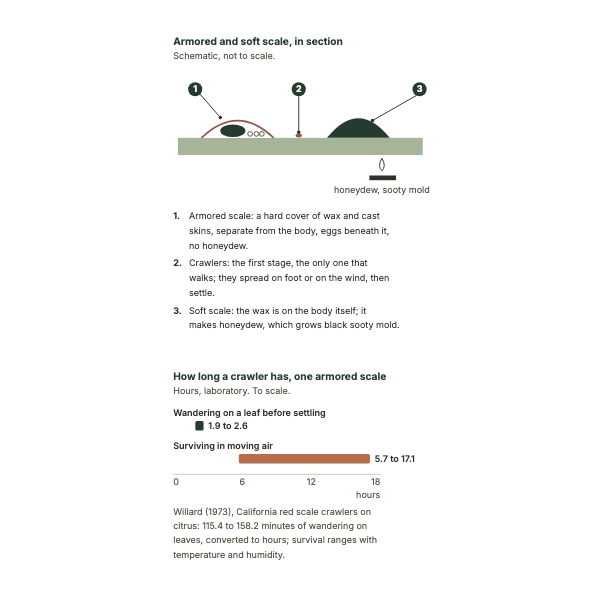
The wax is the obstacle. UC IPM says the mealybug’s waxy coating “repels most contact insecticides,” and that newly hatched young, called crawlers, have no wax yet. Cornell calls crawlers the most susceptible stage, and notes that the cottony masses protect the eggs.
A study on scale insects, close relatives of mealybugs, shows how much stage matters. Carlos Quesada and Clifford Sadof found insecticidal soap killed most newly hatched scales in the laboratory, and the insects “built up tolerance” as they settled (2017, cited from its abstract).
Neither soap nor oil significantly reduced adult scales in their tests. Applying that to mealybugs is an inference, but it matches UC IPM’s statement that soaps, oils and neem give “some suppression, especially against younger nymphs.”
Nebraska adds that killing every insect with the first application “is nearly impossible,” and that eggs present at the first spray hatch within days. Colorado State, Iowa State and Nebraska all expect treatment to be repeated.
Where Mealybugs Hide on a Parlor Palm
The palm’s own structure gives a spray places to miss. NC State Extension describes the base of each leaf stalk as clasping the stem, so the lower part of every frond wraps around it like a sleeve before the leaflets begin.
Where the spray has to reach on a parlor palm
Soap and detergent kill only the mealybugs they wet. On a parlor palm the colonies often sit where a spray from outside misses.
Check the leaf bases, the new frond, the leaflet undersides and the soil line, and wet what you find.
Cornell’s sheet names that kind of place: mealybugs live on the undersides of leaves, in branch crotches, “or under protective sheaths found at the base of some plants.” UC IPM adds the crown, stems near the soil and the space “between the stem and touching leaves.”
The Hawai‘i sheet says to look on growing points and young leaves, and shows waxy filaments on another palm’s unopened fronds. Donald Hodel notes there is “typically only one growing point or apical meristem per palm stem” (2009, cited from its abstract).
Two more places are easy to miss. NC State lists root mealybugs among this palm’s common insect problems, and UC IPM says ground mealybugs generally go unseen until a plant is dug up and its roots exposed.
UC IPM also says to check pots, stakes and other materials for egg sacs, and to throw out any that are infested.
Colorado State’s advice follows: cover the undersides of leaves and “other protected sites,” because what the liquid does not reach, it does not kill. On this palm, those are the leaf bases, the new growth at the top and the stem at the soil.
Washing It Off First
UC IPM and the Hawai‘i sheet both start with water. UC IPM says a strong spray can reduce exposed populations on sturdy plants, repeated as needed, and the Hawai‘i sheet says to dislodge mealybugs with pressurized water. The shower rinse was that advice.
Cornell’s detergent wash is a way of removing mealybugs, not poisoning them: washing with a soft brush or cloth “will help to dislodge the mealybugs.” For a few plants, it says, hand picking, washing or an alcohol swab “can give good control.”
Be gentle around the stem. Hodel writes that palm stems have no ability “to repair damaged tissue,” that wounds “are permanent, unsightly, and potential entry sites for pests and diseases,” and that care should be taken not to damage the growing point.
If you spray soap or detergent, Nebraska advises washing or wiping the residue off the leaves and stems afterward to lower the chance of injury. It also notes that very hard water makes soap sprays less effective.
Alcohol, Neem and Mixing Products
UC IPM recommends dabbing rubbing alcohol straight onto mealybugs with a cotton swab for small infestations on houseplants, after testing it on a small part of the plant for leaf burn.
Whether alcohol reaches the eggs, and why mealybugs return after it, is covered in our article on mealybugs that keep coming back. Drowning them, another method raised in the thread, is covered in our article on mealybugs on lucky bamboo in water.
Neem oil is on the same UC IPM list as soaps and oils, giving “some suppression” when applied directly to young mealybugs. Systemic insecticides taken up through the roots are, in UC IPM’s words, “less reliable against mealybugs” than against other sap-sucking insects.
Iowa State said granular soil insecticides seem to have “very limited effectiveness” on houseplants. UC IPM adds that none of the available insecticides is likely to give complete control, and that treated plants need to be watched and treated again as needed.
Some replies combined several products into one spray. Do not mix products, including household cleaners with pesticides, whatever a recipe says. Use one product at a time as its label directs; Cornell adds that the label must list the plant, the pest and indoor use.
Soap can mark the leaves, too. Colorado State says damage can build up with repeated exposure and some plants are sensitive. What household soaps can do to a leaf’s waxy surface is covered in our article on what leaf shine does to a leaf.
Keep It or Throw It Out
The replies urging the bin were not being dramatic. UC IPM says “When infestations become severe, consider discarding houseplants rather than repeatedly treating them,” and to toss older plants that may be a source of infestation for newer ones.
Cornell says discarding heavily infested plants “may be the best recommendation” for them and the plants around them. Iowa State said in 1996 that unless a plant is particularly valuable, many people find it best to throw it away before the pests spread.
Iowa State also suggested removing heavily infested stems and treating the rest, but only “On those plants that regrow after pruning.” That limit matters on a palm, where each stem has its one growing point and no branches to fall back on.
NC State says growers often put three or more single-stemmed plants in one pot, some of which are outcompeted and die. Cutting out a stem therefore removes one of the plants in the pot rather than pruning a branch.
No source tested removing the worst stems from a crowded pot to save the rest, so that stays a judgment call. If you keep the palm, Cornell says to isolate nearby plants for a few months until you can tell whether they have mealybugs.
What to Do With the Palm You Have
- Move it away from other plants. Cornell says mealybugs spread readily when foliage touches and that crawlers can be blown from plant to plant. Check the plants that stood beside it, and keep the palm apart after treatment.
- Rinse it hard. In a shower or sink, run a strong stream of water over the fronds, the stems and the leaf bases, as UC IPM and the Hawai‘i sheet advise, to knock off as many mealybugs as you can.
- Pick off what is left. Use your fingers, a soft cloth or a soft brush, as Cornell describes, working along the stem and into the edge of each leaf base. Avoid scraping the stem, since palm stems do not repair wounds.
- Look where a spray will miss. Check the leaf bases, the furled new frond, the leaflet undersides and the stem at the soil line. When you next unpot the palm, look at the roots for root mealybugs.
- If you spray, use a labeled insecticidal soap. Pick one whose label lists your plant, indoor use and mealybugs. Test it on a small area first and watch for damage before treating the whole plant, as Colorado State, Nebraska and UC IPM advise.
- Wet the insects, not just the leaves. Aim into the protected places, because a soap kills only what it touches. Rinse or wipe the residue off afterward, as Nebraska suggests, to lower the risk of leaf injury.
- Repeat, and keep checking. Follow the label on how often to reapply. Eggs and hidden insects survive a single round, so keep inspecting the palm, its pot and its neighbors until no new mealybugs appear.
- Decide when to stop. If colonies keep returning on a heavily infested palm, UC IPM, Cornell and Iowa State all treat discarding it as a sound choice, and one that protects the rest of your plants.
Local Regulations and Safety Advisory
If you use pest control products or household chemicals, follow the label. Rules on them vary by country and locality, and your pesticide regulator or hazardous waste service can say what applies where you live. This article is general information, not legal or medical advice.
Authorities to consult:
- Pesticide regulatory authority or environmental protection agency
- Public health department or hazardous waste service
What Remains to Be Explored
No trial comparing dish detergent with insecticidal soap on mealybugs was found, on palms or on any houseplant. The direct comparison in hand is whitefly nymphs on tomato, and the one mealybug trial that included detergent used dips on coleus cuttings.
That trial’s abstract does not report the detergent’s result. No data on how parlor palm leaves respond to soap or detergent were found either; Curkovic notes injury depends on the plant and each product’s surfactants.
How soaps and detergents kill mealybugs is still not settled. The best-documented effect, wax and water loss, comes from a thesis reported in a review, and the effect of life stage comes from scale insects rather than mealybugs.
Nothing found tests whether a heavily infested palm can be cleared at home, or whether taking stems out of a crowded pot helps the rest. Those are the questions an owner standing over this palm most needs answered.
Sources
- Insect Control – Insecticidal Soap (Fact Sheet 5.547) — Colorado State University Extension. Undated.
- Insecticides for Houseplants — Iowa State University Extension and Outreach, Yard and Garden. May 3, 1996.
- Washing Pests Away — Sarah Browning. Nebraska Extension in Lancaster County. February 8, 2024.
- Pest Notes: Mealybugs (Publication 74174) — M.L. Flint. University of California Statewide IPM Program. Undated.
- Mealybugs on Houseplants — Carolyn Klass. Cornell University, Department of Entomology (eCommons). January 2010.
- Chamaedorea elegans (Parlor Palm) — North Carolina State University Extension, Plant Toolbox. Undated.
- Palm Mealybug — A.H. Hara, J. Zarders, R.Y. Niino-DuPonte, S.K. Cabral, K.L. Aoki. University of Hawai’i at Manoa, CTAHR, Komohana Research and Extension Center. 2013.
- Household Detergent on Tomato: Phytotoxicity and Toxicity to Silverleaf Whitefly — C.S. Vavrina, P.A. Stansly, T.X. Liu. HortScience 30(7):1406-1409. December 1995. Cited from its abstract.
- Effects of Application of Various Reduced-Risk Pesticides to Tomato, With Notes on Control of Greenhouse Whitefly — D. Casey Sclar and colleagues. HortTechnology 9(2):185-189. 1999. Cited from its abstract.
- Alternatives to a Pyrethroid for Controlling Madeira Mealybug (Hemiptera: Pseudococcidae) on Coleus Cuttings — Lisbeth Espinoza-Lozano, Sarahlynne Guerrero, Lance S. Osborne, Norman C. Leppla, Amanda C. Hodges, Mihai C. Giurcanu. Florida Entomologist 101(3):389-394. September 2018. Cited from its abstract.
- Efficacy of Horticultural Oil and Insecticidal Soap Against Selected Armored and Soft Scales — Carlos R. Quesada, Clifford S. Sadof. HortTechnology 27(5):618-624. October 2017. Cited from its abstract.
- Detergents and Soaps as Tools for IPM in Agriculture — Tomislav Curkovic S. IntechOpen, in Integrated Pest Management (IPM): Environmentally Sound Pest Management. August 31, 2016.
- Biology of Palms and Implications for Management in the Landscape — Donald R. Hodel. HortTechnology 19(4):676-681. 2009. Cited from its abstract.
- What’s this White Stuff on My Parlor Palm? (R/Plantclinic Thread) — multiple community members. Reddit, r/plantclinic. Undated.