Predators can control spider mites, but the guidance that says so is written for greenhouses, and it comes with conditions many apartments may not meet. The specialist predatory mite needs humid air. The ladybugs sold in bags are aphid hunters that leave. We found no published trial in a home.
The plainest statement about indoor use comes from Susan Mahr at the University of Wisconsin. Predatory mites, she writes, “are not recommended, however, for controlling heavy infestations indoors, or problems on individual plants.”
That sentence should be read before anything is ordered, and it is the reason this article does not end in a recommendation to buy.
One r/houseplants reader with more than 150 plants took on spider mites by releasing 100 mite-eating beetles into an apartment. Some replies came from people whose ladybugs escaped through the windows, others from people still finding them a month later, and others said the wrong predator had been chosen.
Those replies are not really disagreeing. They bought different animals, for different rooms, at different stages of an infestation. Those three things decide the outcome, so the useful question is not whether predators work but which one you mean, and what it needs from the room.
First, Confirm They Are Spider Mites
A predator is a specific purchase, so a wrong identification wastes all of it. Spider mites are barely visible, about 1/50 inch long, and live mostly on the undersides of leaves.
The usual first sign, Mahr says, is “a chlorotic, stippled appearance on the leaves”: pale, speckled, as though the color had been pricked out.
The test takes a minute. Hold a sheet of white paper under a leaf and tap the leaf sharply. Then watch for specks that move, which Wisconsin and UC IPM both give as the check. Dust stays where it lands, so a moving speck is the thing you are looking for, and a 10X hand lens settles any doubt.
Webbing is the other sign and it is the less welcome one. Washington State’s Pestsense page says it is often visible “on the underside of leaves and between leaves and stems”. By that point, Mahr writes, “populations are already well-established and more difficult to control”, which matters for everything below. If the marks are at leaf tips instead, brown tips have other causes.
What a Release Depends On
A contact spray hits what it hits and then it is finished. A predator is a living population, and it has to do three things after it leaves the container: find prey, breed fast enough to keep up, and stay where the prey is. The predators on sale differ in which of those they do well.
Speed is the reason this can work at all. Leanne Pundt’s UConn Extension guide gives Phytoseiulus persimilis, the standard predatory mite, a shorter development time than the spider mite itself: about 9 days at 68°F (20°C).
In a greenhouse, the guide says, spider mite colonies “should be reduced in 2 to 3 weeks.” That figure is not a promise for a shelf.
Pundt’s guide is written for commercial growers, and so is nearly everything else on this subject. The table below takes what those sources say and puts the gaps on the page, because the gaps are what an apartment owner most needs to see.
Six predators, and what each one asks of the room
What extension guidance says about the predators people release against spider mites. Greenhouse figures, not readings from a home.
| Predator | What it needs | When the prey runs out |
|---|---|---|
| Phytoseiulus persimilis
Predatory mite. Eats spider mites only
|
Above 60% humidity or its eggs shrivel. Best above 75% and 68°F | Disperses or starves |
| Neoseiulus californicus
Predatory mite. Also other mites and thrips. Slower
|
Active at 40–80% humidity, 46–95°F | Lives longer. May eat mold, nectar, pollen |
| Galendromus occidentalis
Predatory mite. Feeds on spider mites
|
Does best at 30–60% humidity, 50–115°F | Can feed on pollen |
| Stethorus beetles
Sold and described as spider mite destroyers
|
Not stated | Not stated |
| Lacewing larvae
General predator. “May also feed” on spider mites
|
Not stated | Not stated |
| Bagged lady beetles
Hippodamia convergens, a generalist bought for aphids
|
Containment. Greenhouses hold them better than open gardens | Leaves for good once the aphids are eaten |
Every predatory mite here is listed for air wetter than the 10 to 20 percent Iowa State gives for a heated home in winter. No comparison of these predators in a home has been published.
What Happens When the Spider Mites Are Gone
A specialist has no fallback. P. persimilis “needs to have spider mite prey, or it will disperse or starve”, UConn says, so a successful release ends itself. Our inference is that a cleared plant keeps no standing guard, and mites arriving later would meet nothing. UConn lists others that last longer on other food, as the table shows, but no source measures how long on a houseplant.
Why a Dry Room Is the Deciding Condition
The specialist’s weakness is its egg. At relative humidity below 60 percent, UConn says, P. persimilis “eggs shrivel and do not hatch”, with conditions at their best above 75 percent. Mahr’s figure is close: in hobby greenhouses predatory mites “will be effective only if the humidity is generally above 70%.”
Now set that beside a house. Iowa State Extension says the relative humidity in a heated home in winter may be only 10 to 20 percent.
That figure comes with no house type or measuring method, so treat it as a scale rather than a reading. Even so, the gap to 60 percent is wide, and a hygrometer will tell you where your own room sits.
The same dry air suits the pest. Washington State calls spider mites pests “thriving in the warm, dry conditions found in most homes”, and Mahr dates the houseplant problem to November, “when the heat comes on and the air is drier.”
So the moment mites flare up indoors is also, on these figures, the moment the specialist predator can least reproduce.
Dry air does not stop the adult predator from eating. Mori and Chant found in a 1966 laboratory study, cited here from its abstract, that P. persimilis consumed more prey at low humidity than at high. Our reading, which no source states, is that a release into dry air may be a single generation of hunters with no eggs behind them.
Neoseiulus californicus is the usual alternative. UConn lists it as active at 40 to 80 percent humidity and says it can be the better choice where conditions swing.
It also survives longer without spider mites, because it will eat other mites, thrips, and possibly mold, nectar and pollen. It pays for that in speed: UConn calls it “slower acting” than P. persimilis and useful for keeping low populations low.
Misting is not the fix. UConn says light misting of plants or walkways may raise humidity in a greenhouse, but Iowa State says misting houseplants is not an effective way to raise relative humidity, because foliage dries quickly. A humidifier is the method that holds up.
One caution about reasoning from this. Saying mites prefer dry air is not the same as saying wet air kills them, and the same leap has already spread from thrips.
No source here says humidity alone clears an infestation. Washington State recommends raising it as one measure, and adds: “Do not overwater plants in an attempt to increase humidity.”
Ladybugs Are a Different Purchase
The beetles sold in bags are often Hippodamia convergens, and Washington State Extension’s fact sheet by Linda Chalker-Scott and Michael Bush explains the problem. They are collected in the wild from fall gatherings, held in hibernation and shipped.
“The first behavior of lady beetles as they come out of winter hibernations is to disperse and seek food.” That matches the thread closely. Readers reported beetles gone in about an hour, and a release of 1,500 that seemed to be all over the home for too long.
The fact sheet is about gardens, though, and it adds one point in favor of a room: “Releasing lady beetles into contained spaces like greenhouses improves retention.” Nothing we read tests a closed apartment, so whether a room counts is unknown.
Staying is not the same as helping. These beetles are bought for aphids, and the fact sheet says they also prey on mites, among other things, but calls the species a generalist, and it says that “once the aphids in an area have been eaten, the lady beetles disperse permanently”. We found no measurement of how well bagged lady beetles control spider mites on any houseplant.
The beetles in that thread may be something else. Mite-eating lady beetles in the genus Stethorus exist: UC IPM names “the spider mite destroyer lady beetle” among natural enemies, and UConn lists Stethorus punctillum as commercially available. D.A. Raworth’s 2001 note in The Canadian Entomologist reports releases in greenhouse vegetable crops, cited from its opening paragraph, so its results are not used here.
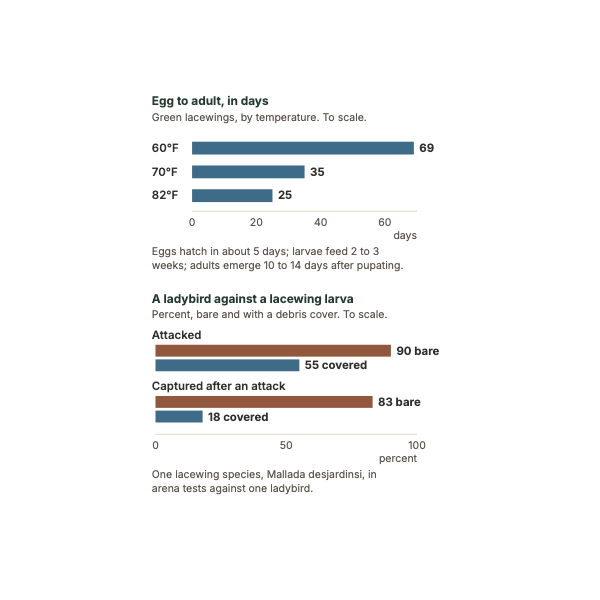
Lacewing larvae, the third option readers raised, are thinner still. UC IPM counts them among “various general predators”, and UConn calls Chrysoperla a “generalist aphid predator” that “may also feed upon spider mites”.
One reader says they vanish after about two weeks because indoor conditions do not suit them. No source we read confirms or contradicts that.
Early Beats Late, and Heavy Infestations Are the Wrong Use
The reader who said predators belong before an outbreak rather than after one is on firm ground. UConn’s first tip is to release “early when mite populations are low”, and it concentrates releases on hot spots. Mahr’s advice against heavy indoor infestations points the same way, from the other end.
Distance matters too. P. persimilis “can spread through a greenhouse as long as plant leaves are in contact with each other.” It hunts on foot, by touch and scent.
Our inference is that plants spaced apart on shelves are separate islands, and a release onto one does little for its neighbors, unless the leaves touch.
How many to release is the one thing this article will not give you. UConn sends growers to their supplier, and says rates vary with the crop and the infestation.
The argument in the thread over whether 100 beetles was enough has no answer, because we found no tested rate for a room of houseplants. A supplier’s number was written for something else.
If You Have Mites on Many Plants Now
Start by reducing the problem without buying anything, in this order. Confirm the mites with the paper test on each plant, because some may be clean. Move infested plants away from the others. Washington State says mites spread by leaf contact, by walking and by drifting on webbing, “so isolation will help protect other plants.”
Then wash them. Mahr says a forceful stream of water can “wash away some of the mites and their webbing”. In a shower or sink, aim at the undersides of the leaves, where the mites live, and let the pot drain afterward. A wash lowers numbers, and no source says it finishes the job.
Be realistic about a heavy infestation. Mahr’s next words are that chemical control “is often the best option”, with insecticidal soap as the first choice for most problems.
If you use any product, the label sets the rate, the interval and the plants it is safe on, and it binds you. We state none of those here.
Soap and predators do not mix on contact. UConn says direct sprays are “very harmful” to adult and nymph predatory mites, and also that soap has no residual activity once dry.
Our reading is that a spray first and a release later is not unreasonable in principle, which is what the thread’s reader did. We found no extension source giving an interval between the two.
If you still want to try predators, match the animal to the room. Measure the humidity where the plants actually stand. Below 60 percent, P. persimilis is not a fit on UConn’s figures.
N. californicus is listed down to 40 percent, and Galendromus occidentalis, the lowest range in the guide, at 30 to 60. Under 30, UConn’s figures support none of them. Choose a small group of plants with touching leaves and a light infestation.
Judge the result by the mites, not the predators. UConn says to look for “dead, shriveled spider mites”, and the paper test repeated on the same plants gives you a before and after.
Keep treated plants apart until they are clean. Washington State suggests “at least one full month” for plants in quarantine. Finding pests again later is the usual shape of the problem, not a personal failure.
Local Regulations and Safety Advisory
If you use pest control products, follow the label. Rules on them vary by country and locality, and your pesticide regulator can say what applies where you live. This article is general information, not legal advice.
Authorities to consult:
- Pesticide regulatory authority or environmental protection agency
What Remains to Be Explored
The central gap is simple: we found no published trial of any predator against spider mites on houseplants in a home, in any climate. Every humidity and timing figure here was written for greenhouse production, and it is carried indoors as reasoning, labeled as such where it matters.
The nearest work we identified is a 1985 paper by Osborne and Petitt in the Journal of Economic Entomology on predatory mites and soap on greenhouse-grown foliage plants.
Its title is close to this subject, but it carries no published abstract, so nothing here draws on its results.
What the sources leave open for Stethorus and lacewing larvae is printed as “not stated” in the table: their humidity needs, and what they do when the mites run out.
We do not know whether a reader’s vanished predators left, starved or simply hid. Nobody appears to have counted them in a room.
Nor do we know how far a plant cluster raises humidity at the leaf surface, which is the number a predatory mite egg actually experiences. Room readings may understate it. A logged comparison of leaf-level humidity and predator egg hatch on a houseplant shelf would change this answer, in either direction.
Sources
- Biological Control of Two-Spotted Spider Mites — Leanne Pundt, UConn Extension, 2007, latest revision 2024. UConn Extension Integrated Pest Management Program. 2024.
- Twospotted Spider Mite, Tetranychus urticae — Susan Mahr. University of Wisconsin-Madison Division of Extension, Wisconsin Horticulture. Undated.
- Lady Beetles: Should We Buy Them for Our Gardens? — Linda Chalker-Scott and Michael Bush. Washington State University Extension, FS268E. January 2023.
- Spider Mites (Pest Notes 7405) — L.D. Godfrey. UC Statewide IPM Program. December 2011.
- Spider Mites — Washington State University, Pestsense. January 22, 2026.
- Insecticidal Soaps — Leanne Pundt. UConn Extension Integrated Pest Management Program. June 2024.
- How Can I Raise the Relative Humidity Indoors for My Houseplants? — Iowa State University Extension and Outreach. March 4, 2022.
- Air in Our Home Is Extremely Dry in Winter. Should I Mist Houseplants? — Iowa State University Extension and Outreach. February 26, 2022.
- The Influence of Prey Density, Relative Humidity, and Starvation on the Predacious Behavior of Phytoseiulus persimilis — Mori and Chant. Canadian Journal of Zoology. 1966. Cited from its abstract.
- Development, Larval Voracity, and Greenhouse Releases of Stethorus punctillum — D.A. Raworth. The Canadian Entomologist. 2001.
- Insecticidal Soap and the Predatory Mite, Phytoseiulus persimilis … on Greenhouse-Grown Foliage Plants — Osborne and Petitt. Journal of Economic Entomology. 1985.
- What Do You Do When You Have Spider Mites in Your 150+ Plant Collection? — r/houseplants. October 2026.