Hundreds of small holes dug overnight, clustered so close that they run together into one torn patch, match what extension guides describe for a skunk. A raccoon more often lifts and flips pieces of sod. Both feed at night, and their damage can look alike.
Either way, the holes show that an animal was looking for food there, not what it found. Skunks and raccoons dig for earthworms and other insects as well as grubs, so lift the sod in a few places and count before you buy a grub product.
If the count does find grubs in autumn, a grub product will do little now; the treatments that work go down in summer. Until then, put back what you can, pin netting or wire over the patch, and keep people and pets away from the animals, which can carry rabies.
No study was found that ties lawn digging to rain, or that tests whether grub control stops skunks and raccoons from digging. What follows rests on extension guidance from Maryland, Iowa, Illinois, New Jersey and neighboring states, and on a few studies of grubs, earthworms and skunks.
The question comes from a thread on r/lawncare. A homeowner in Brick, New Jersey, had just renovated and overseeded the lawn. After heavy rain through the day and night, they woke to a large section of it pocked with hundreds of small holes and divots.
The soil and grass were broken up across the patch, but there were no large holes and no tunnels. Their own guess was a skunk or a raccoon after grubs, and they asked whether there was a way to confirm the cause before treating the lawn.
The replies leaned hard toward grubs. One held that raccoons smell exactly where each grub is, so every hole meant a grub and the lawn’s grubs now had to go. Another promised that a preventive grub product every spring would end it for good, and one called the damage free aeration.
Others blamed short grass for making egg-laying easy, said it did not matter which animal it was as long as the grubs were treated, or argued over which product could still work this late in the year. Those are the claims worth checking.
Which Animal Dug It?
The University of Maryland Extension warns that skunks and raccoons feed at night, are rarely caught digging, and leave lawn damage that can look very similar. As a rule, it says, skunks dig an array of separate holes, often clustered close together (Talabac 2026).
Its skunk page puts those holes at 3 inches across and about 3 inches deep, cone-shaped, dug in search of grubs.
Illinois Extension describes the same hole as shaped like a top, wide at the opening and pointed at the bottom, 2 to 3 inches across, with fairly smooth sides (Hentschel 2016).
Iowa State explains how they are made. A skunk pushes its nose into the lawn and digs out the spot with its front paws, and the holes can be so many that they merge into one large disturbed patch of grass (Steil 2026).
Illinois adds that a skunk digs, may or may not find a grub, moves a little and digs again.
Raccoons work differently. Iowa State says they use their front paws more like hands, lifting and flipping pieces of sod, sometimes so neatly that the turf looks rolled back for transplanting.
Maryland describes the grass left in separate chunks, and Illinois says a raccoon peels the grass back and churns the ground as it goes.
The photo in the post shows small divots running together across a patch of broken soil, with grass torn and scattered but no sheets of sod turned over. That is closer to Iowa State’s description of skunk digging than of raccoon digging.
A photo is not a diagnosis, though, and Maryland’s warning that the two look alike still stands.
Other animals leave other marks. Maryland lists crows, starlings, grackles and other birds that probe or scrape lawns for insects and earthworms, leaving depressions or shallow holes, and Purdue’s diagnostic lab calls them peck holes (Gibb 2013).
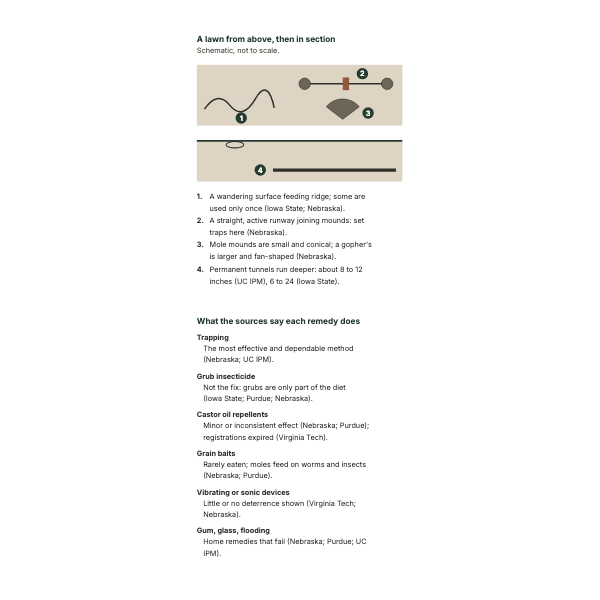
Moles leave runways just under the surface and push up mounds of soil (Maryland), and the post reports no tunnels.
The overnight timing fits either mammal. Striped skunks radio-tracked on the Canadian prairies were mostly nocturnal, typically becoming active about 13 minutes before sunset and stopping about 35 minutes before sunrise (Lariviere and Messier 1997, cited from its abstract). Iowa State says both skunks and raccoons feed at night.
The holes, then the soil under them
Skunks and raccoons dig lawns at night. The shape of the damage hints at which animal; only the soil under it shows what the animal was after.
| 1. Skunk | Pushes in its nose and digs with its front paws (Iowa State), leaving cone-shaped holes about 3 inches across and deep, often clustered (University of Maryland Extension). Illinois describes them as top-shaped and 2 to 3 inches across. So many can be dug that they merge into one torn patch (Iowa State). |
| 2. Raccoon | Lifts and flips pieces of sod, sometimes as if rolled back neatly (Iowa State), leaving the grass in separate chunks (Maryland). Both animals feed at night, and Maryland says their damage can look very similar. |
| 3. Birds | Crows, starlings and other birds probe or scrape for insects and earthworms, leaving shallow holes or depressions (Maryland). Purdue’s diagnostic lab calls them peck holes. |
| 4. Lift a flap | Skunks and raccoons dig for earthworms and other insects as well as grubs (Iowa State; Maryland; Illinois). Only a look under the sod, in several places, shows which it was and whether the grubs reach a number worth treating. |
Drawn from extension descriptions, not measurements. Sizes vary between sources, and one lawn can show more than one kind of digging.
The holes show an animal was looking for food there, not that the lawn needs a grub product. Count before you treat, and if you do treat, the label sets the rate and timing.
Why It Happened After Heavy Rain
No source read ties lawn digging to rain. Two things rain does to what lives under a lawn are documented, though, and both put food within reach of a digging animal.
The first is the grubs. The University of Vermont Extension says grubs move down when the soil is dry and come back up toward the surface within 24 hours when moisture returns.
For the same reason it advises counting grubs after heavy rain or a deep watering, since grubs that have gone deep in dry soil can be missed (Skinner 2023).
The second is earthworms. In a study of two species, one that crawls out of the soil at night after heavy rain tolerated being under water poorly and used more oxygen at night.
The other used less oxygen, survived longer under water and was never seen to leave the soil after heavy rain (Chuang and Chen 2008, cited from its abstract).
Those were two species studied for how they cope with waterlogged soil, not the worms of a New Jersey lawn. Carried to a lawn by inference, they suggest that a soaking can bring some kinds of earthworm up or out while others stay put.
Skunks and raccoons eat both. Iowa State lists earthworms, soil insects and insect larvae such as white grubs among what they dig for in late summer and fall, and Maryland and Illinois say the same. A wet night may simply have put more of their food near the surface.
Do the Holes Mean You Have Grubs?
The extension sources all tie digging to food, and read the grubs differently. The University of New Hampshire Extension says mole or skunk damage indicates that grubs are present. Maryland says not to assume abundant grubs are the reason animals are digging, and to confirm a high grub population before using any grub product.
Illinois gives the reason for caution: because skunks and raccoons also eat earthworms and soil beetles, digging can happen whether or not there are beetle grubs. So the reply that every hole marked a grub claims more than any source read here supports.
The animals may still have found grubs, and in numbers too small to have hurt the grass. Purdue Extension says raccoons, skunks, armadillos and turkeys forage for white grubs even where the grubs’ own damage is not apparent (Richmond 2022).
Iowa State puts numbers on it. Healthy turf can tolerate 20 or more grubs per square foot before it shows injury, but 5 or more per square foot typically draws skunks and raccoons.
Vermont makes a similar point: even a small number of grubs, it says, can attract rodents that do major damage foraging for them.
That is why the count matters more than the holes. Iowa State says to look in nearby undamaged areas and in spots damaged in past years, because grubs gather in irregular, isolated patches. If the numbers are low, it says, no treatment is necessary.
Vermont’s method is to cut three sides of a 6-inch square, 3 to 4 inches deep, fold the flap back and count, then press it back down and water it.
Do it in several places. A 6-inch square is a quarter of a square foot, so multiply the count by four. Turkeys digging up a lawn covers this in more detail.
Ohio State Extension adds a quicker test where damage is already showing. Grip the grass with both hands and pull: where grubs have eaten the roots, the turf comes up like a carpet, often with grubs beneath it (Rice and Wu 2026).
For New Jersey, the numbers to compare against come from Rutgers. Its fact sheet puts published damage thresholds at 6 to 10 grubs per square foot for Japanese beetle, oriental beetle and European chafer, and 15 to 20 for Asiatic garden beetle, varying with the grass, its care and the climate (Rutgers FS1009, 2010).
Which grub it is matters too. Rutgers says the oriental beetle has become by far the most important white grub in New Jersey and neighboring areas, with Asiatic garden beetle, northern masked chafer and Japanese beetle also common.
They are told apart by the pattern of hairs and spines under the tip of the abdomen, seen with a 10- to 15-power hand lens.
Timing affects what a count finds. Rutgers says grubs move deeper as the soil cools in October, and it times its own counts for mid-August, when they feed in the top 3 to 4 inches of soil.
Vermont’s advice to count after rain, not in dry soil, is for the same reason: grubs lower in the soil can be missed.
Will a Grub Product Every Spring Stop It?
Probably not in the way the reply promised, for three reasons: timing, the grub species, and the earthworms. No study was found that tested whether grub control stops skunks or raccoons from digging a home lawn.
Timing first. Preventive grub insecticides last a long time in the soil and act on young grubs, so they go down before or as the eggs hatch. Rutgers says most can be applied as early as May, but that the best time is June and July, while female beetles are laying eggs.
Purdue says early to mid-July is almost always the best timing for a preventive, and that applications made far in advance can fail as the product breaks down in the soil, so they should be avoided unless there is a reason. Iowa State’s window runs from late May to early August.
Iowa State is blunt about early spring. Applied in spring, when the grubs in the soil are full-grown, preventives are not effective. Rutgers says spring treatments for grubs, from late April through May, are generally the least effective and rarely justified, because the grass can outgrow most grub populations.
Species next. Rutgers lists preventive ingredients that fall short against particular grubs: halofenozide gives only about 50 percent control of oriental beetle and European chafer grubs, and imidacloprid, thiamethoxam and halofenozide are ineffective against Asiatic garden beetle grubs.
A product’s label names its active ingredient, and the species found in the count says whether it fits.
Treating every year also has a cost. Rutgers says preventives are often spread over more ground than needed, which raises the cost and may cut the natural enemies that help hold grubs down.
It advises keeping them to areas with a history of grubs, low tolerance for damage, or heavy egg-laying in June and July.
Iowa State is a little warmer to the idea where damage comes back each year: there, it says, preventive treatment may be beneficial. Neither source says it will keep animals away, and a lawn treated for grubs still holds earthworms.
That leaves the argument in the thread over treating now. Iowa State says curative grub treatments, faster-acting products aimed at grubs already in the soil, work best in August and early September and are not effective after early October. Purdue says a late treatment’s effect is greatly reduced once grubs stop feeding or move deeper for the winter.
Rutgers, writing for New Jersey, adds that third-stage grubs, the last and largest stage, are much harder to control and names trichlorfon as usually the best choice for late applications, without saying how late.
The grub’s year and these windows are drawn in turkeys digging up a lawn. Whatever is used, its label sets the rate, the timing and the watering-in.
Does Short Grass Invite Grubs?
One reply blamed short grass for making it easy for beetles to lay eggs and advised raising the mowing height. The evidence for mowing height is thin, and what there is points more strongly at soil moisture.
Vermont says mowing height appears to have some effect: some grub species are smaller in lawns mowed high, and some are fewer where lawns are not cut too short. But it calls soil moisture the most significant factor. Drought kills eggs and larvae, and adult beetles may lay fewer eggs in dry soil.
One choice test looked at mowing height directly. Grubs of the black turfgrass ataenius, the most common grub in Michigan golf fairways, were 3 to 10 times more abundant in fairways mowed at 1.5 cm than in roughs mowed at 5.0 cm or higher.
Yet adults given a choice showed no egg-laying preference between the two heights (Jo and Smitley 2006, cited from its abstract).
The same adults did prefer turf in moister soil, at 13 to 26 percent water by volume, over drier soil at 8 to 9 percent. That is a different grub from New Jersey’s main species, tested in a greenhouse and growth chambers, not on a lawn.
For the Japanese beetle, a study in sand putting-green soils found females avoided digging into soil kept just above the point where the grass wilts, about 5 percent water by volume. The authors suggest conservative watering could lessen infestations (Obear and colleagues 2014, cited from its abstract).
Rutgers draws the practical line. Watering during peak beetle flight in summer tends to attract egg-laying females, especially when the soil around is dry, and raises the survival of eggs and young grubs.
In late summer and fall, by contrast, watering makes the grass more tolerant of grub feeding. Ohio State also warns that excessive watering can worsen infestations.
The post does not say when the renovation was done or how the lawn was watered, so none of this says why grubs, if there are any, are in this one. For the future, the sources point at summer watering more than at mowing height.
Keeping Them Off While the Grass Comes Back
Iowa State calls exclusion often the most effective option for skunk and raccoon damage. Skunks do not jump or climb, so a sturdy chicken-wire or woven-wire fence pinned to the ground can keep them out of an area prone to digging.
Raccoons climb fences, so Iowa State suggests covering the ground instead: lay hardware cloth, chicken wire or bird netting over the damaged area, or over areas with high grub numbers, and hold it down with landscape staples or bricks.
A determined raccoon can lift or claw through it, but it may make digging frustrating enough to send the animal elsewhere.
Scent repellents are typically not very effective, in Iowa State’s judgment, and must be reapplied often, especially after rain. If you try one, its label sets how often. Maryland adds that skunks may return to a site again and again until the food is gone, and that the damage is temporary.
Take away other food. Maryland advises not leaving pet food outside and securing garbage, and its skunk page adds bird feeders and compost piles. New Jersey’s wildlife policy makes the same point from the other side: removing an animal without removing what drew it, or keeping it out, guarantees the problem will continue.
Keep your distance. The Centers for Disease Control and Prevention lists skunks and raccoons among the animals most often found with rabies in the United States, spread through bites and scratches. Keep pets’ rabies vaccinations up to date and keep them and children away from these animals.
If anyone is bitten or scratched, the CDC says to wash the wound at once with soap and water and seek medical care urgently. Maryland adds that a skunk wandering aimlessly, acting aggressive, moving in an uncoordinated way or unusually tame around people should be treated with caution.
Trapping is governed by wildlife law, and it varies. In New Jersey, raccoons and skunks are classed as rabies vector species, and the state’s policy prefers release at the place of capture and restricts where else a trapped one may be let go.
In Maryland, Extension says they cannot be relocated at all. Check with your state wildlife agency or a licensed wildlife control operator before trapping.
Repairing the Patch
Iowa State notes that this digging usually happens in fall, which is a good time to repair turf.
Put back any flipped or pulled-up pieces of sod, water them if the weather is dry so they root again, then overseed the gaps or, where the damage is heavy, pull up whole sections and reseed or lay sod.
Purdue’s diagnostic lab says torn-up grass that is dead should be raked up and replanted, while grass that was not torn out will survive and gives an overseeding a head start (Gibb 2013).
How late seed can still go down depends on where you are; Purdue’s guidance on late and dormant seeding is set out in turkeys digging up a lawn, and seeding gaps in late summer covers the usual method.
If the lawn is reseeded, the grass chosen matters for next year. Rutgers says no grass resists grubs, but among cool-season grasses tall fescue tolerates their feeding best and perennial ryegrass least. It ties tolerance to deeper roots and better heat and drought tolerance.
Local Regulations and Safety Advisory
If you use pest control products, follow the label. Rules on them vary by country and locality, and your pesticide regulator can say what applies where you live. Skunks and raccoons can carry rabies; keep children and pets away and pets' vaccinations current, and get medical care for any bite or scratch. Trapping rules come from state wildlife law, so ask your wildlife agency first. This article is general information, not legal, medical or veterinary advice.
Authorities to consult:
- Pesticide regulatory authority or environmental protection agency
- A doctor or urgent care for any bite or scratch, and your state wildlife agency or a licensed wildlife control operator
- Poison control service
- Veterinarian or animal poison control service
If a child or pet may have been exposed to a product, contact a poison control service or a veterinarian.
What Remains to Be Explored
No study was found that ties lawn digging by skunks or raccoons to rain, or that compares digging on lawns treated for grubs with lawns left alone.
The case that rain brings food up rests on Vermont’s account of grubs and on a laboratory study of two earthworm species, carried to a lawn by inference.
The ways to tell skunk from raccoon digging come from extension descriptions, not measured comparisons, and the sources give different hole sizes. New Jersey’s grub species and thresholds come from a Rutgers fact sheet dated 2010, so the products it names may have changed since.
The mowing evidence is one choice test on a different grub and one moisture test in sand. No study was found of oriental beetle egg-laying and mowing height, or of how far a soaked lawn draws skunks compared with a dry one.
What would change the answer: a count under the sod that finds few grubs and many earthworms, or one above Rutgers’ thresholds; a camera that shows which animal comes back; or a study that measures whether grub control reduces skunk and raccoon digging.
Sources
- What Animal Tore up My Lawn Overnight? Hundreds of Small Holes Appeared After Heavy Rain (Brick, NJ) — multiple community members. Reddit, r/lawncare. Undated.
- Animals Digging in Lawns — Miri Talabac. University of Maryland Extension, Home and Garden Information Center. March 16, 2026.
- Skunks — University of Maryland Extension, Home and Garden Information Center. May 4, 2026.
- Managing Skunk and Raccoon Damage to Lawns — Aaron Steil. Iowa State University Extension and Outreach, Yard and Garden. September 2026.
- White Grub Control in Turfgrass — Iowa State University Extension and Outreach, Yard and Garden. September 1, 2016.
- An Integrated Approach to Insect Management in Turfgrass: White Grubs (FS1009) — Albrecht Koppenhofer. Rutgers Cooperative Extension. March 2010.
- White Grubs in Turfgrass (ENT-0107) — Henry Rice, Shaohui Wu. Ohio State University Extension, Ohioline. March 13, 2026.
- White Grubs [Fact Sheet] — University of New Hampshire Extension. April 16, 2018.
- Mysterious Damage in the Lawn — Richard Hentschel. University of Illinois Extension, Over the Garden Fence. October 7, 2016.
- Managing White Grubs in Turfgrass (E-271-W) — Douglas S. Richmond. Purdue University Extension, Department of Entomology. June 2022.
- Guess Who Came to Dinner? — Tim Gibb. Turfgrass Science at Purdue University. May 20, 2013.
- White Grubs: A Serious Lawn Pest — Margaret Skinner. University of Vermont Extension. June 2023.
- Policy on the Relocation of Wildlife — New Jersey Department of Environmental Protection, Division of Fish and Wildlife. Undated.
- About Rabies — US Centers for Disease Control and Prevention. January 27, 2026.
- Role of Diurnal Rhythm of Oxygen Consumption in Emergence From Soil at Night After Heavy Rain by Earthworms — Shu‐Chun Chuang; Jiun Hong Chen. Invertebrate Biology. January 2008. Cited from its abstract.
- Oviposition Preference of the Japanese Beetle (Coleoptera: Scarabaeidae) in Golf Putting Greens Under Different Soil Moisture and Fungicide Regimes — Glen R. Obear; R. Chris Williamson; P. J. Liesch. Applied Turfgrass Science. 2014. Cited from its abstract.
- Impact of Soil Moisture and Mowing Height on Ataenius spretulus (Coleoptera: Scarabaeidae) Selection of Golf Course Turf Habitat in Choice Tests — Young-Ki Jo; David R. Smitely. HortScience. April 2006. Cited from its abstract.
- Seasonal and Daily Activity Patterns of Striped Skunks (Mephitis mephitis) in the Canadian Prairies — S. Lariviere; F. Messier. Journal of Zoology. October 1997. Cited from its abstract.