A watermelon from red-fleshed seed that is mostly white inside, with only a little pink, was almost certainly cut before it ripened. In a red watermelon the flesh starts white, turns white-pink and then red over several weeks on the vine.
Sugar builds over those weeks and beyond, and once the fruit is picked, both stop. A watermelon does not go on coloring or sweetening on the counter, so this one will stay as it is.
The next one can be timed better. The signs that tell you when are below, with what each source says about how far that sign can be trusted.
The case that prompted this was posted in a thread on r/gardening. A grower in southern California cut open the only fruit a big vine had made all season and found thick white flesh with a few small patches of pink.
By the grower’s account it was heavy and sounded watery when tapped. An earlier melon had rotted when they left it on the vine too long, so this time they had erred toward picking early. Most replies said the fruit was simply unripe and argued over how to tell.
One reply took another view. It set an old still-life painting of pale watermelons beside the photo, as a picture of what watermelons looked like before breeding.
Others blamed the seed, a recessive gene, too little heat or a dry spell. Each of those ideas is checked against the research below, after the timeline that explains the photo.
What White Flesh Means in a Red Watermelon
The clearest timeline comes from a 2015 study by Guo and colleagues in PLOS ONE, which followed an early red-fleshed cultivar called 97103. It matures at about 30 days after pollination, counted from the day pollen reached the flower that became the fruit.
The researchers sampled its flesh at four stages they named by color. At 10 days it was immature white, at 18 days white-pink, at 26 days red, and at 34 days full ripe.
Over that time the flesh’s lycopene, the red pigment, rose steadily. An earlier study by the same group gives the same four stage names, cited from its abstract.
So white with a little pink is not a strange color for a red watermelon. It is how one looks partway through, roughly where 97103 sits in its third week. The study calls 97103 an early variety, so the days will differ for others.
Sweetness follows its own schedule. Brown and Summers grew four cultivars in Iowa and picked fruit every four days. Total sugar climbed from 20 to 60 days after the flower opened, rising fastest between days 20 and 36, by their 1985 abstract.
Color and sugar do not always finish together. Brown and Summers found that Charleston Gray “develops its maximum red flesh color before reaching maximum sweetness.” A red interior, in other words, is not proof of a sweet one.
The last few days still count. In fruit from Oklahoma fields and commercial shipments, Perkins-Veazie and colleagues found melons about 3 to 5 days short of fully ripe held 18 percent less lycopene than ripe ones, cited from their 2000 abstract.
White inside: a stage in one watermelon, the finish in another
Rows 1 and 2 from one study, row 3 from another. Days to scale; colors schematic.
A red-fleshed watermelon is white inside for its first weeks and turns red on the vine; a wild one is still white when mature. Cut early, the first can be as white inside as the second.
Why It Will Not Finish on the Counter
Fruits are sorted into two kinds by how they ripen. In climacteric fruit, ripening comes with a burst of the gas ethylene and a rise in respiration; nonclimacteric fruit has neither, as the 2015 study above explains. The study counts watermelon among the nonclimacteric fruits.
Elkashif, Huber and Brecht picked watermelons at several stages of development and stored them. Melons kept in air changed little in texture and gave off only traces of ethylene, they reported in 1989, cited from their abstract.
Adding ethylene did not ripen them either. It made fruit at every stage deteriorate fast, with the inner flesh softening and turning water-soaked. Their conclusion was that watermelon follows a nonclimacteric pattern of ripening.
Extension advice says the same in plain terms. Watermelons “do not continue to ripen after they have been removed from the vine,” the University of Illinois Extension states, and so they should be picked at full maturity.
For the fruit already on the counter, that settles it: it will not turn red or sweeter with time. None of the sources read for this article addresses cooking or otherwise using an unripe watermelon, so that question is left open here.
Did It Turn Back Into an Old Watermelon?
The painting reply has a real idea behind it. Wild watermelons are not like the ones in stores. Their flesh is “typically hard-textured, pale-coloured and bland or bitter,” Paris wrote in a 2015 review in Annals of Botany, cited from its abstract.
Paris traces the domesticated watermelon to northeastern Africa more than 4,000 years ago, and the sweet dessert watermelon to Mediterranean lands by about two thousand years ago. Dessert watermelons, with their tender, colored, non-bitter flesh, have a narrow genetic base, which suggests, he writes, a series of selection events in a single ancestral population.
The genetics agree. A 2019 study in Nature Genetics resequenced 414 watermelons. It found that selection for sweet flesh started early and continues in modern breeding, and that a non-bitter form of one gene is now found in nearly all sweet watermelons.
The same study suggests flesh color and sugar may have evolved together through some genes they share. It is cited here from its abstract, which does not say how many genes are involved.
The 2015 study above grew a wild watermelon beside 97103. It matured at about 50 days with “non-sweet and white flesh,” and its lycopene stayed relatively constant and low. So white flesh can be a finished state, as the figure shows in its second row.
The question is whether a packet of garden seed could produce that state, and the sources point the other way. Start with the neighbors: pollen from another plant does not change the fruit it lands on.
Iowa State University Extension explains that when two varieties cross, only the seeds inside the fruit carry the cross: “The genome of the plant determines the qualities of the fruit.” The fruit you cut was set by the plant that grew it.
Saved seed is a different matter. Plants grown from seed of a crossed fruit can bear fruit unlike either parent, Iowa State adds. That is the route by which home-saved seed can surprise a grower.
It is why one reply asked whether the seed came from a store-bought melon. This grower’s came from a bought packet, which rules out that saved-seed route.
Genes do set flesh color, so an off-type plant is possible in principle. In a 2024 study in The Plant Cell, knocking out a single ripening gene delayed ripening and gave paler, less sweet flesh, cited from its abstract.
Crosses between yellow-fleshed and red-fleshed types have also produced a pale yellow form that neither parent showed, by a 2010 abstract. No study found here, though, reports a packet of red-fleshed seed growing a plant with mature white fruit.
A photo cannot settle it, but three checks can. First, does the packet name a red-fleshed variety? Illinois notes that watermelon flesh may be red, pink, orange or yellow, depending on the variety grown.
Second, look at the seeds. Illinois says a ripe fruit has mature seeds, and most watermelons have dark brown or black ones, while seedless types carry a few white ones. Third, the next fruit from the same seed, left to ripen, will show whether this one was simply early.
Heat, Water and a Vine With One Fruit
Heat is not what the sources link to poor melons. Watermelon is a warm-season crop, and Illinois says the sweetest grow during long, hot summers, while cool weather and short seasons are behind poor melons in the north.
In one study the timing of heat mattered. Fukuoka and colleagues warmed the air around developing fruit at different times. Heat sped fruit growth whenever it came, cited from their 2008 abstract.
Heat 10 to 20 days after flowering raised most sugars at harvest, but heat after day 20 lowered sugar throughout the fruit. That is a sugar result, from a test that warmed the fruit rather than the field, and it does not describe white flesh.
One reply suggested working out the crop’s heat units, or growing degree days, to time the harvest. No heat-unit total for watermelon maturity was found in the sources read here, so no figure is given.
Heat at the wrong moment matters in other fruiting crops too. Our article on pepper feeding and hot weather covers what heat during flowering does to fruit set in peppers, where it has been studied closely.
The one trial found on water and flesh color points away from a dry spell. Leskovar and colleagues watered watermelons in southwest Texas at full or reduced rates, before and after fruit set, by their 1999 abstract.
Water shortage cut yield and the number of fruit, but “flesh color was not affected by irrigation at any maturity stage.” Sugar at the ripe stage rose only in seedless plants given less water.
Purdue University Extension in fact advises watering less late in the season “to encourage fruit to mature,” when, it says, the roots are more extensive. Illinois links a different problem to drought at that stage: melons that develop poorly and rot at the ends are probably the result of a long, very dry spell while they mature.
A big vine with a single fruit is a separate story from the white flesh. Whether a flower becomes a fruit depends on pollination, the subject of our article on tiny watermelons and fruit that never set. One reply suggested hand pollination; no hand-pollination method was among the sources read.
How to Tell When the Next One Is Ripe
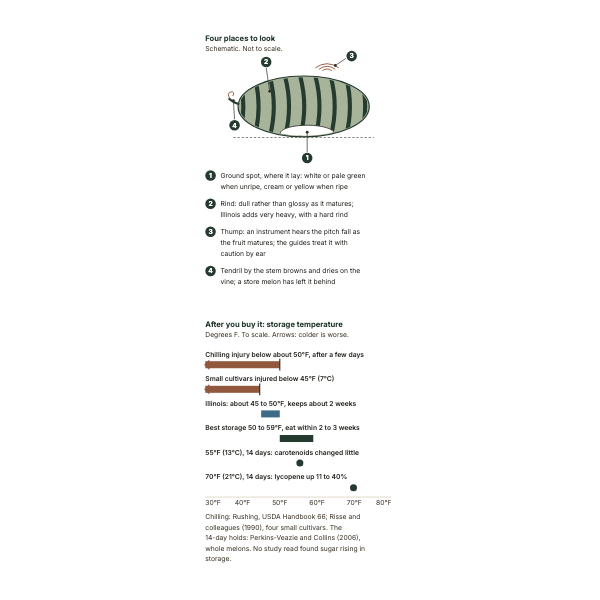
No single sign is enough on its own, and Purdue and Illinois both say to use several together. Here is what each sign looks like and what its source says about how far to trust it.
| Sign | Ripe looks like | How far to trust it |
|---|---|---|
| Ground spot
Where the fruit rests on the soil
|
Cream or yellowish, not white or greenish | Probably the most important sign (Illinois). Deeper yellow on dark-skinned types (Purdue) |
| Tendril
The curl on the vine where the fruit attaches
|
Brown and dry | A first sign. Some varieties brown it 5 to 10 days early (Purdue) |
| Rind
The surface of the fruit
|
Dull rather than slick, and rough | Part of both guides. They disagree on the thumbnail test |
| Thump
A knuckle tap
|
A dull thud rather than a ring | Weak. Many ripe melons do not thud, and a thud can mean overripe (Illinois) |
| Plug
A small cut to see the flesh
|
Deep color under the rind | The surest, but it ruins a garden melon that is not ripe (New Mexico State) |
The ground spot is the sign most guides put first. Illinois calls it probably the most important: turn the melon over, and it should be yellow or creamy underneath, not white or pale green.
New Mexico State University’s garden column describes the spot as greenish or white while the melon is immature, and cream or yellowish as it ripens. Purdue adds that dark green varieties turn a buttery yellow there, and lighter ones turn yellow less deeply.
The column adds a practical point: do not turn the melon while it grows, or the spot will not form where you can read it. A 2015 column warns that the yellow may not be distinct, only more yellow than before, and not to break the stem while checking.
The tendril is the sign the thread leaned on most, and it is the one with a published warning. Purdue lists the tendrils near the fruit turning brown and dry, then adds: “Some varieties may do this 5-10 days before the fruit is fully ripe.”
New Mexico State calls the dry tendril “a first sign” and backs it up with the ground spot. In some varieties, then, a dead tendril on its own can come several days before the fruit is ready.
The rind gives two more clues. It loses its slick look and turns dull, and its skin becomes rough, both guides agree. They split on the thumbnail.
Illinois says a ripe skin becomes resistant to a thumbnail, while Purdue’s guide says you can penetrate it with one. With the sources in conflict, the thumbnail is the weakest part of the rind check.
Thumping is the sign the guides trust least. Illinois says its other indicators are “much more reliable” than a knuckle, that many ripe melons never give the proverbial dull thud, and that a thud may mean an overripe, mushy fruit.
New Mexico State calls thumping difficult, with a ringing sound pointing to an unripe melon. That fits this grower’s experience: a watery-sounding tap on a fruit that turned out unripe.
Two other popular tests have little support in the sources read. No source found addresses stripe width. Weight is not among Purdue’s four signs, though Illinois does advise looking for a melon that is very heavy, alongside a hard rind and a yellow or creamy underside.
Putting the Signs Together
The closest thing to a test of the tendril comes from a field study of a seedless variety by Devi, Perkins-Veazie and Miles. They treated a fruit as mature once both the tendril and the small leaf at its stem were completely dry, cited from their 2020 abstract.
They then picked fruit 0, 7 and 14 days after that point. Sugar, measured as soluble solids, and lycopene did not differ among the three harvest dates. In that trial, waiting up to two weeks after the tendril and leaf dried cost nothing measurable.
New Mexico State’s column gives the order: the tendril first, then the ground spot to confirm it. Purdue and Illinois add a dull rind. In the Devi trial, maturity was marked by the tendril and the leaf beside it, both fully dry.
That is more patience than this grower used. In the Iowa study, sugar was still rising at 60 days after flowering, the last point it reports.
The worry behind early picking, a melon left too long and rotting, is real. None of the sources read, though, says how long a ripe watermelon can stay on the vine before it spoils. Illinois’ warning that a dull thud may mean overripe is the only hint of that limit in these guides.
The research counts days from the morning the flower opened, which a home grower rarely knows. None of the extension guides read here suggests marking flowers, so the field signs above are what the guides offer.
What Remains to Be Explored
The stage timeline in the figure comes from one early East Asian cultivar and one wild watermelon. How many days a given garden variety needs from pollination to red flesh was not found in the sources read.
No heat-unit total for watermelon ripening was found, and no test of stripe width as a sign of ripeness. The one trial of quality after a dry tendril used a single seedless variety in a disease-infested field.
Purdue’s warning that the tendril can brown early does not say which varieties do it, and the extension guides read the thumbnail test differently. Neither question has a study behind it in the sources read.
No study was found of seed from a packet producing a plant with mature white fruit. How quickly a ripe melon left on the vine begins to rot, the risk that made this grower pick early, is not addressed by any source read here.
Sources
- Comparative Transcriptome Analysis of Cultivated and Wild Watermelon During Fruit Development — Guo S, Sun H, Zhang H, Liu J, Ren Y, Gong G, Jiao C, Zheng Y, Yang W, Fei Z, Xu Y. PLOS ONE 10(6):e0130267. 2015.
- Characterization of Transcriptome Dynamics During Watermelon Fruit Development: Sequencing, Assembly, Annotation and Gene Expression Profiles — Guo S, Liu J, Zheng Y, Huang M, Zhang H, Gong G, He H, Ren Y, Zhong S, Fei Z, Xu Y. BMC Genomics 12:454. 2011. Cited from its abstract.
- Carbohydrate Accumulation and Color Development in Watermelon — Brown AC, Summers WL. Journal of the American Society for Horticultural Science 110(5):683. 1985. Cited from its abstract.
- 133 Watermelon Lycopene Content Varies With Cultivar and Maturity Stage — Perkins-Veazie P, Collins JK, Pair S. HortScience 35(3):412. 2000. Cited from its abstract.
- Respiration and Ethylene Production in Harvested Watermelon Fruit: Evidence for Nonclimacteric Respiratory Behavior — Elkashif ME, Huber DJ, Brecht JK. Journal of the American Society for Horticultural Science 114(1):81-85. 1989. Cited from its abstract.
- A Natural Variant of NON-RIPENING Promotes Fruit Ripening in Watermelon — Wang J, Yu Y, Guo S, Zhang J, Ren Y, Tian S, Li M, Liao S, Gong G, Zhang H, Xu Y. The Plant Cell. 2024. Cited from its abstract.
- Origin and Emergence of the Sweet Dessert Watermelon, Citrullus lanatus — Paris HS. Annals of Botany 116(2):133-148. 2015. Cited from its abstract.
- Resequencing of 414 Cultivated and Wild Watermelon Accessions Identifies Selection for Fruit Quality Traits — Guo S, Zhao S, Sun H, Wang X, Wu S, Lin T, Ren Y, Gao L, Deng Y, Zhang J, Lu X, Zhang H, Shang J, Gong G, Wen C, He N, et al. Nature Genetics 51:1616-1623. 2019. Cited from its abstract.
- 454 Deficit Irrigation Affects Yield and Quality of Triploid and Diploid Watermelon — Leskovar DI, Perkins-Veazie P, Meiri A. HortScience 34(3):523. 1999. Cited from its abstract.
- Effect of Timing of High Temperature Treatment Around the Fruit on Sugar Accumulation in Watermelon — Fukuoka N, Masuda D, Kanamori Y. Environment Control in Biology 46(4):241. 2008. Cited from its abstract.
- Rootstock and Plastic Mulch Effect on Watermelon Flowering and Fruit Maturity in a Verticillium Dahliae-Infested Field — Devi P, Perkins-Veazie P, Miles CA. HortScience 55(9):1438-1445. 2020. Cited from its abstract.
- Flesh Color Inheritance and Gene Interactions Among Canary Yellow, Pale Yellow, and Red Watermelon — Bang H, Davis AR, Kim S, Leskovar DI, King SR. Journal of the American Society for Horticultural Science 135(4):362. 2010. Cited from its abstract.
- Watermelon (Home Vegetable Gardening) — University of Illinois Extension. Undated.
- HO-8: Growing Cucumbers, Melons, Squash, Pumpkins and Gourds — Lerner BR, Dana MN (originally Chamberlain J). Purdue University Extension. Undated.
- When Is That Melon Ripe? (Southwest Yard and Garden, July 6, 1998) — New Mexico State University Extension, Southwest Yard and Garden. New Mexico State University, College of ACES. July 6, 1998.
- Southwest Yard and Garden, October 3, 2015 (Harvesting Melons) — New Mexico State University Extension, Southwest Yard and Garden. New Mexico State University, College of ACES. October 3, 2015.
- Cross-Pollination Between Vine Crops — Steil A, Naeve L. Iowa State University Extension and Outreach, Yard and Garden. May 2025.
- Why Does My Watermelon Look Like This? — multiple community members. Reddit, r/gardening. Undated.