Both rules you have heard are true, at opposite ends of the light range. Leaves come out smaller when a plant gets too little light and also when it gets too much, and they reach full size somewhere in between.
A philodendron that starts making bigger leaves after a move to a dimmer window fits what the sources describe when a plant comes down from strong light: it grows shade leaves, which are larger and thinner.
That is not proof the new spot is bright enough, and for a climbing philodendron the biggest leaves come from climbing in good light.
The question came from a thread on r/houseplants about a lemon lime philodendron that had begun putting out the biggest leaves any of its owner’s philodendrons had ever made. The owner was pleased, which is not the usual mood of a post asking why a plant is doing something.
Replies explained it as a plant spreading wider leaves to catch scarce light, and talk turned to which windows get the least.
Soon one grower was asking whether to move a small-leaved micans out of its bright spot, and the poster and another reader said they might move theirs too. One plant’s good fortune was turning into a plan to move other plants away from their windows.
Then a reply pointed out that other sources say the opposite, that small leaves mean a plant wants more light, and asked which was right.
Others thought more light should mean bigger leaves, because it gives the plant more energy. Each side was describing something real, and the sources show where each one applies.
Both Sides of the Thread Were Describing Real Leaves
NC State Extension’s Extension Gardener Handbook, in its chapter on plants grown in containers, describes both ends. Below the best light for a plant, leaves “do not expand to their full potential size”, color is pale, and the internodes, the lengths of stem between leaves, are long.
Above the best light, the same chapter says, “Plants produce smaller leaves, reducing leaf surface area in an effort to minimize the amount of sunlight absorbed”. Leaves can turn yellow as chlorophyll is destroyed, and in severe cases they scorch.
In between, it says, “leaves are normal size” and growth is compact.
So the reply that read small leaves as a hunger for light was right about the dim end. The replies that read big leaves as a response to shade were right about what happens when a plant comes down from the bright end, which has a name of its own.
The University of Arkansas Cooperative Extension describes sun leaves, grown in full sun, as “thick, small and large in number”, and shade leaves as “thin, large and few in number”.
Moved into low light, it says, a plant must remake its sun leaves, or drop them and grow a new set of shade leaves.
Measured examples exist. In a 1982 greenhouse study, cited from its abstract, Barbara S. Fails, A. J. Lewis and J. A. Barden found weeping fig leaves grown with 75 percent of the light shut out were “larger, thinner, flatter, and darker green” than leaves grown in full sun.
A 2026 study of chili pepper in Plants by V. Solís-Montero and colleagues found mean leaf area rose from 8.95 square centimeters in full light to 22.24 in low light (about 1.4 to 3.4 square inches), while the leaves grew thinner. Both studies are on plants that grow upright from the ground, which matters later.
The Middle Is Where Leaves Are Largest
If leaves come out smaller at both ends, the biggest form somewhere between them. One study caught that middle in measurements, though not in a philodendron.
Z. Yang and colleagues, writing in BMC Plant Biology in 2026, grew Dendrobium fimbriatum, an epiphytic orchid, meaning one that grows on trees, for five months at 40, 20 and 8 percent of full sunlight.
At 20 percent, single leaves gained about two and a half times as much area as at 40 percent, and nearly three times as much as at 8 percent.
The brightest and the dimmest treatments did not differ significantly from each other, and the middle one beat both. It is an orchid, with three light levels and four replicates, so it shows the shape of the answer, not where a philodendron’s middle lies.
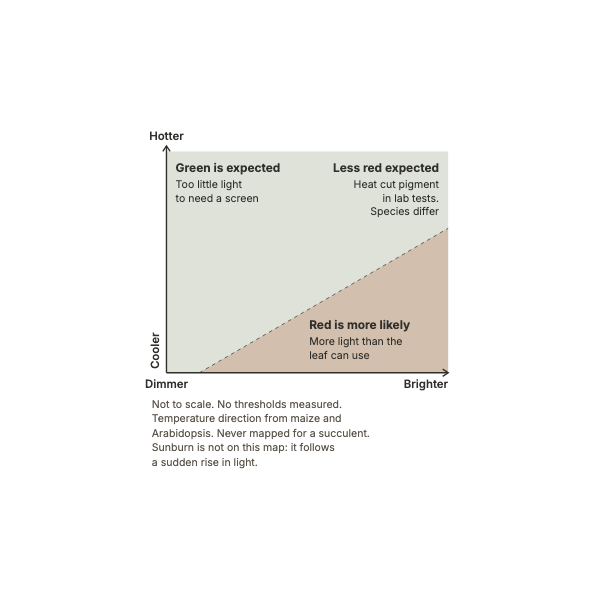
No study was found that measured heartleaf philodendron leaf size across the light levels of a home. The figure therefore places the two ends and the middle without a scale, and adds a fourth case the ends leave out: climbing.
Small leaves come from either end
Too little light and too much both give smaller leaves. Full-size leaves come in between, and a climbing philodendron adds a step of its own.
A plant moved from strong light to less light grows new shade leaves, and shade leaves are larger and thinner.
Bigger Leaves, but Fewer of Them
Larger leaves in less light are not a sign of more growth. The weeping figs in the Fails study had the same total leaf area and the same height in sun and in shade, so the shade plants spread the same amount of leaf surface across fewer, larger leaves.
Arkansas makes the same point when it calls shade leaves few in number. In the pepper study, the average count fell from about 79 leaves a plant in full light to about 33 in low light, even as each leaf grew larger.
The leaves are also thinner. Specific leaf area is leaf area per gram of leaf, and a higher value means the same material spread over more surface.
In a 2025 pothos experiment in PeerJ by C. Brito and colleagues, leaves grown in low light had about twice the specific leaf area of leaves grown in high light.
The same experiment found the pothos grew faster overall in high light. Relative growth rate, the daily gain in dry weight in proportion to the plant’s size, was higher under high light whether the plants climbed a support or crept along the ground.
A 2024 study in Scientific Reports by S. Sugano and colleagues grew pothos under office-style LED lighting for about six months. In the dimmest setting the plants kept growing, with thinner leaves. With more light they made more leaves, more total leaf area and thicker leaves.
Across many species the pattern holds at the level of the whole plant. A 2019 meta-analysis in New Phytologist by H. Poorter and colleagues, covering 500 experiments on 760 species and cited from its abstract, found leaf area ratio, leaf area per unit of plant weight, fell as much as three-fold as daily light rose.
So a bigger leaf in a dim spot is the plant spreading what it has across more surface to catch the light there. On its own, it does not say whether that light is enough for the plant to keep growing well.
Why the Canopy-Tree Comparison Runs Backward for a Philodendron
One reply compared the plant to a rainforest tree, with small leaves at the sunny top and big ones in the shade below. Another said philodendrons grow on jungle trees with little direct sun, and was told in reply that in the wild they grow large on sunlit parts of trees. For this plant, that answer was closer.
Heartleaf philodendron, Philodendron hederaceum, is a climbing vine and an aroid, a member of the family that includes pothos and monstera. NC State’s plant toolbox lists ‘Lemon Lime’ as a cultivar of it and lists Philodendron micans as an older name for the same species, so the micans in the thread is a heartleaf philodendron too.
The Brito paper’s introduction sets out the general rule for the climbing aroids whose leaves change most. Their leaf area “increases under a more illuminated exposure” toward the canopy, while “The opposite response is generally found for terrestrial plants”. The tree in the reply is a terrestrial plant, and the philodendron is a climber.
Measurements of this species from the ground into the canopy by A. Mantovani and colleagues in 2018, reported in a 2025 review in Frontiers in Plant Science by P. Yu and colleagues, put average leaf area at about 8 square inches (52 square centimeters) on the ground, 15 (96) at about 5 feet up and 27 (177) at about 10 feet.
Leaves at the higher point were more than three times the size of those on the ground. Those figures come secondhand, from the review’s table. The review also places heartleaf philodendron, following a 1990 classification, among the climbing aroids whose leaves change least in size and shape as they climb, so the general rule above was not written for it. The measurements show its leaves still grow larger higher up.
The University of Florida’s IFAS Extension fact sheet on the plant says the same in plainer terms.
Indoors it describes leaves 2 to 3 inches wide on stems trailing from a basket, and adds, “As the strong stems climb up a tree trunk or other vertical support, the leaves become larger, eventually reaching 12 inches or more in length.”
Height, light and contact with a support all change together up a tree, so field figures cannot say which one does the work. The Brito pothos experiment separated them, growing rooted cuttings for ten months either creeping along the ground or climbing a vertical support, under shade cloth or without it, in an open-air greenhouse.
Only the plants that climbed in high light made big leaves, about 1,160 square centimeters (180 square inches) on average, 9 to 13 times the size of those in every other treatment.
The other three did not differ significantly from one another. Under the shade cloth, peak light was about one twenty-fourth of the open treatment’s.
Pothos changes far more on climbing than heartleaf philodendron does, so the size of that jump does not carry over. The direction does carry over, in the philodendron measurements and in Florida’s account, though only the pothos work tested whether good light is needed for it.
So the evidence points to a support in good light, not shade, for the largest leaves, with the light half resting on pothos. The article on moss poles and pothos leaf size covers what the support itself changes.
The First Big Leaves Are Not the Verdict on a Spot
A plant moved into dimmer light does not live on that light alone at first. NC State’s handbook warns that a newly bought plant “may have food reserves built up, so its decline may take a few months” when it is moved into too little light.
A 2005 study in the journal Científica by Adalberto Di Benedetto and colleagues at the University of Buenos Aires kept Aglaonema, another aroid houseplant, in very dim light for four months. New leaves formed there came out smaller relative to the size of the plant, slightly but significantly, and the difference grew on the smaller plants.
The authors propose that in long low light, leaf size is limited by how much of the plant’s stored reserves can be moved into new leaves. They did not measure the reserves themselves.
They also cite an earlier study by Di Benedetto and a colleague in which a change in leaf size took ten to twelve months and three to five leaves to show after a move from high to low light.
Neither study is on a philodendron, and that earlier paper is known only through this one.
Together with NC State’s warning, they describe a change that shows over months and over several leaves, which is why the first one or two big leaves after a move say little on their own about how the spot will hold up.
North, East, and What Counts as Less Light
The thread also argued over whether an east or a north window gives less light. NC State’s handbook answers the general case: “Windows that face south, east, and west allow more light indoors than windows that face north,” and it lists rooms facing north among low-light places.
That holds in the Northern Hemisphere; south of the equator, north and south swap. Distance counts as well as direction, because the same chapter treats spots more than 8 feet from a window, dim corners and the middle of a room as low light too.
NC State’s toolbox says heartleaf philodendron prefers medium light, tolerates low light and “can survive for long periods in extremely low light”.
Surviving is not the same as growing well. The article on why no houseplant likes low light takes up that difference, and what a plant that only tolerates dim light is giving up.
What to Do With Yours
If the leaves got bigger after a move to dimmer light, the change matches the sun-to-shade switch the sources describe, and no source read treats bigger leaves alone as a problem. What matters is what comes next, over the following months and the next several leaves.
NC State’s signs of too little light are new leaves that stop short of full size, pale color, long stretches of bare stem between leaves, and leaves dropping.
If those begin to show, the spot is too dim for the plant, and moving it closer to a light source is one of the fixes the handbook lists.
‘Lemon Lime’ complicates one of those signs. NC State describes its foliage as bright yellow to chartreuse to begin with, and no source describes how that color shifts with light, so pale color is the one sign on the list that nobody has checked against this cultivar.
If a plant in strong light makes small leaves, as the micans in the thread did, look for NC State’s other signs of too much light: yellowing and scorched patches.
The Florida sheet says direct sun “often discolors the foliage” of this plant. If the leaves are yellowed, discolored or scorched, give it less direct sun. The NC State handbook notes that draperies, shades and sheers cut the light coming in, and light falls off with distance from the window.
If the leaves are small but a good color, size alone does not show the light is too strong, since small leaves come from both ends and from other causes, such as a shortage of water while the leaf was growing.
On the evidence above, moving such a plant into dim light trades leaf count and growth for thinner leaves, which may or may not come out bigger. In the pothos trial, low light alone did not make them bigger.
If you want bigger leaves, give the stems something to climb in good light. Florida describes leaves enlarging as the stems climb a vertical support, and mentions growing it on a totem pole or other moisture-retentive support column. In the pothos trial, the support made big leaves only in high light.
A Note for Homes With Pets
NC State rates heartleaf philodendron’s poison severity as low, lists calcium oxalate crystals as the toxic principle, and lists every part of the plant. The symptoms it gives are “Oral irritation, pain and swelling of mouth, tongue and lips, excessive drooling, vomiting, and difficulty swallowing.”
It tags the plant as a problem for dogs, cats and children, and notes that it causes contact dermatitis, a skin rash, which is worth knowing before tying stems to a support.
If a pet or a child may have chewed it, the article on what “toxic to cats” means covers what the labels mean and who to contact.
Local Regulations and Safety Advisory
Plant toxicity depends on the species, the amount and the individual, and a poison control service or a veterinarian can say whether a particular plant is a concern for your household. This article is general information, not medical or veterinary advice.
Authorities to consult:
- Poison control service
- Veterinarian or animal poison control service
If a child or pet may have eaten part of a plant, contact a poison control service or a veterinarian.
What Remains to Be Explored
No study was found that measured heartleaf philodendron’s leaf size across the light levels of a home. No source found says where its middle lies, or how dim a window must be before its leaves start to shrink.
The middle peak was measured in an orchid, the effect of climbing in pothos and the slow shrinking in Aglaonema. The idea that stored reserves explain the shrinking is its authors’ proposal, and the philodendron field figures come secondhand through a review.
No study was found on whether ‘Lemon Lime’ and the other colored forms respond to light the way the green plant does. A measured comparison of leaf size, leaf count and growth for this species in north, east and south windows would settle most of what the thread argued about.
The weeping fig study and the meta-analysis are cited from their abstracts; the pothos, pepper, orchid, office-lighting and Aglaonema studies and the review are cited from their full texts.
Sources
- Philodendron hederaceum (North Carolina Extension Gardener Plant Toolbox) — NC State Extension, North Carolina Cooperative Extension. Undated.
- 18. Plants Grown in Containers, North Carolina Extension Gardener Handbook — NC State Extension. Undated.
- Philodendron scandens, Heart Leaf Philodendron (FPS472) — Edward F. Gilman, Ryan W. Klein, Gail Hansen. UF/IFAS Extension, University of Florida. Original October 1999, revised October 2023.
- Transporting House Plants — University of Arkansas System Division of Agriculture, Cooperative Extension Service. Undated.
- Increasing Leaf Sizes of the Vine Epipremnum aureum (Araceae): Photosynthesis and Respiration — Brito C, Mantuano D, De Toni KLG, Mantovani A. PeerJ 13:e19214. April 4, 2025.
- Adaptation of Indoor Ornamental Plants to Various Lighting Levels in Growth Chambers Simulating Workplace Environments — Sugano S, Ishii M, Tanabe SI. Scientific Reports 14:17424. July 29, 2024.
- Responses of Growth, Photosynthesis, Leaf Microstructural Properties, and Bioactive Compounds of Dendrobium fimbriatum to Different Light Intensities — Yang Z, Peng L, Wei L, Deng Z, Tang J, Wei Y, Chen Z, Wei X, Chai S, Ding T. BMC Plant Biology 26:1136. May 12, 2026.
- Phenotypic Plasticity Beyond Domestication: Trait- and Accession-Dependent Responses to Light in Capsicum annuum — Solís-Montero V, Téllez-Villagómez EO, Munguía-Rosas MA, Bello-Bedoy R. Plants 15(18):2825. September 15, 2026.
- Anatomy and Morphology of Sun- and Shade-Grown Ficus benjamina — Barbara S. Fails, A. J. Lewis, J. A. Barden. Journal of the American Society for Horticultural Science 107(5):754-757. September 1982. Cited from its abstract.
- Aglaonema commutatum Schott (Araceae) Leaf Growth Under Limited Light Environments. Effect of Plant Size — Adalberto Di Benedetto, Carlos Boschi, Rolando Klasman, Jorge Molinari. Cientifica (Jaboticabal) 33(2):160-164. 2005.
- A Meta-Analysis of Plant Responses to Light Intensity for 70 Traits Ranging From Molecules to Whole Plant Performance — Poorter H, Niinemets U, Ntagkas N, Siebenkas A, Maenpaa M, Matsubara S, Pons T. New Phytologist 223(3):1073-1105. April 8, 2019. Cited from its abstract.
- Diverse Climbing Strategies in Aroid Vines: Functional Adaptations and Environmental Drivers — Yu P, Weng S, Zhang B, Huang Y, Xu F. Frontiers in Plant Science 16:1692444. November 19, 2025.
- Why Would My Lemon Lime Philodendron Suddenly… (R/Houseplants Thread) — multiple community members. Reddit, r/houseplants. Undated.