Lines left on a glass cooktop by a sliding pan are not always scratches. Some are burnt food or metal from the pan base sitting on top of the glass, and a scraper followed by a cooktop cleaner is Consumer Reports’ answer for what sits on top.
A true scratch is a groove in the glass itself, cut by something harder than the glass, and cleaning does not remove it.
So clean first, then judge what is left. What the cleaning lifts was on the glass. What stays may be a groove, though no test was found that tells a stubborn deposit from a scratch by eye.
No study of pan marks on cooktops was found, and no test of polishing a scratched one. What follows rests on Consumer Reports’ care guidance and on laboratory work with glass and metals, and it says each time a finding is carried from one material to another.
The question comes from a thread on r/CleaningTips about a glass-top cooker after one stir-fry.
A friend had taken over the cooking and kept shaking a pan with a coated base back and forth across the burner, and the top came out with a ring around the burner and marks across the middle that looked like scratches.
The replies split three ways. One camp said scratched glass cannot be cleaned and the top has to be replaced. Another said this was build-up or metal from the pan, arguing that glass-ceramic is harder than any cookware. A third blamed sand or salt trapped under the pan.
By the poster’s own later report, a cream cleaner found at the back of a cupboard brought it up well, and the top no longer looked bad.
That is one kitchen and one report, not a test. It fits a mark rather than a scratch, though, and it is the reason to clean the top before pricing a new one.
A Mark Sits on the Glass; a Scratch Is in It
The smooth top of a radiant electric cooktop is glass ceramic, and Consumer Reports calls that surface vulnerable to scratching and cracking. Two different things can leave lines on it, and they need different answers.
A mark is material added to the surface: a smear of metal from a pan base, or food and spills burnt on. It stands on top of an unbroken surface, so a scraper can reach it, and a cooktop cleaner can work on what the scraper leaves.
A scratch is the surface itself changed. In soda-lime glass, the kind used in windows, Roy and colleagues (2022, Scientific Reports, cited from the abstract) describe scratches forming when a harder material is dragged across the glass, deforming it and often cracking and chipping it.
The damage does not stop at the visible line. In single scratches on the same kind of glass, Bandyopadhyay and colleagues (2012, International Journal of Applied Glass Science, cited from the abstract) found that hardness inside the groove could fall by about 30 to 70 percent, depending on load and speed.
Neither study tested cooktop glass-ceramic.
On the glass, or in it
A pan can leave metal or burnt food on top of the glass, or drag a hard grain across it. Only the first sits where a scraper can reach.
| Mark | Heavy, burned-on residue comes off with a razor blade or a glass scraper made for the purpose, held at a 45 degree angle, then a cooktop cleaner (Consumer Reports). Pots of aluminum, copper or other soft metal can leave deposits when dragged (same source). |
| Scratch | An abrasive must be at least 1.2 times harder than a surface to scratch it (Pintaude 2010). Consumer Reports says food bits under a pan can scratch the top. On soda-lime glass, the kind in windows, a scratch forms when a harder material drags across it, deforming the surface, often with cracks and chipping (Roy and others 2022); that study did not test glass-ceramic. |
| Hardness | On the Mohs scratch scale, quartz is 7, a steel nail 6.5 and a glass plate or knife 5.5 (National Park Service); halite, table salt, is 2.5 (Kansas Geological Survey). No Mohs value for cooktop glass-ceramic was found. |
| Unresolved | The thread blamed spilled salt, though halite is far softer than glass on the Mohs scale. No test of salt under a pan on a cooktop was found. |
Schematic, not to scale. No deposit thickness or groove depth was measured for a cooktop. Terracotta: what sits on top; dark band: the glass-ceramic.
Clean first. What the cleaning lifts was on the glass. What stays may be a groove in it, or a deposit the cleaning did not shift; no test was found that tells them apart by eye.
No test that tells the two apart by eye or by touch was found, so cleaning is the test, by elimination.
Whatever the scraper and the cleaner lift was on the glass. Whatever survives them is either a groove, or a deposit the cleaning did not shift, and no source found says how often each happens or how to tell them apart.
How a Pan Leaves Metal Behind
Metal does not need to be harder than glass to leave a line on it. It needs only to stick.
In a laboratory study of aluminum sliding on tool steel, Westlund, Heinrichs and Jacobson (2018, Tribology Letters, cited from the abstract) found that without a lubricant, aluminum transferred onto the steel within a few millimeters of sliding.
The study used steel, not glass, and a needle-shaped aluminum tip, not a pan, so applying it to a cooktop is an inference. It shows the mechanism the thread’s build-up camp was pointing at: metal from one surface smearing onto another rather than cutting it.
Consumer Reports names the metals. Dragging pots across glass ceramic, its cleaning guide says, is a particular problem with pots of aluminum, copper or other soft metal, which can leave deposits behind on the surface.
The thread’s pan had a coating on its base, chipped in places by the poster’s account. No source found says what pan-base coatings are made of or how they behave on a cooktop, so whether that coating, the metal under it, or burnt food made the lines is not known.
What Can Actually Scratch It
To scratch something, a material has to be harder than it, by a margin. Pintaude (2010, Journal of Tribology, cited from the abstract) gives the working figure: empirically, “the abrasive must be at least 1.2 times harder than the worn surface if it is to produce a scratch.”
The review adds that models of the ratio give different answers when materials behave very differently.
The Mohs scale ranks minerals and common objects by what scratches what. The National Park Service table puts quartz at 7, a steel nail at 6.5, a knife or glass plate at 5.5 and a copper penny at 3.5. The Kansas Geological Survey gives halite, table salt, as 2.5.
Cooktop glass-ceramic is not on that table, and no Mohs value for any cooktop glass-ceramic was found. Its position against quartz or steel therefore cannot be read off the National Park Service numbers.
That matters for the thread’s claim that glass is harder than any metal cookware. On the National Park Service table, a steel nail outranks a glass plate, so “no metal can scratch glass” is not a rule.
No hardness figure for the steel or aluminum in pan bases was found, so how a particular pan compares with a particular cooktop is unknown.
What the care guidance names as the cause of scratches is drag and grit. Consumer Reports says dragging heavy pots and pans across glass ceramic can cause nasty scratches, and tells owners to clean pan bottoms thoroughly so food bits do not scratch the surface.
Salt is the open question. The thread blamed it, yet halite at 2.5 sits far below a glass plate at 5.5. No test of salt dragged under a pan on a cooktop was found, and this article does not guess.
Cleaning It Off Without Adding Damage
The steps below follow Consumer Reports’ two guides to smoothtop care, which are written for radiant smoothtops; if yours is an induction top, check its manual for each step. Manuals differ in detail, so where yours gives a different angle, tool or cleaner, follow the manual.
- Wipe wet spills with a sponge or paper towel. Keep scouring sponges off the glass, which Consumer Reports says can scratch it.
- For heavy, burned-on residue, use a razor blade or a glass scraper made for the purpose, held at a 45 degree angle to avoid scratching the top. Several replies in the thread recommended the same tool.
- Wear an oven mitt if the top is still hot. Consumer Reports notes that smoothtops hold their heat a long time, so the surface will probably still be hot while you scrape.
- Finish with a liquid cooktop cleaner on paper towels or a ceramic cooktop cleaning pad, then buff the residue off with a clean towel.
The two guides give the same method with different timing. The cleaning guide expects the top to be hot while you scrape; the guide to making a range last longer says to tackle spills once the cooktop has cooled. No test of either was found, so follow your manual where it says.
The cleaners are made for this surface. Consumer Reports says the fine abrasives in specially formulated cooktop cleaners polish glass-ceramic better than plain soap and water, and that most it tested were excellent at cleaning smudges and spills. It names products, and this article does not.
Some spills cannot wait. Consumer Reports says sugar-based foods, such as chocolate or tomato sauce, can bond to the glass as they cool and mar the top layer, and that plastic melted onto a smoothtop can lead to potentially serious pitting.
The thread also suggested steel wool, scouring powders and stronger cleaners. Consumer Reports’ only stated warning is against scouring sponges, and no independent test of the others on glass-ceramic was found, so check your manual before any of them goes near the glass.
One reply suggested a vinegar and water spray before scraping. None of the guidance cited here mentions vinegar for a cooktop, so it is not part of the method here.
If vinegar is used anywhere nearby, it must never meet bleach: as fruit fly trap baits sets out, the New Jersey Department of Health warns the two can make a toxic gas.
Read each cleaner’s label and the cooktop manual before using it, and never mix cleaning products, on the glass or in a bottle.
Can a Real Scratch Be Polished Out?
The thread offered drill attachments, car buffing pads, car polish, baking soda and specialist polishes for what survives cleaning. No test of any of them on a cooktop was found, and none of the guidance cited here recommends polishing a scratch.
Polishing glass means taking glass away. Bandyopadhyay and colleagues describe precision grinding and polishing as the controlled removal of glass from the surface. No measurement of whether a polish leaves a scratched cooktop clearer or duller was found.
The fine abrasives in a cooktop cleaner are a different matter. Consumer Reports describes them as polishing the surface to keep its shine. Neither of its guides says a cooktop cleaner removes a scratch, and no test of one on a scratched cooktop was found.
The laboratory work points the same way. Bandyopadhyay and colleagues found hardness falling inside a scratch groove, so a scratch changes the glass beneath the visible line as well as the line itself. That finding is for soda-lime glass, not glass-ceramic.
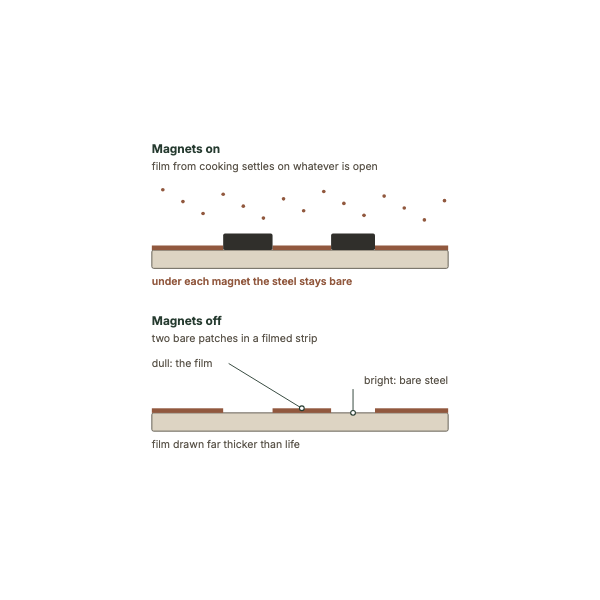
The same order, clean first and abrade last, applies to the stainless steel of a range hood marked where magnets sat, where the pale shapes may be the clean steel and the film around them the change.
For a scratch that stays after cleaning, the honest choices are to live with it or to replace the top, and the next section covers what is known about each.
Living With It, or Replacing the Top
No independent source found says whether a scratched top is safe to keep cooking on, or how much a surface scratch matters to how the cooktop works. Your cooktop’s manual is the place to check that for your model.
A crack is different, and so is pitting. Consumer Reports describes glass ceramic as vulnerable to cracking as well as scratching, and says that once melted plastic has pitted the surface, you will probably have to replace the entire glass ceramic panel.
Replacing the glass is a repair to an electrical appliance, so it is work for a qualified appliance technician or the maker’s authorized service, as your manual directs. This article gives no procedure.
No current source for what a replacement costs was found, and whether a store, a warranty or an insurer covers the damage depends on the country and the policy.
Keeping It From Happening Again
Lift pans instead of sliding them, as both Consumer Reports guides advise. The second also says to use flat-bottomed pots and pans and to place them rather than plunking them down. Neither discusses stir-frying, but shaking a pan back and forth across the burner, as in the thread, is the sliding both guides warn against.
Before cooking, clean the bottoms of your pans so that food bits do not scratch the surface, and wipe up sugary spills promptly. Consumer Reports also suggests metal or wood utensils in place of plastic ones, which can melt onto the glass.
Take most care with pots of aluminum, copper or other soft metal, which Consumer Reports singles out for the deposits they leave when dragged, and clean the top now and then with a cooktop cleaner to keep its shine.
Local Regulations and Safety Advisory
If you use household chemicals, follow the label. Rules on them vary by country and locality, and your hazardous waste service can say what applies where you live. Replacing a cracked or broken cooktop glass is a repair to an electrical appliance, for a qualified appliance technician or the maker's authorized service as your cooktop's manual directs. This article is general information, not legal, medical or professional safety advice.
Authorities to consult:
- Public health department or hazardous waste service
- A qualified appliance technician or the cooktop maker's authorized service
- Licensed electrician
Leave electrical work to licensed professionals, and call emergency services if there is an immediate hazard.
What Remains to Be Explored
No study was found of marks on cooktops: how often a line left by a pan is metal or food on the surface rather than a groove, or which pans and coatings leave which. The transfer finding is from aluminum on tool steel, carried to glass-ceramic by inference, and the scratch findings are from soda-lime glass.
No Mohs value for cooktop glass-ceramic was found, and no hardness for the steel, aluminum or coatings used in pan bases was found, so no source places a given pan against a given cooktop. A published hardness for both on one scale would settle the thread’s argument about metal directly.
Salt remains unexplained. The thread blamed it, while the hardness tables put halite far below glass. Whether impurities, other grains in a spill, or something else could scratch is not known, and a test of salt dragged under a pan on glass-ceramic would answer it.
The cleaning method rests on one consumer testing organization’s guidance, not on a controlled test, and its two guides time the scraping differently, hot or cooled. No independent test of steel wool, scouring powders or oven sprays on glass-ceramic was found.
No source found says whether a scratched top is safe to keep cooking on, no test of polishing a scratched cooktop was found, and no current price for a replacement top. Any of these would sharpen the answer for a reader deciding between a cleaner, a polish and a new top.
Sources
- An Overview of the Hardness Differential Required for Abrasion — Pintaude G. Journal of Tribology 132(3). 2010. Cited from its abstract.
- Revealing the Surface Structural Cause of Scratch Formation on Soda-Lime-Silica Glass — Roy B, Rosin A, Gerdes T, Schafföner S. Scientific Reports 12. 2022. Cited from its abstract.
- Novel Combined Scratch and Nanoindentation Experiments on Soda-Lime-Silica Glass — Bandyopadhyay P, Dey A, Mukhopadhyay AK. International Journal of Applied Glass Science 3(2). 2012. Cited from its abstract.
- On the Role of Material Transfer in Friction Between Metals: Initial Phenomena and Effects of Roughness and Boundary Lubrication in Sliding Between Aluminium and Tool Steels — Westlund V, Heinrichs J, Jacobson S. Tribology Letters 66. 2018. Cited from its abstract.
- How to Clean a Smoothtop Range or Cooktop — Daniel DiClerico. Consumer Reports. September 2, 2016.
- How to Make Your Range Last Longer — Paul Hope. Consumer Reports. June 20, 2019.
- Mohs Hardness Scale — National Park Service, Geologic Resources Division. Undated.
- Halite (Salt) — Kansas Geological Survey, University of Kansas (GeoKansas). Undated.
- My Fried [Sic] Cooked Last Night and Has Destroyed My… — multiple community members. Reddit, r/CleaningTips. Undated.