If the letters were pressed into the wood rather than cut, the remedy extension bulletins give for a dent is water and heat: a damp cloth over the groove and a warm iron touched lightly to the cloth, never to the wood, repeated until the crushed fibers swell back.
On a finished top, the same bulletin follows the steaming with fresh sealer and names water and excessive heat as the usual causes of white marks, so try it first where it will not show. Cut letters are filled, not raised, and before sanding it pays to know whether the top is veneer.
No source read tests steam on a pressed message, gives a veneer thickness, or covers epoxy or glass over a dent.
What follows rests on extension bulletins about furniture repair and on wood science about compressed wood, and it says where a finding is carried from one setting to another.
The question comes from a thread on r/CleaningTips. A child pressed a message of love into the top of a wooden kitchen table that does not belong to the parent who posted it, and the parent, rather than erase it, has started to think about keeping it, with a gold filler or epoxy.
The replies split between a refinishing job, perhaps for the whole top, and a damp cloth and an iron to raise the pressed grooves.
Also offered were a walnut rubbed in, wood filler, colored pencils, a clear coat, epoxy and a glass top, and one reply warned that the top might be veneer.
Pressed or Cut
Michigan State’s 1976 bulletin on simple furniture repairs (E-1045, Boschetti), kept as an archive copy the university marks as not for current recommendations, sorts damage to a finished surface by kind. Bruises and dents, a moderate depression, can be raised by applying water and heat. Deep mars and burns are filled instead, then built up with finish until level.
The thread describes the message as pressed in, which puts it on the raising side of that line if no wood was cut away. The bulletins do not give a test for telling a pressed groove from a cut one, and no source read does.
What can be said is what each kind leaves. A pressed groove still holds all of its wood, squeezed into less space. A cut groove has lost some of it.
Water and heat act on wood that is there, and the bulletins fill a deep mar rather than steam it.
Two refinishing bulletins agree on the raising step. Idaho’s 1974 guide (Shryack, Current Information Series 250) says to raise indentations with steam, a damp heavy cloth and a heated iron, repeating until the dent is level.
Michigan State’s 1948 bulletin (Extension Bulletin 295, Peck and Marion), archived with the same mark, gives the same method. Both describe it on wood stripped for refinishing, not on a finished top.
Why Water and Heat Can Lift a Dent
The idea behind the iron is that crushed wood remembers its shape. Wood scientists who compress wood on purpose, to make it denser and harder, describe two shape-memory effects: spring-back when the press is released, and set-recovery when the wood takes up moisture again.
A 2023 study in Holzforschung (Scharf and colleagues, cited from its abstract) densified Scots pine under heat and pressure. Pieces whose growth rings lay parallel to the surface showed high set-recovery when re-moistened.
Pieces with rings at 15 to 45 degrees recovered little, which the authors read as damage to the cell walls.
Recovery from damp air alone is partial. Surface-compressed poplar in a 2019 BioResources study (Gao and colleagues, cited from its abstract) regained on average 12.9 percent of its compression after conditioning at 40°C and 90 percent humidity; heat treatment after compression cut that to 4.1 and 1.5 percent.
Water also takes time to reach squeezed wood. In compressed sugi studied under a microscope (Abe and colleagues 2001, IAWA Journal, cited from its abstract), water entered first where crushed and uncrushed wood met, and more heavily compressed pieces took longer to take it up.
None of these studies is about a dent in a table. They are about lumber pressed in a machine.
Carried to a pressed groove, they fit the bulletins: crushed cells can swell back with water and heat, cells broken in the crushing recover less, and a deep groove may need more than one pass, as Michigan State’s instruction to repeat implies.
Steaming a Finished Table
Pressed wood can swell back; cut wood is filled
The same tabletop in section: a groove that only crushed the wood, one that cut it away, the finish over both, and a veneered top.
| 1. Pressed groove | Michigan State raises a moderate depression with water and heat: a damp cloth over it, a medium hot iron touched lightly to the cloth, never the wood, repeated until the fibers swell (E-1045, 1976). Pine densified under heat and pressure regained thickness when re-moistened, less where the authors read cell-wall damage (Scharf and colleagues 2023). |
| 2. Cut groove | Michigan State fills deep mars with a lacquer or shellac stick of matching color, then builds finish coats until level (E-1045). On bare wood, Idaho fills holes and cracks with wood putty or sawdust and glue (1974). No source read raises a cut. |
| 3. The finish | White marks are usually caused by water or excessive heat (E-1045). Michigan State removes wax before steaming a dent and applies a wood sealer after. |
| 4. A veneered top | Veneers are thin slices mounted on a more uniform base wood (Chuong 2020, on furniture of about 1790 to 1810). Virginia Tech smooths veneers with steel wool only (1964), and Michigan State calls replacing veneer better done by a professional (E-1045). No source read gives a thickness. |
Every step on a finished top is tried first in an inconspicuous spot (E-1045). No depth, thickness or number of passes is drawn.
Water and heat are the extension remedy for a dent, where the wood is crushed but still there; a cut is filled. On a finished top, water and heat can leave white marks, and Virginia Tech smooths veneer with steel wool only.
Michigan State’s 1976 steps are written for a finished piece. Remove the wax first; the bulletin uses a cloth dampened with turpentine or mineral spirits.
Place a damp cloth over the dent and touch it lightly with a medium hot iron, without letting the iron touch the wood. Repeat until the fibers swell and rise to the surface.
The bulletin does not stop there. It goes on to apply wood sealer, let it dry 24 hours, rub with very fine steel wool and wax.
The steaming, in other words, is followed by new finish over the spot.
The same bulletin lists white marks among finish damage and says they are usually caused by water or excessive heat.
Michigan State’s 1948 bulletin says white spots from water or heat can be removed if they have not gone too deep into the finish, and that otherwise the finish must come off.
So the cost of steaming a finished top is the finish over the letters. Michigan State’s bulletin ends with a reminder to test any untried method in an inconspicuous spot first. On a borrowed table, the finish at stake is the owner’s.
How much a finish keeps water out of the wood below is not covered by any source read, and neither is how many passes a pressed message would take. The bulletins give no iron setting beyond medium hot or warm, and no time per pass.
Filling What Was Cut
For a cut or a deep mar, Michigan State’s 1976 bulletin fills the hole with a lacquer or shellac stick in a color that matches the wood’s finish, then applies several coats of the original finish until the blemish is even with the surface, sanding the spot level if needed.
On wood being refinished, Idaho’s 1974 guide fills holes and cracks with sawdust and glue, wood dough or wood putty, building the fill above the surface because it shrinks, and adding more after a day if it has. Michigan State’s 1948 bulletin adds wood putty mixed with powdered stain the color of the wood.
All of these fillers are meant to disappear into the wood. A gold or other contrasting filler, which would make the message stand out, is not covered by any source read, so nothing here says how it would wear or take a finish.
Solid Wood or Veneer, and Sanding the Whole Top
A veneered top is a thin slice of wood mounted on a base wood. An essay on American veneer furniture of about 1790 to 1810 (Chuong 2020, Journal18) describes cabinetmakers mounting fragile veneers onto more uniform base woods, showing off the figure while making up for its weakness.
That thinness is why the replies’ warning matters. To sand a groove out, the whole surface around it has to come down to the groove’s floor.
Virginia’s 1964 refinishing circular (Habel, Circular 946) says veneers should be smoothed with steel wool only, and that water stains are not ordinarily used on veneer.
Michigan State’s 1976 bulletin counts replacing veneer and refinishing an entire piece among repairs better done by a professional, and Alabama Extension’s guide to salvaging flood-damaged furniture (2018) sends extensive repair or reveneering to a furniture repair shop, while saying solid wood can usually be restored unless damage is severe.
Whether the whole top must be redone depends on the finish as well. Idaho’s guide says surface finishes such as lacquer, varnish and shellac show scratches and mar readily, and that when repair is necessary the entire surface must be redone. Penetrating finishes, it says, make patch repairs easy.
No source read gives a veneer thickness or a way to tell veneer from solid wood on a finished table. The guidance read on veneer stops at Virginia’s steel wool and Michigan State’s referral to a professional.
Keeping It: Nuts, Coatings and Glass
The walnut in the replies has an extension source. Michigan State’s 1976 bulletin and Virginia’s 1964 circular both say broken nutmeats, pecan, English or black walnut, Brazil or butternut, rubbed diagonally along a minor scratch on natural-finish wood darken it. Michigan State offers it to disguise minor scratches. Neither bulletin offers it for a dent or a groove, and it colors rather than fills.
Whether rubbed nutmeat would disguise pressed letters or darken them so they read more plainly is not covered by either bulletin. Neither bulletin says how long the color lasts or how it behaves under a later finish.
A clear coat, epoxy poured over the top and a sheet of glass were all offered as ways to preserve the message.
No source read covers any of them over a dented or carved top, so this article does not say how they would hold up or whether they would trap the grooves as they are.
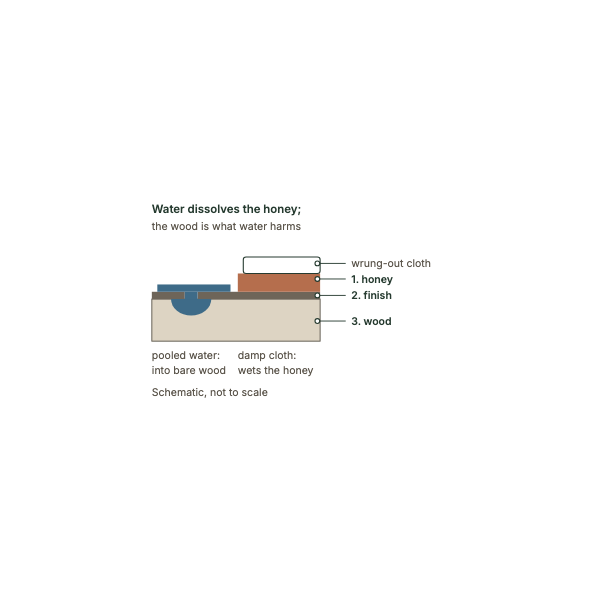
For other marks on household surfaces, see dried honey in a wooden drawer, which covers water on bare and finished wood, and dried nail polish in a bathtub.
Local Regulations and Safety Advisory
Use one product at a time and follow its label; never mix a solvent with another cleaner, and try any step on a hidden spot first. The table's finish belongs to its owner, so check before changing it. This article is general information, not legal advice.
Authorities to consult:
- Each product's label
What Remains to Be Explored
No test of steam on a pressed message, or of any dent repair on a finished top, was found.
The advice rests on extension bulletins from 1948 to 1976 that name no test behind their steps, and on studies of lumber densified in a press; a test on finished tabletops would change it most.
No source read gives a veneer thickness, a way to tell veneer from solid wood without cutting into it, or a way to tell a pressed groove from a cut one.
How many passes of the iron a deep groove needs, and how far water passes through a finish, are not known here either.
Nothing read covers a contrasting filler, epoxy or glass over a dent, or how nutmeat color holds under a finish. Studies of compressed wood recovering in water, rather than humid air, and on hardwoods common in tables would show how much a pressed groove can rise.
Sources
- Kiddo Decided to Memorialize Her Love in the Kitchen Table — multiple community members. Reddit, r/CleaningTips. Undated.
- Making Simple Repairs on Wood Furniture (Extension Bulletin E-1045) — Margaret Boschetti; prepared by Jane Castle and Margaret Boschetti. Michigan State University Cooperative Extension Service (MSU Extension Publication Archive). October 1976.
- Refinishing Furniture: Natural Finishes (Extension Bulletin 295) — Ruth J. Peck, Jessie E. Marion. Michigan State College Extension Service (MSU Extension Publication Archive). November 1948.
- Refinishing Wood Furniture (Current Information Series No. 250) — Willma Shryack. University of Idaho Cooperative Extension Service. November 1974.
- Refinishing Furniture (Circular 946) — Katherine L. Habel. Agricultural Extension Service, Virginia Polytechnic Institute. April 1964.
- Salvaging Furniture — Alabama Cooperative Extension System. December 7, 2018.
- The Nature of American Veneer Furniture, Circa 1790-1810 — Jennifer Chuong. Journal18. 2020.
- The Effect of the Growth Ring Orientation on Spring-Back and Set-Recovery in Surface-Densified Wood — Alexander Scharf, Antoine Lemoine, Benedikt Neyses, Dick Sandberg. Holzforschung (De Gruyter). 2023. Cited from its abstract.
- Effects of Pressurized Superheated-Steam Heat Treatment on Set Recovery and Mechanical Properties of Surface-Compressed Wood — Gao Z, Huang R, Chang J, Li R. BioResources. January 14, 2019. Cited from its abstract.
- Confocal Laser Scanning Microscopy of Water Uptake During the Recovery of Compressed and Drying-Set Wood — Abe H, Funada R, Kuroda N, Furusawa O. IAWA Journal. 2001. Cited from its abstract.
- Challenges in Wood Densification: Processing and Properties — Parviz Navi. Innovation in Woodworking Industry and Engineering Design. 2013. A conference paper; cited from its abstract.