Ragweed’s pollen is a major trigger of hay fever, and the plant can also cause a skin allergy in people already sensitized to it, so “only the pollen matters” is not quite right. Whether pulling one yard’s plants changes anyone’s allergies, and how much wildlife depends on it, the sources read do not settle.
Pulling or hoeing before it sets seed is the method extension sources give for a yard. This article does not identify any plant.
The question comes from a thread on r/whatsthisplant. A plant about a foot tall at the edge of a suburban Minnesota lawn drew replies naming ragweed, first giant ragweed and then common ragweed.
The poster said touching it brought out hives, and one reply described being brought to tears by picking it.
The replies then argued. One said only flowering pollen causes hay fever and the plant itself is not an allergen.
Others said to get rid of it for the sake of the neighborhood’s allergies, against replies that it matters to wildlife, seed-eating birds in winter and insects that feed only on it. One said it was once grown as a crop for its oily seed.
What This Article Covers
This article covers ragweed in a home yard: why its pollen affects so many people, whether touching it can cause a rash, what removal does, what it offers wildlife, and how extension sources say to remove it.
It names no plant in the thread; naming a plant is left to someone who can examine it. Other weeds in a yard are in our articles on common mullein and its seed bank and Russian sage runners and seed.
Two Ragweeds
Common ragweed and giant ragweed are both native to North America and both annuals of the aster family, according to South Dakota State University Extension’s 2025 guide.
It puts common ragweed at up to 3.5 feet, usually one to two, flowering from July to September, and giant ragweed at 3.5 to 13 feet, flowering from August to October.
The NC State Extension plant record for common ragweed calls it a summer annual that grows 1 to 3 feet tall and can reach 6, tolerating drought and poor soil. It says the many seeds it makes stay viable for several years.
A Wisconsin Extension column from Marinette County by Scott Reuss says ragweed thrives in road ditches, field edges, garden beds and yard edges, and handles more salt than most plants, which gives it an edge near asphalt.
Why So Many People React
Reuss explains the reach of the pollen. Ragweed relies on wind rather than insects, so its pollen is light and floats.
Goldenrod, which blooms at the same time and often takes the blame, has heavy pollen carried by insects that does not contribute to allergies, he writes.
He gives the numbers behind it. In bloom season, 200 to 400 ragweed pollen grains in each cubic meter of air is common, and the roughly 10 percent of people sensitive to it will generally react to as few as 5 grains per cubic meter.
The plants make that pollen in vast amounts. The South Dakota State guide puts one common ragweed plant at 100 million to 3 billion grains depending on its size, and calls the pollen a major trigger for hay fever and asthma.
A Purdue Extension guide to giant ragweed, GWC-12, puts one giant ragweed plant at more than a billion grains over its life.
The season has also grown longer in the north. Ziska and colleagues found the ragweed pollen season in central North America lengthened by as much as 13 to 27 days since 1995 at latitudes above about 44 degrees north, mainly because the first fall frost came later, according to their abstract.
Carbon dioxide adds to it. In growth experiments, Ziska and Caulfield found that common ragweed grown at current carbon dioxide made 131 percent more pollen than plants grown at pre-industrial levels, and 320 percent more at a level projected for this century, according to their abstract.
Can Touching It Cause a Rash?
Yes, in some people. The NC State record names ragweed as a cause of contact dermatitis as well as allergies and hay fever, and tags it for contact dermatitis.
A review by Paulsen traces the link. Sesquiterpene lactones are compounds widespread in the aster family, and skin allergy from the family has been reported since the early 1900s, and these lactones were identified as its main allergens in the late 1960s and early 1970s. In North America about 0.8 percent of patients patch tested with the standard lactone mix react to it, according to the abstract.
Ragweed itself has been tested. Möller and colleagues recalled 17 patients in southern Sweden already allergic to the lactone mix and patch tested them with ragweed extracts: 8 reacted to an American extract, 14 to a Swedish summer extract and 15 to an autumn one. All but one had chronic hand eczema, according to the abstract.
The allergen can travel in the air too. Schumacher and Silvis describe three people with rashes worsened by time outdoors who reacted to triangle-leaf bursage, which the authors call a ragweed, and filters from an air sampler in one patient’s home also gave a positive patch test, according to their abstract.
None of these sources describes hives. The reaction they report is contact dermatitis, an eczema-like rash, and the people tested were already sensitized. Whether the poster’s hives were that reaction or something else, the article cannot say.
Giant ragweed is included as well: a CABI datasheet by Iamonico says its pollen is allergenic and can induce allergic rhinitis, fever or dermatitis, according to the abstract.
Does Pulling One Yard’s Plants Help?
Reuss thinks so. He believes cutting down the number of plants in an area will lower the overall pollen load, which may help keep someone in the family from becoming sensitized, since a lifetime of exposure raises the chance of stronger allergies. He gives the plant counts as his reason.
That is an agent’s reasoning, labeled as his belief, and no source read measured how much one yard’s plants change the pollen a household breathes.
Pollen also travels: a study of Upper Silesia, Poland, found ragweed pollen in the air from early August to mid-October and said transport from distant areas could not be excluded, according to its abstract.
Reuss adds that mowing timing cuts pollen even where plants survive. Mown plants grow smaller and make less pollen, and waiting to mow ditches and edge areas until mid-August kills a good share of plants and cuts pollen on the rest.
Wildlife and Insects
On wildlife, the sources give two answers. The NC State record says birds and game birds love the seeds for their high oil content, and tags the plant wildlife friendly.
The South Dakota State guide, citing the Missouri Department of Conservation, says herbivorous wildlife tends to avoid both ragweeds for their bitter taste and a tough seed coat that resists digestion.
Purdue’s GWC-12 says giant ragweed seed left on the soil surface is more prone to being eaten by insects, mice, birds or soil organisms. No study read measured how much of a bird’s winter diet ragweed seed makes up.
Insects do rely on it. Bosio and colleagues write that many insects and fungi feed or develop on common ragweed in North America, some of them specific to it or to a few plants, and that the ragweed leaf beetle has been introduced elsewhere, reaching northwestern Italy by 2013, according to their abstract.
The beetle is not strictly limited to ragweed. Milković and colleagues recorded adults feeding on Xanthium strumarium and Helianthus decapetalus at one site in Serbia, with leaf damage under 10 to 15 percent on those plants against up to 100 percent on ragweed, according to their abstract. The NC State record says the beetle proved an effective control in Europe.
Removing It
The NC State record says control is best accomplished by hoeing and hand pulling. Reuss calls hand pulling, hoeing and other physical control the most effective in garden beds and small edge areas, and says preventing seed set is the key to managing it over the long term.
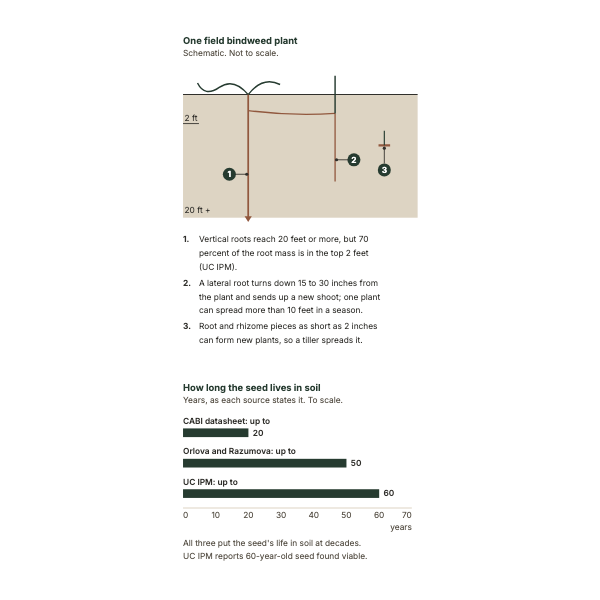
A 2019 Wisconsin Extension guide from La Crosse County quotes an Illinois Master Gardener coordinator: cut, cultivate or pull ragweed before it goes to seed, then mulch the next season and remove plants in May or June before flowering. It says the seeds can last up to thirty years in the soil.
Seed depth matters for giant ragweed. In field plots, Harrison and colleagues found the most seedlings came from seed buried 5 cm deep, 19 percent of small seeds and 49 percent of large ones, and none from 20 cm. Their model put nearly all emergence within four to seven seasons, depending on seed size and depth, according to their abstract.
On herbicides, Reuss writes that none sold to homeowners does well against ragweed later in the year, and none kills it without harming broadleaf ornamentals, vegetables or fruit. The Wisconsin and Purdue sources also report ragweed populations resistant to several herbicides. This article names no product.
Was It Ever a Crop?
One reply said ragweed was once grown for its oily seed. No source read covers ragweed as a past crop, so the claim is neither confirmed nor ruled out here. The NC State record notes only that the seeds are high in oil.
Ragweed: what the replies got right
Six things the replies said about ragweed in a yard, and what extension sources and studies found. It does not identify any plant.
| What the thread said | What the sources found |
|---|---|
| Only the pollen causes allergy, not the plant
Not quite
Skin allergy is documented
|
Ragweed is listed as a cause of contact dermatitis as well as hay fever. Of 17 patients already allergic to the plant family’s skin allergens, 8 to 15 reacted to ragweed extracts on patch testing.
NC State plant record; Möller and colleagues, 2002 (abstract)
|
| It is wind pollinated, so many people react
Supported
Light, floating pollen
|
Ragweed relies on wind, and its pollen is light and floats. About 10 percent of people are sensitive, reacting to as few as 5 grains in a cubic meter of air.
Wisconsin Extension, Marinette County
|
| Remove it for the community’s allergies
Not measured
One plant, millions of grains
|
One plant can make 100 million to 3 billion grains. An extension agent believes cutting plants lowers the pollen load; no source read measured what one yard changes.
SDSU Extension, 2025; Wisconsin Extension
|
| It matters to wildlife and birds in winter
Two accounts
No diet study read
|
NC State says birds love the oily seeds. SDSU, citing Missouri, says wildlife tends to avoid them for their bitter taste and tough seed coat.
NC State plant record; SDSU Extension, 2025
|
| Some insects feed only on it
In part
Ragweed leaf beetle
|
Many insects feed on common ragweed in North America, some on it or a few plants alone. The ragweed leaf beetle has been recorded feeding on two other plants as well.
Bosio and colleagues, 2014; Milković and colleagues, 2022 (abstracts)
|
| It was once grown as a crop
Not covered
No source read
|
No source read covers ragweed as a past crop.
None
|
Ragweed pollen drives hay fever, and the plant can cause skin allergy in people already sensitized. What pulling one yard’s plants changes, and how much wildlife uses it, the sources read do not settle.
Local Regulations and Safety Advisory
If you use pest control products, follow the label. Rules on them vary by country and locality, and your pesticide regulator can say what applies where you live. This article identifies no plant, so have yours named by someone who can examine it. A rash or breathing trouble after contact with a plant is for a doctor. This article is general information, not legal advice.
Authorities to consult:
- Pesticide regulatory authority or environmental protection agency
- Doctor or allergist, for a skin or breathing reaction
What Remains to Be Explored
No source read measured how much removing the plants in one yard lowers a household’s pollen exposure, or how much of a bird’s diet ragweed seed provides. Nothing read describes hives from touching ragweed, as opposed to contact dermatitis.
Whether ragweed was ever cultivated for its seed was not covered by any source read. How long common ragweed seed survives in a yard’s soil is given differently by different sources, from several years to thirty.
Sources
- Plant? — multiple community members. Reddit, r/whatsthisplant. Undated.
- Ambrosia artemisiifolia — NC State Extension. Undated.
- Ragweed Season Upon Us — Scott Reuss. University of Wisconsin-Madison Division of Extension, Marinette County. October 2020.
- Ragweed – A Quick Guide — Wisconsin Extension, La Crosse County. University of Wisconsin-Madison Division of Extension, La Crosse County. August 16, 2019.
- Identification and Management of Common Ragweed (Ambrosia artemisiifolia) and Giant Ragweed (Ambrosia trifida) — Zachary Loomis, Eric Jones, Adam J. Varenhorst. South Dakota State University Extension. January 2025.
- Biology and Management of Giant Ragweed (GWC-12) — Bill Johnson, Mark Loux, Dawn Nordby, Christy Sprague, Glenn Nice, Andy Westhoven, Jeff Stachler. Purdue Extension. Undated.
- Recent Warming by Latitude Associated With Increased Length of Ragweed Pollen Season in Central North America — Ziska Lewis, Knowlton Kim, Rogers Christine, Dalan Dan, Tierney Nicole. Proceedings of the National Academy of Sciences. February 22, 2011. Cited from its abstract.
- Rising CO2 and Pollen Production of Common Ragweed (Ambrosia artemisiifolia L.), a Known Allergy-Inducing Species: Implications for Public Health — Ziska Lewis H., Caulfield Frances A. Australian Journal of Plant Physiology. October 13, 2000. Cited from its abstract.
- The Sesquiterpene Lactone Mix: A Review of Past, Present and Future Aspects — Paulsen Evy. Contact Dermatitis. October 11, 2023. Cited from its abstract.
- Contact Allergy to the Asteraceae Plant Ambrosia artemisiifolia L. (Ragweed) in Sesquiterpenelactone-Sensitive Patients in Southern Sweden — Möller Halvor, Spirén Anna, Svensson Åke, Gruvberger Birgitta, Hindsén Monica. Contact Dermatitis. September 2002. Cited from its abstract.
- Airborne Contact Dermatitis From Ambrosia deltoidea (Triangle-Leaf Bursage) — Schumacher Michael J., Silvis Nancy G. Contact Dermatitis. April 2003. Cited from its abstract.
- Ambrosia trifida (Giant Ragweed) — Iamonico Duilio. CABI Compendium. March 25, 2021. Cited from its abstract.
- Ragweed (Ambrosia) Pollen in Aeroplankton of Upper Silesia — Chłopek Kazimiera, Tokarska-Guzik Barbara. Acta Agrobotanica. 2012. Cited from its abstract.
- Spread of the Ragweed Leaf Beetle, Ophraella communa LeSage, 1986 (Coleoptera Chrysomelidae), in Piedmont Region (Northwestern Italy) — Bosio Giovanni, Massobrio Viola, Chersi Catarina, Scavarda Giovanni, Clark Shawn. Bollettino della Società Entomologica Italiana. April 15, 2014. Cited from its abstract.
- The First Record on Xanthium strumarium and Helianthus decapetalus as Host Plants of Ragweed Leaf Beetle (Ophraella communa L.) in Serbia — Milković Matija, Stanković Mihajlo, Gogić Tatjana, Rodić Sara, Konjević Aleksandra. Biljni lekar. 2022. Cited from its abstract.
- Seed Size and Burial Effects on Giant Ragweed (Ambrosia trifida) Emergence and Seed Demise — Harrison S. K., Regnier E. E., Schmoll J. T., Harrison J. M. Weed Science. February 2007. Cited from its abstract.