A snake plant grows from a rhizome, a thick underground stem that sends up one rosette of leaves after another, and the sources describe it as propagated from rhizomes and offsets. Pieces cut from that rhizome keep the parent’s yellow leaf edge; leaf cuttings do not.
Whether a division survives has not been tested for snake plants. What the sources do say is that wet mix rots snake plant roots, and that a cut surface takes days to seal, so the first weeks after dividing are when water matters most.
The question comes from a post on r/houseplants. A very tall snake plant had filled a decorative ceramic pot in a kitchen so completely that little mix was left, and a flower stalk was showing. One family member wanted to divide it into several pots; another feared cutting it apart would kill it.
Replies said dividing would not hurt it, that a piece now and then fails to root, that tall divisions fall over for weeks, and that the pot might have to be broken.
Others said to sterilize the blade, go easy on water at first, or keep it whole and move up a pot size, and that division keeps the yellow edge a leaf cutting loses.
What This Article Covers
This article covers dividing an indoor snake plant: how it grows, what happens to the yellow edge, watering after a cut and pot size. It does not identify the cultivar in the thread, and it names no product.
How a Snake Plant Grows
Singapore’s National Parks Board describes the plant as spreading through an underground rhizome, fleshy and ringed with nodes, each ending in a rosette of leaves. Janet Carson of the University of Arkansas writes that it grows from a rhizome.
Dolati and colleagues, in a study of snake plant propagation, write that it is propagated clonally through rhizomes and offsets, the abstract reports. A rosette joined to the rest by the rhizome is what a division separates.
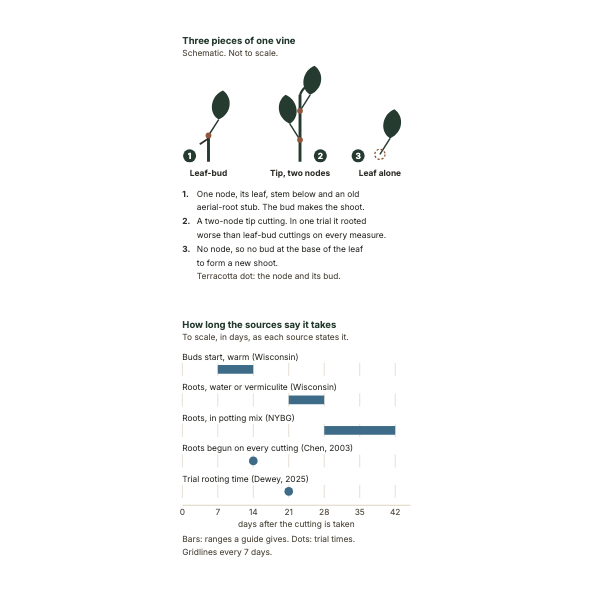
Divide at the rhizome to keep the yellow edge
Pieces cut from the rhizome carry their own rosettes and roots and keep the parent’s edge; a leaf cutting grows back green.
Rhizome: National Parks Board Singapore; University of Arkansas. Chimera: Iowa State University; Kazemzadeh Bahnamirei and colleagues, Scientific Reports, 2025; Dolati and colleagues, Flower and Ornamental Plants, 2023, both from abstracts.
In tissue culture, shoots from rhizome buds kept the chimera; leaf pieces did not give variegated plants.
Will Dividing Kill It?
No source read tested dividing a snake plant or counted how many divisions root. The nearest evidence comes from tissue culture: Kazemzadeh Bahnamirei and colleagues found that every plant regenerated from the rhizome’s nodal and terminal buds resembled its mother plant, the abstract reports. That shows rhizome buds can grow on, not how a cut piece fares in a pot.
In two trials on other plants, cutting into a root-bound root ball did little lasting harm. In begonias, cutting off the bottom of a root-bound root ball did not change establishment or growth, Scheiber and Beeson found, and in tomatoes even halving the root ball did not change total yield, Thompson and colleagues found.
Neither study was on a snake plant, and the cutting of root balls is set out in a root-bound spider plant.
The reply that a chunk sometimes fails to reroot is untested; no source read reports a failure rate.
Why Leaf Cuttings Lose the Yellow Edge
Iowa State writes that leaf section cuttings work well for snake plant, but that most variegated forms do not come true from them, because their variegation is a chimera: the yellow edge is a layer of genetically different tissue.
Dolati and colleagues tested this in a greenhouse: no type of leaf cutting produced plants with the chimeric edge, including cuttings shaped to include it, likely because new buds formed from the leaf’s inner layers, the abstract reports.
Kazemzadeh Bahnamirei and colleagues write that the edge is compromised when plants are grown from leaf cuttings, while shoots from rhizome buds kept it.
So the reply was right: a division keeps the edge, and a leaf cutting gives a green plant.
Iowa State’s Aaron Steil puts it as advice: to keep the leaf pattern, propagate by division instead. Leaf pieces are still a way to get more plants, green ones.
Steil’s steps are to cut a leaf into 3 to 4 inch sections, keep track of which end was nearer the base, and set that end 1 to 2 inches deep in moist rooting medium.
The sections need warmth, 65°F to 75°F air, bright indirect light and high humidity, and new shoots should appear at the base in about two months, Steil writes. Dolati and colleagues found a coconut-coir and perlite mix gave leaf cuttings more roots than perlite alone, though not more shoots.
Watering After a Cut
The sources agree on the main risk to snake plants. NC State’s plant record says not to overwater, as the roots will rot.
Mississippi State’s Eddie Smith calls overwatering the quickest way to run into problems, Illinois’s Rhonda Ferree the likely cause of failure, and Carson says the plant takes almost any abuse except too much water.
A cut also takes time to seal. In stem cuttings of Dieffenbachia, another houseplant, Marlatt found the cut surface needed at least 2 days to lay down suberin, a corky barrier, and at least 9 to form a periderm, a new protective layer, fastest at high humidity, the abstract reports. No study read times the first watering after dividing a snake plant.
Whether a cut should dry before potting is covered for succulent pieces in a succulent pup that won’t root.
Pot Size and Tall Divisions
Carson’s advice is to repot as needed when the plant gets pot-bound and not to increase the pot size too much, with a drainage hole in every container to avoid overwatering. That bears on the reply to move up about 30 percent, though no source read gives a percentage.
No source read covers foam blocks, chopsticks or deep pots to hold up a tall division. What staking does to roots in other plants is set out in a jade plant loose in its pot.
Thin Leaves and Light
One reply said thin leaves mean too little light. NC State’s plant record gives the plant direct sun for part of the day, 2 to 6 hours, while noting that it tolerates very low light.
Mississippi State’s Smith ties flowering to bright, indirect light. No source read ties leaf thickness to light in this plant, so the reply is unconfirmed here.
Handling Cut Pieces
NC State notes that the sap can cause skin irritation, and that the plant is toxic if eaten, with saponins as the toxic principle.
The National Parks Board calls the sap an irritant and the plant mildly toxic to dogs and cats. Dividing means handling cut leaves and rhizomes, where that sap is exposed.
Dividing While It Flowers
No source read covers dividing a snake plant in flower. Why it flowers, and whether that means it is root-bound, is taken up in a flowering snake plant. Ferree writes that typically only mature plants flower, and Carson that plants may bloom when pot-bound and old enough, usually 5 to 7 years.
What to Do
- Divide along the rhizome so each piece has its own rosette and roots; pieces from the rhizome keep the yellow edge (NParks; Dolati; Kazemzadeh Bahnamirei).
- Do not count on leaf cuttings to keep the edge; they come up green (Iowa State; Dolati).
- Pot each piece in a container with a drainage hole, not much bigger than the piece (Arkansas).
- Keep the mix on the dry side at first; overwatering rots snake plant roots (NC State; Mississippi State; Illinois).
- Expect a cut surface to take days to seal, as it did in Dieffenbachia (Marlatt).
- Keep pets and children from chewing the leaves; see the advisory below.
Local Regulations and Safety Advisory
Plant toxicity depends on the species, the amount and the individual, and a poison control service or a veterinarian can say whether a particular plant is a concern for your household. This article is general information, not medical or veterinary advice.
Authorities to consult:
- Poison control service
- Veterinarian or animal poison control service
If a child or pet may have eaten part of a plant, contact a poison control service or a veterinarian.
What Remains to Be Explored
No study read tested dividing a snake plant, counted how many divisions root, or timed their recovery. Nothing read covers sterilizing the blade, holding up a tall division, the right first watering, or dividing a plant in flower.
The chimera evidence comes from greenhouse and tissue culture work, cited from abstracts; the cut-sealing timeline is from Dieffenbachia.
Sources
- Snake Plant Question — multiple community members. Reddit, r/houseplants. Undated.
- How to Propagate Houseplants by Leaf Section Cuttings — Aaron Steil. Iowa State University Extension and Outreach, Yard and Garden. January 2025.
- Innovative in Vitro Shoot Regeneration in Variegated Snake Plant (Sansevieria trifasciata cv. Laurentii) Through Utilization of Light Exposed Rhizome Explants — Matin Kazemzadeh Bahnamirei, Mostafa Khoshhal Sarmast, M. Alizadeh, M N Padasht Dehkaei. Scientific Reports. 2025. Cited from its abstract.
- Appraisal of Leaf Cutting, Soil Mixture and Leaf Explants on Production of Sansevieria trifasciata Under Ex/in Vitro Condition — Matin Dolati, Maryam Abasabad, Esmaeil Seyfi, M. Alizadeh, Mostafa Khoshhal Sarmast. Flower and Ornamental Plants. 2023. Cited from its abstract.
- Suberin and Periderm Formation in Dieffenbachia — Robert B. Marlatt. Journal of the American Society for Horticultural Science. 1970. Cited from its abstract; Dieffenbachia.
- Establishment and Growth of Begonias in the Landscape as Affected by Root Ball Condition at Transplanting — S.M. Scheiber, Richard C. Beeson. Journal of Environmental Horticulture, 24(4):213-217. 2006. Cited from its abstract.
- Transplanting Root-Bound Tomato Starts Using Methods With High Levels of Root Disturbance Offers No Advantages — Marisa Thompson, Israel Joukhadar, Stephanie Walker, Charles Havlik, Dawn VanLeeuwen. HortTechnology, 35(3):337-342. 2025. Cited from its abstract.
- Dracaena trifasciata (Golden Birds Nest, Good Luck Plant, Mother-In-Law’s Tongue, Snake Plant) — North Carolina Extension Gardener Plant Toolbox, NC State University. Undated. A plant database from NC State Extension; it cites no studies.
- Sansevieria Is a Stylish House Plant for Everyone — Dr. Eddie Smith. Mississippi State University Extension, Southern Gardening. January 12, 2026. A gardening column from Mississippi State University Extension; it cites no studies.
- Sansevieria (Arkansas Living, January 2018) — Janet B. Carson. University of Arkansas System Division of Agriculture, Cooperative Extension Service. January 2018. A magazine column from University of Arkansas Extension; it cites no studies.
- A Houseplant Anyone Can Grow… Mother-In-Laws Tongue — Rhonda Ferree. University of Illinois Extension, ILRiverHort blog. January 25, 2014. A blog post from University of Illinois Extension; it cites no studies.
- Dracaena trifasciata (Prain) Mabb. — National Parks Board Singapore, Flora & Fauna Web. May 4, 2026. Singapore’s national plant database; it cites no studies for each entry.