To get a new fiddle leaf fig, take a piece of stem with at least one node, the joint where a leaf stalk meets the stem, or air layer a stem while it is still on the plant. A single leaf will not do it: the new stem grows from the dormant bud at the node, and a leaf pulled off on its own leaves that bud behind.
Air layering is the method Nebraska Extension lists for this plant, and the one Iowa State University Extension walks through for it. Stem cuttings are the other route, and a trial in India rooted fiddle leaf fig cuttings well in a soilless mix.
What This Article Covers
This article covers starting a new fiddle leaf fig (Ficus lyrata) at home: why a leaf on its own does not become a plant, air layering, stem and leaf-bud cuttings, and water against a rooting mix. It names no products. Rooting hormone comes up as a category only, used by its label.
How roots formed in water differ from roots formed in soil is covered in how water roots differ from soil roots, and getting a fiddle leaf fig to branch where it stands is in whether notching a stem makes a plant branch.
Why a Leaf Alone Will Not Make a Tree
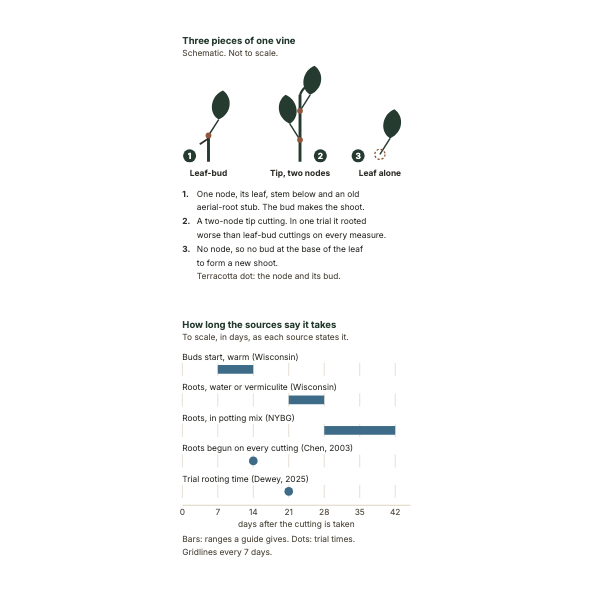
A new shoot has to come from a bud. Nebraska Extension’s guide to propagating house plants, by David Lott and Dale Lindgren, describes a leaf-bud cutting as “a single leaf attached to a piece of 1- to 1½-inch stem,” and explains where the new plant comes from: “The dormant bud, located where the leaf stalk joins the stem, will give rise to a new shoot and branches.”
A leaf pulled off at its stalk does not bring that bud with it. Some house plants can grow a whole new plant from a leaf: Nebraska names peperomia and African violets as plants started from whole leaf cuttings, where “Roots and leaves eventually will form at the base of the leaf.”
Fiddle leaf fig is not on that list; the guide’s table gives it one method, air layering.
The research is consistent with that. When Jona and Gribaudo cultured pieces of fiddle leaf fig leaf on a sterile medium with added growth regulators, the pieces began producing buds at their edges only “After 3 months,” and the buds grew into small shoots.
That is a laboratory method, and it is the only report found of fiddle leaf fig leaf tissue making shoots.
Once a cutting has a bud, roots help it start. In leaf-bud cuttings of two other house plants, Hansen and Kristensen found that “the onset of axillary bud growth is accelerated in cuttings as a result of accelerated root formation and a higher number of roots per cutting,” with some exceptions.
A cutting needs a bud, and a leaf alone has none
The new stem grows from the dormant bud where a leaf stalk meets the stem. Pieces that carry one can make a plant; a leaf on its own has none to grow from.
Nebraska Extension, Propagating House Plants (Lott and Lindgren, G1853, revised 2012); Iowa State University Extension and Outreach (Steil, reviewed 2025); Jona and Gribaudo, HortScience, 1987, from its abstract.
Take a piece with a node, or air layer the stem while it is still on the plant.
Air Layering, the Guides’ Method
Air layering forms new roots on a stem “while the propagule is still attached to the parent plant,” in Iowa State’s words.
Aaron Steil of Iowa State says layering is the option “For some plants, taking cuttings is not successful as propagules may die before new roots can be formed,” and lists fiddle leaf fig among the house plants propagated this way.
The mechanism is in the cut. Iowa State explains that “Complete or partial girdling of the plant stem interrupts the downward translocation of carbohydrates and other compounds. The accumulation of these compounds promotes rooting at the point of injury.”
Its steps for fiddle leaf fig and other plants with woody stems: with a sharp knife “cut completely around the stem,” down “to the woody center”; apply rooting hormone to the cut, as its label directs; wrap one or two handfuls of moist sphagnum moss around the wound; cover the moss with clear plastic tied above and below so none of the moss sticks out.
Check the moss and rewet it if it dries. Iowa State says roots “should appear in the sphagnum moss in several weeks,” though “for some species it could take several months.”
When roots several inches long show through the plastic, cut the stem just below the bottom tie and pot it in potting mix.
Aftercare is simple. Iowa State says to keep the new plant “well-watered and in bright, indirect light,” and that it “should be well established within a few weeks,” after which it can go where it will live.
On the hormone itself, Iowa State warns against using too much, “Too much rooting hormone can sometimes slow root development,” and says to replace it after about two years “as the efficacy of rooting hormone drops over time.” Pour out what you need rather than dipping into the original container, it adds, so disease does not spread.
Iowa State calls early spring the ideal time to layer, though most house plants can be layered at any time of year, and says air layering “can help improve the appearance of tall or leggy houseplants.”
Stem and Leaf-Bud Cuttings
A cutting with a node is the other route. Nebraska’s general rule for stem cuttings is “at least one node (joint) under the surface of the medium,” pushed about an inch deep, in moist but not soggy mix, under a clear bag, at 60 to 70°F, and potted once there is “an abundance of roots.”
It warns against setting covered cuttings in direct sun, because the heat builds up inside the plastic, “rapidly raising the temperature inside the plastic and damaging the cuttings.”
The one fiddle leaf fig cutting trial found used cuttings “with at least 2-3 nodes and one leaf.”
Chaupoo and colleagues, at Nagaland University in India, compared ten rooting media; a mix of fine river sand, cocopeat and perlite gave the most roots and the best shoot growth, about 33 roots per cutting and a root length of 31.29 cm (about a foot), and plain topsoil the least for every trait measured.
Leaf-bud cuttings, one leaf with its bud on a short piece of stem, make more plants from the same stem.
In rubber plant, another Ficus, Ghasemi Ghehsareh and Khosh-Khui found leaf-bud cuttings rooted better than one-leaf tip cuttings, and cuttings with the whole leaf blade rooted better than those with half of it cut away.
Dewey and colleagues found the same direction in pothos: two-node leaf-bud cuttings “outperformed tip cuttings based on every parameter.” Neither trial was on fiddle leaf fig, so how well its leaf-bud cuttings root at home is not established.
Water or a Rooting Mix
Nebraska’s guide says cuttings can be rooted in water, sand, perlite or vermiculite, and that “Some plants are easy to root in water, but perlite or vermiculite generally gives more satisfactory results.”
It advises against field soil, which holds too little air and can carry disease. The fiddle leaf fig trial points the same way: the soilless mix did best and topsoil worst.
No trial read compared water with a mix for fiddle leaf fig cuttings, and roots grown in water meet a different world when potted, as how water roots differ from soil roots explains.
Cuttings and air layers are asexual methods, which Nebraska notes give plants identical to the parent in most cases; starting a tree from seed instead is the subject of growing an avocado from a pit.
Local Regulations and Safety Advisory
If you use pest control products, follow the label. Rules on them vary by country and locality, and your pesticide regulator can say what applies where you live. This article is general information, not legal advice.
Authorities to consult:
- Pesticide regulatory authority or environmental protection agency
What Remains to Be Explored
No source read gives a rooting time for fiddle leaf fig stem cuttings at home, or a success rate for air layering it; Iowa State’s several weeks to several months covers house plants in general.
Whether fiddle leaf fig leaf-bud cuttings root as readily as the rubber plant and pothos cuttings in the trials was not tested.
Water against a rooting mix was not compared for this plant, and the only report of a fiddle leaf fig leaf making shoots comes from tissue culture with growth regulators, not a glass of water.
Sources
- Propagating House Plants (NebGuide G1853) — David E. Lott and Dale T. Lindgren. Nebraska Extension. December 2012.
- How to Propagate by Air Layering and Simple Layering — Aaron Steil. Iowa State University Extension and Outreach, Yard and Garden. January 2025.
- Adventitious Bud Formation From Leaf Explants of Ficus lyrata — Roberto Jona and Ivana Gribaudo. HortScience. 1987. Cited from its abstract.
- Axillary Bud Growth in Relation to Adventitious Root Formation in Cuttings — Jürgen Hansen and Kristian Kristensen. Physiologia Plantarum. 1990. Cited from its abstract.
- The Effect of Cutting Type, Leaf Area, Leaf Number, Putrescine and Indole-3-Butyric Acid on the Rooting of Ficus Cuttings (Ficus elastica Roxb. Ex Hornem.) — M. Ghasemi Ghehsareh and M. Khosh-Khui. Advances in Horticultural Science (Firenze University Press). 2018. Cited from its abstract.
- Leaf-Bud Cuttings of Devil’s Ivy and Dragon-Tail Vine Varieties Result in Higher Rooting Percentages and Better Rooting Quality Than Tip Cuttings — Carter R. Dewey, Jacob C. Hueste and Kimberly A. Williams. HortTechnology. 2025. Cited from its abstract.
- Impact of Various Rooting Media on Ficus Lyrata ‘Fiddle Leaf Fig’ Capacity for Rooting and Growth — Anu Seng Chaupoo, Rokolhuii Keditsu and Alemla Imchen. Journal of Advances in Biology and Biotechnology. 2025. Cited from its abstract.