Notching can make a stem branch, and on young apple trees it does so strongly. It can only wake a bud that is already supplied, though, so it cannot save a dying plant by itself. We found no trial of it on any houseplant.
That last point is the one the how-to pages leave out. The measured work on notching comes from orchards, where it is an established way to fill bare wood on young trees.
The fiddle leaf fig instructions we found appear to be borrowed from there, and they rarely say so.
What follows is what those trials found, what they do not tell you about a plant in your living room, and what to do with a tall bare stem or a struggling fig before you reach for a knife.
What a Notch Does
The growing tip holds back the buds below it, which is why a stem can stay bare for years with buds along it. Cutting the top off releases them, and that article covers the mechanism in full.
A notch tries for the same release at one chosen spot, without removing the top. Illinois Extension describes it as “making a small cut just above a bud with a sharp knife.”
Its explanation is the standard one: “The cut disrupts the flow of auxin, a plant hormone that suppresses lateral growth.”
So the plant keeps its height and its leaves, and you pick the position. That is the whole appeal, and it is the real difference from a tip cut, which trades height for branches and releases whichever buds sit nearest the cut.
Does it make branches or just new leaves? Readers ask this, and the two are the same event. A bud that grows produces a shoot, and that shoot carries the leaves. A new leaf on a bare stretch of stem has to come from a bud.
The auxin explanation is also less settled than the how-to pages suggest. In 2014, Michael Mason and colleagues reported in PNAS that garden pea buds began growing after the tip was removed before auxin levels had changed in the stem beside them.
Their conclusion was that the tip holds buds back largely by taking the sugar. “An enhancement in sugar supply is both necessary and sufficient for suppressed buds to be released from apical dominance,” they wrote.
That was a pea with its top cut off, not a notched stem, and we found nobody who has measured what a notch does to either substance.
What the Trials Found
The central study is Duane Greene and Wesley Autio’s, published in the Journal of the American Society for Horticultural Science in 1994 and cited here from its abstract. They removed a strip of bark 2 millimeters wide from directly above a bud on young apple trees.
The cut went down to the wood and about a third of the way around the stem. Across all their years, experiments and cultivars, notching “increased shoot production ≈600%.” That is a large effect, and it is the reason orchards use the method.
Two of their other findings matter more for your plant. There was a “positive, linear relationship between bud size and the percentage of buds growing into lateral shoots,” so a bigger bud was likelier to respond.
Position counted too: buds on top of a branch responded best, and those underneath worst.
What a notch does, and what it cannot add
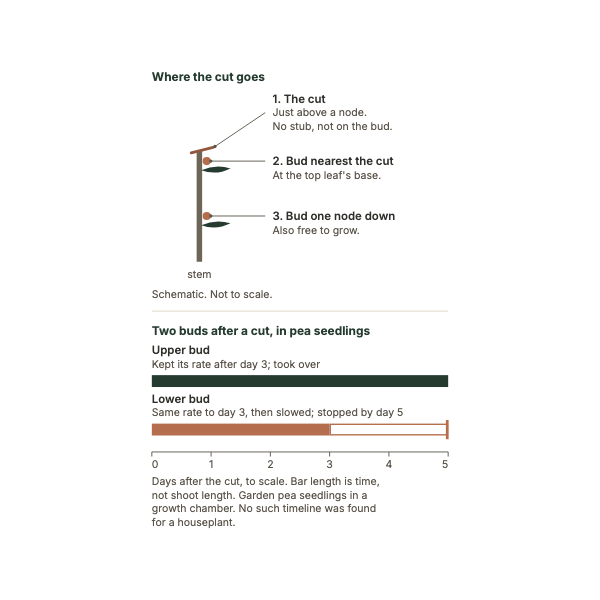
A section of stem, with the cut just above a bud. The cut comes from apple trees; no trial on a houseplant was found.
A notch can free a bud that exists and is supplied. It adds no light, no leaves and no water, so a plant short of those needs them fixed first.
Age matters as well. Virginia Tech’s Sherif M. Sherif writes, “Younger trees are more responsive to notching than older trees.” If that holds outside orchards, the old woody base of a big fig is a poor place to expect a result. Nobody has tested that on a fig.
And none of this was done on a houseplant. These were orchard trees, notched at a chosen moment before bloom. A fiddle leaf fig by a window shares the general plumbing, which is why the idea transfers at all, and very little else.
Why One Notch Works and Another Does Nothing
Because failure is normal, even for professionals. NC State’s apple specialist Tom Kon gives “~70% success rate, best case scenario” for notching plus a commercial growth-regulator spray on two-year-old wood. So even with that help, about three buds in ten stay shut.
That figure is why the replies under one widely shared fig post should not surprise anyone. Its author reports more than one notch with only one taking, and puts that down partly to chance. Another reader has tried twice without result.
A third took away an even chance of success. That figure is one person’s reading of one post.
We found no published success rate for any houseplant. The 70 percent belongs to apple wood with a growth regulator, so neither figure can tell you your odds.
What the apple results do give you is a list of reasons a particular notch can fail: the bud was small, it sat on the underside, or the tree was old. Add the one the sugar result suggests, which is our inference: a plant with little light and few leaves has little to send.
Can a Notch Save a Dying Fig?
Nothing in the evidence says so, and the post that started this argument cannot show it. The owner notched a fig with two leaves left and got a recovery over 14 months.
In those same months, by their own account, they also moved it to a sunnier window, watered it more often, and repotted it once growth appeared.
Any of those could have done the work, and light is the obvious suspect. The University of Missouri’s David Trinklein puts it plainly: “With less light, the plants have less energy to grow.” A notch changes none of that.
There is a clue in the post itself. The owner says, without explaining why, that the plant also put out new growth at the top.
A notch lower down has no obvious way to do that. A whole plant recovering because its conditions improved does, though that is our reading rather than anything measured.
So if your fig is struggling, fix what it is short of first, in this order.
- Light. Missouri’s advice for Ficus is within “about 4 feet of a good-sized east-, west-, or south-facing window.” UC Agriculture and Natural Resources lists spindly, leggy growth among the signs of an unhappy fiddle leaf fig, and no houseplant actually prefers low light.
- Water. NC State says leaf drop “may occur from too much or too little water,” so check the mix before you change anything. If it stays wet and the plant is still collapsing, look at the roots, because root rot comes from staying saturated.
- Drafts. Missouri names blasts of air noticeably warmer or cooler than the room as a cause of leaf drop. Move the plant away from heating vents and doors.
- Keep every leaf it has. This is our reasoning rather than a sourced rule. If buds need sugar and leaves make it, removing the last leaves to force a branch takes away the supply.
Dropped leaves alone do not mean the plant is dying. Missouri says of the habit, known as shattering, that it “isn’t necessarily a sign of a problem unless leaves continue to drop over a period of time.” Stress can follow a change of surroundings, Missouri adds, so a fig in a new spot may be reacting to the move.
Notch or Cut the Top Off?
If you can accept losing height, cutting the top has the better evidence on Ficus. It is the only Ficus pruning comparison we found.
Richard Criley, writing for the University of Hawaii’s extension service, tested weeping fig air layers in one-gallon pots.
Without pruning, 36.4 percent of branches showed bud break. With pruning and no chemical treatment, 72.0 and 74.0 percent did, about twice as many.
His verdict: “Pruning definitely improves bud break even without BA.” BA is a growth regulator his trial was testing, and it is not something you need here.
His warning is just as useful. “Variation was great among the treatments with some plants reacting adversely to pruning and dying.” That was a small trial, on air layers of a different species from a fiddle leaf fig. It is still a reason not to cut hard into a plant that is already failing.
For fiddle leaf figs, the extension advice is unmeasured but consistent: UC Agriculture and Natural Resources says the trunk will sprout new leaves if it is cut back, and Missouri says the plant “takes well to pruning.”
So the choice runs like this. If the plant is healthy and you can lose some height, top it. If it is healthy and the height matters, a notch is an untested gamble worth trying. If it is struggling, do neither yet.
How to Notch, If You Are Going To
These steps follow the apple work, because we found nothing else. Scale them to your stem with care: a fig is not an apple tree, and no one has given a tested depth for a thin stem.
- Put on gloves. NC State says the stems of fiddle leaf fig have “a milky sap that can irritate the skin,” and recommends gloves “particularly when pruning or propagating.” UC Agriculture and Natural Resources warns the sap will bleed from the cuts, so protect the floor as well.
- Find a node. NC State defines a node as where leaves are attached “or were once attached,” and within it sits a bud. Choose one that shows a visible bud if you can, since bigger buds did better on apple.
- Pick the side. A new shoot heads the way its bud points, so choose a bud facing where you want the branch. On an upright stem, the top-versus-underside finding has no direct equivalent.
- Cut directly above the bud. Greene and Autio took out a strip 2 millimeters wide, under a tenth of an inch. NC State’s method uses about 4 millimeters. Illinois says to use a sharp knife.
- Stop at the wood. How deep? The apple cut went through the bark to the wood and about a third of the way around, and we have no source for going further. NC State warns that notching “may create sites for infection,” though that concerns fire blight in orchards.
- Then wait, in good light. The bud needs what the leaves can make, so this is the step the rest depends on.
When should you do it? Apple’s answer is about two to four weeks before full bloom, which means nothing for a plant that may never flower indoors.
Our inference from the sugar result is to notch when the plant is in good light and already making new leaves. No source tests that.
How long will it take? We found no published figure for a houseplant. The fig’s owner reports growth after about a month, and that is one plant. A quiet notch tells you little either way.
Is the sap dangerous? Treat it as something to keep off skin and away from animals. NC State says fiddle leaf fig is “toxic to humans, cats, and dogs if ingested.”
The ASPCA lists weeping fig and Indian rubber plant as toxic to dogs, cats and horses, with signs given as “Gastrointestinal and dermal irritation.” Keep pets away from the cut and anything you trim, and see what “toxic to cats” means if one chews a plant.
Local Regulations and Safety Advisory
Plant toxicity depends on the species, the amount and the individual, and a poison control service or a veterinarian can say whether a particular plant is a concern for your household. This article is general information, not medical or veterinary advice.
Authorities to consult:
- Poison control service
- Veterinarian or animal poison control service
If a child or pet may have eaten part of a plant, contact a poison control service or a veterinarian.
What Remains to Be Explored
We looked for a notching trial on a fiddle leaf fig, a rubber plant, or any other houseplant, in extension publications and the horticultural literature, and found none. The instructions in circulation trace to orchard practice, whether or not they say so.
So we have no success rate for a houseplant, no tested depth for a thin stem, and no time to response. A controlled comparison on a fig, notched against un-notched in the same light, would settle most of this.
The mechanism is also unsettled. The extension account says a notch disrupts auxin. The pea result says sugar leads when a tip is removed. Nobody we found has measured either in a notched stem, so what a notch actually interrupts remains an open question.
Buds can also arise away from the nodes. NC State’s handbook notes that adventitious buds may develop on the stem between nodes, and we found nothing on whether a notch can provoke them. The trials notched existing buds, and that is all the evidence covers.
Finally, the Greene and Autio paper is cited from its abstract, so its methods and year-to-year variation cannot be examined from what is available here. The Ficus trial is short, covers a different species, and gives no statistics in its published text.
Sources
- Notching Techniques Increase Branching of Young Apple Trees — Duane W. Greene and Wesley R. Autio. Journal of the American Society for Horticultural Science 119(4):678-682. July 1994. Cited from its abstract. Young apple trees.
- Special Focus: Notching for Improved Apple Branching — Grant McCarty. University of Illinois Extension, Commercial Fruit and Vegetable Growers. April 30, 2025.
- Minimizing Blind Wood on Apple — Tom Kon. NC State Extension, Apples. March 24, 2020.
- Notching and PGRs to Induce Branching in Newly Planted, Non-Bearing and Bearing Apple Trees — Sherif M. Sherif. Virginia Tech, Tree Fruit Horticulture. March 27, 2020.
- Sugar Demand, Not Auxin, Is the Initial Regulator of Apical Dominance — Michael G. Mason, John J. Ross, Benjamin A. Babst, Brittany N. Wienclaw and Christine A. Beveridge. Proceedings of the National Academy of Sciences 111(16):6092-6097. April 7, 2014. Garden pea, tip removed.
- Chemical Branch Induction on Ficus benjamina — Richard A. Criley. Hawaii Cooperative Extension Service, Horticulture Digest 103. Undated. Weeping fig air layers. Page last edited 2001.
- Ficus: 2026 Houseplant of the Year — David Trinklein. University of Missouri, Integrated Pest Management, Missouri Environment and Garden. February 5, 2026.
- Fiddle Leaf Fig Houseplant – Proper Care — Sherida J. Phibbs. UC Agriculture and Natural Resources, Coastal Gardener. March 4, 2021.
- Ficus lyrata (Banjo Fig, Fiddle-Leaf Fig) — North Carolina Extension Gardener Plant Toolbox. Undated.
- Fig (Ficus benjamina), Toxic Plant Entry — ASPCA. Undated.
- 3. Botany, North Carolina Extension Gardener Handbook — K.A. Moore and L.K. Bradley (eds), 2nd ed., AG-831. NC State Extension. February 1, 2022.
- 14 Months Ago, I Notched the Trunk of My Dying Fiddle Leaf Fig (With Only Two Sad Leaves Left) in a Last Ditch Effort to Save It, and Look How Far… — Reddit, r/houseplants. Undated.