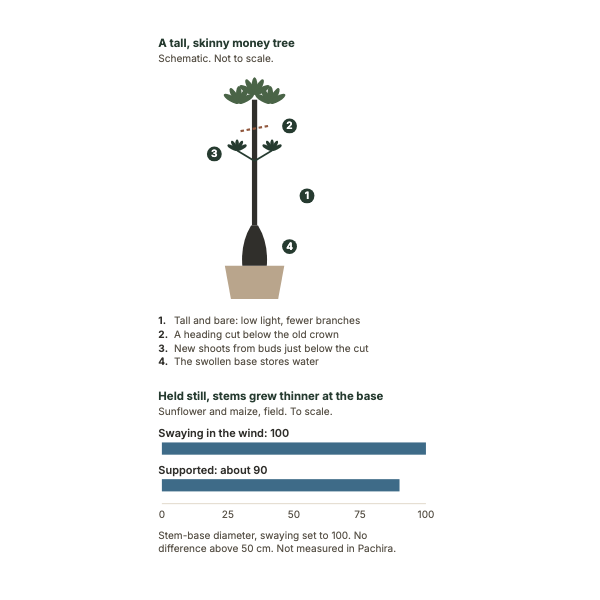
Cutting a stem back takes off the part that was holding back the buds below it. Those buds, one at each node, start to grow. When more than one starts they compete, and in the one study that timed it, the bud nearest the cut won. In the studies that tested it, whether any of them broke depended heavily on light, and no study has timed any of this on a houseplant.
A monstera that had reached the ceiling of an apartment started one r/houseplants thread. Its owner could not bring themselves to cut it or give it away.
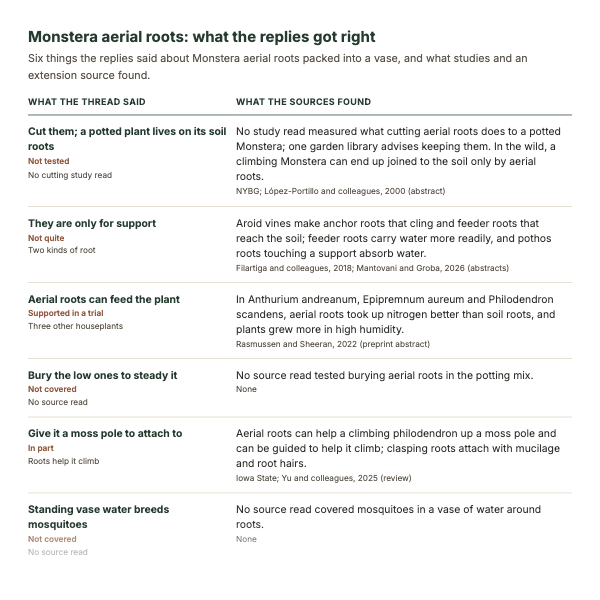
The replies offered jokes, ways to sell the cuttings, advice to cut and root the top, a suggestion to trim the leaves to keep it compact, and a warning that breaking off its aerial roots would stop it making leaves.
Hardly any reply said what the plant would do after a cut, which is the one thing that turns a frightening cut into a planned one. Here is what the sources show the plant does, where the cut belongs, and which of those beliefs the evidence supports.
Why the Buds Below the Tip Were Waiting
Every node on a stem holds a bud, sitting where the leaf stalk meets the stem. NC State’s Extension Gardener Handbook defines a node as “the stem area where leaves are attached (or were once attached)” and says that “within the node is a bud.” So a long stretch of stem below the leaves still has bud positions along it, including where leaves have fallen.
The handbook gives the classic account of why those buds wait, built on the hormone auxin: “Auxins are produced in the stem tips and promote apical dominance by suppressing the growth of lateral buds.”
Removing the tip, it goes on, “eliminates the source of auxin, and thus allows lateral buds to grow,” while cytokinin, a hormone that favors side growth, rises in the buds.
That account is right about the outcome and incomplete about the trigger. Working on garden pea, Mason and colleagues (2014) saw buds released up to 24 hours before auxin in the stem beside them changed.
What reached the buds first was sugar, and supplying extra sugar alone released held buds. In their reading, the growing tip holds the buds by taking the sugar they would need.
Auxin still matters, through other routes. Brewer and colleagues (2009) found that it acts partly by driving production of strigolactone, a second hormone that stops buds.
Tanaka and colleagues (2006) showed that cutting off a pea’s tip switches on cytokinin production in the stem at the node, yet Müller and colleagues (2015), using thale cress mutants, found that a rise in cytokinin production was not needed for buds to be released.
A 2023 review of a century of this research describes a network of auxin, strigolactone, cytokinin and sugar rather than a single switch. The studies behind it start from the same observation: with the tip gone, the buds below it grow.
Cline (1996) found the classic auxin result held in most of the ten species and plant types tested, though not in greenhouse coleus or thale cress.
Where the New Growth Will Come From
From those buds, and first from the ones nearest the cut. NC State’s pruning publication, by Barbara Fair, says that after a branch is headed back “new growth develops from buds just below the cut,” growth that “may be quite vigorous.”
It is written for trees and shrubs, so it describes where growth appears, not what a houseplant will look like afterward.
The houseplant guides agree on the place. The University of Arkansas grooming sheet says new growth “forms just below pinched-out tip,” and the University of Maryland says pinching to just above a node stimulates “new lateral growth.” Neither says how many buds will grow or how soon, and none of the guides cites a trial.
The buds below a cut start together, then one takes over
Where to cut on a stem, and the one measured race between two buds after the tip was removed.
A cut can free more than one bud, and the buds then compete. In these seedlings the upper bud took over and the lower one stopped within five days.
What happens among those buds was timed in one study. Balla and colleagues (2016) cut the tip off week-old pea seedlings with two buds below the cut.
Both buds started growing at the same rate, their length doubling daily. From day 3 the lower bud slowed, and by day 5 it had stopped, while the upper bud kept its rate and became the dominant shoot.
The race is not fixed. By redirecting the flow of auxin in the stem, the same authors changed which bud won.
Wubs and colleagues, working on a cut-rose crop, describe a harvest cut as setting “a varying number” of buds growing. No source gives a way to predict how many will grow on a particular houseplant.
Where Exactly Should You Cut?
Just above a node. NC State’s chapter on plants in containers, which covers houseplants, says to “always cut stems just above a node” or where a stem joins a larger branch, using “sharp, sanitized pruners.”
A cut below a node takes that node’s bud away with the top. A cut just above it leaves the bud on the plant with nothing growing above it.
To find a node on a vining plant, look for the place where a leaf stalk joins the stem, or where one was attached before it fell; the handbook’s definition covers both. Each is a bud position. On a long bare stretch, the old attachment points are the places to count down to.
How close to cut is a matter of degree. Fair’s guidance, for woody stems, is about a quarter inch above a bud, leaving no stub and not cutting too close.
In pea seedlings, Balla and colleagues found that leaving 90 mm of stem above the top bud delayed the genetic signs of its release by about 12 hours, compared with a 5 mm stump.
Fair adds one choice worth making on purpose: cut back to a bud “that is pointing in the direction in which you want the plant to grow.” It is written for shrubs, none of the houseplant guides cited here repeats it, and no test of it was found, but it is the one instruction among these sources that is about the shape of the plant rather than the place of the cut.
Will It Grow Back, and Will Cutting the Top Kill It?
The extension guides expect regrowth. University of Illinois Extension’s container-garden guide counts cutting back a vining plant as pinching and says new shoots then develop to fill in the plant, and the Arkansas and Maryland guides describe the same response.
None of them gives a time, and none says when a cut is too much for a houseplant or names a plant that dies of one.
The variable the research keeps returning to is light. In roses, darkness after the tip was cut stopped bud burst entirely (Girault and colleagues 2010). Rose plants moved from high to low light held their buds back (Corot and colleagues 2017).
In a cut-rose crop, the light reaching the buds was an important and consistent factor in how many broke (Wubs and colleagues 2013).
Cline found that light weakened the tip’s hold in coleus and in a morning glory.
Virginia Tech’s greenhouse guidance says plants given less light become “leggy plants with fewer branches,” and NC State’s houseplant chapter ties long, spindly stems to light below what the plant needs. Roses in growth chambers and greenhouses are not houseplants, but no study of a foliage plant was found that points the other way.
A cut changes which buds are free to grow; it does not change the light they grow in. If the plant became tall and bare in a dim spot, NC State’s description of too little light fits that shape, and the shoots that follow a cut will grow in the same light unless the plant is moved.
Does Cutting Make a Plant Bushier?
In the direction the research describes, yes: removing the tip frees buds that were held, and the Arkansas sheet says frequent pinching keeps a plant “compact, but well filled out.”
What no source promises is a number. Balla’s seedlings ended with one dominant shoot from two buds, and the rose crop with a varying number.
The thread’s other suggestion, trimming leaves to keep the plant compact, removes something different. A leaf is not the growing tip, and the studies that removed leaves disagree on what it does to the buds.
In sorghum seedlings, cutting just 2 cm from the tip of one leaf blade held back a bud lower on the plant (Kebrom and Mullet 2014).
In the cut-rose crop, removing leaves tended to increase budbreak rather than reduce it (Wubs and colleagues 2013). Neither a grass seedling nor a greenhouse rose is a houseplant, so leaf trimming has not been shown to make a vine compact.
NC State’s chapter treats leaf removal as grooming: take an unwanted leaf off where it attaches to the stem.
My Plant Has Outgrown My Space
Choose the height you want the plant to stop at, find the nearest node below it, and cut just above that node with clean, sharp pruners. NC State’s houseplant chapter lists reducing a plant’s size among the reasons to prune, and the buds at the nodes below are where the new growth will come from.
The top does not have to be thrown away. The University of Wisconsin’s monstera guide takes a top cutting “just below an aerial root,” and UConn’s fact sheet takes one 3 to 5 inches below a node, “with as many aerial roots present as possible.”
Wisconsin also lists air layering and simple layering as ways to propagate monstera at any time of year.
A cutting needs a node, because that is where the bud is; a rooted monstera leaf with no node is a different case. Roots made in a jar of water are not the same as the ones made in soil.
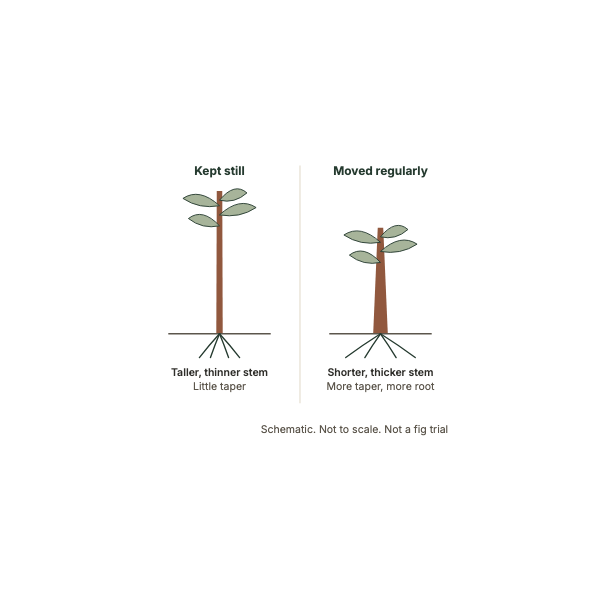
And if the stem left behind is bare low down, a bare stretch of stem is not refilled from the tip.
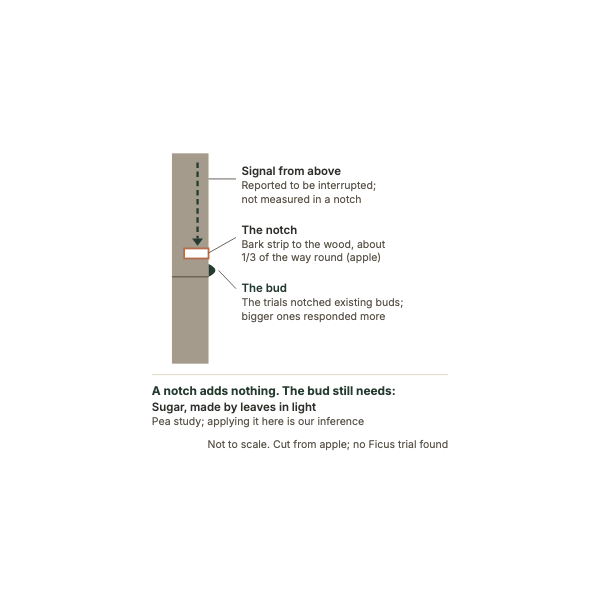
If the urge is to make the plant branch without taking the top off, a notch above a bud is the other technique people try, and what a notch can and cannot do is its own question. Either way, the light studies above apply to the buds it wakes.
What About the Aerial Roots?
No published source found supports the claim that breaking off aerial roots stops a plant making leaves, and none refutes it.
Hinchee (1981) found that monstera aerial roots that reach soil become rooting roots that branch, and Wisconsin’s guide says they “will root if they reach the ground,” suggesting a moss-covered support for them to attach to.
What removing them does to a potted plant’s leaves has not been measured in anything found. That is an absence, not a verdict: an anecdote that it stops leaves is no stronger than an anecdote that it does not. If they are in the way, the same guide’s support gives them somewhere to go.
Before You Cut: Sap, Pets and Tools
NC State’s plant records list contact dermatitis for monstera, pothos and heartleaf philodendron, and calcium oxalate crystals in all three, and note for monstera that “contact with cell sap may cause skin irritation.”
All three records list the plant as a problem for cats and dogs, and the leaves and stems among the poisonous parts.
So the pieces you cut off carry the same risk as the plant they came from. What “toxic to cats” means for a monstera is covered separately.
NC State’s chapter asks for sharp, sanitized pruners, so the cut does not fray the stem and dirty blades do not carry disease from plant to plant.
Local Regulations and Safety Advisory
Plant toxicity depends on the species, the amount and the individual, and a poison control service or a veterinarian can say whether a particular plant is a concern for your household. This article is general information, not medical or veterinary advice.
Authorities to consult:
- Poison control service
- Veterinarian or animal poison control service
If a child or pet may have eaten part of a plant, contact a poison control service or a veterinarian.
What Remains to Be Explored
No trial of cutting back a houseplant was found. None of the extension guides gives a season, an amount to remove at once, or a recovery time, and the inch or less that Arkansas and Maryland give defines a pinch rather than setting a limit. Any figure for how much is safe would need a study that was not found.
The one timed race between buds is in week-old pea seedlings in a growth chamber, and the light results come from roses and coleus. Whether a monstera’s buds compete the same way, how many a cut wakes on a mature plant, and how long they take indoors have not been measured.
The aerial-root claim stays unanswered, and the leaf-trimming evidence is split between a grass and a rose. The pet and sap lines rest on NC State’s plant records alone; a veterinary toxicology source by species would strengthen them.
A trial that cut back a common vining houseplant at set heights and light levels, and counted the shoots, would answer most of what this article cannot.
Sources
- 3. Botany — K.A. Moore and L.K. Bradley (eds), 2nd ed., AG-831; chapter contributor Chad Jordan. NC State Extension, North Carolina Extension Gardener Handbook. February 1, 2022.
- 18. Plants Grown in Containers — D. Mays, K. Richter, L.K. Bradley, J. Sherk, M. Kistler and J. Neal; K.A. Moore and L.K. Bradley (eds). NC State Extension, North Carolina Extension Gardener Handbook. February 1, 2022.
- General Pruning Techniques — Barbara Fair. N.C. Cooperative Extension, NC State University. March 5, 2025.
- Monstera deliciosa — Unsigned plant record. NC State Extension Gardener Plant Toolbox. Undated.
- Epipremnum aureum — Unsigned plant record. NC State Extension Gardener Plant Toolbox. Undated.
- Philodendron hederaceum — Unsigned plant record. NC State Extension Gardener Plant Toolbox. Undated.
- Monstera deliciosa — Susan Mahr. University of Wisconsin-Madison Extension, Horticulture. October 2026.
- Monstera deliciosa — Unsigned fact sheet. UConn Home and Garden Education Center. 2020.
- Training and Grooming Houseplants — Unsigned PDF. University of Arkansas System Division of Agriculture, Cooperative Extension Service. Undated.
- Grooming Indoor Plants — Unsigned page. University of Maryland Extension, Home and Garden Information Center. March 10, 2023.
- Container Gardens: General Maintenance — Unsigned page. University of Illinois Extension. Undated.
- Selecting and Using Plant Growth Regulators on Floricultural Crops — Joyce Latimer, Brian Whipker and Eric Stallknecht. Virginia Cooperative Extension, Virginia Tech. January 10, 2025.
- Auxin Flow-Mediated Competition Between Axillary Buds to Restore Apical Dominance — Jozef Balla, Zuzana Medveďová, Petr Kalousek, Natálie Matiješčuková, Jiří Friml, Vilém Reinöhl, Stanislav Procházka. Scientific Reports. 2016.
- Sugar Demand, Not Auxin, Is the Initial Regulator of Apical Dominance — Michael G. Mason, John J. Ross, Benjamin A. Babst, Brittany N. Wienclaw, Christine Anne Beveridge. Proceedings of the National Academy of Sciences. 2014. Cited from its abstract.
- Auxin Controls Local Cytokinin Biosynthesis in the Nodal Stem in Apical Dominance — Mina Tanaka, Kentaro Takei, Mikiko Kojima, Hitoshi Sakakibara, Hitoshi Mori. The Plant Journal. 2006. Cited from its abstract.
- Cytokinin Is Required for Escape but Not Release From Auxin Mediated Apical Dominance — Dörte Müller, Tanya Waldie, Kaori N. Miyawaki, Jennifer P.C. To, Charles W. Melnyk, Joseph J. Kieber, Tatsuo Kakimoto, Ottoline Leyser. The Plant Journal. 2015. Cited from its abstract.
- Strigolactone Acts Downstream of Auxin to Regulate Bud Outgrowth in Pea and Arabidopsis — Philip B. Brewer, Elizabeth A. Dun, Brett J. Ferguson, Catherine Rameau, Christine Anne Beveridge. Plant Physiology. 2009. Cited from its abstract.
- Lessons From a Century of Apical Dominance Research — Christine Anne Beveridge, Catherine Rameau, Akila Wijerathna Yapa. Journal of Experimental Botany. 2023. Cited from its abstract.
- Four Hypotheses to Explain Axillary Budbreak After Removal of Flower Shoots in a Cut-Rose Crop — A. Maaike Wubs, E. Heuvelink, Leo F. M. Marcelis, R.C.O. Okello, Alisa Shlyuykova, Gerhard Buck-Sorlin, Jan Vos. Journal of the American Society for Horticultural Science. 2013. Cited from its abstract.
- Photosynthetic Leaf Area Modulates Tiller Bud Outgrowth in Sorghum — Tesfamichael H. Kebrom, John E. Mullet. Plant, Cell & Environment. 2014. Cited from its abstract.
- Sugars Are Under Light Control During Bud Burst in Rosa sp. — Tiffanie Girault, Farouk Abidi, Monique Sigogne, Sandrine Pelleschi-Travier, Rachid Boumaza, Soulaïman Sakr, Nathalie Leduc. Plant, Cell & Environment. 2010. Cited from its abstract.
- Cytokinins and Abscisic Acid Act Antagonistically in the Regulation of the Bud Outgrowth Pattern by Light Intensity — Adrien Corot, Hanaé Roman, Odile Douillet, Hervé Autret, Maria-Dolores Pérez-Garcia, Sylvie Citerne, Jessica Bertheloot, Soulaïman Sakr, Nathalie Leduc, Sabine Demotes-Mainard. Frontiers in Plant Science. 2017. Cited from its abstract.
- Exogenous Auxin Effects on Lateral Bud Outgrowth in Decapitated Shoots — Morris G. Cline. Annals of Botany. 1996. Cited from its abstract.
- Morphogenesis of Aerial and Subterranean Roots of Monstera deliciosa — Maud A. W. Hinchee. Botanical Gazette. 1981. Cited from its abstract.
- HELP! What Should I Do With My Monstera? It’s Outgrown My Apartment, but I Can’t Bring Myself to Get Rid of It. — multiple community members. r/houseplants, Reddit. Undated.