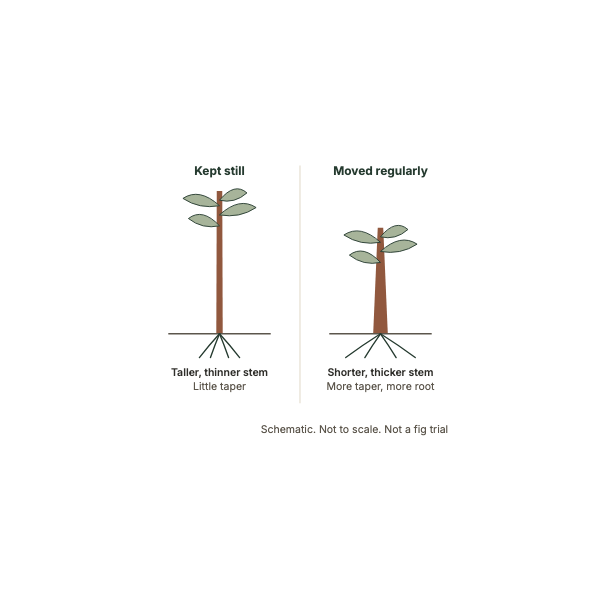
No source read explains how nurseries grow the thick money tree trunks sold in stores. The swollen base is a caudex that stores water, and the studies on stem thickness point to movement: in sunflower and maize, stems held still grew about 10 percent thinner at the base than stems left to sway.
A tall, skinny money tree is a light problem first. Low light makes plants leggy with fewer branches, and a heading cut sends new shoots out just below it, which is what one owner saw after cutting.
Two posts raise the same plant from opposite ends. In one post on r/houseplants, a grower asked how sold money trees get such fat trunks under short crowns.
Replies suggested cuttings from much bigger plants, cutting back again and again over years, growing them in the ground until thick, pruning side shoots, air layering, shaking and time.
In another post on r/houseplants, a money tree had grown past 5 feet 6 inches in four years, branching only at the top under a grow light.
Replies said it had stretched for light and should be cut, with the top rooted. The poster later reported four small branches from the stump and from the cut piece.
What This Article Covers
This article covers what the thick base of a money tree is, what the studies say about the replies’ ways of thickening a stem, why a money tree grows tall and thin, and what cutting it back does. It does not identify the plants in the threads’ photos.
What the Thick Base Is
The money tree, Pachira aquatica, has furrowed bark and a swollen caudex, which serves as a water reservoir, the University of Arizona Campus Arboretum says. NC State Extension’s plant record also calls the caudex the tree’s water reservoir.
It is a tree of seasonally flooded plains of Central and South America, sold mostly as an indoor plant under the name money tree, a CABI datasheet by Fabiola Areces-Berazain says.
Arizona gives wild trees up to 60 feet, about 30 in cultivation, and houseplants not over 6 to 8 feet. With proper care, it says, a money tree lives 50 to 150 years.
The braided form also came from cultivation. Arizona says the trunks were first braided in Taiwan in the 1980s, and that stems must be braided while young and pliable. For a braided money tree in trouble, see a dying money tree with a braided trunk.
How Sold Trunks Get Thick
No source read describes how commercial growers produce the thick-trunked money trees sold in shops, whether from seed, cuttings, plants grown in the ground or repeated cutting. So the thread’s main question has no sourced answer here, and none of the production replies can be confirmed or ruled out.
What the sources do support is narrower. Trees acclimate the internal structure of their trunk and branches to the stress they experience, Éric Badel and colleagues write in a 2015 review. Gravity and wind are among those stresses.
Does Shaking Thicken a Trunk?
The shaking reply has some indirect support, though none of it comes from money trees. Adrian M. Goodman grew sunflower and maize in the field, some held still by supports and some left to sway in the wind. Stem bases were about 10 percent thinner in the supported plants, with no difference above 50 cm.
Support also made the roots of both crops 40 to 50 percent less rigid and strong. The effect fell mostly on the lowest, most stressed parts of the plant, the abstract reports.
Wind does two things at once, V. C. Smith and A. R. Ennos found in sunflowers. Flexing the stem made it stronger and stiffer, while air flowing past the leaves made plants taller with weaker stems. So a breeze is not the same as bending, and their abstract separates the two.
No study read flexed a houseplant indoors. For a potted plant that wobbles in its pot, the flexing and staking studies are covered in a jade plant loose in its pot.
Does Pruning Side Shoots Help?
No study read pruned a money tree. In red maples planted from containers, Edward F. Gilman shortened the largest branches at planting; three growing seasons later their total cross-sectional area was 26 percent smaller than on unpruned trees, and they were smaller relative to the trunk.
That shows pruning holds a branch back. The abstract does not report trunk diameter, so it does not show that removing side shoots makes the trunk thicker, as one reply claimed.
A Tall, Skinny Money Tree
Higher light tends to limit stem elongation, giving shorter plants with more branches, and lower light has the opposite effect, giving leggy plants with fewer branches, Virginia Tech’s guide to growth regulators says. It is written for greenhouse crops, but the pattern matches the thread’s tree.
In a growth-chamber trial by Soma Sugano and colleagues, money trees kept growing for 191 days under white LEDs at office-level light, about 500 lux.
Unlike pothos, Pachira showed no significant difference in dry weight between the light levels, which the authors put down to its heavy stem, including dead tissue.
The two extension sources agree on keeping it out of direct sun; one reply did not. Arizona says money trees thrive under indirect sun, even fluorescent light, and should not be exposed to direct sun or moved once established, to avoid leaf scorch and leaf drop. NC State notes leaf scorch from direct sunlight. One reply urged the most direct sun possible.
No source read gives a light level that keeps a money tree compact.
Cutting It Back
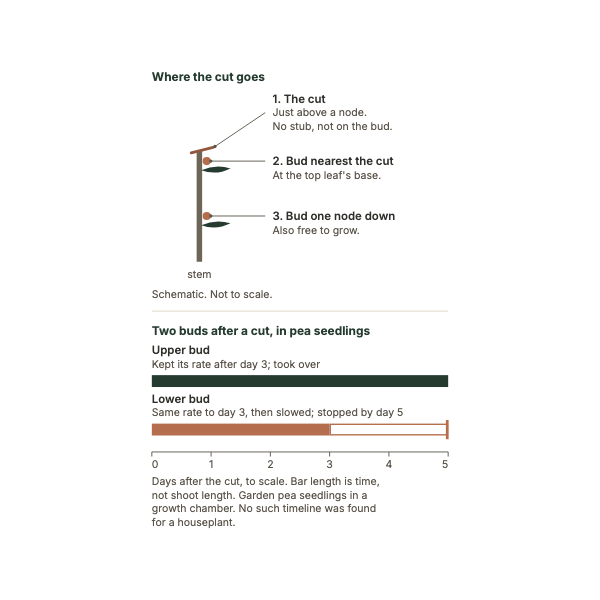
When a young branch or leader is headed back, new growth develops from buds just below the cut and may be vigorous, dense and upright, NC State Extension’s pruning guide says.
Cut a quarter inch above a bud pointing the way you want growth, without a stub. That guide is written for trees and shrubs.
Cut it back, give it light
Low light makes plants leggy with fewer branches; a heading cut sends new shoots out just below it. In sunflower and maize, stems left to sway grew thicker at the base.
1: Virginia Tech, 430-102, 2025. 2 and 3: NC State, AG-780-03, 2025, written for trees and shrubs. 4: University of Arizona Campus Arboretum. Bars: Goodman, Annals of Botany, 1997, from the abstract.
No source read measured trunk thickening in a money tree; the swaying result is from sunflower and maize.
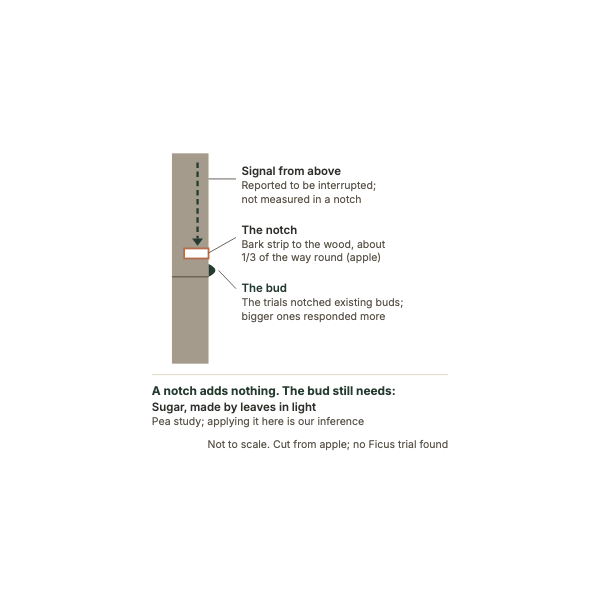
Why the buds start is still argued. In pea, Michael G. Mason and colleagues saw buds released up to 24 hours before auxin changed in the stem, as sugar moved to them, and concluded that more sugar is both necessary and sufficient for a bud to grow. For the general case in houseplants, see what happens when you cut a houseplant back.
The poster’s later report, branches from the stump, matches that account. No source read says how far down a money tree can be cut, or how long new shoots take to appear.
Rooting the Top
Money trees are propagated by softwood cuttings, air layering and seed, with cuttings and air layering the most popular, Arizona says. Cuttings taken in spring or summer may take longer to root.
No source read tested rooting money tree stem pieces in water. For a cutting that will not root, see a succulent pup that won’t root.
Pets
NC State rates the money tree’s poison severity as low, lists cats as at risk of mild to moderate stomach upset, and names the seeds as the poisonous part, adding that houseplants never produce seeds. It does not mention dogs.
Local Regulations and Safety Advisory
Plant toxicity depends on the species, the amount and the individual, and a poison control service or a veterinarian can say whether a particular plant is a concern for your household. This article is general information, not medical or veterinary advice.
Authorities to consult:
- Poison control service
- Veterinarian or animal poison control service
If a child or pet may have eaten part of a plant, contact a poison control service or a veterinarian.
What Remains to Be Explored
No source read describes how commercial money tree trunks are grown, measures trunk thickening in Pachira from shaking, pruning or light, or says how far a money tree can be cut back. The flexing results come from sunflower and maize, the pruning result from red maple.
No source read gives a light level that keeps a money tree compact, settles direct sun against indirect, or tests rooting stem pieces in water.
Sources
- How Do They Get Money Trees This Fat? — multiple community members. Reddit, r/houseplants. Undated.
- Help My Money Tree. He’s Too Tall and Skinny. — multiple community members. Reddit, r/houseplants. Undated.
- Pachira aquatica (Malabar Chestnut, Money Tree) — University of Arizona Campus Arboretum. Undated.
- Pachira aquatica, North Carolina Extension Gardener Plant Toolbox — NC State Extension. Undated.
- General Pruning Techniques — Barbara Fair. N.C. Cooperative Extension, NC State University. March 5, 2025.
- Selecting and Using Plant Growth Regulators on Floricultural Crops — Joyce Latimer, Brian Whipker and Eric Stallknecht. Virginia Cooperative Extension, Virginia Tech. January 10, 2025.
- Sugar Demand, Not Auxin, Is the Initial Regulator of Apical Dominance — Michael G. Mason, John J. Ross, Benjamin A. Babst, Brittany N. Wienclaw, Christine Anne Beveridge. Proceedings of the National Academy of Sciences. 2014. Cited from its abstract.
- Adaptation of Indoor Ornamental Plants to Various Lighting Levels in Growth Chambers Simulating Workplace Environments — Soma Sugano, Masahisa Ishii, Shin-ichi Tanabe. Scientific Reports. 2024.
- The Responses of Field-Grown Sunflower and Maize to Mechanical Support — Adrian M. Goodman. Annals of Botany. 1997. Cited from its abstract.
- The Effects of Air Flow and Stem Flexure on the Mechanical and Hydraulic Properties of the Stems of Sunflowers Helianthus annuus L. — V. C. Smith, A. R. Ennos. Journal of Experimental Botany. 2003. Cited from its abstract.
- Acclimation of Mechanical and Hydraulic Functions in Trees: Impact of the Thigmomorphogenetic Process — Éric Badel, Frank W. Ewers, Hervé Cochard, Frank W. Telewski. Frontiers in Plant Science. 2015. Cited from its abstract.
- Pruning Acer rubrum at Planting Impacts Structure and Growth After Three Growing Seasons — Edward F. Gilman. Arboriculture & Urban Forestry. 2015. Cited from its abstract.
- Pachira aquatica (Pachira Nut) — Fabiola Areces-Berazain. CABI Compendium. 2020. Cited from its abstract.