A big pot does not rot roots on its own. Roots rot when the mix around them stays short of air long enough for the fungi and fungus-like organisms in it to take hold. What a too-big pot adds, in the extension accounts, is time: more wet mix around the same roots, drying more slowly.
How much air a drained pot keeps is set by the mix and by the pot’s shape, and in the same mix a taller container keeps more of its volume as air, not less.
So the variable to manage is air and how long it stays missing. Pot size is one of several things that change it.
Why Both Camps Are Describing Something Real
The warning against big pots has extension support. Aaron Steil, writing for Iowa State University Extension, puts it plainly: “When it comes to container size, bigger is not always better.”
The aim is a pot small enough that the mix and roots “dry out in a reasonable amount of time and are not sitting for long periods in wet soil.”
The other camp has support too. The North Carolina Extension Gardener Handbook, in its container chapter, says choosing larger containers “is beneficial, however, as they do not dry out as quickly and require less frequent watering.”
That line sits in a passage mostly about vegetables and fruit, and it names the trade plainly: slower drying, less watering.
Both are describing the same fact from opposite ends: a bigger pot of mix dries more slowly.
Whether slower drying is a safety margin or a hazard depends on how long the mix then stays wet, and Iowa State lists what changes how often a pot needs water: light, temperature, humidity, the mix, the container, the plant and the season.
On growth, the evidence leans one way. A meta-analysis by Hendrik Poorter and colleagues, cited from its abstract, pooled 65 studies of pot size in plant experiments and found that doubling the pot increased plant mass by 43% on average.
It did not look at root rot, and it is the subject of whether a big plant needs a bigger pot.
What a Drained Pot Actually Holds
Soak a pot of mix completely and water fills every pore. Then gravity pulls water out of the wide pores, and air takes their place. The narrow pores hold their water against gravity. What is left once the dripping stops is the container’s water-holding capacity, also called container capacity.
Krishna Nemali’s guide for Purdue Extension, written for greenhouse growers, names the state to avoid: “at saturation, all pores are occupied by water only (not a good situation as air is needed for root growth).” Saturation, in other words, is not a lot of water. It is a pot with no air in it.
Draining is not instant, and it is not the same speed in every pot. Purdue’s measuring procedure allows 10 to 15 minutes for a saturated pot to drain.
Avery Rowe, testing potting media in containers for a 2025 study in PLOS ONE, watched until water stopped visibly draining, which took “between one minute and three hours, depending on the condition.”
Even then, the bottom of a pot does not drain. Nemali describes a perched water zone, a band at the base that “has virtually no air space,” because, in Nemali’s account, gravity has less pull on the water there. That band is why height matters.
Height Changes the Air Share; Volume Alone Does Not Say Which Way
The physics is laid out in a short 2006 paper by John B. Passioura, cited from its abstract. The medium at the bottom of a freshly drained pot “is inevitably saturated,” and the pull on the water rises by only 1 kPa (kilopascal, the unit suction is measured in) for every 100 mm of height, about every 4 inches.
So even at the top of a typical pot the suction is far below the 10 to 30 kPa of field soil drained to field capacity, Passioura notes. His conclusion: “if the pot is short the whole of the medium may have such little air-filled porosity that it becomes hypoxic.”
Air-filled porosity is the air left in the mix once it has drained; hypoxic means short of oxygen. Commercial potting mixes cope, he adds, by using coarse materials with large pores that drain at small suctions.
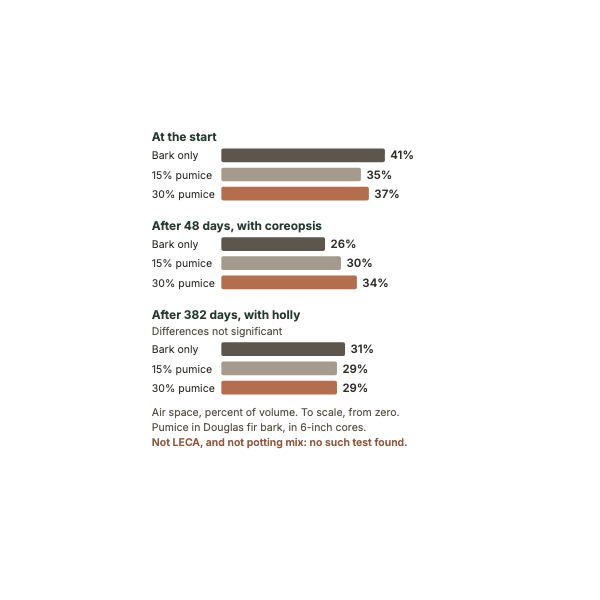
Measurements follow the same direction. James S. Owen and James E. Altland packed Douglas fir bark into cores 1.5, 3 and 6 inches tall (3.8 to 15.2 cm).
As the cores got taller, container capacity fell and air space rose in a straight line. Between the shortest and tallest cores, water-holding capacity dropped by 20% in the medium bark and 42% in the fine bark.
T.E. Bilderback and W.C. Fonteno did the calculation for four containers in 1987, cited from their abstract, from each medium’s moisture retention curve and each container’s shape.
For one medium, air space ranged from 28% of the volume in a #1 container, a nursery-trade size, down to 12% in a bedding-plant cell, while water after drainage rose from 43% to 59%. A peat-lite mix showed the same trend in the same containers.
What a drained container holds: the container and the mix both change it
Air, water and solids once draining has stopped, from greenhouse and nursery work. In none of the four is air the largest share.
In one mix, the bedding-plant cell kept 12% of its volume as air and the #1 container 28%: container geometry, in the authors’ words, changed the air share. The mix changes it too, and the one with bark in it measured the wetter of Purdue’s two.
So the same mix in a taller pot is airier, as a share of the pot, not wetter. Nemali states both halves of the shape rule: for a given diameter, water-holding capacity “will decrease as the container gets taller,” and “for a given height, water-holding capacity increases with diameter of the container.”
A step up that adds height, by these sources, raises the air share. A pot that grows mostly sideways does the opposite. A broad, shallow bowl holds more mix without adding height, and by Nemali’s diameter rule that is the wetter direction.
Rowe’s review of earlier work makes the same point: the saturated layer’s depth is set by the mix, so a shallower container holds a greater share of water.
None of these sources gives a figure for a houseplant pot. Bilderback and Fonteno’s values are calculated for nursery media, and Owen and Altland’s cores held bark alone. They give the direction and its size in those materials, not a rule for your pot.
The Mix Moves It Too
Purdue measured two greenhouse mixes by the same procedure. The peat-and-perlite mix kept 23.3% of the pot’s volume as air once drained. The mix of peat, bark, perlite and vermiculite kept 16.5%. The mix with bark in it, which sounds like the airier one, held less air and more water.
That is a result for two production recipes, not a verdict on bark, and the table does not say why. What it shows is that an ingredient list does not predict the number. Particle size is one thing that does move it.
Altland and colleagues showed how far that can move it. Comparing pine bark from six commercial sources, they found that aging bark from a month or less to six months or more shifted it from coarse to fine particles.
That raised container capacity by 21.4% and cut air space by 17.2% by volume, whatever the source.
Mix also changes in the pot. Purdue lists the ways pore space shifts during growing: peat swells and shrinks, organic matter decomposes and changes particle size, and watering and root growth compact the mix.
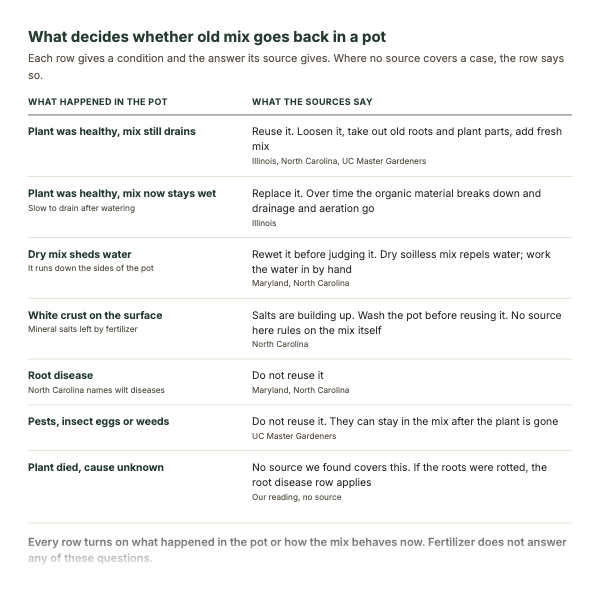
NC State adds that reused mix breaks down into smaller particles, “resulting in reduced drainage and aeration,” which is the subject of reusing old potting mix.
The label can still tell you something. The University of Maryland Extension advises against buying products described as “potting soil,” because “they are usually too dense to allow for proper aeration.”
What the Rot Trials Show
Lack of air can damage roots by itself. Maryland Extension puts it directly: “Excess water reduces oxygen in the soil, which damages fine roots and renders the plant unable to take up water.” A plant in that state is the kind Iowa State says root-rot organisms attack.
Erika Saalau, writing for Iowa State’s Yard and Garden, names them: root rots “are caused by several fungal and fungus-like organisms such as Pythium, Phytophthora, Rhizoctonia, and Fusarium.” They “thrive in wet, poorly drained soils and potting mix, and they infect the root system of stressed or weakened plants.”
The most direct test of air against rot in a container found here is a 1986 study by C. L. R. Filmer and colleagues, cited from its abstract.
They grew toyon cuttings (Heteromeles arbutifolia) in container media with air-filled porosity from 1% to 20%, inoculated them with Phytophthora cinnamomi, and kept every pot at or near container capacity for 3 weeks.
Plants in media with less than 10% air-filled porosity developed severe root rot. Those at 10 to 20% “appeared relatively healthy.” And roots of plants that were not inoculated, growing in the low-air media, “were not adversely affected during the experimental period.” Wet mix alone did not rot them in three weeks; wet mix plus the pathogen did.
Frequency matters as well as degree. Amal de Silva and colleagues, cited from their 1999 abstract, flooded blueberries in soil inoculated with Phytophthora cinnamomi for 48 hours at a time, weekly, every two weeks or monthly, for three months. Disease incidence was higher with weekly and biweekly flooding than with monthly flooding or none.
A single long soak can do it too. K.A. Jacobs and G.R. Johnson flooded seedlings of eight ornamental cherries once, for four or five days, with and without Phytophthora cryptogea.
The combination was more severe than either alone, long-term survival was 70% against 99% in the controls, and in most taxa flooding injured the seedlings more than the pathogen did.
None of these is a houseplant, and none varied pot size. Together they point to the same two dials: how little air the mix has, and how long or how often it stays that way. Pot size reaches root rot through those two, not around them.
What a Bigger Pot Does Change: How Long It Stays Wet
Here the overpotting warning earns its place. NC State lists what sets a container’s watering needs, and one item is “the amount of media in a pot compared to the amount of roots.”
The reasoning behind the warning is that a small root system draws water slowly out of a large volume of mix, so the mix stays wet longer.
No study found here timed it. None measured how long a houseplant’s mix stays wet in an oversized pot against the right-sized one, so no figure can be given for how much longer it takes. None of the extension pages read cites a trial for its step size.
The advice itself is consistent. Iowa State says to “only move up one (maybe two) container sizes,” adding that “Houseplants do not benefit from moving from super cramped quarters to enormous pots.” Colorado State’s PlantTalk says a pot “only one to two inches larger in diameter than the current one.”
NC State’s handbook gives the most detail: interior plants “grow best in pot sizes that are one size larger than their root system.” For pots 8 inches across or less, it suggests 1 to 2 inches wider than the root ball; for pots 10 inches or wider, 2 to 3 inches wider.
The same handbook, though, treats too much mix as a hazard once roots have rotted. Its advice on a plant whose roots have rotted is to reduce water or “down-pot” into a smaller container, “or do both,” to “balance the root size and potting mix volume ratio.” The ratio of roots to mix is the variable it names, not pot size on its own.
How to Tell Whether Your Plant Is in Trouble
The symptom misleads. Saalau writes that root rot begins with “wilting of bottom leaves that may progress upward until total plant collapse,” and that “These symptoms can be commonly mistaken for lack of water.”
Maryland adds that plants with too much water show the same symptoms as drought stress, starting with wilting or yellowing of lower and inner leaves.
NC State gives a check that separates the two. Leaves that wilt often but recover after watering point to roots not getting enough water. “If a plant’s leaves remain wilted after watering, most likely the roots are rotted,” because the roots can no longer absorb water.
Before you add water, look. Iowa State says to examine the roots and the moisture of the mix first.
Colorado State’s way to see them: spread your fingers over the top of the mix, tip the plant upside down and lift the pot off.
Healthy roots are “firm, white, and show numerous feeder roots,” Saalau writes; rotted roots “are mushy and have a brown or reddish color.” NC State adds that rotting roots may smell.
To judge whether the mix is still wet without unpotting, Maryland suggests lifting the pot and comparing its weight with how it felt just after watering.
For large containers, push a stick or dowel long enough to reach the bottom into the mix: moist mix will stick to it or darken it slightly.
How to Measure the Air in Your Own Mix
Purdue’s procedure gives the number for the mix you actually use. It needs an empty pot, a measuring jug, and at least 70 minutes: an hour of soaking plus 10 to 15 minutes of draining. Because height changes the result, it measures the mix in that pot’s shape.
One. Find the pot’s volume; Purdue says the maker can usually supply it. Tape a watertight liner, such as plastic wrap, over the outside of the base so nothing drains through the holes.
Two. Fill the pot to the top with mix, compacting it as you would when potting. The mix now fills the pot’s volume.
Three. Pour in measured water until a shiny layer shows on the surface. Cover the pot and leave it an hour, then add a little more if needed. The total water added is the pot’s pore space.
Four. Stand the pot in a watertight container, make holes in the bottom of the liner, and let it drain for 10 to 15 minutes. Measure what came out. Purdue’s equation makes air space 100 times the drained volume divided by the pot’s volume.
What the number tells you is mainly comparative: one mix against another, or a fresh bag against the same mix after time in a pot, which Purdue warns can differ. Nemali says to use measurements of fresh substrate “with caution,” because pore space changes as plants grow.
There is no clean pass mark. Purdue states that a substrate should “ideally” have 20 to 25 percent air space, but the same publication defines water space once against the pot and once against the pore space.
Filmer’s toyon rotted below 10% air-filled porosity, in one species with one pathogen, and the abstract does not give its denominator.
What to Do About the Pot You Are Already In
Most people asking have already repotted. The sources point to managing water and roots, not to undoing the move. NC State’s advice to down-pot is for a plant whose roots have rotted; none of the sources read advises moving a healthy plant back into a smaller pot.
- Water when the plant needs it, not on a schedule. Iowa State’s root rot page says to water by each plant’s needs rather than by the calendar, and Steil’s guide notes that watering frequency changes with light, temperature, humidity, the mix, the container, plant size and season. Check the weight, a dowel or the top inch of mix first.
- Water thoroughly, then let it drain. Maryland says to water until it runs from the bottom. Iowa State says to empty the saucer or outer pot after about 30 to 45 minutes, because “Roots that stay in water for long periods will rot.”
- Check the roots if the plant wilts and stays wilted. Firm, white roots are Iowa State’s picture of health. If they are brown and soft, NC State says to trim off the brown roots and repot, “possibly putting it in a smaller container,” in a pot with drainage holes.
- After down-potting, water with care. NC State says the new container “should accommodate the size of the root system” and that “it is crucial not to overwater nor let the few remaining roots dry out.”
- Next time, step up one size. One to two inches wider for small pots, two to three for large ones, per NC State; one to two inches per Colorado State. Before you choose a new pot, check whether the plant needs repotting at all.
A pot with no drainage hole is a separate problem: Iowa State says that without one “the soil stays wet and roots rot and die.” The reasons are covered in whether pots need drainage holes.
What Remains to Be Explored
How much longer a houseplant’s mix stays wet in an oversized pot. No measurement of drying time across pot sizes for a houseplant was found, and no trial that grew the same houseplant in a right-sized and an oversized pot and counted root rot.
A 1998 study by J. D. Ray and T. R. Sinclair on pot size and transpiration in maize and soybean has no published abstract, so its result is not reported here.
Where the air threshold sits for houseplants. Filmer’s 10% line comes from one shrub, one pathogen and three weeks at container capacity. A 1991 Phytopathology paper on matric water potential, air-filled porosity and Phytophthora root rot in container media, by B. H. Ownley, has no published abstract either.
What a retail houseplant mix holds. Every air-space figure here is for greenhouse and nursery substrates, none of them a bag bought for houseplants, which is why measuring your own is the way to get a number for it.
Which pathogen is in a given pot. The trials inoculated plants deliberately. Whether a home pot carries enough of an organism to matter, and which one, cannot be told from the symptoms, and Iowa State’s root rot page names no chemical treatment for houseplants.
Sources
- Understanding the Pores of a Soilless Substrate (HO-287-W) — Krishna Nemali. Purdue Extension, Purdue Horticulture and Landscape Architecture. March 2018.
- Root Rots of Houseplants — Erika Saalau. Iowa State University Extension and Outreach, Yard and Garden. February 14, 2014.
- Overwatered Indoor Plants — University of Maryland Extension, Home and Garden Information Center. March 13, 2023.
- Potting and Repotting Indoor Plants — University of Maryland Extension, Home and Garden Information Center. March 10, 2023.
- Plants Grown in Containers, Chapter 18, North Carolina Extension Gardener Handbook — D. Mays, K. Richter, L.K. Bradley, J. Sherk, M. Kistler and J. Neal. NC State Extension. February 2022.
- How to Care for Houseplants — Aaron Steil. Iowa State University Extension and Outreach, Yard and Garden. October 2023.
- 1316 – Houseplants: Repotting — Colorado State University Extension, PlantTalk Colorado. Undated.
- Influence of Air-Filled Porosity of Container Media on Phytophthora Root Rot of Toyon — C. L. R. Filmer, J. D. MacDonald, J. L. Paul, A. T. Leiser. HortScience 21(4):1010-1011. August 1986. Cited from its abstract.
- Effects of Container Geometry and Media Physical Properties on Air and Water Volumes in Containers — T.E. Bilderback, W.C. Fonteno. Journal of Environmental Horticulture 5(4):180-182. December 1987. Cited from its abstract.
- Container Height and Douglas Fir Bark Texture Affect Substrate Physical Properties — James S. Owen, James E. Altland. HortScience 43(2):505-508. April 2008. Cited from its abstract.
- The Perils of Pot Experiments — John B. Passioura. Functional Plant Biology. December 2006. Cited from its abstract.
- Physical and Hydraulic Properties of Commercial Pine-Bark Substrate Products Used in Production of Containerized Crops — James E. Altland, James S. Owen, Brian E. Jackson, Jeb S. Fields. HortScience. December 2018. Cited from its abstract.
- Phytophthora Root Rot of Blueberry Increases With Frequency of Flooding — Amal de Silva, Keith Patterson, Craig Rothrock, Ron McNew. HortScience. July 1999. Cited from its abstract.
- Ornamental Cherry Tolerance of Flooding and Phytophthora Root Rot — K.A. Jacobs, G.R. Johnson. HortScience. October 1996. Cited from its abstract.
- Pot Size Matters: A Meta-Analysis of the Effects of Rooting Volume on Plant Growth — Hendrik Poorter, Jonas Bühler, Dagmar van Dusschoten, José Climent, Johannes A. Postma. Functional Plant Biology 39(11):839-850. June 2012. Cited from its abstract.
- Effect of Drainage Layers on Water Retention of Potting Media in Containers — Avery Rowe. PLOS ONE 20(2):e0318716. February 25, 2025. Read in full.