For almost every houseplant, yes. A drainage hole is the only way out of a pot for two things: water beyond what the potting mix can hold, and the salt that fertilizer and tap water leave behind. Neither has another exit, and nothing placed inside the pot creates one.
Extension horticulture says it without hedging. Aaron Steil of Iowa State University Extension writes that “all containers must have a drainage hole” and that “without one, the soil stays wet and roots rot and die.” NC State’s Extension Gardener Handbook calls drainage holes “necessary in all containers.”
The research underneath that rule is more conditional than the rule. A pot with no hole is not a death sentence on a fixed timetable. It removes the margin for error with water, and it takes away the one routine extension services give for clearing salt out of the mix.
So the usual answer for a pot you love is not to plant straight into it. Use it as a sleeve around a plain pot that drains, which Iowa State, NC State, Illinois and Clemson all recommend, and the decorative pot keeps its place on the shelf.
Is This Your Pot?
The signs of a pot that cannot drain overlap with other problems, so read them as clues rather than a diagnosis.
Sarah Browning of Nebraska Extension lists “reduced growth, brown leaf tips, dead root tips and wilting” as possible signs of fertilizer salt buildup, and adds that “they can have other causes, too.”
The more specific clue sits on the surface. Browning describes salts that “accumulate on top of the soil over time, forming a yellow to white crust,” sometimes with a crusty ring around the rim of a clay pot or around the drainage hole. NC State’s handbook describes the same white crust on top of potting mix.
White on the surface is not always salt. Mealybugs, mold and perlite can all look white, and the white stuff on your plant sorts them apart. The other clue is time: in Steil’s words, without a hole “the soil stays wet.” A pot that stays heavy and damp for days after watering is worth a closer look.
What the Hole Lets Out: Water the Mix Cannot Hold
Roots need air as well as water. NC State’s handbook says air spaces in the mix give roots “access to the oxygen that is necessary for a plant to grow, take up nutrients, and absorb water,” and that overwatering fills the pore space until “the roots are unable to get enough oxygen.”
Krishna Nemali’s Purdue Extension guide to potting-mix pores shows how that air is measured, and the method explains what a hole is for.
You tape a watertight liner over the pot’s holes, pour in water until the mix is saturated, then open the holes and let it drain for 10 to 15 minutes.
Then you “measure the drained volume of water. This volume is equivalent to the air space volume in the substrate,” substrate being the trade’s word for potting mix. In a pot with a hole, the water that runs out after a thorough soaking is the room the air gets back.
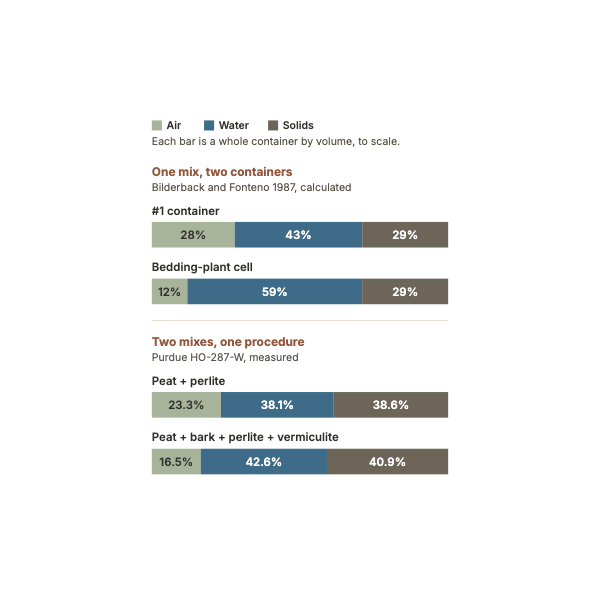
Nemali’s Table 1 gives a fresh peat and perlite greenhouse mix 61.4 percent pore space, with 38 percent of that pore space draining. That puts air at about 23 percent of the pot, inside the 20 to 25 percent the same guide gives as ideal for root growth.
Purdue calls the amount of water a mix can hold its water-holding capacity. A hole is what disposes of anything beyond it.
Without one, the extra has nowhere to go but the pore space the air was using, and it leaves only as fast as the plant drinks and the surface dries. No published measurement gives that rate for a houseplant pot.
Even a pot with a hole is wettest at the bottom. Nemali describes a layer at the base that never drains, the perched water zone, with “virtually no air space,” and says it takes up a larger share of the pot as the pot gets shorter.
Researchers call this the container effect. In a 2025 Plant and Soil paper, Kristopher Criscione, James Owen and Jeb Fields describe it as “the lower part of the container nears saturation which can decrease root health and growth”, which is why container mixes are made so porous in the first place.
What wet roots go through is well described in plant science. Julia Bailey-Serres and Timothy Colmer, introducing a 2014 special issue on flooding, write that soil waterlogging “leads to hypoxia and progressively to anoxia and high CO2 in the root zone.” Hypoxia means too little oxygen; anoxia means none.
The link to rot is narrower than “wet kills roots,” and one 1986 study shows it. C.L.R. Filmer and colleagues grew toyon cuttings (Heteromeles arbutifolia) in mixes with 1 to 20 percent air space, kept at or near container capacity, as wet as a mix stays after draining, for three weeks, with a root-rot organism added to some pots and not others.
The abstract reports that infected plants in mixes under 10 percent air developed severe root rot, while those at 10 to 20 percent “appeared relatively healthy.”
Roots in low-air mix with no pathogen added “were not adversely affected during the experimental period.” In that trial, wet mix opened the door, and the disease walked through it.
Illinois Extension puts the household version in one line: “Wet soils favor root rot, because they leave little space for air to get to the roots.” It adds that “plants rarely recover from root rot.” Our article on why root rot is a saturation problem covers that side in more depth.
The Part Most Answers Leave Out: Salt Has to Leave Too
Browning’s definition is short. “Soluble salts are minerals dissolved in water. Fertilizer dissolved in water becomes a soluble salt.” When water evaporates from the mix, the minerals stay behind, and as their concentration rises, she writes, plants find it harder to take up water.
Iowa State adds a second source: if household water is heavily softened, “it is possible to see a build-up of salts in the soil, especially with those plants that are not frequently repotted.”
Anne Schellman of UC Agriculture and Natural Resources adds that if enough salt accumulates, “the water absorbing root tips are killed.”
The standard fix is leaching, which means flushing the pot with far more water than a normal watering so the salt-laden water runs out of the bottom.
Browning’s method starts by putting the plant “in the bathtub or deep sink where water can drain freely” and pouring until water comes out of “the bottom drain holes.”
She gives the amount as “twice the volume of the pot,” noting that “a 6-inch pot holds about 5 cups of water, so 10 cups would be used.”
Every step depends on water leaving. In a pot with no hole, the flush cannot be done, because the water poured in has nowhere to go. Watering carefully does not change that: by Browning’s account the salt comes in with the water, and evaporation leaves it behind however little you pour.
How often is less settled. Browning gives every four to six months as standard practice; Schellman says every two or three months. Neither says what its interval rests on, so treat both as routines, not measured limits.
The closest research to a pot with no hole comes from greenhouse trials of the leaching fraction, the share of each watering that runs out of the bottom.
Catherine Ku and David Hershey grew geraniums and poinsettias in 6-inch (15-cm) pots at leaching fractions of about 0, 10, 20 and 40 percent, feeding at every watering.
When nothing drains, the salt stays
Two greenhouse trials fed plants at every watering and let different shares of the water run out of the bottom. With almost none draining, the mix ended saltiest in both.
Salt built up in both species when almost nothing drained. Whether it cost growth depended on the plant: geraniums grew less, poinsettias did not.
A fraction near zero is the salt condition of a sealed pot: water arrives and nothing leaves. Their pots had holes, so this is not the water or air condition of a sealed pot.
But the salt result is direct. In both species, the less that drained, the saltier the mix ended, as the chart shows.
Where the salt sat changed too. In the geraniums, with some water draining, the lower two-thirds of the pot ended 47 to 68 percent less salty than the top third.
With almost nothing draining, the bottom was “not lower” than the top. Drainage cleared salt from the lower part of the pot; without it, no layer stayed cleaner.
The growth results split, and the split is the honest answer. Geraniums at 20 and 40 percent had 46 percent more leaf area and 40 percent more fresh shoot weight than those at about zero and 10 percent. The authors concluded that minimizing the leaching fraction “substantially reduced growth.”
Poinsettias showed no significant difference in height, weight or leaf and bract area across the four levels, and the 1991 paper concludes: “Under conditions of this study, container poinsettias required no leaching.” Both papers are cited from their abstracts, and both ran eight to ten weeks in a greenhouse.
Bottom-watered greenhouse systems, which send almost nothing out of the pot, show the same pattern. In a 1995 HortScience abstract, Nancy Todd and David Reed watered New Guinea impatiens with increasingly salty water and report that, with zero leaching, salt was “much higher” in the top layer of the pot, and root weight there fell substantially.
A 2015 review of those systems by Rhuanito Ferrarezi and colleagues says the salt that collects in the top layer “does not seem to have a negative impact on plants,” in systems that typically use lower fertilizer concentrations.
So salt build-up is measured, and in these trials it cost growth in one species and not another.
That is the case against a sealed pot on salt grounds. It is not that the plant will die by a certain month.
It is that the routine for removing salt needs a hole, and nobody has measured how quickly a houseplant in ordinary care reaches the levels at which some species grew less.
Why Nothing You Put in the Bottom Works
The usual workaround is a layer of something at the bottom: gravel, pebbles, clay balls or activated charcoal. Steil’s answer is direct. A layer of gravel in the bottom “does not make up for the lack of a drainage hole.”
The extension explanation is about where water goes. Illinois Extension calls it “a myth that a layer of gravel (inside the bottom of an individual pot) beneath the soil improves container drainage,” because water “‘perches’ or gathers in the soil just above the gravel” until no air space is left.
NC State’s handbook says the same, and says “never” put one in: “Only when no air space is left in the potting mix will the water drain into the gravel below.”
Linda Chalker-Scott of Washington State University gives the principle that water will not move from a finer soil into a coarser material “until the finer soil is saturated.”
One recent study tested part of this, for pots that drain. In a 2025 PLOS ONE paper, Avery Rowe tested drainage layers in 1,290 mL pots with a single hole and found that “any drainage layer was likely to reduce water retention of any medium, and almost never increased it.”
Rowe concludes that warnings about a raised perched water table “should be considered inaccurate,” but notes the results “cannot be used to predict whether a given plant will benefit,” because no plants were grown. Every pot in that study had a hole, so it does not test a sealed pot.
For a pot with no hole, the extension account is the one that applies: by NC State’s and Illinois’s description, water reaches the bottom layer only after the mix above has lost its air. Whatever the layer is made of, the water in it is still inside the pot.
One Extension Sheet With Different Advice
Clemson University’s Home and Garden Information Center is the exception. Its 1999 fact sheet by Debbie Shaughnessy and Al Pertuit advises that if a pot has no hole, you “place a layer of coarse gravel in the bottom to allow a space for excess water (it is important not to saturate soil in such containers).”
Read closely, it does not claim the gravel drains the mix. It offers a space for overflow, and its own parenthesis tells the reader not to saturate the soil anyway. Set beside NC State’s account, that space fills only once the mix above has already lost its air.
The same sheet is firm on the alternative it also gives, double potting: the smaller, interior pot “should have a drainage hole.”
And Activated Charcoal
No extension publication or trial was found that tests a charcoal layer in a pot without a hole, in either direction. The research on charcoal in containers is about mixing it into the medium of pots that drain, and none of it measures water in a sealed pot.
Those mixed-in trials point different ways. Carl Whitcomb and Bonnie Appleton (1985) found plants grew equally well in pine bark mixes with or without activated charcoal.
Jennifer Lau and colleagues (2008) found that for most species tested it increased plant growth in potting media, which they tied to greater nitrogen availability, not water. Both are cited from their abstracts.
A 2019 review by Lan Huang and Mengmeng Gu on biochar, a related charred material, found it changes a mix’s porosity and how much water it holds, and that its effect on plants depends on the char, the plant and the share used. None of this supports charcoal as a substitute for a drainage hole.
How to Use the Pot You Actually Like
Grow the plant in a plain pot with holes and set it inside the decorative one. Iowa State calls this a double pot or cache pot, often written cachepot, and Steil calls it “one way to use a container without a drainage hole”, with the desirable container as an outer “sleeve”, which “allows you to get the drainage you need while using a container that doesn’t have a drainage hole.”
NC State says a plant showcased in an attractive pot without holes “needs to be double-potted.” Illinois Extension describes the inner pot as a pot liner, “often this is a plain plastic pot,” which lets you lift it in and out “without disturbing the plant roots.”
Water at the sink. NC State’s rule is to “water pots until the water starts to come out the bottom of the container,” and Iowa State notes that watering in a sink or bathtub lets you water thoroughly without wetting floors.
Let the inner pot finish draining before you put it back, as Browning does with a leaching, and the excess is gone for good.
Empty the outer pot if you water in place. Steil gives the one interval any source here states: “Always remove any excess water in the saucer or outer pot after about 30 to 45 minutes.”
It is practical guidance rather than a measured deadline; no study of how long houseplant roots tolerate standing water was found.
Illinois puts the same rule from the plant’s side: check that the plants in the liner “never stand in water (unless you have aquatic plants),” and if water collects, “remove the inside pot and drain the water from the outside pot.”
Gravel goes in the outer pot, if anywhere. Illinois allows gravel in the bottom of the outer pot if it is deep enough, so “a little excess water can accumulate in the gravel without the plant roots having to stand in water.”
Clemson gives the same advice. That gravel sits under a pot that can still drain, which is the whole difference.
A saucer works the same way and needs the same emptying. NC State says removing the water “prevents root rot, prevents a buildup of salts that would occur if the water evaporated and left the salts in the saucer, and prevents mosquitoes from breeding there.”
Illinois warns against “pots with permanently attached saucers where emptying the overflow is difficult or impossible.” A saucer that cannot be emptied gives the water and salt the same dead end as a pot with no hole.
Drilling a Hole
Illinois Extension’s advice for a pot that arrives without a hole is short: “figure out a way to make a hole. One way is to drill one.” It gives no method, and neither do the other sources read here, so this article does not give one either.
NC State adds one placement detail. Where a container sits flat on a solid surface such as a paved patio, “drainage holes can be placed along the side of the container, ¼-inch to ½-inch from the bottom.” If you would rather not drill at all, the double pot above needs no tools.
If Your Plant Is Already in a Pot With No Hole
Illinois Extension allows that “sometimes a plant is already planted in a pot with no drainage at all.”
The sources give two lasting fixes, and both end with a hole under the roots: move the plant into a pot that drains and use the decorative pot as a sleeve, as Iowa State recommends, or make a hole, as Illinois suggests.
Until then, Illinois Extension gives an interim step: “take it to a sink, water it, then after a few minutes turn it on its side for a minute or two to let excess water drain out.”
It lets free water out; it does not let you leach, because a flush needs water running through and out.
Clemson’s sheet says it is “important not to saturate soil” in containers like this. On feeding, Browning warns that fertilizing dormant plants “could cause a harmful buildup of fertilizer salts.” Follow the product’s label for any fertilizer.
When the plant comes out, look at the roots and the mix; what to check before you repot covers what to look for. Once it is in a pot that drains, a leaching becomes possible, and Browning advises removing any crust first, with “no need to remove more than ¼ inch of soil.”
Where a Sealed Container Is Deliberate
Some plants want wet feet. Illinois’s rule about standing water carries its own exception, “unless you have aquatic plants,” and the same page suggests shoreline plants, which “love wet soil,” for a pot that does not drain.
Designed bottom-watering systems are the other case, and they still use holes. Ferrarezi’s review describes greenhouse subirrigation as flooding a bench so the mix absorbs water “through holes in the bottom of the containers.” What bottom watering does to the pot covers the home version.
Pot material is a separate question. NC State groups glazed pots with plastic, metal and fiberglass as nonporous, and clay, unglazed ceramic and terracotta as porous.
A glazed pot in a terracotta color is on the nonporous side, and a pot with no hole has no exit whatever it is made of.
Local Regulations and Safety Advisory
If you use fertilizer products, follow the label. Rules on them vary by country and locality, and your agriculture department can say what applies where you live. This article is general information, not legal advice.
Authorities to consult:
- Local agriculture department
What Remains to Be Explored
No study was found that grew houseplants in pots without drainage holes under home watering and feeding. So there is no measured answer to how long a plant lasts in one.
The salt evidence comes from greenhouse crops fed at every watering for eight to ten weeks, in pots that had holes. It shows salt rising when nothing drains, and it shows species differing. How quickly a houseplant fed occasionally reaches those levels, and which houseplants tolerate them, has not been measured.
The time water may stand around roots is also unmeasured for houseplants. Steil’s 30 to 45 minutes is practical guidance. Filmer’s toyon trial ran three weeks in one shrub and found harm only where a pathogen was present, which says something about mechanism and nothing about a safe limit.
Nothing tests activated charcoal as a substitute for a hole. The extension sources and Rowe’s 2025 measurements disagree about whether a coarse layer helps a pot that drains, and Rowe’s test used no plants.
Purdue’s pore figures describe a fresh greenhouse mix, and the guide itself warns that pore space changes as a mix settles and breaks down.
What would change the answer is a trial of common houseplants in sealed and drained pots, watered and fed the way people actually do it, with roots examined at the end.
Until one exists, the advice rests on how water and salt move in containers, as extension and greenhouse research describe it, rather than on a measured outcome for houseplants.
Sources
- Effect of Drainage Layers on Water Retention of Potting Media in Containers — Avery Rowe. PLOS ONE. February 25, 2025. Read in full.
- Container Drainage Options — Illinois Extension, University of Illinois College of Agricultural, Consumer and Environmental Sciences. Undated. Unsigned and undated.
- Understanding the Pores of a Soilless Substrate (HO-287-W) — Krishna Nemali. Purdue Extension, Purdue Horticulture and Landscape Architecture. Undated.
- Success With Houseplants – Fertilization — Sarah Browning, Nebraska Extension Educator. Nebraska Extension in Lancaster County, University of Nebraska-Lincoln. January 17, 2021.
- North Carolina Extension Gardener Handbook, Chapter 18: Plants Grown in Containers — NC State Extension Publications, North Carolina Cooperative Extension. Undated. Chapter page names no author or date.
- How to Care for Houseplants — Aaron Steil. Yard and Garden, Iowa State University Extension and Outreach. October 2023.
- Indoor Plants – Cleaning, Fertilizing, Containers and Light Requirements (HGIC 1450) — Debbie Shaughnessy, former HGIC Information Specialist; Al Pertuit, PhD, Emeritus Faculty, Horticulture. Home and Garden Information Center, Clemson University Cooperative Extension Service. September 21, 1999. Published 1999, no revision listed. Its gravel advice is contested by four more recent extension sources.
- The Myth of Drainage Material in Container Plantings — Linda Chalker-Scott, PhD, Extension Horticulturist and Associate Professor. Puyallup Research and Extension Center, Washington State University. Undated. Cites no references of its own.
- Leach Your Houseplants to Avoid Salt Problems — Anne E. Schellman. The Stanislaus Sprout, UC Agriculture and Natural Resources. February 1, 2021.
- Leachate Electrical Conductivity and Growth of Potted Poinsettia With Leaching Fractions of 0 To 0.4 — Catherine S.M. Ku, David R. Hershey. Journal of the American Society for Horticultural Science. 1991. Cited from its abstract.
- Leachate Electrical Conductivity and Growth of Potted Geranium With Leaching Fractions of 0 To 0.4 — Catherine S.M. Ku, David R. Hershey. Journal of the American Society for Horticultural Science. 1992. Cited from its abstract.
- Potted Geranium (Pelargonium X Hortorum) Growth With Leaching Fractions of 0 To 0.4 — Catherine S.M. Ku, David R. Hershey. HortScience. 1990. Cited from its abstract.
- Response of New Guinea Impatiens to Various Levels of Salinity in a Subirrigation System — Nancy K. Todd, David Reed. HortScience. 1995. Cited from its abstract.
- Subirrigation: Historical Overview, Challenges, and Future Prospects — Rhuanito Soranz Ferrarezi, Geoffrey M. Weaver, Marc W. van Iersel, Roberto Testezlaf. HortTechnology. 2015. Cited from its abstract.
- Influence of Air-Filled Porosity of Container Media on Phytophthora Root Rot of Toyon — C. L. R. Filmer, J. D. MacDonald, Jack L. Paul, Andrew T. Leiser. HortScience. 1986. Cited from its abstract.
- Plant Tolerance of Flooding Stress – Recent Advances — Julia N. Bailey-Serres, Timothy D. Colmer. Plant, Cell & Environment. 2014. Cited from its abstract.
- Stratified Soilless Substrates Decrease the Vertical Gravitational Water Gradient Altering Helianthus Root Morphology — Kristopher S. Criscione, James S. Owen, Jeb S. Fields. Plant and Soil. 2025. Cited from its abstract.
- Effect of Pine Bark Age, Starter Nitrogen, and Activated Charcoal on Growth of Plants in Containers — Carl Erwin Whitcomb, Bonnie Lee Appleton. Journal of Environmental Horticulture. 1985. Cited from its abstract.
- Inference of Allelopathy Is Complicated by Effects of Activated Carbon on Plant Growth — Jennifer A. Lau, Kenneth P. Puliafico, Joseph A. Kopshever, Heidi Steltzer, Edward P. Jarvis, Mark Schwarzländer. New Phytologist. 2008. Cited from its abstract.
- Effects of Biochar on Container Substrate Properties and Growth of Plants – A Review — Lan Huang, Mengmeng Gu. Horticulturae. 2019. Cited from its abstract.