White stuff on a houseplant can be several unrelated things: a fungal film, a salt crust, perlite, springtails, or a sap-feeding insect such as mealybugs. Where it sits narrows the list, but it does not settle it, because several of them share the same places.
The top of the potting mix is the crowded spot. A fungal film, a salt crust and the wax of root mealybugs can all appear there, and only the last is an insect. The check that separates it is to slide the plant out of its pot and look at the roots.
The question comes up in exactly this form. In an r/houseplants thread titled “What is this white stuff?”, a white collar had grown around a terracotta ornament standing in a pot, and it came straight back after days in antiseptic and a repot into fresh, dry soil.
Replies settled on salts. One reader admitted searching the photo for mealybugs first, since by that reader’s account bugs are the forum’s usual diagnosis for white fuzz. The poster’s own worry was different again: whether the growth meant mold somewhere in the house.
Where It Sits Narrows It Down
Each of these things has a different origin, and the origin limits where it can turn up. That is why location is the first clue.
The trouble is that the sources put two or three candidates in the same place, so a location alone leaves a short list rather than an answer.
The table sorts them by place, lists what each extension or research source puts there, and gives the check that source offers for telling them apart. Nothing in it is ranked, because no source counts how often any of these turns up in a houseplant pot.
Where it sits narrows it down. It does not settle it
Each place on a potted plant can hold more than one white thing. The check that separates them is the one each source gives.
| Where it is | What it can be | What separates them |
|---|---|---|
| On top of the mix
The place most of them share
|
A fungal film, a salt crust, or wax from root mealybugs | Slide the plant out and look at the outer roots: white wax with slow, oval insects means mealybugs. Feel will not settle the rest: a heavy fungal mat can dry to a crust |
| Tiny specks that hop
On wet mix, after watering
|
Springtails | Many species jump or hop on the surface after watering, though not every species does |
| Grains in the mix
Part of the mix itself
|
Perlite | A white, heat-treated volcanic rock added to help the mix drain: a standard potting mix ingredient |
| Around the drainage holes
Underneath the pot
|
A salt crust, or mealybugs on the roots | Small white cottony masses there can mean mealybugs below. The roots confirm it |
| On a clay pot or the stems
Outside the mix
|
A salt crust, or mealybugs | A mealybug is an insect: an oval body tapering to the tail, at rest or slowly crawling |
| On leaves and leaf joints
Under leaves, in folds and crotches
|
Mealybugs and their egg masses, scale, or a leaf mold | White cottony masses point to mealybugs or scale. A fuzzy growth on the leaves points to powdery mildew or gray mold |
The top of the mix is shared, and only one of the three there is an insect. Looking at the roots separates it; feeling the crust does not.
The shortcut readers reach for is texture: crunchy means salt, fuzzy means fungus. University of Maryland Extension undoes it. A heavy mat of fungal growth “can become dry and crusty on the surface, and interfere with water absorption, and infiltration into the growing media,” so a fungus can feel like a crust.
Feel fails exactly when there is a lot of it, which is when a reader most wants an answer.
And nothing in the sources read separates a dry fungal crust from a salt crust by look alone, which is why the checks below lean on where things are and what is underneath them.
On Top of the Mix: Three Candidates
The first candidate is a fungal film. Maryland describes fungi that grow “on the growing media surfaces under moist conditions” and “form a white to grayish layer,” sometimes alongside algae, which make a greenish layer. “Their growth isn’t usually detrimental to plants,” the page says, and the word “usually” is Maryland’s.
No source read identifies the fungus in any one pot. One known candidate is the peat mold, Peziza ostracoderma, which a 2021 review by Madsen and Crook says “has gained attention for its visible growth on growing media.” The review reports it found on peat, vermiculite, rockwool, paper pots and sterilized soil (abstract).
The second candidate is a salt crust. Colorado State University Extension is direct about it: “The white or tan crust on the surface of house plants’ potting mix is a buildup of soluble salts,” from the mix itself, from fertilizer, or from salty water. Capillary action, the wicking that draws water up through the mix, carries the salts upward.
Colorado State adds that it is worst when a pot stands in a saucer of drainage water, because the water is drawn back up instead of draining the salts away.
Colorado State also lists what excess salts do: they burn foliage, damage roots and interfere with water uptake, with wilting, yellowing and scorched leaf tips and margins as the signs.
Research on pots and on porous materials shows salt gathering where water evaporates. In greenhouse trials of peace lily and New Guinea impatiens watered from below, the top third of the mix had 2 to 5 times the electrical conductivity, a measure of dissolved salt, of the layers beneath (Kent and Reed, 1996, abstract).
Laboratory studies of salt water drying out of beds of beads found salt crystals forming at the surface where the water evaporated, in two forms the authors call crusty and patchy, depending on the size of the beads (Veran-Tissoires and Prat, 2014, abstract). Beads are not potting mix, so the pattern is a model, not a measurement of a pot.
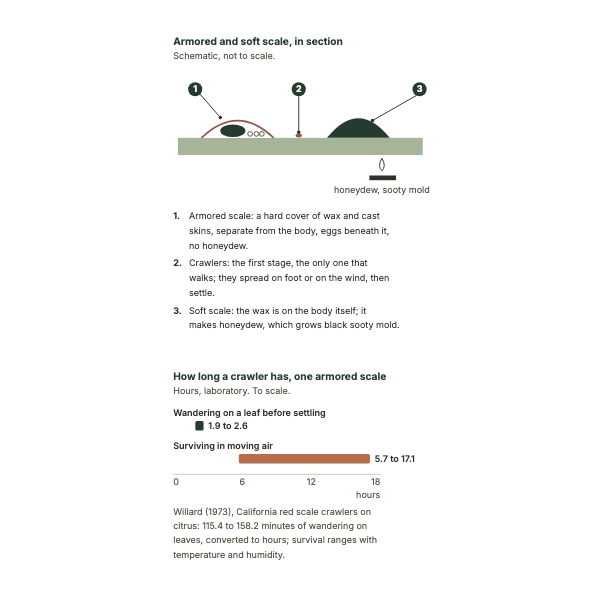
The third candidate is the one the shortcut misses: root mealybugs. These are separate species that live in the soil and feed on roots.
UC IPM, the University of California’s pest management program, says “White, powdery wax on the soil surface especially near plant stems or around the root ball can indicate the presence of ground mealybugs.”
The European Food Safety Authority’s plant health panel, writing about one root mealybug in potted plants, adds the line that matters most here. In heavy infestations “the roots and soil can appear to be completely white, at first glance this can look like a fungal disease,” citing an account from 1995.
The Check: Look at the Roots
Every source read on root mealybugs gives the same check. UC IPM tells nurseries to “remove a portion from their container and examine roots for white, powdery wax and the presence of slow-moving, oval, whitish insects.” Wisconsin Horticulture says infestations “can be confirmed only by removing the root-ball from the pot.”
UC IPM says where to look. In pots, ground mealybugs “are concentrated on the outer portion of the rootball, between roots and the pot.”
The EFSA panel likewise says the white adults and nymphs show on the outer surface of the root ball, against the inside of the pot, where “the white can stand out against dark soil.”
NC State’s handbook gives the household version: “Gently slide the plant out of the pot to examine the roots.” Two cautions keep the check honest. Healthy roots are pale too: NC State Extension’s gardener handbook says a healthy root system in most species “has white or tan roots,” so color alone is not the sign. What separates mealybugs is wax and slow, oval insects, not white roots.
The second caution is that a clean look at the roots clears the pot of root mealybugs, but it does not tell a fungal film from a salt crust. None of the sources read gives a test for that pair.
Maryland ties the film to a surface kept moist, and Colorado State ties the crust to water rising and drying, so both say something about water at the surface of the pot.
On the Outside of a Clay Pot, and Around the Holes
The thread’s case is this one. Colorado State says soluble salts “also accumulate on the outside of clay pots, around drainage holes on pots and even on the stems of plants.” Replies read the white collar on the thread’s terracotta ornament, which stood in the mix, this way.
Laboratory work shows the same process on porous material. When salt water was drawn up through a porous sample and evaporated from its face, salt crystals grew over that face except in a zone at the bottom, whose size depended on the salt concentration in the water below (Lazhar and colleagues, 2020, abstract). A clay pot was not tested, so this explains the pattern rather than measuring a pot.
Two of the same places also hold insects. Maryland’s indoor mealybug page says mealybugs may be found “even on the outside of the pot.”
Wisconsin says “Small white cottony masses around the drainage holes of pots also indicate the presence of mealybugs” on the roots, which again only the root ball confirms.
On the pot’s outside, the difference is whether there is an insect. Maryland describes mealybugs as “covered with a powdery wax” with a body that “tapers towards the tail,” found “at rest or slowly crawling.”
Iowa State notes that egg masses look like puffs of cotton, so a cottony tuft with no insect in it can still be mealybugs.
Specks in the Mix, and Specks That Hop
White grains mixed through the potting mix can be perlite. NC State describes it as “a white, heat-treated, expanded volcanic rock used to improve drainage,” and names it among the most common ingredients of soilless potting mixes, with pine bark, sand, peat moss and vermiculite. Perlite is an ingredient put there to help drainage, not a growth on the mix.
NC State adds two notes for anyone mixing it: avoid breathing perlite dust, by wearing a dust mask or wetting it down, and leave it out of mixes for fluoride-sensitive plants such as spider plants and dracaenas.
Tiny white specks that move are something else. UConn Extension’s fact sheet says springtails, very small soil animals about a sixteenth to an eighth of an inch long, can be white, gray, black, brown or purple, and that growers “may notice the springtails hopping on the growing media surface after watering.”
Not every species jumps, UConn adds, and springtails are found in mixes high in organic matter, “especially if plants have been overwatered.” They are generally considered beneficial. What a swarm of them means is the subject of our article on springtails in a houseplant pot.
White on the Plant Itself
On leaves and stems the list changes. Wisconsin describes mealybugs as soft-bodied insects “covered with a white, waxy, cottony material,” with females about a sixteenth of an inch long, and immatures that “wedge themselves in stem crotches, leaf folds, or other tight locations.”
Iowa State University’s encyclopedia entry adds the egg masses, which “look like puffs of cotton” because the female covers the eggs in waxy filaments, usually in the axils where leaves join stems. One of its photo captions notes that they feed in protected places “such as beneath a leaf petiole,” the stalk that joins a leaf to the stem.
NC State’s handbook warns that “white cottony masses” can mean scale or mealybugs, and that “gray fuzzy growth on leaves” points to gray mold or powdery mildew.
Mildew, a growth on the leaf rather than an insect, is sorted from mealybugs and mineral marks in our article on white on a leaf.
What to Do Once You Know Which It Is
For a fungal film, Maryland’s advice is to let the surface dry between waterings and keep humidity low with good air circulation between pots.
If a mat has already formed, break it up with a small tool such as a fork, or remove the top layer of mix along with the mat and discard it.
The mat matters for one more reason. Maryland says it “can serve as a food source, and attract other pests such as fungus gnats, and shore flies,” whose larvae feed on roots. If small flies are already about, our article on fungus gnats covers what controls them.
For a salt crust, Colorado State’s remedy is leaching, running water through the mix to carry the salts out, and it names a saucer of standing drainage water as what keeps them in.
How to leach, and why a pot with no hole makes it harder, is in our article on drainage holes.
For mealybugs on the leaves, what works and why they return is in our article on why mealybugs keep coming back.
For root mealybugs, UC IPM’s nursery advice is to discard infested plants and those next to them, because “It is difficult to completely disinfest roots of these soil-dwelling pests,” and not to let drainage water run to clean plants.
The EFSA panel adds why that last point matters: root mealybug crawlers can leave one pot through its drainage holes and enter the next the same way, or travel in irrigation water. UC IPM’s advice extends to plants nearby, which it says “also are likely to be infested.”
Does Mold in a Plant Pot Mean Mold in the House?
This was the thread poster’s real question, and the sources answer it in parts. The first part is the U.S. Environmental Protection Agency’s: mold spores already “float through outdoor and indoor air,” and “It is impossible to get rid of all mold and mold spores indoors.”
There are many types of mold, it adds, and “none of them will grow without water or moisture.”
So a film on a wet pot says that the pot is wet. It does not, on any source read here, say that walls or carpets are.
EPA’s guidance on mold in the home is about moisture and water damage, and that is where to look if there are signs of damp elsewhere in the house.
The second part is whether potted plants put mold into the air. In a study published in 1982, Burge and colleagues sampled indoor air in homes with 10 or more plants in one room and in three university greenhouses. They concluded that “modest numbers of undisturbed house plants contribute minimally to aeroallergen prevalence in homes” (abstract).
The same study found that watering and a fan blowing on the plants raised counts of common molds slightly in homes and markedly in greenhouses. Plantings, the authors wrote, “can harbor abundant fungus growth that may become airborne, especially when agitated directly.”
The third part is who is at risk. The EPA says mold may cause allergic reactions in sensitive people, can trigger asthma attacks in people with asthma who are allergic to mold, and can irritate the eyes, skin, nose, throat and lungs. Those warnings are about mold in general, not about plant pots in particular.
For people with a weakened immune system, the evidence on pots is specific. Soil from five potted plants in a hospital held 16 potentially pathogenic species, which the authors called “a serious mycotic hazard to the immunosuppressed patient” (Summerbell and colleagues, 1989, abstract).
All 23 pot samples from hospitals in Sari, Iran, grew fungi, which those authors called “a potential source of nosocomial infection,” meaning infection caught in hospital (Hedayati and colleagues, 2004, abstract).
The first reported invasive infection with the peat mold, in 2023, was in a patient with chronic lymphatic leukemia and no neutrophils, the white blood cells that fight infection.
The authors thought the patient had probably inhaled spores from houseplants or soil, though no gardening or greenhouse visit was on record (Kinch and colleagues, 2023). Madsen and Crook’s review records hypersensitivity pneumonitis, an allergic lung disease, in people exposed to fungi from pots and growing media at work.
Those are hospital and workplace findings, not studies of a home with a few pots.
For people with weakened immune systems, the CDC advises avoiding “activities involving close contact to soil or dust,” while noting that such steps “haven’t been proven to prevent aspergillosis.” Anyone in that group should ask their doctor about plants at home.
Local Regulations and Safety Advisory
If you use fertilizer products, follow the label. Rules on them vary by country and locality, and your agriculture department can say what applies where you live. People with a weakened immune system, asthma or a mold allergy should ask their doctor about potted plants and soil at home, and if mold in your home raises a health concern, your public health department can advise. This article is general information, not legal or medical advice.
Authorities to consult:
- Local agriculture department
- Your doctor, and your public health department
What Remains to Be Explored
No source compares these look-alikes side by side or counts how often each one is the answer in a houseplant pot. The table here is assembled from separate extension, agency and research sources, so it narrows the possibilities without ranking them.
No test separates a dry fungal crust from a salt crust by look or feel in the sources read. The fungus on a given pot is not identified either: the peat mold is one known candidate, but no survey of home houseplant pots was found to say how often it is the white film.
How salt crust forms has been measured in beads and porous lab samples, and in greenhouse pots watered from below, but not on a terracotta pot on a windowsill. And root mealybug guidance comes from nurseries and plant health inspections, not from studies of homes.
The household question rests on one 1982 study of homes and greenhouses and on hospital and occupational work. Whether a moldy pot changes the air of an ordinary modern home, especially for people with allergies or asthma, has not been measured in any study found.
Sources
- Algae and Fungal Growth on the Soil of Indoor Plants — University of Maryland Extension. March 13, 2023.
- Whitish Crust on Potting Mixes (PlantTalk Colorado Script 1338) — PlantTalk Colorado, Colorado State University Extension. Undated.
- Ground (Root) Mealybugs – Floriculture and Ornamental Nurseries — UC IPM Pest Management Guidelines, UC ANR Publication 3392. UC Statewide Integrated Pest Management Program, University of California ANR. January 2022.
- Pest Categorisation of Ripersiella hibisci — EFSA Panel on Plant Health (PLH): C. Bragard and colleagues. EFSA Journal 18(6): e06178. June 25, 2020.
- Mealybugs — Susan Mahr. Wisconsin Horticulture, University of Wisconsin-Madison Division of Extension. Undated.
- Mealybugs on Indoor Plants — University of Maryland Extension. October 17, 2024.
- Mealybugs (Yard and Garden Encyclopedia) — Laura Iles. Iowa State University Extension and Outreach, Yard and Garden. September 13, 2016.
- Plants Grown in Containers, Chapter 18 — D. Mays, K. Richter, L.K. Bradley, J. Sherk, M. Kistler, and J. Neal; K.A. Moore and L.K. Bradley (eds). NC State Extension, North Carolina Extension Gardener Handbook, 2nd ed.. February 1, 2022.
- Springtails in the Greenhouse — Leanne Pundt. UConn Extension. July 2024.
- A Brief Guide to Mold, Moisture and Your Home — U.S. Environmental Protection Agency. February 18, 2026.
- Reducing Risk for Aspergillosis — Centers for Disease Control and Prevention. November 14, 2024.
- Nitrogen Nutrition of New Guinea Impatiens ‘Barbados’ and Spathiphyllum ‘Petite’ in a Subirrigation System — Matthew W. Kent and David Wm. Reed. Journal of the American Society for Horticultural Science 121(5). September 1996. Cited from its abstract.
- Evaporation of a Sodium Chloride Solution From a Saturated Porous Medium With Efflorescence Formation — Stéphanie Veran-Tissoires and Marc Prat. Journal of Fluid Mechanics. May 22, 2014. Cited from its abstract.
- Combined Wicking and Evaporation of NaCl Solution With Efflorescence Formation: The Efflorescence Exclusion Zone — Ramzi Lazhar, Mustapha Najjari and Marc Prat. Physics of Fluids. June 1, 2020. Cited from its abstract.
- Evaluation of Indoor Plantings as Allergen Exposure Sources — Burge HA, Solomon WR, Muilenberg ML. The Journal of Allergy and Clinical Immunology 70: 101-108. 1982. Cited from its abstract.
- Potted Plants in Hospitals as Reservoirs of Pathogenic Fungi — Summerbell RC, Krajden S, Kane J. Mycopathologia 106: 13-22. 1989. Cited from its abstract.
- A Survey on the Pathogenic Fungi in Soil Samples of Potted Plants From Sari Hospitals, Iran — Hedayati MT, Mohseni-Bandpi A, Moradi S. The Journal of Hospital Infection 58: 59-62. 2004. Cited from its abstract.
- Occupational Exposure to Fungi on Recyclable Paper Pots and Growing Media and Associated Health Effects – A Review of the Literature — Madsen AM, Crook B. The Science of the Total Environment 788: 147832. 2021. Cited from its abstract.
- Invasive Fungal Infection by Peziza ostracoderma in an Immunocompromised Patient — Amelie Kinch, Mia Furebring, Erja Chryssanthou and Helene Hallböök. Medical Mycology Case Reports 39: 26-30. 2023.
- What Is This White Stuff? — multiple community members. r/houseplants, Reddit. Undated.