Yes, if the last plant was healthy and the mix still drains. No, if it held root disease or pests. Fertilizer, the fix the thread below reaches for, settles neither question, because reuse turns on what the mix is carrying and how it behaves in the pot, not on how much food is left in it.
There is no houseplant measurement behind any of this. The extension guidance below was written for containers in general, mostly outdoors, and no study we found has followed reused mix in a houseplant pot. Research on aging mixes fills in part of the rest, and it complicates the usual story.
The usual story is about food. A thread on r/houseplants called Old soil? shows the pattern.
One reader saw no reason to buy fresh, having reused mix many times. Another said fertilizer would make up for whatever had gone.
One reply set the limit: reuse is fine unless the last plant had pests.
Another reply came from a reader who blends old mix with new. The blend no longer retains water well, that reader reported, and rinsing it with hot water made no difference.
Start With What Happened in That Pot
The sources agree on the shape of the decision, even though each covers only part of it. Before you think about feeding, ask two questions. What was living in this mix? And what does the mix do now when you water it?
What decides whether old mix goes back in a pot
Each row gives a condition and the answer its source gives. Where no source covers a case, the row says so.
| What happened in the pot | What the sources say |
|---|---|
| Plant was healthy, mix still drains | Reuse it. Loosen it, take out old roots and plant parts, add fresh mix
Illinois, North Carolina, UC Master Gardeners
|
| Plant was healthy, mix now stays wet
Slow to drain after watering
|
Replace it. Over time the organic material breaks down and drainage and aeration go
Illinois
|
| Dry mix sheds water
It runs down the sides of the pot
|
Rewet it before judging it. Dry soilless mix repels water; work the water in by hand
Maryland, North Carolina
|
| White crust on the surface
Mineral salts left by fertilizer
|
Salts are building up. Wash the pot before reusing it. No source here rules on the mix itself
North Carolina
|
| Root disease
North Carolina names wilt diseases
|
Do not reuse it
Maryland, North Carolina
|
| Pests, insect eggs or weeds | Do not reuse it. They can stay in the mix after the plant is gone
UC Master Gardeners
|
| Plant died, cause unknown | No source we found covers this case
No source
|
Every row turns on what happened in the pot or how the mix behaves now. Fertilizer does not answer any of these questions.
What the Mix Brings With It
This is the part no amount of feeding touches. “Pathogens, insect eggs, and weed seeds can remain in the soil even after a plant is removed,” say the UC Master Gardeners of Santa Clara County, and they draw the obvious line: “Do not reuse the container soil if there have been problems with disease, insects, or weeds.”
University of Maryland Extension says the same about roots: “Don’t save the media if root diseases were a problem.”
North Carolina’s Extension Gardener Handbook allows reuse only “as long as no soilborne disease problems have occurred”, naming Verticillium and Fusarium wilt. So the thread’s reply dismissing what grew there before holds only for a plant that stayed healthy.
Root rot starts with saturation, as root rot as a saturation problem sets out, but the organisms involved do not leave with the plant.
A Pacific Northwest extension handbook says Pythium, one root-rot organism, “can survive in dust, planting media, or soil particles” on greenhouse floors, flats and pots.
That sentence is about greenhouses, not a windowsill, and no source we found addresses the mix from a plant that died of an unknown cause.
Fungus gnats belong in the same row, because their larvae live in the mix itself. If you are fighting them, moisture is what they are answering, and carrying that mix into a new pot carries the problem with it.
Repeated reuse may add a risk of its own, though the evidence here is from a long way off.
X. Hu and colleagues reused a peat-based growing mix up to three times under hydroponic strawberries, and report in BMC Plant Biology (2025) that “pathogenic fungi accumulated over the reusing times”. That is one crop in one system, cited from its abstract.
What Wears Out, and How Much
The extension account is short. In North Carolina’s words, “organic matter breaks down and decomposes, causing a decrease in the size of particles and pore space, resulting in reduced drainage and aeration.”
Illinois Extension says reused media eventually reaches the point where “you will loose [sic] the drainage and aeration properties”, and then it should go.
The measurements mostly support the direction and complicate the rest. Stan Durand and Jean-Charles Michel, writing in Frontiers in Horticulture in 2026, let materials decompose for 42 days at 95°F (35°C), with no plant and no pot.
At the same light suction, white peat went from 20 percent air-filled volume to 18, and coir from 35 to 34. Wood fiber products lost two to seven points.
That is a small change, in a warm laboratory test built to speed decay, and total porosity did not move.
It is not a measurement of a bag that has spent three years on a shelf. But it suggests decay alone, at least over those weeks, is not what takes the air out of peat.
Roots appear to do much more, although the two studies were built too differently to subtract. Patrice Cannavo and colleagues grew New Guinea impatiens in peat for 196 days in 1.1-liter containers, keeping the mix constantly moist, and report in HortScience (2011) that air-filled porosity, the share of the volume holding air, fell from 35 percent to 14.
By the end, roots took up about as much of the container as the peat did, 6.5 percent against 6.8.
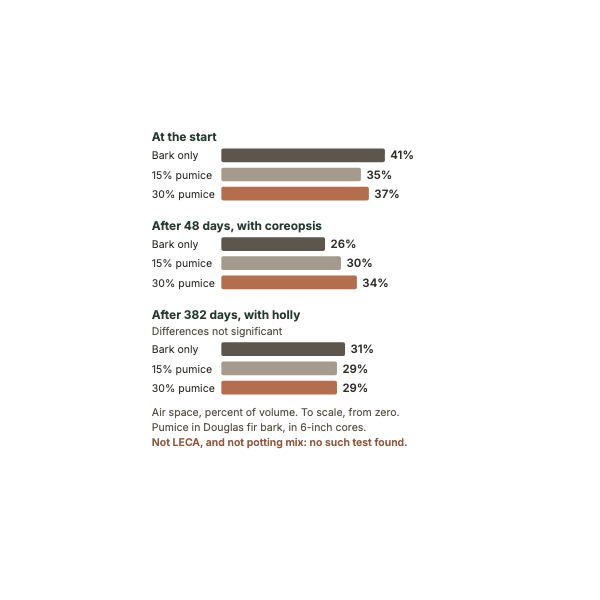
A study by James Altland and colleagues in HortTechnology (2011) points the same way in fir bark. Air space fell over time with or without a plant, and having a plant in the container tended to make the drop larger.
Both papers are cited from their abstracts. Neither tested reused mix, and the plants were impatiens, coreopsis and holly.
Here is the complication. In a 14-month nursery study reported in the Canadian Journal of Soil Science (1999), Allaire-Leung and colleagues saw air-filled porosity drop below optimum while gas movement through the mix stayed the same, because the remaining pores worked better.
They concluded that, “contrary to the general belief, aeration properties of potting substrates may not deteriorate with time.”
So “old mix has lost its air” is stronger than the evidence. Old mix usually has less air room.
Whether that starves roots is a separate question, cited here from one abstract, and it is why the test in the table is how the mix behaves rather than how old it is.
Why Feeding Answers a Different Question
The thread is not wrong about nutrients. North Carolina notes that “many of the nutrients are used by plants or leached out during the previous growing season”, and it includes fertilizer in its refresh step. Maryland says the same of soilless media: they “lose nutrients and break down physically over time.”
But notice that Maryland’s sentence has two halves, and fertilizer speaks to one of them. It adds no pore space and removes no pathogen.
A mix that stays wet for a week stays wet after feeding, and a mix that held root disease still holds it. If you do feed, the product label sets the amount and timing.
If the Mix Is Shedding Water
This may be what the reader who mixes old with new was seeing. Mix that dries hard stops taking up water.
“Soilless mixes tend to be hydrophobic – they repel water,” Maryland says, and North Carolina adds that peat or pine bark “that is excessively dry is very difficult to rehydrate.”
Maryland’s instruction is physical: “Work water into the media with your hands” until it is thoroughly wetted, and it suggests gloves.
A white crust is a different matter: that is salt buildup, and flushing a pot is its own subject.
How to Reuse Mix From a Healthy Plant
One. Empty it and break it up. North Carolina’s method is “emptying out the container mix, breaking up the material and any old roots, and re-blending”. Pull out the roots as you go.
Nobody has measured what removing old roots gives back to a reused mix.
Two. Rewet it if it needs it. Use the hand method above, then let it drain.
Three. Add fresh mix. Illinois says only that you “may have to add some additional new media”. Maryland suggests going half and half with fresh growing media, for container gardens. No source tested a proportion on houseplants. Maryland and North Carolina also name compost, and that advice leans outdoors.
Four. Measure it, if you want an answer rather than a guess. The jug test, set out under root rot as a saturation problem, takes about an hour and works on a blend as well as a fresh bag.
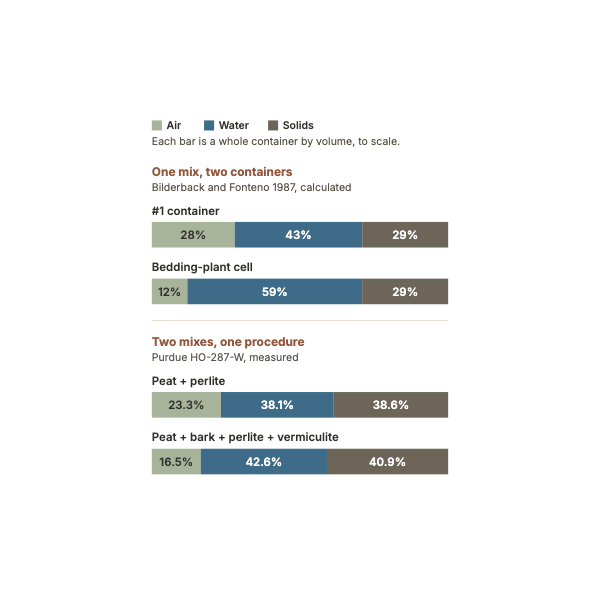
Run it on the reused mix and on fresh mix, then compare. Purdue’s Krishna Nemali gives 20 to 25 percent air space as the ideal for a production substrate.
Five. Use a clean pot. “When reusing a pot, it’s important to clean it thoroughly to avoid transferring pathogens and insects,” says Colorado State’s PlantTalk. North Carolina’s handbook calls for a non-bleach household disinfectant, rinsed off thoroughly, and a wire brush with water for salts on clay.
Keep reused mix away from seeds and cuttings. North Carolina wants a rooting medium that is “sterile, low in fertility”, and Illinois says to begin with “clean, disease-free media”. Neither is talking about old mix directly. Rooting in fresh material is covered in cutting in fresh perlite.
If the mix has failed or carried disease, North Carolina says to discard it or add it to a part of the garden with resistant plants such as grasses, lilies or ferns. Illinois suggests the compost pile or garden for mix that has simply worn out.
If You Have Already Reused It
None of the sources above addresses a plant already growing in reused mix. Their tests still apply to it: how the mix behaves when watered, and whether pests or rotting roots turn up. Whether a settled plant needs moving at all has its own test, in whether to repot at all.
Does Heating It Make It Safe?
Other replies treated heat as the answer: an oven, boiling water, a microwave. Every extension method we found was written for seed-starting soil or compost, not for old potting mix, and none offers heat as a way to rescue mix that held disease.
So it does not override the “do not reuse” rows above. Steam is how the strawberry researchers sanitized reused substrate. Oregon State warns that heat can do harm: “Avoid overheating because it can damage the soil structure.”
For boiling water, and for leaving pots out over a freezing winter, we found no extension source either way. Those replies are reports of what people do, not evidence that it works.
Does Potting Mix Go Bad in the Bag?
The one year-long storage study found points to a slow change, not a spoiled bag. Linda L. Taylor and colleagues bagged a pine-wood substrate and a peat and perlite mix and kept them for a year on shelves in an open shed in Blacksburg, Virginia, testing them at intervals up to day 365.
In the pine substrate, the carbon-to-nitrogen ratio and bulk density stayed the same and particle sizes changed little. Electrical conductivity, a measure of dissolved salts, was highest on the first day and lower by day 42.
Without added lime its pH fell, and marigolds grew as well in the limed, stored pine substrate as in the peat mix at every sampling after the first day. The authors called it relatively stable in storage, apart from that pH drop. The study is cited from its abstract, which does not give the peat mix’s own changes.
Lime goes on working inside a bag. Jinsheng Huang and Paul R. Fisher stored a 70 peat to 30 perlite mix with dolomitic limestone at temperatures from 1.9 to 33.3°C. At the driest moisture tested, the mix took 53 days to reach pH 6.0 at 1.9°C (about 35°F) and 17 days at 33.3°C (about 92°F), and drier mix reacted more slowly.
Neither study kept a bag for years, wet a stored bag or grew a houseplant in it. The change the extension sources do name is drying. Maryland’s warning is about dry soilless mix in general: it repels water, and the fix is working water in by hand, as above.
Is Potting Mix the Same as Potting Soil?
Usually the two names are used for the same thing. Aaron Steil of Iowa State Extension says houseplant substrate is not made from actual soil, and so is often called media, substrate, potting media, growing media or simply potting soil. Maryland’s own page is titled Growing Media (Potting Soil) for Containers.
The name is not a guarantee. Christopher Enroth of Illinois Extension advises a soil-free potting mix for most houseplants, writes that he often finds “potting soil” on garden center shelves in an incredibly heavy bag compared with soil-free mix, and says not to use it. The weight of the bag is the sign he points to. What garden soil does in a pot is covered in garden soil in a pot.
Local Regulations and Safety Advisory
If you use fertilizer products or household chemicals, follow the label. Rules on them vary by country and locality, and your agriculture department or hazardous waste service can say what applies where you live. This article is general information, not legal or medical advice.
Authorities to consult:
- Local agriculture department
- Public health department or hazardous waste service
What Remains to Be Explored
The main gap is simple: nobody has measured reused mix in a houseplant pot.
We looked for a comparison of plants grown in used and fresh mix, for how many times a mix can be reused, and for any measured age limit. We found none for houseplants.
Nobody has measured what removing old roots gives back either. Cannavo’s roots were still alive and in place, so the air they displaced is not necessarily the air a reader recovers by pulling out dead ones.
Whether lost air space harms a houseplant is also open. Allaire-Leung’s result concerned gas movement in nursery containers, in one abstract, and Cannavo’s concerned pore structure under a constant watering regime. A study following one houseplant through fresh and reused mix, with air space measured at each step, would settle much of this.
For stored bags, no study followed a peat-based mix kept for several years, or a bag left open or wet, and none measured plant growth in such a bag.
The disease rows rest on advice, not on trials in home pots, and the sources reach different distances: only UC names insects and weeds, and none says how long a pathogen persists in stored mix. The extension pages also lean outdoors, so whether a houseplant pot behaves the same way is assumed rather than shown.
Sources
- Soil (Container Gardens) — Illinois Extension, University of Illinois. Undated.
- Growing Media (Potting Soil) for Containers — University of Maryland Extension. March 23, 2026.
- Plants Grown in Containers, Ch. 18, North Carolina Extension Gardener Handbook — NC State Extension. Undated.
- Soil Tips — UC Master Gardeners of Santa Clara County, University of California Agriculture and Natural Resources. Undated.
- Greenhouse Plants, Ornamental-Pythium Seed Rot, Damping-Off, and Root Rot — J. Weiland and L. Santamaria. Pacific Northwest Plant Disease Management Handbook (Oregon State University, Washington State University, University of Idaho). March 2026.
- The Bacterial and Fungal Strawberry Root-Associated Microbiome in Reused Peat-Based Substrate — X. Hu, J. Claerbout, B. Vandecasteele, S. Craeye and D. Geelen. BMC Plant Biology 25(1):245. 2025. Cited from its abstract.
- Changes in Physical Properties of Growing Media Constituents According to Biodegradation — Stan Durand and Jean-Charles Michel. Frontiers in Horticulture, volume 5. January 30, 2026.
- Impact of Root Growth on the Physical Properties of Peat Substrate Under a Constant Water Regimen — Patrice Cannavo, Houda Hafdhi and Jean-Charles Michel. HortScience 46(10):1394-1399. 2011. Cited from its abstract.
- Influence of Pumice and Plant Roots on Substrate Physical Properties Over Time — James E. Altland, James S. Owen and Magdalena Z. Gabriel. HortTechnology 21(5):554-557. 2011. Cited from its abstract.
- Changes in Physical Properties of Peat Substrates During Plant Growth — S. E. Allaire-Leung, J. Caron and L. E. Parent. Canadian Journal of Soil Science 79(1):137-139. February 1999. Cited from its abstract.
- Understanding the Pores of a Soilless Substrate (HO-287-W) — Krishna Nemali. Purdue Extension, Horticulture and Landscape Architecture. Undated.
- 1316 – Houseplants: Repotting (PlantTalk Colorado) — Colorado State University Extension. Undated.
- Make Your Own Seed-Starting Mix for Winter Prep — Kym Pokorny, with Brooke Edmunds. Oregon State University Extension Service. January 2024.
- 16 Easy Steps to Gardening in Alaska (HGA-00134) — Stephen Brown. University of Alaska Fairbanks Cooperative Extension Service. October 2019.
- Southwest Yard & Garden, October 22, 2005 — Marisa Y. Thompson. New Mexico State University. October 22, 2005.
- Propagation (Houseplants) — Illinois Extension, University of Illinois. Undated.
- Propagation, Ch. 13, North Carolina Extension Gardener Handbook — Anthony V. LeBude and Frank A. Blazich. NC State Extension. February 1, 2022.
- Old Soil? — multiple community members. r/houseplants, Reddit. Undated.
- Storage Time and Amendments Affect Pine Tree Substrate Properties and Marigold Growth — Linda L. Taylor, Alexander Xavier Niemiera, Robert D. Wright, J. Roger Harris. HortScience. 2012. Cited from its abstract.
- Substrate Moisture and Temperature Effects on Limestone Reaction Rate in a Peat-Based Substrate — Jinsheng Huang, Paul R. Fisher. Communications in Soil Science and Plant Analysis. 2024. Cited from its abstract.
- How to Care for Houseplants — Aaron Steil. Iowa State University Extension and Outreach, Yard and Garden. Undated.
- Tips for Repotting Houseplants — Christopher Enroth. University of Illinois Extension, Good Growing. March 19, 2018.