Before you run the sprinklers longer or shut them off, lift a corner of a brown piece of sod, the pad of grass and thin soil it was cut as, and look underneath. If the soil under it is dry, water is not reaching it, however long the sprinkler has run.
If the soil is saturated, the sod is getting more water than the ground can drain.
If white roots are growing from the pad into the soil, the sod is rooting, whatever color its blades are.
Purdue’s turf specialists define watered new sod as a strip wet all the way through, with the soil beneath it moist about an inch down and not saturated.
The argument comes from a thread on r/lawncare. A homeowner in central Indiana asked whether most of their new sod was already lost. There had been no rain since it went down. The front lawn, laid the same day, was green; the back was brown.
The poster said both areas got the same water, with the sprinklers running at least 12 to 14 hours a day. Twelve hours sounds like plenty, which is exactly why the number settled nothing: the replies could not even agree on which direction the problem ran.
Some said it was not enough water and the sprinkler was too weak, and one described a neighbor’s sod that came back after a sprinkler ran for days.
Others said that much watering had drowned it, and the poster should stop, let it dry out and aerate. One insisted sod cannot die of overwatering unless it sits under water.
Still others blamed heat, sod left too long on the pallet, a sunnier side of the house, and compacted clay or builder’s fill under the sod. Several of those have support in turf research. The hours on the timer cannot tell them apart, but the soil under the sod often can.
Hours on a Hose Are Not Inches of Water
A sprinkler timer measures time. What new sod needs is water in a particular place: in the pad and in the inch of soil under it.
Purdue’s homelawn irrigation guide notes that hose-end sprinklers usually put down small volumes, and that how much any sprinkler applies has to be measured rather than assumed.
The measurement is simple. Set shallow, straight-sided containers, such as empty tuna cans, in a grid across the area the sprinkler covers. Run it for a set time, then measure the water in each can with a ruler. The cans give you the amount, and they also show where the pattern runs thin.
That second reading matters for the thread, whose photo shows hose-end sprinklers on garden hoses. No source read for this article gives an output per hour for a hose sprinkler, so 12 hours cannot be turned into inches.
The same 12 hours could be too much near the sprinkler and too little at the edge of its reach.
Edges are where new sod most often fails. Purdue’s sod guide, written by turf specialist Aaron Patton for Indiana lawns, names too little irrigation in summer, especially at the edges of the sod, as the most common mistake. It also warns that short or narrow pieces dry out quickly.
New sod is unforgiving of a gap because it has almost nothing in reserve.
Rieke and Lucas, Michigan State soil scientists, wrote in 1967 that a layer of sod holds less than a quarter inch of available water while losing water across its whole surface, so it may need water every day until roots grow into the soil below.
Purdue’s irrigation guide sets the target for new sod: water once or twice a day so the strip is wet through its whole thickness and the soil underneath is moist to about an inch.
The sod guide asks for daily morning watering until the sod roots, and adds that in warm, dry spells several waterings a day may be needed.
Lift a Corner and Look
Purdue’s check for rooting takes seconds. Grasp a corner of a piece of sod and try to pull it up.
New roots are white and older roots are brown, and new white roots are usually visible a few days after the sod is laid. A piece that has rooted holds on; a piece that has not lifts away.
While the corner is up, look at three things: the soil under the pad, the underside of the pad, and whether any white roots join the two. Check a green piece as well, if one was laid the same day. Then press the corner back down firmly: Rieke and Lucas noted that new roots are likely to dry up if they have to grow across air pockets.
Dry soil under the pad means the water is not getting there. Soggy, saturated soil means more water is arriving than the ground can drain, and roots growing into it are short of air. White roots in the soil mean the sod is rooting, whatever color its blades are.
The answer is under the sod, not on the timer
Too little water and too much can both set new sod back. The soil under the pad, and whether white roots have crossed into it, tells you which.
On compacted soil, sod watered a quarter inch every day held the least soil on its roots. Soaked only when it began to wilt, it held more there and on soil loosened at the top. On soil tilled 6 inches deep, daily watering did as well. Not every difference was statistically significant, and the trial ran in boxes in fall, not on a lawn in June.
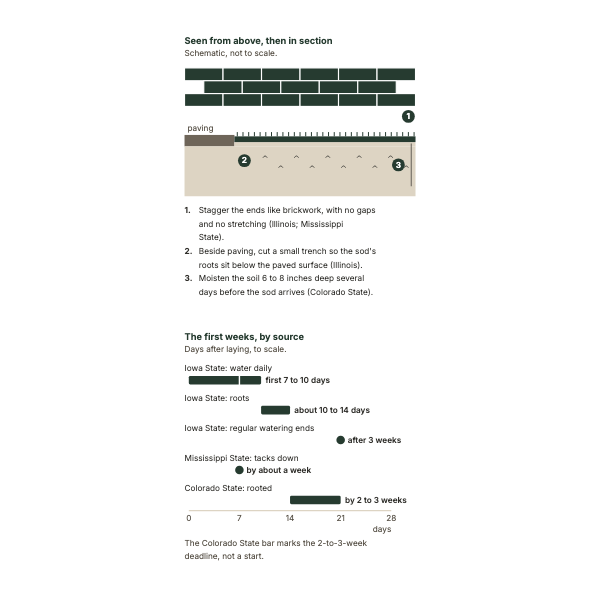
Purdue says most grasses are fairly well rooted within 10 to 14 days when temperatures are good and the sod is kept moist. Rooting takes longer when it is hotter or colder than that.
Sod laid in summer heat, above about 90 degrees F, may not grow any new roots until the air and soil cool.
Can You Overwater New Sod?
Yes. Purdue’s irrigation guide calls overwatering sod a common mistake and says not to saturate the soil below it, because that keeps roots from growing into the soil. Rieke and Lucas made the same point in 1967: where drainage is slow, excess water limits root growth.
Saturated soil is an air problem as much as a water problem, and the same failure drives root rot in houseplant pots. Heat adds to it. In growth chambers, Huang, Liu and Fry grew creeping bentgrass, a golf green grass, at 35 degrees Celsius by day (95 degrees F), in soil either well drained or kept saturated.
Heat alone and saturation alone each reduced root growth and root viability, and the two together hurt viability more than either one (cited from the abstract). Creeping bentgrass is not lawn sod and a growth chamber is not a yard, so this applies to a June lawn only by inference.
Watering a little every day is not automatically the safe middle either. In a fall 1978 Michigan State trial, John E. Kaufmann and James F. Johnson re-rooted Kentucky bluegrass sod in boxes on three soils.
Each box got either a quarter inch of water every day or a deep soak at the first sign of wilt. After 8 weeks they lifted the pieces and weighed the soil the roots held.
On compacted soil watered daily, the sod held the least: 6.8 and 7.3 pounds for the two cultivars, against 19 and 12 when soaked only at wilt. With the top half inch loosened, soaking again came out ahead.
On soil tilled 6 inches deep, daily watering did as well, at 16.8 and 21.3 pounds against 14 and 17.3.
Not every one of those differences was statistically significant, and a fall trial in boxes is not a lawn in June. What the trial does show is that the soil under the sod changed how the watering worked, which is the same thing the corner check looks at.
Why One Yard Can Fail on the Same Schedule as the Other
The poster’s strongest evidence was the front lawn: same day, same water, green. But the same schedule is not the same water on the ground. If different sprinklers, hoses or positions served the front and back, a row of cans in each is the way to compare them.
The ground under the sod can also differ from one side of a house to the other, especially on a new build.
Purdue’s sod guide asks for wood, concrete, rock and construction scrap to be removed before sodding, and for topsoil to be put back or added. It also warns about layering.
Layering happens when the soil on the sod is very different from the soil it is laid on, such as clay-based sod over a sandy site. The boundary between the two can hold back water and air and reduce rooting. Purdue suggests core aeration, which punches out small plugs of soil to open channels for roots, but only once the sod is securely rooted.
Compaction alone matters too. In the Michigan State boxes, sod on deeply tilled soil rooted better than sod on compacted soil.
At the University of Massachusetts, Dest and Ebdon compacted soil with a plate tamper before laying Kentucky bluegrass sod and found less root mass below about 3 inches, with no change above that (cited from the abstract).
The sod itself may have differed. Purdue says it should be laid within 24 hours of harvest, and that the longer it sits on the pallet, the more it deteriorates.
A stack of sod heats itself as it respires: in Darrah and Powell’s 1977 storage study, sod that went into storage at 28 degrees Celsius (about 82 degrees F) reached 39 degrees (about 102 degrees F) in 72 hours.
Longer storage in that study meant less root and top regrowth after planting, and sod cut in the afternoon ran as much as 14 degrees Celsius (about 25 degrees F) hotter in storage than sod cut at dawn (cited from the abstract). Whether the back-yard pallets sat longer or were cut differently is something only the installer could say.
Replies also suggested the brown side gets more sun, or reflected heat from a south-facing wall. No source read for this article measures either on sod, so it stays a possibility rather than a cause. Which of these applied to the poster’s yard is not known from the thread.
Is It Dead or Dormant?
Brown leaves alone do not settle it. Purdue’s irrigation guide explains dormancy in established lawns: in a long drought the leaves die and turn brown, but the crown, the growing point at the base of the plant, and the roots stay alive.
Turf that has been severely drought stressed takes about two weeks to grow new leaves once it is watered.
Recovery also depends on the grass. Wang and Huang dried two Kentucky bluegrass cultivars at 35 degrees Celsius until they were brown and fully desiccated, which took 14 days, then watered and cooled them. The tolerant cultivar recovered on every measure except chlorophyll; the sensitive one recovered only partly (cited from the abstract).
Both findings come from established grass with a full root system. New sod has very little root: it is cut from its field with a thin slab of soil, which Purdue asks to be half to three quarters of an inch thick.
No source read gives a time after which brown new sod can be called dead, so the roots are the part to check.
What to Do Now, by What You Find
If the soil under the pad is dry, the sod is short of water whatever the timer says. Water until the strip is wet through and the soil under it is moist about an inch down, then lift the corner again to confirm.
Use the cans to find the dry parts of the pattern, and move the sprinklers so the edges get water too.
Purdue recommends watering in the morning, and in warm, dry weather more than once a day. If water runs off before it soaks in, the irrigation guide’s advice for compacted ground applies: water until runoff just begins, stop, let it soak in, and repeat until the soil is wet.
If the soil under the pad is saturated, stop watering until it is no longer soggy.
The Michigan State researchers’ procedure for re-sodded lawns was to soak the area thoroughly at the first sign of wilt along the edges of the pieces, then hold off until wilt appears again, so the interval lengthens as the roots go deeper.
Purdue describes the first sign of thirst in a lawn as a blue-green tinge to the grass. If water still collects in low spots after watering, that is a grading problem, and Purdue’s guide asks for such spots to be filled before sod goes down.
If white roots are growing into the soil, the sod is establishing even if its blades are brown. Keep the soil under it moist but not saturated. As the roots take hold, water less often but more deeply, as both Purdue guides advise.
Whatever you find, stay off it. Purdue asks for three to four weeks without foot traffic, and in the Massachusetts trial, wear on new sod reduced its rooting more than compaction did. A reply’s suggestion to rent an aerator now runs against Purdue’s guidance: wait until the sod is securely rooted, typically at least two months after laying.
Several replies suggested starter fertilizer. Purdue’s sod guide does call for a follow-up nitrogen feeding about a month after laying, with less of it for sod laid in summer. The timing is Purdue’s; the amount belongs to the product’s label.
If It Has to Be Redone
If pieces still lift freely with no white roots well past the 10 to 14 days Purdue gives for rooting in good weather, replacing them may be the honest outcome.
Purdue calls fall the best time to establish cool-season grasses such as tall fescue and Kentucky bluegrass in Indiana, so roots can develop before the next summer. That advice is for cool-season grasses: Purdue says warm-season sod such as zoysiagrass and bermudagrass, suited to southern Indiana, does best laid in early summer.
Purdue also warns that sod laid in spring and summer will not handle drought well in its first year. Henderson and colleagues at the University of Connecticut laid Kentucky bluegrass sod in December, May, June and July; the December sod generally had more rooting strength through the following season (cited from the abstract).
A fall-laid lawn then meets fall leaves, and whole leaves left lying on grass shade it, as the article on mulching leaves explains.
Purdue also asks for perennial grass weeds in the old lawn to be controlled before the sod goes down; afterward, a grass weed is hard to remove from a grass lawn.
Before new sod arrives, prepare what it will sit on. Purdue’s list: test the soil, clear construction debris, put back or add topsoil, and grade so water does not collect. Moisten the soil ahead of time, far enough ahead that the site is not muddy when the sod arrives.
Do not lay sod on dry, hot soil: Purdue says root growth is held back even if the sod is watered right after.
Have water ready before delivery, lay the sod within 24 hours of harvest, and roll it lightly so the pad presses against the soil. Then run the can test, so the schedule is set in inches rather than hours.
Local Regulations and Safety Advisory
If you use fertilizer products, follow the label. Rules on them vary by country and locality, and your agriculture department can say what applies where you live. This article is general information, not legal advice.
Authorities to consult:
- Local agriculture department
What Remains to Be Explored
No study found measures what a hose-end sprinkler puts down per hour, so no one can say how much water 12 hours delivers.
No trial found compares watering schedules for new sod in summer heat. The one comparison of daily light watering against soaking at wilt is a fall trial in boxes from 1978.
The heat-and-saturation study was on established plants, not new sod, and it used creeping bentgrass, not a lawn sod.
The storage heating figures come from simulated storage in 1977, and how hot pallets get on a delivery truck or a driveway in June was not measured in any source read.
No source read measures reflected heat from a south-facing wall on new sod, and none gives a deadline after which brown sod can be called dead. The grass in the thread is not named. A field trial watering new summer sod by hours, inches and soil type, with rooting measured, would answer the thread’s argument directly.
Sources
- Have I Lost It Already? — multiple community members. Reddit, r/lawncare. Undated.
- Turfgrass Management: Establishing a Lawn From Sod (AY-28-W) — Aaron Patton. Purdue Extension, Purdue University. May 2013.
- Irrigation Practices for Homelawns (AY-7-W) — Clark Throssell and Zac Reicher. Purdue University Cooperative Extension Service. July 1998.
- When, Where and How to Sod For Turf — P. E. Rieke, R. E. Lucas. Weeds Trees and Turf, October 1967, via Turfgrass Information Center archive, Michigan State University. October 1967.
- Re-Sodding Business: The Mechanics — John E. Kaufmann and James F. Johnson. Proceedings of the Michigan Turfgrass Conference 1979, via Turfgrass Information Center archive, Michigan State University. 1979.
- Post-Harvest Heating and Survival of Sod as Influenced by Pre-Harvest and Harvest Management — C. H. Darrah, A. J. Powell. Agronomy Journal 69(2). 1977. Cited from its abstract.
- Effects of High Temperature and Poor Soil Aeration on Root Growth and Viability of Creeping Bentgrass — Bingru Huang, Xiaozhong Liu, Jack D. Fry. Crop Science 38(6). 1998. Cited from its abstract.
- Physiological Recovery of Kentucky Bluegrass From Simultaneous Drought and Heat Stress — Zhaolong Wang, Bingru Huang. Crop Science 44(5). 2004. Cited from its abstract.
- Late Fall Sod Installation Produces Equivalent or Greater Rooting Strength of Poa pratensis Than Typical Spring Installations During the Subsequent Growing Season — Jason Henderson, Nathaniel Miller, Karl Guillard, Ofer Harel, Balaji Raman. Applied Turfgrass Science. 2009. Cited from its abstract.
- The Effect of Wear and Soil Compaction on Kentucky Bluegrass Sod Rooting and Plant Recovery — William M. Dest, J. Scott Ebdon. International Turfgrass Society Research Journal. 2017. Cited from its abstract.