Cut a piece of vine that carries at least one node, the bump where a leaf joins the stem, with its leaf attached. Root it in water or a moist, airy mix somewhere warm and bright, then plant several rooted cuttings together for a full pot.
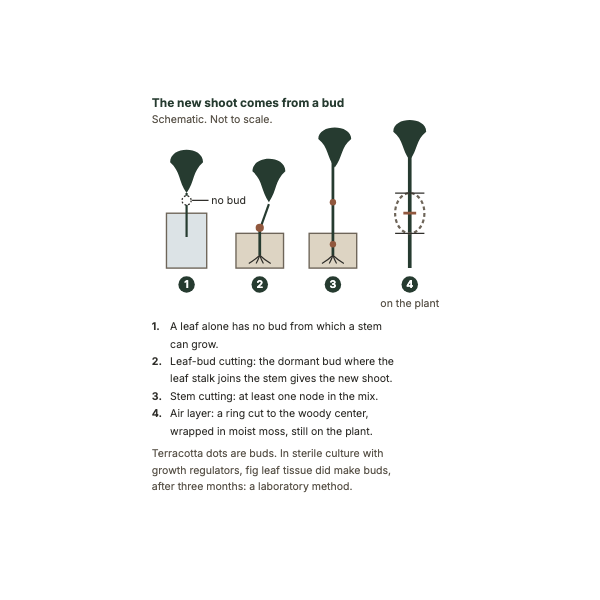
The node is the part that matters. Of these short cuttings, University of Arkansas Extension says: “The stem will root, and the bud at the base of the leaf will form the new shoot.” A leaf cut off above the node has no bud to make that shoot.
Beyond that, the guides fill in the details each in their own way, and a handful of commercial propagation trials on golden pothos fill in what the guides leave out: which node to take, how much stem to leave, whether to keep the leaf, and what speeds rooting.
What This Article Covers
This article covers rooting pothos from stem, tip and leaf-bud cuttings indoors. It explains why the node matters, how many nodes a cutting needs, where on the vine to cut, whether to keep the leaf, water against soil, and how long rooting takes, by source.
Related questions have their own articles: a Monstera leaf that rooted without a node, water roots and soil roots, what makes a pothos leaf bigger and brown bumps on a pothos stem.
Why the Node Matters
A pothos stem is a chain of nodes, each with a leaf and a bud at its base. University of Wisconsin-Madison Extension notes that the plant’s clasping aerial roots arise “from nodes and internodes,” so roots can come from along the stem.
Arkansas’s “single-eye” technique for pothos and philodendron uses “a piece of stem an inch or two long with a leaf attached”: the stem roots, and the bud at the leaf base forms the new shoot.
University of Illinois Extension defines a leaf-bud cutting the same way, a leaf blade, its stalk and “a portion of the stem containing a bud.”
Illinois adds that this type of cutting suits “plants that will not initiate shoots from a leaf cutting.” No source read says a pothos leaf with no node can make a new shoot. The same question for a Monstera is covered in a Monstera leaf that rooted without a node.
One Node or Several
Every guide wants at least one node on a cutting; they set the count differently. Illinois’s general rule for houseplant stem cuttings is “a minimum of two nodes, but not more than six.”
Arkansas’s single-eye cutting has one, and one trial’s authors write that ‘Marble Queen’ pothos “is propagated commercially using single nodal stem cuttings” (Attanayake and colleagues 2023).
In a 2003 production study, every single-eye pothos cutting had begun roots 14 days after sticking, in enclosed plastic tents, whatever the substrate (Chen and colleagues 2003).
Cutting type does matter. In a 2024 trial reported in HortTechnology, two-node leaf-bud cuttings of two devil’s ivy and two dragon-tail vine cultivars “outperformed tip cuttings based on every parameter,” rooting percentage, root length, root quality and secondary roots alike.
The authors note that leaf-bud cuttings are “more plentiful compared with tip cuttings” (Dewey, Hueste and Williams 2025).
The node makes the plant
A pothos cutting grows its new shoot from the bud at a node. Single-node cuttings are a common method, and in one trial two-node leaf-bud cuttings rooted better than two-node tip cuttings.
Panel A: University of Arkansas Cooperative Extension Service, FSA-2095; Wang and Boogher, HortScience, 1988; Dewey, Hueste and Williams, HortTechnology, 2025; the last two from their abstracts. Panel B: University of Wisconsin-Madison Extension (Mahr); New York Botanical Garden Mertz Library; Chen and colleagues, HortTechnology, 2003; Dewey and colleagues, 2025; the trials from their abstracts.
Keep a node on every piece; a leaf cut off above the node has no bud to grow from.
Where on the Vine to Cut
Which node you take changes how fast the cutting grows. In leaf-bud cuttings of golden pothos, days to the first new leaf rose the farther back along the vine the cutting came from, from the second node behind the tip to node 14 (Wang and Boogher 1988).
The very top node, with the newest fully expanded leaf, grew more slowly than the nodes just behind it, and cuttings from near the tip made more leaves, longer stems and more leaf area. The same study found two more details.
Shoot growth was faster when a cutting kept “a 3-cm or longer internode below the nodes,” about an inch and a quarter of bare stem, and keeping “a 6 to 8-mm section of the old aerial root” on the cutting promoted the new shoot.
The New York Botanical Garden’s plant information service cuts “immediately below a node” for tip cuttings.
Keep the Leaf?
Keeping the leaf on a single-node cutting costs some time and pays back in size. Leaf-bud cuttings “needed 10 more days to unfold the first leaf compared to stem cuttings without parent leaves,” but their shoots had “longer stems, more leaves and total leaf area, and heavier dry weight” (Wang 1987).
For tip cuttings, the New York Botanical Garden removes the bottom leaf, and Illinois removes any leaves that would sit below the mix line. Both keep the leaves above.
Water or Soil
Here the guides give the same wait in different media. Wisconsin says the vines “root in water or vermiculite within 3 to 4 weeks.”
The New York Botanical Garden roots them in mix: “Potting mixture is used and not water, because it’s difficult for the plant to acclimate water grown roots into soil.”
No trial comparing water and mix for pothos cuttings was found, so neither view has been tested on this plant. The wider evidence on roots grown in water and then potted is set out in water roots and soil roots.
If you use mix, the New York Botanical Garden’s recipe is equal parts peat moss and coarse perlite, moistened, with three or four cuttings around the rim of a 3-inch pot inside a plastic bag in bright, filtered light. Illinois also bags cuttings to keep the humidity high.
In production trials, the rooting medium mattered. Substrate changed root length at 21 days and how well roots filled the pot at 45 days (Chen and colleagues 2003).
In a trial of ‘Marble Queen’ cuttings, “Rooting media showed the most significant effects on the rooting” (Attanayake and colleagues 2023).
How Long It Takes
Wisconsin gives buds that “can start to grow in 1 to 2 weeks under warm temperatures” and roots in 3 to 4 weeks. The New York Botanical Garden gives 4 to 6 weeks in potting mix.
The production trials rooted devil’s ivy for 3 weeks (Dewey and colleagues 2025) and saw roots begin by day 14 (Chen and colleagues 2003).
Warmth and light speed it up. A warm rooting medium at 28°C, about 82°F, and brighter light “enhanced both shoot and root growth” of single-node cuttings compared with an unheated medium at 10 to 16°C, about 50 to 61°F, and dim light (Wang 1987).
Cuttings taken from stock plants grown in more light also grew more rapidly, and a week or more under mist sped growth (Wang 1990). Wisconsin lists 70 to 90°F as the plant’s preferred range.
Potting Them Up
A single cutting makes a thin plant, so the guides group them. Wisconsin says “it is best to plant several rooted cuttings together in a single pot,” and Arkansas makes “a cluster of six to ten of these single-eye cuttings” for “an attractive pot in short order.”
The New York Botanical Garden moves rooted cuttings on about three months after starting, each into a 3- or 4-inch pot or several into a hanging basket. Wisconsin’s watering rule then applies: water “only when the soil surface is dry,” because root rots “are most often due to overwatering.”
North Carolina State Extension rates pothos a medium-severity poison, with calcium oxalate crystals as the toxic principle, lists contact dermatitis, and tags it a problem for cats and dogs.
What to Do
- Pick healthy vine near the tip. Nodes from the second behind the tip grew fastest in one trial; the very tip and far-back nodes were slower (Wang and Boogher 1988).
- Cut so every piece has a node. For single-node cuttings, leave about 3 cm of stem below the node and any short stub of old aerial root (Wang and Boogher 1988; Arkansas).
- Keep the leaf on each node. Remove only leaves that would sit under water or mix (Wang 1987; Illinois; New York Botanical Garden).
- Choose water or mix. Water or vermiculite (Wisconsin) or a moist peat and perlite mix in a bag (New York Botanical Garden); the guides disagree and no trial settles it.
- Keep them warm and bright. Out of direct sun, with the mix or water warm (Wang 1987; Wisconsin).
- Pot several together. Group rooted cuttings in one pot for a full plant (Wisconsin; Arkansas).
Local Regulations and Safety Advisory
Plant toxicity depends on the species, the amount and the individual, and a poison control service or a veterinarian can say whether a particular plant is a concern for your household. This article is general information, not medical or veterinary advice.
Authorities to consult:
- Poison control service
- Veterinarian or animal poison control service
If a child or pet may have eaten part of a plant, contact a poison control service or a veterinarian.
What Remains to Be Explored
No trial was found that compares rooting pothos cuttings in water and in mix, or follows water-rooted cuttings after potting. The rooting times here are guide figures and production trials in tents, mist beds and sphagnum, not homes.
No study was found of a pothos leaf cut without a node, so whether one can root and how long it lives is untested for this plant. Most of the trials are on golden pothos or a few named cultivars, and how other cultivars compare is not known.
Sources
- Pothos, Epipremnum aureum — Susan Mahr; revised by Bruce Spangenberg. University of Wisconsin-Madison Extension. 2025.
- How Do I Propagate Scindapsus (Epipremnunm)? (Plant Information Answer) — NYBG Plant Information Service. New York Botanical Garden, LuEsther T. Mertz Library. Undated.
- Propagating Houseplants (FSA-2095) — Gerald L. Klingaman and Janet B. Carson. University of Arkansas Cooperative Extension Service. Undated.
- Cuttings (Houseplants) — University of Illinois Extension. Undated.
- Epipremnum aureum, North Carolina Extension Gardener Plant Toolbox — Unsigned plant record. North Carolina State University Extension. Undated.
- Effect of Nodal Position, Cutting Length, and Root Retention on the Propagation of Golden Pothos — Yin-Tung Wang and Carol A. Boogher. HortScience (American Society for Horticultural Science). 1988. Cited from its abstract.
- Effect of Warm Medium, Light Intensity, BA, and Parent Leaf on Propagation of Golden Pothos — Ying-Tung Wang. HortScience (American Society for Horticultural Science). 1987. Cited from its abstract.
- Growth Substance, Light, Fertilizer, and Misting Regulate Propagation and Growth of Golden Pothos — Yin-Tung Wang. HortScience (American Society for Horticultural Science). 1990. Cited from its abstract.
- Leaf-Bud Cuttings of Devil’s Ivy and Dragon-Tail Vine Varieties Result in Higher Rooting Percentages and Better Rooting Quality Than Tip Cuttings — Carter R. Dewey, Jacob C. Hueste and Kimberly A. Williams. HortTechnology (American Society for Horticultural Science). 2025. Cited from its abstract.
- Rooting Foliage Plant Cuttings in Compost-Formulated Substrates — Jianjun Chen, Dennis B. McConnell, Cynthia A. Robinson, Russell D. Caldwell and Yingfeng Huang. HortTechnology (American Society for Horticultural Science). 2003. Cited from its abstract.
- Stimulatory Effect of Indole-3-Butyric Acid and Rooting Media on Adventitious Rooting in Epipremnum Aureum ‘Marble Queen’ Stem Cuttings — Attanayake R.M.T.D, Dasanayaka Y.M.H.M.H, Dilshan H.K.L, Hettiarachchi W.A.B.H, Sandarenu K.M.S.D, Gamage S.N.W, Wickramasinghe P.A.S.C, Dayarathna C.R and Kumarihami H.M.P.C. Indonesian Journal of Applied Research (Universitas Djuanda). 2023. Cited from its abstract.