No test of a living lavender plant against mosquitoes was found. The only trials of live potted plants found, all of other species, saw three of nine plants repel about a third of one malaria mosquito, and none repel a second species. A repellent registered with EPA is the tested choice.
Lists of plants said to keep mosquitoes away often name lavender without saying where the idea comes from. This article sets out what has actually been measured, for plants, for lavender oil and for repellents.
What This Article Covers
This article covers whether a growing lavender plant, or lavender oil, keeps mosquitoes off people, and what EPA says about plant-oil repellents. It names no product and gives no rate; a repellent’s label governs how it is used.
Growing lavender through winter is covered in whether lavender comes back every year, and cutting it back in when to cut back lavender. Another biting pest in the yard is covered in ticks on a large property.
What Live-Plant Tests Found
The trials found that put living plants between mosquitoes and people are two studies by the same group, the second in western Kenya. Seyoum and colleagues set potted plants in experimental huts inside a screen-walled greenhouse, with people as bait, and counted one malaria mosquito.
Three plants made a difference: Ocimum americanum, Lantana camara and Lippia uckambensis “repelled at an average of 39.7%,” “32.4%” and “33.3%” of the mosquitoes. Six others, among them Corymbia citriodora and Azadirachta indica, “did not significantly repel mosquitoes.” No lavender was among the nine.
The analysis allowed for differences between the people used as bait, the huts and the test nights. Pairing plants gave mixed results: Ocimum americanum with Lippia uckambensis repelled 45.2 percent, and with Lantana camara 31.6 percent, against 39.7 percent for Ocimum americanum on its own.
The authors called it the first study “to show that live intact plants can reduce domestic exposure to malaria vector mosquitoes.” The best result still left about six in ten mosquitoes unrepelled.
Some potted plants repelled about a third of mosquitoes; no lavender test found
In the only live-plant trials found, three species repelled roughly a third of one malaria mosquito, others had no significant effect, and none was lavender.
Panel A: Seyoum and colleagues, American Journal of Tropical Medicine and Hygiene, 2002. Panel B: Seyoum and colleagues, Tropical Medicine and International Health, 2003. Both from their abstracts.
No test of a living lavender plant against mosquitoes was found.
In a second study the same group moved two of the plants into village houses in western Kenya. Potted Ocimum americanum and Lantana camara repelled one vector group by 37.91 and 27.22 percent, but “none of the potted plants repelled” a second species, An. funestus.
The authors proposed plants as a complement to bed nets, “particularly for the early part of the evening before bedtime,” not as a replacement for them.
Potted Plants Against Heated Leaves and Skin Repellents
The same field study tested a second way of using plants. Leaves of Corymbia citriodora and leaves and seeds of two Ocimum species were heated on modified traditional stoves, a method the authors call thermal expulsion. All three had failed to repel significantly as live potted plants in the earlier huts.
Heated, Corymbia citriodora repelled 48.71 percent of the main vector group and the two Ocimum species 44.54 percent each. After heating stopped, the three still repelled 36 to 44 percent through the night, from 22:30 to 06:30. Heated Ocimum kilimandscharicum also repelled An. funestus, which no potted plant did.
Across the two studies, in different settings, these three kinds did nothing significant as potted plants and repelled when their leaves were heated. Why a plant in a pot did less, the abstracts do not say. They also do not test lavender, by either method.
No study found set a potted plant against a skin repellent directly. The two also sit in different places: a skin repellent is on the person, a potted plant beside them.
In laboratory work from 1962, Kellogg and Wright found that once human breath had stimulated Aedes aegypti to fly, warm, wet air currents brought them to alight.
On copper bars covered with damp cloth, warm at one end and cool at the other, the warm, wet end was “highly attractive.” That was a bar, not skin, and it measured where mosquitoes landed, not how a repellent works.
Lavender Oil Is Not the Plant
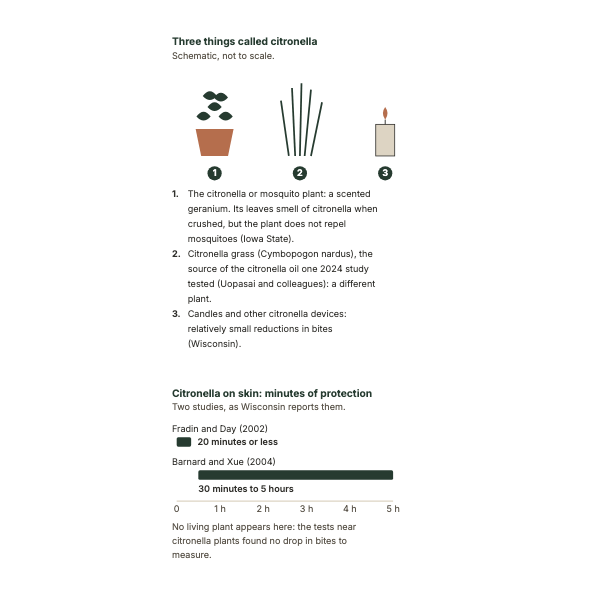
Lavender oil is a separate question from the plant in a pot. The one lavender oil test found compared citronella, lavender and rosemary oils in humidifier vapor against Aedes aegypti, 20 mosquitoes per group.
Mitasari and colleagues found citronella oil “most effective and stable for 30 seconds to 20 minutes to repel mosquitoes compared to lavender and rosemary essential oils.”
The authors’ introduction says lavender plants contain alcohols “comprising linalool and geraniol” and other chemicals such as borneol. Each oil was tested three times, for 20 minutes.
The study shows lavender oil did less than citronella in vapor over those 20 minutes; it does not show what a plant in a garden does over an evening.
Oil on a band is a different test again. Kim and colleagues put citronella extracts on bands, counted bites on people used as bait, and calculated 73 to 86 percent repellency in vitro and 80 percent in the field. That was citronella, not lavender, and on a band, not given off by a plant.
What EPA Says About Plant-Oil Repellents
Before they can be marketed, most skin-applied repellents must be registered by EPA, and registration “indicates that they have been evaluated and approved for human safety and effectiveness when applied according to instructions on the label.”
Some plant-oil products do not need registration. EPA evaluated their ingredients for safety and exempted them, but notes that “products made from these ingredients have not been evaluated for effectiveness.” Its examples are citronella, cedar, geranium, peppermint and soybean oils.
EPA adds that “The Centers for Disease Control and Prevention (CDC) recommends the use of products containing EPA-registered active ingredients,” and that repellents without a registration number “have not been evaluated by EPA.”
What Does Protect
In tests on volunteers, Xue and colleagues found protection time “proportional to the dose applied,” and that it “varied from the individual human volunteer.” The same product protects some people longer than others.
In that study DEET gave longer protection than the two experimental compounds tested beside it. At the higher rates tested, protection against Aedes albopictus lasted 5 to 8 hours, and lasted longer against Culex nigripalpus than against Aedes albopictus.
EPA’s safe-use page asks users to read the label and understand how much to apply, to put repellent only on exposed skin or clothing and not under clothing, never over cuts or irritated skin, and to wash treated skin and clothes with soap and water after coming back indoors. For children, it advises applying to your own hands first and not to a child’s hands.
EPA lists what can change a repellent’s effect: physical activity and sweat, water, air temperature, and how attractive a person is to mosquitoes, since “every person is different.”
EPA’s search tool lets you choose a registered repellent by pest, active ingredient and protection time, and EPA advises using “a product with a protection time that fits your activity.”
What to Do
- Plant lavender for its own sake if you want it; with no test of a living lavender plant found, nothing makes it worth planting for mosquitoes.
- For what actually repels mosquitoes on a person, use an EPA-registered repellent, which EPA has evaluated for effectiveness, and follow its label for how much and how often (EPA).
- Pick a protection time that fits how long you will be outside (EPA).
- Treat plant-oil products without a registration number as untested for effectiveness (EPA).
Local Regulations and Safety Advisory
If you use pest control products, follow the label. Rules on them vary by country and locality, and your pesticide regulator can say what applies where you live. This article is general information, not legal advice.
Authorities to consult:
- Pesticide regulatory authority or environmental protection agency
What Remains to Be Explored
No source read tested a living lavender plant, in a garden or a hut, against any mosquito. The live-plant trials found tested other species against malaria mosquitoes, the second in western Kenya, and their results varied by mosquito species.
A trial that set lavender plants around a seating area and counted bites against an area without them would answer the question directly. Until then the answer rests on the absence of that test.
Sources
- Repellency of Live Potted Plants Against Anopheles gambiae From Human Baits in Semi-Field Experimental Huts. — Aklilu Seyoum, Ephantus W Kabiru, Wilber Lwande, Gerry F Killeen, Ahmed Hassanali and Bart G J Knols. The American Journal of Tropical Medicine and Hygiene. 2002. Cited from its abstract.
- Field Efficacy of Thermally Expelled or Live Potted Repellent Plants Against African Malaria Vectors in Western Kenya — Aklilu Seyoum, Gerry F. Killeen, Ephantus W. Kabiru, Bart G. J. Knols and Ahmed Hassanali. Tropical Medicine & International Health. 2003. Cited from its abstract.
- The Effectiveness of Various Essential Oils on the Market as Aedes Aegypti Mosquito Repellent — Army Mitasari, Aris Santjaka and Iqbal Ardiansyah. Jurnal Kesehatan Lingkungan. 2024. Cited from its abstract.
- Evaluation of Repellency Effect of Two Natural Aroma Mosquito Repellent Compounds, Citronella and Citronellal — Jeong‐Kyu KIM, Chang‐Soo KANG, Jong‐Kwon LEE, Young‐Ran KIM, Hye‐Yun HAN and Hwa Kyung YUN. Entomological Research. 2005. Cited from its abstract.
- DOSE-PERSISTENCE RELATIONSHIP OF THREE TOPICAL REPELLENT COMPOUNDS AGAINST AEDES ALBOPICTUS AND CULEX NIGRIPALPUS — Rui-de Xue, Gunter Muller and Mustapha Debboun. Journal of the Florida Mosquito Control Association. 2022. Cited from its abstract.
- Studies in Mosquito Repellency. IV. The Effect of Repellent Chemicals — F. E. Kellogg and R. H. Wright. The Canadian Entomologist. 1962. Cited from its abstract.
- Regulation of Skin-Applied Repellents — US Environmental Protection Agency. June 25, 2026.
- Using Insect Repellents Safely and Effectively — US Environmental Protection Agency. November 3, 2026.
- Find the Repellent That Is Right for You — US Environmental Protection Agency. September 8, 2026.