A turmeric stain in a sink is a dye, and it is one that light breaks down. Left in a lit room and cleaned as usual, it fades, more slowly the heavier it is; a single oxygen-bleach or peroxide product, used as its label directs, attacks the same dye where it sits.
The suggestions to be wary of act on something else. Grit, pumice and hard scrubbing wear the sink’s finish, and a worn, rougher finish takes the next stain deeper. Chlorine bleach can dull porcelain enamel, and meeting vinegar, an acid cleaner or ammonia it gives off toxic gas.
If the stain turns red when soap or baking soda touches it, that is the dye changing color in an alkaline wash. Red is not gone.
No test of cleaning a turmeric stain from a sink was found.
What follows rests on laboratory chemistry of curcumin, the yellow pigment in turmeric, a 2025 study of how turmeric fades under indoor light, stain studies on dental enamel and resin, and extension and government safety pages, and it says where a finding is carried from one surface to another.
The question comes from a thread on r/CleaningTips.
A renter’s spouse had juiced turmeric with carrots and left the juicer soaking in the kitchen sink for a few hours. The white basin came out the color of the spice. The poster believed the sink had been metal and that the landlord had painted it, and asked how to get the color out.
Oil and baking soda had done nothing, and chlorine bleach was next on the list. The replies offered a cupboard’s worth of alternatives: oxygen bleach, peroxide, chlorine bleach, scouring powder and pumice, sunlight and UV lamps, rubbing alcohol, vinegar, and a few mixtures of those.
One reply warned that grit would strip a painted sink, another that bleach wears enamel. One held that the dye sits in the surface and never comes out, and several that it fades by itself within days or weeks of ordinary use.
What the Yellow Is, and Why Light Fades It
Turmeric’s yellow comes from a family of pigments called curcuminoids, and curcumin is the most abundant of them, as Kim and colleagues note below. In a review of its chemistry, K. Indira Priyadarsini (2014, Molecules) describes an intensely yellow compound, almost insoluble in water, which breaks down much faster when exposed to sunlight.
The products of that breakdown, such as vanillin and ferulic acid, are colorless.
Priyadarsini also notes that turmeric stains can be removed quickly by sunlight, and presents it as a common observation rather than a measurement. Tønnesen, Karlsen and van Henegouwen (1986, cited from the abstract) studied curcumin breaking down under UV and visible light, both in solvents and as a solid.
The closest thing to a measurement comes from Heejeong Kim, Juyeon Oh and Jungil Hong (2025, Molecules). They dissolved turmeric extract in a solvent and set it under a fluorescent tube or a white LED, each at 10 watts per square meter, for 24 hours. Samples kept in the dark lost no significant color.
Under light, the weakest sample kept only 22.4 percent of its color under the fluorescent tube and 14.1 percent under the LED. The strongest, 50 times as concentrated, kept 78.0 and 56.4 percent.
A dense deposit fades more slowly, which the authors attribute to stronger bonding between the pigment molecules and to the outer pigment screening the rest from the light.
For curcumin alone in the weakest sample, half was gone after 15.1 hours of fluorescent light and 9.9 hours of LED light. The LED’s stronger blue light, the authors suggest, is what made the difference.
What acts on the stain, and what acts on the sink
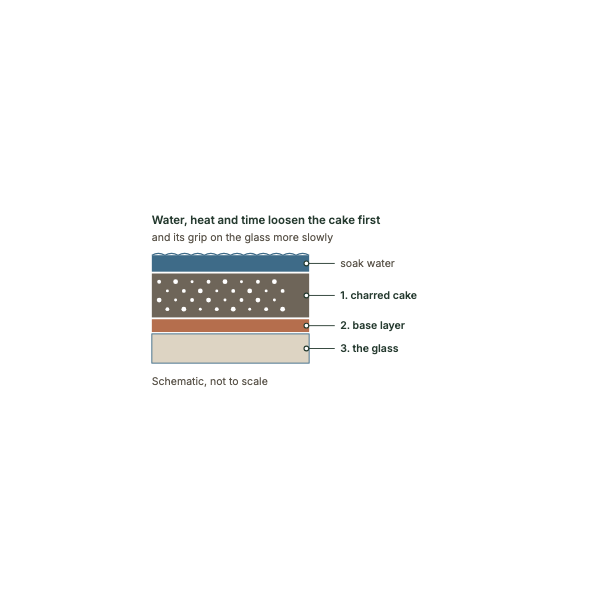
A turmeric stain is a dye sitting in the top of the sink’s finish. Light and bleach break the dye down where it is; grit wears the finish, and a rougher finish holds the next stain deeper.
| 1. Turmeric dye | Curcumin: yellow, and red in alkali, the same dye in another color (Priyadarsini 2014). Light breaks it into colorless products; common indoor light faded turmeric over a day in the lab, a dense deposit more slowly (Kim and others 2025, in solution). Bleaches decolorize it (University of Idaho Extension 1994); on a dental resin a peroxide bleach cleared more of it than polishing (Dabaghi Tabriz and others 2025). |
| 2. Enamel or paint | The part that can be harmed. Harsh abrasives scratch sink finishes, coarse ones damage painted woodwork, and dull, rough surfaces stain deeper; chlorine bleach can dull porcelain enamel (University of Idaho Extension 1994). Roughened tooth enamel held more turmeric (Kandalkar and others 2025), a different enamel. |
Schematic, not to scale; layer thicknesses and groove depths are not measured. Dark terracotta: turmeric dye; pale band: the finish; dark band: the sink body.
Use one product at a time and rinse between. Never let chlorine bleach meet vinegar, an acid cleaner or ammonia: together they give off toxic gas (Health Canada).
So the replies that said the stain would fade with time and use were right about the direction. The dye breaks down where it is, which is also the answer to the reply that it is in the surface and can never come out: light does not need to lift it out to take the color away.
Two limits stand. Kim’s samples were dissolved in a solvent, not dried into a sink’s finish, and no study found timed a stain fading on a sink. A heavy stain from hours of soaking is the dense-deposit case, so it should be expected to fade more slowly than a light splash.
In practice that means leaving the sink in light, room light or daylight, and keeping on with ordinary cleaning. In Kim’s test, darkness was the one condition in which the color held.
Do You Need a UV Lamp?
Several replies swore by a black light, a nail-curing lamp or a plant light left shining on the stain.
The evidence does not single out UV. Kim’s fading came from a fluorescent tube and a white LED, two common indoor light sources, and white LEDs, the authors note, emit across the visible spectrum; theirs faded the turmeric faster than the tube did.
No test of a nail lamp, black light or grow light on a turmeric stain was found. A lamp is a device with its own instructions, and any use of one should follow them.
Daylight is what Priyadarsini’s review describes for stains, and a fluorescent tube and a white LED are what Kim’s group tested. Those are the light sources with evidence behind them.
Why It Turned Red, and Why Red Is Not Gone
One reply reported spraying dish soap on a turmeric stain and watching it turn red within seconds, and took that as the cleaner working.
Curcumin is a pH indicator. Priyadarsini describes its yellow turning deep red in basic, or alkaline, solution, and Sivakumar and colleagues (2025, cited from the abstract) used that red-to-yellow shift to read the result of a laboratory DNA test.
Red, then, is the same dye in another color, and a change of color is not removal. The University of Idaho Extension’s cleaning bulletin (Ernestine Porter, 1994) calls baking soda in water a very mild alkali, and recommends it for cleaning porcelain enamel; nothing found tested it on turmeric.
Alkali does speed curcumin’s breakdown, in solution. Wang and colleagues (1997, cited from the abstract) found about 90 percent of curcumin decomposed within 30 minutes in a buffer at pH 7.2 and 98.6°F (37°C), and faster at neutral and basic pH than in acid.
Tønnesen and Karlsen (1985, cited from the abstract) found the breakdown depends on pH in a complex way. Priyadarsini adds the qualification that matters here: that 90 percent figure applies to very dilute solutions, and the breakdown slows at high concentrations.
No study found tested an alkaline wash on a turmeric stain dried onto a surface, so the red is not evidence either way that the stain is coming out.
Oxygen Bleach and Peroxide
Oxygen bleach in hot water came up again and again in the thread. The granular kind is sodium percarbonate, which Nasreddine and colleagues (2025, RSC Advances) describe as releasing sodium carbonate and hydrogen peroxide when it dissolves, and as a bleaching agent in laundry detergents, stain removers and household cleaners.
Bleaches, in the Idaho bulletin’s account, remove stains mainly by decolorizing the dyed material rather than lifting it off. Like light, then, a bleach acts on the dye itself rather than on the surface under it.
The nearest test on a hard surface comes from dentistry. Fathemeh Dabaghi Tabriz and colleagues (2025) soaked discs of a dental resin in turmeric for seven days, and turmeric changed their color far more than saffron or black pepper did.
They then polished one side of each disc and bleached the other with a hydrogen peroxide gel. Measured on the color scale the study used, turmeric had shifted the discs by 56.63. Polishing left 37.27 of that change; bleaching left 20.37. Neither returned the resin to its starting color.
Two cautions travel with that result. The gel was 40 percent hydrogen peroxide, four times the 10 percent that Kandalkar’s group, below, describes as widely used for at-home tooth bleaching, and nothing here suggests a concentration. And a dental resin is not a sink coating, so the finding is carried to a painted sink by inference only.
The poster tried an oxygen-bleach soak for 30 minutes and saw little change. No study found gives a soak time for turmeric on a sink.
The product’s label sets the strength, the water temperature, the time and whether it may be used on the sink’s finish.
The NIOSH Pocket Guide lists eye irritation and corneal ulcers among the effects of hydrogen peroxide, along with reddened and blistered skin; its entry covers the chemical itself rather than any particular household solution, which is one more reason to follow the product label.
Chlorine Bleach on Enamel, and on Paint
Chlorine bleach is the poster’s next step and a common answer. The Idaho bulletin warns that chlorine bleach can dull the shiny finishes of sinks, tubs and other porcelain enamel surfaces, and the same bulletin says that dull, rough surfaces soil faster and stain deeper.
That is close to the reply that warned bleach wears enamel and leaves it quicker to stain. The bulletin supports the dulling and the deeper staining that follows a dull surface; the word porous is the reply’s, and no source read measured porosity.
Health Canada adds that household bleach, used on its own, can irritate or burn skin, eyes and lungs, and advises goggles, rubber gloves and an open window or running fan.
A painted or refinished sink is a different surface again. No independent source on caring for a refinished sink was found, so the coating’s own care instructions, or the landlord, are the place to ask before any bleach goes on it. The resin study above is the only evidence found on bleaches and turmeric on a plastic-type surface.
Grit, Pumice and Melamine Sponges
Powdered cleansers, a degreaser and a pumice stone came from a reply by someone who said they clean professionally. Another reply objected that on a painted sink, grit, pumice or a melamine sponge would take the paint off and leave a bigger problem.
The Idaho bulletin sides with the objection. Harsh abrasives used regularly scratch the shiny finishes of sinks and tubs, and coarse ones also damage painted woodwork, plasticware, glass and polished metals.
Dull, rough surfaces soil faster and stain deeper, it adds, so a harsh abrasive has to keep being used to clear what settles into them.
Dental research shows the same pattern with turmeric. Sachin Kandalkar and colleagues (2025, Cureus) roughened tooth enamel with an acid etch and then stained it: the etched enamel gave up 16.80 micrograms of turmeric per milliliter of the solution used to extract it, against 5.10 for untreated enamel, about three times as much.
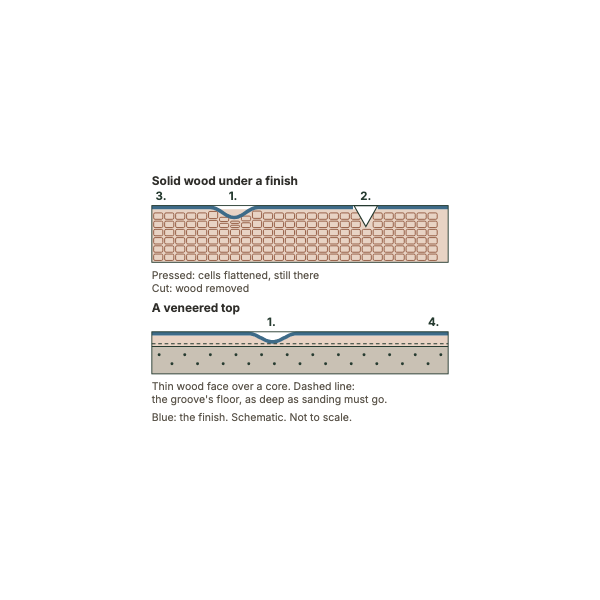
Tooth enamel is not a sink’s enamel or paint, so that result supports the Idaho point only by analogy. It is the drawing’s left half: a worn finish with the dye sitting down in its scratches.
Abrasion can still remove a stain, by removing the layer the stain is in. That is what the dental polishing did, and in Dabaghi Tabriz’s test it cleared less turmeric than bleaching. On a sink that does not belong to the person scrubbing it, the layer being removed is the landlord’s finish.
No test of melamine sponges on sink enamel or paint was found, so the reply’s warning about them is neither confirmed nor ruled out here. How hardness decides what a grit can scratch is set out in the article on scratched glass cooktops.
Alcohol, Oil and Solvents
Several replies reached for rubbing alcohol, hand sanitizer, nail polish remover, oil-based cleaners or mineral spirits, on the reasoning that turmeric dissolves in alcohol or oil.
Priyadarsini lists curcumin as almost insoluble in water and readily soluble in alcohols such as methanol and ethanol and in other polar solvents such as ethyl acetate. Ethanol, she notes, is the preferred solvent for extracting it from turmeric.
Her list also says curcumin is only sparingly soluble in hydrocarbon solvents such as hexane. Oils and mineral spirits are not on her list, no test of them on turmeric was found, and the poster’s oil did nothing. The alcohol replies are the ones with solubility data behind them.
No test of rubbing alcohol, sanitizer or nail polish remover on a stained sink was found, and nothing read says how any of them treats enamel or paint. The product’s label decides whether it may touch the sink’s finish.
Isopropyl alcohol is a flammable liquid. The NIOSH Pocket Guide classes it as Class IB, its category for liquids that catch fire below 73°F, with a flash point of 53°F (about 12°C), and lists irritation of the eyes, nose and throat among its effects.
NIOSH also lists chlorine, strong oxidizers and acids among the things isopropyl alcohol must not meet. Health Canada’s rule in the next section, never to mix bleach with another cleaning product, covers it too.
The Mixtures to Leave Out
Some replies put several products in the same basin: vinegar, baking soda and chlorine bleach together, or an acid lime-scale remover with bleach. Those are the combinations the safety sources single out.
Health Canada’s advisory on mixing bleach is plain. Bleach reacts with any cleaning product that contains ammonia or an acid, vinegar included, and makes toxic gases such as chloramine. The effects include burning eyes and light-headedness, and the gases can kill.
It is never safe, the advisory says, to mix bleach with other cleaning products. The Idaho bulletin gives the same warning for bleach with a toilet bowl cleaner, and for bleach with ammonia.
The consequences are not rare. Atalla and colleagues (2024, Clinical Toxicology, cited from the abstract) counted 85,104 chlorine and chloramine gas exposures reported to US poison centers from 2015 to 2022.
Yearly totals rose 61 percent over the period, 84.9 percent of exposures happened at home, and 26 people died, though most cases were mild.
The working rule from those sources: one product at a time, rinsed away completely before the next, with the window open. The same rule runs through the article on burnt food in a glass baking dish, and the mildest-first order for a kitchen finish is laid out in the one on magnet marks on stainless steel.
Local Regulations and Safety Advisory
If you use household chemicals, follow the label. Rules on them vary by country and locality, and your hazardous waste service can say what applies where you live. Use one cleaner at a time and never mix them, read each product's label for whether it may be used on the sink's finish, and check the care instructions for a painted or refinished sink before using bleach or anything gritty. This article is general information, not legal or medical advice.
Authorities to consult:
- Public health department or hazardous waste service
- The sink's care instructions, and each cleaner's label
What Remains to Be Explored
No test of any cleaning method on a turmeric-stained sink was found. The fading evidence comes from turmeric extract dissolved in a solvent under two lamps for 24 hours, so how long a stain takes to fade on enamel or paint, in daylight or room light, is not known.
No test of household-strength oxygen bleach or peroxide on turmeric on a sink was found; the bleaching evidence is a dental resin and a dental-office gel. No test of UV lamps, black lights or grow lights on a turmeric stain was found either.
No independent source on the care of painted or refinished sinks was found, and no test of melamine sponges on sink finishes. Whether chlorine bleach makes porcelain enamel porous, as one reply said, rather than dull, as the Idaho bulletin says, was not settled by any source read.
A timed test of turmeric stains on enamel and on a refinishing coating, under daylight and indoor light, with and without one oxygen-bleach product, would change parts of this answer and would put a number on the wait.
Sources
- Turmeric Stain in Sink, Need Help — multiple community members. Reddit, r/CleaningTips. Undated.
- The Chemistry of Curcumin: From Extraction to Therapeutic Agent — Kavirayani Indira Priyadarsini. Molecules 19(12):20091-20112. 2014.
- Photodegradation of Turmeric Oleoresin Under Fluorescent Light and White LED: Impacts on the Chemical Stability, Bioactivity, and Photosensitizing Property of Curcuminoids — Heejeong Kim, Juyeon Oh, Jungil Hong. Molecules 30(15):3187. 2025.
- Stability of Curcumin in Buffer Solutions and Characterization of Its Degradation Products — Wang YJ, Pan MH, Cheng AL, Lin LI, Ho YS, Hsieh CY, Lin JK. Journal of Pharmaceutical and Biomedical Analysis 15(12):1867-1876. 1997. Cited from its abstract.
- Studies on Curcumin and Curcuminoids. VIII. Photochemical Stability of Curcumin — Tønnesen HH, Karlsen J, van Henegouwen GB. Zeitschrift fur Lebensmittel-Untersuchung und -Forschung 183(2):116-122. 1986. Cited from its abstract.
- Curcumin – a Natural Colorant-Based pH Indicator for Molecular Diagnostics — Sivakumar R, Lim N, Park SK, Lee NY. The Analyst 150(8):1632-1641. 2025. Cited from its abstract.
- Studies on Curcumin and Curcuminoids. VI. Kinetics of Curcumin Degradation in Aqueous Solution — Tønnesen HH, Karlsen J. Zeitschrift fur Lebensmittel-Untersuchung und -Forschung 180(5):402-404. 1985. Cited from its abstract.
- Effect of Bleaching and Re-Polishing on Saffron, Turmeric, and Black Pepper Stain Removal From Anterior Composite Veneering Material — Fathemeh Dabaghi Tabriz, Katayoun Katebi, Seyedeh Neda Bahiji, Soodabeh Kimyai. Journal of Dental Research, Dental Clinics, Dental Prospects 19(2):122-127. 2025.
- Effects of Acid Etching and Bleaching on Enamel Stain Retention From Turmeric and Coffee: An In Vitro Study — Sachin Kandalkar, Shreya Bhukal, Apurva R Kamble, Nikhil Sathawane, Gaurav Nagar, Manish Sharma. Cureus 17(8):e90134. 2025.
- Trends in Chlorine and Chloramine Gas Exposures Reported to United States Poison Centers — Atalla A, Shulman J, Rose J, Lynch M. Clinical Toxicology 62(9):589-595. 2024. Cited from its abstract.
- A New Method for the Rapid Determination of Sodium Percarbonate in Aqueous Samples Using a Modified HPLC Setup — Nasreddine A, Ghazali S, Bou Karroum W, Baalbaki A, Ghauch A. RSC Advances 15(13):10191-10199. 2025.
- Household Cleaning Products (CIS 1010) — Ernestine Porter. University of Idaho Cooperative Extension. 1994.
- Reduce Your Risk of Toxic Gases: Never Mix Bleach With Other Cleaning Products (RA-62070) — Health Canada. Health Canada, Recalls and Safety Alerts. 2021.
- NIOSH Pocket Guide to Chemical Hazards: Isopropyl Alcohol — NIOSH. US National Institute for Occupational Safety and Health. Undated.
- NIOSH Pocket Guide to Chemical Hazards: Hydrogen Peroxide — NIOSH. US National Institute for Occupational Safety and Health. Undated.