Dried honey is sugar that water dissolves and warmth thins, so it comes out of a drawer with patience rather than chemistry.
Scrape off the thick part, then lay a warm, well-wrung cloth on what is left, wait, wipe, rinse the cloth and go again, and dry the wood as you go.
The honey is not the hard part; the drawer is what can be harmed. Water that pools, soaks in or arrives as steam reaches the wood wherever its finish is missing or worn. And a drawer of honey set outdoors is a risk to bees nearby.
No test of cleaning honey from wood was found. What follows rests on studies of honey’s chemistry, on the Canadian Conservation Institute’s guidance for cleaning wood and furniture finishes, and on beekeeping and pest-control guidance, and it says where a finding is carried from one setting to another.
The question comes from a thread on r/CleaningTips. A squeeze bottle of chili-infused honey had been stored on its side in a kitchen drawer, and it leaked, drying in an amber sheet across the plywood bottom and around the spice jars beside it.
The poster had no idea where to start. The replies had plenty of ideas, and a fair number of them involved recruiting wildlife: ants, bees, at one point a bear. One beekeeper insisted, apparently in earnest, that bees within a few miles would clear it so thoroughly that a quick wipe would finish the job.
The other replies split between hot soapy water and warnings that water would ruin the plywood. Scrapers, hot towels, hair dryers and steamers came up, along with vinegar, salt, baking soda, rubbing alcohol, turpentine, bleach spray, a new drawer and a drawer liner.
What Dried Honey Is, and Why Water Beats Everything Else
Honey is mainly a supersaturated solution of sugars, mostly fructose and glucose with some sucrose, in a small amount of water. That is how Célia Faustino and Lídia Pinheiro put it in a 2021 review of honey’s flow behavior in Foods.
Supersaturated means the water holds more sugar than it can keep dissolved for good. Glucose, the less soluble of the two main sugars, is the one that tends to come out as crystals, the review notes, which is what turns stored honey grainy.
Two things thin honey, the review finds. Viscosity, the resistance to flowing, usually falls as temperature rises, because warmth weakens the forces between molecules.
It also falls as water content rises, with water acting as what the authors call a plasticizer, lowering the friction between molecules. A spill that has lost water to the air goes the other way.
The two effects interact. In a 2006 study of six Greek honeys by Yanniotis and colleagues, as the review describes it, viscosity was more sensitive to temperature when the honey held less water. Honey that has dried out is the kind whose stiffness answers most to warmth.
So the replies that called honey sugar water were right about the chemistry, and right that water is the solvent. Sugars dissolve in water readily.
Sucrose, the sugar with the clearest figure among the sources read, dissolves to 67 percent by weight at about 20°C (68°F), as Yuya Teduka and colleagues (2020, ACS Omega) note.
Whether this particular spill crystallized or simply lost water cannot be told from a photograph. Either way, the cloth’s water and warmth are what bring it back to something a cloth can lift.
Honey also trades water with the air, which matters after cleaning. L. Yao and colleagues (2003, cited from the abstract) held two Australian honeys at 30°C (86°F) at set humidities: they took up moisture at 67.9 percent relative humidity and above, and gave it up at 51.4 percent and below.
A thin film of honey left on the wood should behave the same way, by inference: dry to the touch on a dry day and tacky again in humid weather. That is one reason a drawer can feel clean and then sticky a few days later.
What Water Does to the Drawer
The worry that ran through the thread, that water would warp or lift the plywood, has the strongest support of any reply. The Canadian Conservation Institute, part of the Government of Canada, is plain about bare wood: it readily absorbs water, so wet cleaning methods are considered unsuitable for it.
Water and solvents, its note on unfinished wood says, can quickly swell wood fibers, raise the grain and cause unwanted changes in dimension.
They can also carry surface dirt below the surface, where it becomes a stain. That note, by Robert L. Barclay and revised by Amanda Salmon, is written for museum objects, not kitchen drawers.
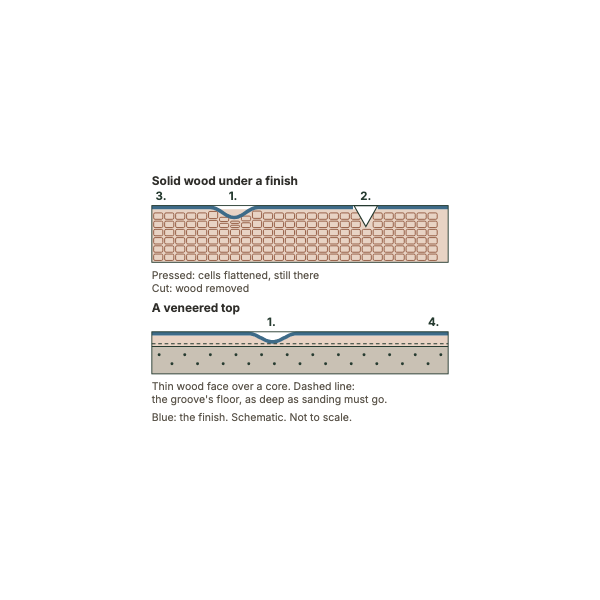
A finish changes the picture, but only partly. The institute’s companion note on furniture finishes describes a finish as a coating that gives wood some resistance to moisture.
On natural resin finishes, such as shellac and oil varnishes, it says, water usually does rapid and obvious damage, and many such finishes are sensitive to water in their own right.
The note’s method for damp cleaning a sound finish is the one this mess calls for. Test first, on a hidden spot, with a cotton swab dampened in warm water and squeezed almost dry, then watch for finish coming off on the swab and for the surface turning white or cloudy as it dries.
If neither happens, clean with a scant amount of water on a barely dampened cloth, and dry the surface immediately with a clean cotton cloth. If a little detergent was added, the note says, wipe again with clear water to take the detergent off.
Water for the honey, not for the wood
Dried honey is sugar that water dissolves and warmth thins. The same water, left to pool, goes into the wood wherever the finish is missing or worn.
| 1. Honey | Mostly fructose and glucose in little water, a supersaturated sugar solution. More water and more warmth both make it thinner (Faustino and Pinheiro 2021). Crystallized honey liquefies with heat, slowly unless hot (Rababah and others 2024). It takes up water from humid air (Yao and others 2003). |
| 2. Finish | Gives the wood some protection from water, and none where it is missing. Many traditional finishes are harmed by water themselves; conservators test a hidden spot with a barely damp swab, use a scant amount of water and dry the surface at once (Canadian Conservation Institute). |
| 3. Wood | Bare wood readily absorbs water, which swells the fibers, raises the grain and can carry dirt below the surface (Canadian Conservation Institute). |
No thickness, amount of water or time is measured. Terracotta: honey; dark band: the finish, with a gap where it is missing or worn; blue: water; pale band: the wood.
Keep the water in a wrung-out cloth, not in the drawer, and dry the wood at once. Use one cleaner at a time; never let bleach meet vinegar or ammonia (Health Canada).
The notes were written for historic finishes, and a modern drawer’s coating may behave differently; how much water one tolerates was not measured in any source read.
Nor does any source say where a drawer’s finish is likely to be thin, so the drawing’s gap stands for wherever it is missing or worn.
What the conservators’ notes do establish is the direction: honey needs water, and wood is harmed by it. That is the case for bringing the water to the honey in a cloth instead of bringing the drawer to the water.
How to Get It Out, Step by Step
Take the drawer out if it lifts free, as several replies suggested, so you can see into the corners and work on a counter. Empty it first, and wash the sticky jars separately.
Scrape off the thick part first. Replies suggested an old plastic card, a putty knife, a paint scraper, a bench scraper, a spatula or a razor blade, and one advised a shallow angle so as not to gouge the wood. No source tested any of them on honey.
The conservators’ note is the nearest guide. Wood is relatively soft and can be damaged by cleaning, it says, and aggressive cleaning can wear away the softer wood and exaggerate the grain.
No source compares scrapers, so the note’s point is the guide: whatever edge you use, the aim is to lift honey off the surface without cutting into the wood beneath it.
Then bring water to the honey, not to the wood. Wet a cloth in warm water and wring it out until it no longer drips.
Lay it on a patch of honey and leave it there for a while, so the water and warmth soak into the honey rather than across the drawer.
Wipe what has softened, rinse the cloth, wring it again and repeat. Several replies described exactly this, with a dish towel or paper towels and water from a kettle, and one reader reported it working on a similar spill. No source gives a time for each pass, so judge by whether the honey has softened.
Avoid pouring water into the drawer, flooding the towel, or filling the drawer to dissolve everything at once, as one reply proposed.
Those put water on the wood for as long as the honey takes to dissolve, which is the opposite of the scant water the conservators’ notes call for.
Finish with plain water, then dry. If you used dish soap, wipe once more with a cloth wrung out in clear water, as the finishes note advises for any detergent.
Then dry every surface straight away with a clean, dry cloth, and leave the drawer out or open to air.
One reply warned that corners hide residue well. The joints where the bottom meets the sides are where the honey in the photo had pooled, so give them their own passes before calling the drawer done.
Rinsing the whole drawer under a tap or in a tub, which a few replies recommended and others warned against, puts every face and edge of the plywood in running water. No source tested what that does to a drawer box. The conservators’ guidance points the other way.
Does Heat Help? Hot Water, a Hair Dryer, a Steamer
Warmth helps, in the direction the honey studies describe: warmer honey is thinner honey. Warm water in the cloth works on two fronts at once, adding water and heat together, which is why the warm-cloth method is the one with the most behind it.
Warmth alone is slower than it looks when honey has crystallized. Taha Rababah and colleagues (2024, ACS Omega) heated jars of crystallized honey in a water bath. It took 960 minutes, 16 hours, to liquefy fully at 45°C (113°F), and 23 minutes at 90°C (194°F).
Those were full jars, not a film on wood, so the times do not transfer. They do show that crystals give way slowly to moderate heat.
A hair dryer can soften honey before scraping, as several replies said, but it supplies no water, and no source tested one on honey or on a drawer’s finish.
A steamer brings both heat and water and was offered as the fast way through. No source read tested steam on wood finishes, and none gives a temperature a drawer finish tolerates. Steam is water arriving at the wood as well as the honey, which is what the woodworking replies feared.
Pouring very hot water over a spill is the same trade. One reply described cleaning dried honey off a store shelf that way, and no source tested it on plywood. Glass is a different case: burnt food in a glass baking dish can soak for hours, and wood cannot.
Alcohol, Turpentine, Vinegar, Salt and Baking Soda
One reply called turpentine the solvent for honey. No source read supports that. The sugars in honey dissolve readily in water, and Teduka’s group found sucrose so poorly soluble in hexanol, a longer-chain alcohol, that they could not see it dissolve at all.
That is a different sugar and a different liquid from honey and turpentine or rubbing alcohol, so it bears on them only by analogy. No test of rubbing alcohol or turpentine on honey was found. What the record does show is that both are flammable liquids.
The NIOSH Pocket Guide to Chemical Hazards classes turpentine as a flammable liquid with a flash point, the temperature at which its vapor can ignite, of 95°F, lists skin sensitization and eye, skin, nose and throat irritation among its effects, and records it as insoluble in water. Isopropyl alcohol has a flash point of 53°F, by the same guide.
The finishes note does use a paint thinner, carefully, on sound finishes, and only to lift wax and greasy dirt, with ventilation and its safety data sheet. Honey is neither. Any solvent’s label decides whether it may be used on a finish at all.
Vinegar, salt, baking soda, oats and rice each had a supporter. No source tested any of them on honey or on wood, and none of them adds the one thing the honey chemistry says is needed, which is water.
Disinfecting wipes and bleach spray were suggested too. Nothing in the sources read calls for disinfecting a honey spill; the job is removing sugar.
If bleach is used for any reason, it must never meet vinegar, an acid cleaner or ammonia. Health Canada warns that together they give off toxic gases, which can be deadly.
Use one product at a time, rinse with plain water before switching, and read each label, the same rule as for a turmeric stain in a sink. NIOSH also lists chlorine among the substances isopropyl alcohol and turpentine are incompatible with.
Should It Go Outside for Ants or Bees?
Several replies suggested setting the drawer outdoors, by an ant nest or within reach of bees, and some meant it. Both creatures would take the honey. That is exactly the trouble with the plan.
Ants first. The University of California’s pest note on ants, by M.K. Rust and D.H. Choe, is built on taking food away from them: clean up crumbs, grease and spills, and when ants arrive, find what they are after and remove it.
Ants also leave a scent trail, which the note says to wipe away with soapy water.
A drawer outside is also wood left out in the weather, which one of those replies conceded by adding the condition that it not rain. The same principle runs through the advice on fruit fly traps: remove the food source first.
Bees are the more serious case, and the beekeeper’s reply was right about their behavior. Robbing, bees taking the honey stores of another colony, is natural behavior, as Ontario’s Ministry of Agriculture, Food and Agribusiness describes it. It is also one of the routes for American foulbrood, a bacterial disease of bee larvae.
Its guidance states that robbing can spread the disease within a bee yard or between yards up to 8 kilometers (about 5 miles) apart, when spores travel with the honey. Honey from outside sources may contain the spores, it says, and should not be fed to colonies.
The disease, in Ontario’s account, kills larvae rather than adult bees, which carry the spores, and in most cases kills the colony. Its spores survive heat and have stayed alive on used equipment for up to 70 years.
A. Lindström, S. Korpela and I. Fries (2008, cited from the abstract) showed the honey route directly. Colonies given honey comb contaminated with spores built up spores in their adult bees once they began using that honey, and the treatment raised larval deaths. The authors conclude that contaminated honey can act as a reservoir of the disease.
Nobody knows whether the honey in this drawer carries spores; it was not tested. But a drawer of honey on a lawn is outside honey offered to any colony that finds it, which is what the Ontario guidance tells beekeepers not to feed their bees.
Still Sticky, Stained, or Time for a New Drawer?
A drawer that feels tacky after it dries still has sugar on it, and as Yao’s measurements suggest, that film is likely, by inference, to take up moisture whenever the kitchen is humid. Another pass with a cloth wrung out in plain warm water, followed by drying, is what the chemistry points to; nothing in the sources read calls for a stronger cleaner.
One reply warned that infused honey might stain the wood. No source read addresses honey or chili staining wood. The nearest mechanism is the conservators’ note that water can carry dirt below the surface of bare wood, which is one more reason to keep the water scant.
A drawer liner laid over what is left, another suggestion, hides the sugar without removing it, and a reply pointed out that ants and roaches would find it anyway. Clean first; a liner afterward is a separate choice.
Replacing the drawer came up several times. If the plywood has already swollen, its surface veneer has lifted or the bottom has warped, no source read covers repairing that, and it, not the honey, is the case for a new drawer. Sound wood with honey on it is a cleaning job.
One reply, from experience, said honey hides under a drawer’s front lip and in the slide tracks, and that damp slides rust.
No source read covers drawer slides, so the only guidance is the drawer’s own: a wrung-out cloth, then a dry one.
And the advice the thread repeated almost as often as ants: store the bottle upright.
Local Regulations and Safety Advisory
If you use household chemicals, follow the label. Rules on them vary by country and locality, and your hazardous waste service can say what applies where you live. Use one cleaner at a time and never mix them, keep rubbing alcohol and turpentine away from flame, and test anything on a hidden spot of the drawer before using it on the rest. This article is general information, not legal or medical advice.
Authorities to consult:
- Public health department or hazardous waste service
- Each cleaner's label, and the drawer's care instructions if it came with any
What Remains to Be Explored
No test of any method for removing honey from wood or plywood was found. The case for a wrung-out cloth rests on honey chemistry measured in bulk and on conservation guidance written for historic furniture, not on a cleaning trial.
How much water a finished drawer bottom tolerates, and for how long, has not been measured in any source read.
No test of steam, a hair dryer, rubbing alcohol, turpentine, vinegar, salt or baking soda on honey on any surface was found, and whether chili-infused honey stains wood was not addressed.
How often store-bought honey carries American foulbrood spores was not established by the sources read, and this bottle was not tested. A side-by-side test of wrung-out cloths against soaking and steam on finished and unfinished plywood, with swelling measured, would settle most of what is left.
Sources
- Advice on Cleaning Dried Honey? — multiple community members. Reddit, r/CleaningTips. Undated.
- Analytical Rheology of Honey: A State-Of-The-Art Review — Célia Faustino, Lídia Pinheiro. Foods 10(8):1709. 2021.
- Effect of Temperature and Time on the Physicochemical and Sensory Properties of Crystallized Honey — Taha Rababah, Muhammad Al-U’datt, Amjad Naqresh, Sana Gammoh, Ali Almajwal, Mohammed Saleh, Sevil Yücel, Yara AL-Rayyan, Numan AL-Rayyan. ACS Omega 9(18):20243-20252. 2024.
- Crystallisation and Moisture Sorption Properties of Selected Australian Unifloral Honeys — Yao L, Bhandari BR, Datta N, Singanusong R, D’Arcy BR. Journal of the Science of Food and Agriculture 83(9):884-888. 2003. Cited from its abstract.
- Atomic Force Microscopy Imaging of Crystalline Sucrose in Alcohols — Yuya Teduka, Akira Sasahara, Hiroshi Onishi. ACS Omega 5(6):2569. 2020.
- The Distribution of Paenibacillus larvae Spores in Adult Bees and Honey and Larval Mortality, Following the Addition of American Foulbrood Diseased Brood or Spore-Contaminated Honey in Honey Bee (Apis mellifera) Colonies — Lindström A, Korpela S, Fries I. Journal of Invertebrate Pathology 99(1):82-86. 2008. Cited from its abstract.
- American Foulbrood — Ontario Ministry of Agriculture, Food and Agribusiness. Government of Ontario. January 8, 2026.
- Pest Notes: Ants — M.K. Rust, D.H. Choe. University of California Statewide IPM Program, Pest Notes Publication 7411. Undated.
- Care and Cleaning of Unfinished Wood — Robert L. Barclay, revised by Amanda Salmon. Canadian Conservation Institute, Government of Canada (CCI Notes 7/1). 2016.
- Care of Furniture Finishes — Robert L. Barclay, revised by Amanda Salmon. Canadian Conservation Institute, Government of Canada (CCI Notes 7/2). 2017.
- NIOSH Pocket Guide to Chemical Hazards: Turpentine — NIOSH. US National Institute for Occupational Safety and Health. Undated.
- NIOSH Pocket Guide to Chemical Hazards: Isopropyl Alcohol — NIOSH. US National Institute for Occupational Safety and Health. Undated.
- Reduce Your Risk of Toxic Gases: Never Mix Bleach With Other Cleaning Products (RA-62070) — Health Canada. Health Canada, Recalls and Safety Alerts. February 8, 2021.