The white film on a glass shower door is one of three things.
Two are left on the glass by hard water: mineral scale, which a weak acid such as vinegar dissolves, and soap curd, which detergent loosens. The third is etched glass, which has lost some of its own surface, and no cleaner can put that back.
A shower door is safety glass, and the federal consumer safety agency says tempered glass can break on its own from scratches.
So work from chemistry to the gentlest scrub, use one product at a time and never with bleach, and keep steel wool, blades, sandpaper and polishing for the end of the list, or leave them off it.
No test of any cleaning method on shower glass was found. What follows rests on extension guidance about hard water and household cleaners, laboratory work on soap scum, the science of how glass corrodes, and federal safety records, and it says where a finding is carried from one setting to another.
The question comes from a thread on r/CleaningTips. A homeowner in southwest Ohio, new to a walk-in shower, squeegeed the glass after every shower, and the glass was still clouded white. A glass cleaner sold for shower glass left nothing at all on the paper towel.
The replies ran from vinegar to sandpaper by way of steel wool, razor blades, a homemade chelator spray and a polishing compound, with one dry observation that the calcium was all that held the door up. The poster later reported that very fine steel wool had done it.
What the White Film Can Be
Hard water carries dissolved calcium and magnesium. Virginia Tech’s extension sheet on household hardness lists what it leaves behind: mineral deposits, or scale, on plumbing fixtures, and a buildup of soap scum on fixtures, skin and hair (Ling and Benham 2024).
Those are two different materials. Scale is the minerals themselves. Soap curd forms when soap meets them: soap used in hard water combines with the minerals into a sticky curd, Nebraska Extension’s hard water guide says, and that curd deposits on bathtubs and showers (Skipton and Dvorak 2016).
Chemists who study soap scum use calcium stearate and magnesium stearate as models of it (Itsadanont and colleagues 2013, cited from its abstract). Its solubility in plain water is the baseline: with the right additives, the same work found it on the order of 2,000 times higher, which comes up again below.
The third possibility is not a deposit at all.
In a lecture on glass surfaces, Carlo Pantano of Penn State sets out how water draws sodium out of ordinary soda-lime glass, and how the hydroxide left behind reacts with carbon dioxide in the air to leave carbonates on the surface.
His list of what that corrosion does to glass includes haze, staining, pitting and roughening, and two effects any shower owner will recognize: a surface that soils more easily, and one that is harder to clean.
A 2023 review of glass corrosion (Zanini and colleagues, npj Materials Degradation) adds the step that matters in a shower. A lasting film of moisture on glass raises the pH of that water until pits form where the glass network itself dissolves.
The review’s evidence is mostly ancient and archaeological glass, so carrying it to a shower door is an inference. But its mechanism is the shower’s routine: water left standing on glass, again and again.
Etching, in Pantano’s list, is glass dissolved away. A cleaner removes what sits on the glass. It cannot put back glass that is gone, which is the difference the figure draws.
Is the film on the glass, or in it?
Mineral scale and soap curd are left on the glass by hard water, and chemistry can lift them. Etched glass has lost some of its own surface, which no cleaner can add back.
| 1. Mineral scale | Hard water leaves mineral scale on plumbing fixtures (Virginia Tech, 2024). Vinegar, a very mild acid, removes hard water deposits from glassware (University of Idaho, 1994); a shower door is carried from that by inference. |
| 2. Soap curd | Soap used in hard water forms a sticky curd that deposits on bathtubs and showers (Nebraska Extension, 2016). In the lab, model soap scums dissolved far better in a surfactant with a chelating agent (Itsadanont and others 2013). |
| 3. Etched glass | Water leaches sodium from ordinary glass and can leave haze, pits and a surface that soils more easily (Pantano, 2015; Zanini and others 2023, mostly on old glass). Etching is glass lost from the surface (Pantano), which cleaning cannot add back. |
White: the glass; gray: mineral scale; sage: soap curd. Tempered glass can break spontaneously from scratches, because its surface is under pressure (CPSC, 2018). No thickness or time is measured.
Start with detergent and a weak acid, one at a time and rinsed between, then a non-scratch pad. Keep steel wool, blades and sandpaper for last or leave them out, and never let any cleaner meet bleach (Health Canada).
Why the glass cleaner did nothing. The University of Idaho’s guide to household cleaning products sorts cleaners by their chemistry. Acids, it says, remove hard water deposits; alkalies such as ammonia are for oily dirt (Porter 1994). Health Canada’s warning about mixing cleaners lists glass cleaners under ammonia.
No source read tested a glass cleaner on shower scale. But a cleaner built around ammonia sits in the family the Idaho guide gives to oily dirt, not to hard water deposits, so a clean paper towel is consistent with that chemistry.
Telling the three apart. No source read gives a home test. The order below works through them anyway, and what each step does is a clue.
A film that a detergent lifts was largely curd, one that a weak acid lifts was largely scale, and one that survives both and a gentle scrub may be in the glass.
That reading is ours, built from the chemistry above, and nobody has tested it as a diagnosis. A film can also be more than one of these, and nothing read says how often, which is why the steps come in sequence rather than as alternatives.
What to Try, in Order
1. Wash it. Soap curd is soap bound to minerals. In the laboratory, model soap scums dissolved far better in surfactant solutions, the working ingredient of detergents, than in plain water (Itsadanont and colleagues 2013, abstract).
Dish detergent on a soft cloth or a non-scratch sponge, worked over the glass and rinsed off, is the household form of that. No source tested it on a shower door, so judge it by the glass: if the film thins, keep going; if nothing changes, move on.
2. Then a weak acid. Vinegar, a very mild acid, removes hard water deposits from glassware, according to the Idaho guide, and lemon juice works much the same way. A shower door is not glassware, so the advice is carried over rather than tested on a door.
No source gives a time to leave vinegar on glass, or a strength to use. Judge by the film as it dries, go again if it has thinned, and rinse with plain water before anything else touches the glass.
Weak acids are also slow ones. In oil-field work on dissolving carbonate rock, hydrochloric acid reacts faster and completely, while weak organic acids react more slowly and not to completion (Metcalf and colleagues 2005, cited from its abstract).
That is rock in hot wells, not a bathroom, but it fits a thick crust needing more than one round.
3. A lime-scale remover, read first. For a dull film of hard water deposits on porcelain and chrome, the Idaho guide’s remedy is a lime scale remover.
It does not list glass in that row, so read the label for glass, for the door’s frame and for the rest of the shower before using one.
4. Then a gentle scrub. Glass resists mild abrasives, acids and alkaline cleaners, the Canadian Conservation Institute says in its note on cleaning glass display cases. The Idaho guide separates mild abrasives and liquid cleaners, which act gently, from coarse abrasives, which damage glass.
So a non-scratch pad, used with the detergent or the acid from the steps above, is the gentlest mechanical step. It is still a scrub, and the next section is about what happens when the scrubbing gets harder than that.
Between steps. Use one product at a time and rinse it off before the next.
Health Canada’s advice is never to mix any cleaning product with household bleach; it names acidic cleaners, vinegar among them, and ammonia glass cleaners as products that give off toxic gases when they meet it.
Mind the frame. The conservation note warns that heavy use of wet cleaners may damage aluminum framing, and the Idaho guide says strong acids damage some metals. The note’s own method is to apply a cleaner sparingly to the glass and wipe outward, rather than flooding the edges.
The stronger acids in the thread. One reply swore by a lime-and-rust toilet bowl cleaner.
The Idaho guide lists hydrochloric acid, sulfuric acid or sodium bisulphate among the ingredients of some toilet bowl cleaners, and classes all three as very strong acids that are poisonous, injure skin and eyes, and damage some metals.
Powder cleansers sold for rust removal may contain oxalic acid, the same guide says, another of its very strong and poisonous acids. Stronger acids react faster, as in the oil-field work above, which is the appeal.
Whether a given product may go on glass, near a metal frame or in a shower at all is on its label, and the label governs.
Steel Wool, Razor Blades, Sandpaper and Polishing
Much of the thread’s most confident advice was mechanical: very fine steel wool, a wide razor blade, wet sandpaper, and a polishing compound for the cases nothing else would shift. The poster tried the steel wool and reported that it worked.
That result says the film came off, which means it was on the glass rather than in it. It does not say whether the glass was scratched. No study of steel wool, razor blades or eraser sponges on shower glass was found, in either direction.
What sets a shower door apart is what it is made of. Shower doors and enclosures fall under the federal safety standard for architectural glazing, 16 CFR Part 1201, which requires the glazing in them to pass impact tests and to carry a manufacturer’s label.
The same regulation defines tempered glass as glass that cannot be cut, drilled, ground or polished after treatment without fracture. That definition is written about fabrication, and nothing read says whether polishing a surface by hand crosses the line it draws.
The Consumer Product Safety Commission supplies the part that matters most here. Tempered glass, it says, can break spontaneously from scratches, installation error or other factors, because its surface is under pressure.
It estimated 2,300 emergency department visits tied to shattering glass shower doors in the United States from 2012 through 2016.
Neither source says how deep a scratch must be, or links any cleaning method to a break, so the step from scraping to shattering is not established. It is the reason abrasives go last, not proof that they cause harm.
Sandpaper sits in a category of its own. It is on the Idaho guide’s own list of abrasives, and the guide says coarse abrasives damage glass. Nothing read says whether a very fine paper counts as coarse on glass, and on a tempered door, grinding is in the definition above.
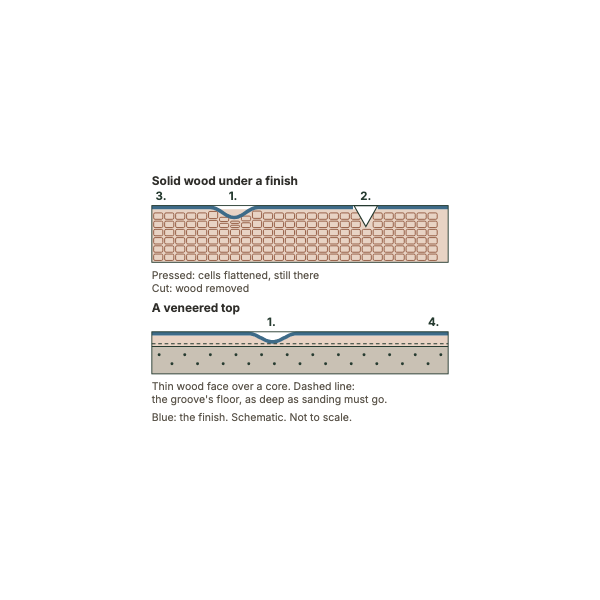
Once glass is scratched, the conservation note says of display cases, it is very laborious and time consuming to restore, and in almost all cases replacing it is preferable. How a mark sitting on glass differs from a scratch in it is covered in scratches on a glass cooktop.
When Nothing Moves It: Etched Glass
If detergent, a weak acid and a gentle scrub all leave the haze where it was, the case left in this article is the glass itself. Dulling, as the Zanini review describes it, is a loss of clarity from layers of alteration products, and pits come from glass dissolving in place.
No source read describes etching on a shower door, gives a home test for it, or says how many years of hard water it takes to appear. So this is an explanation that fits a stubborn haze, not a diagnosis of one.
If the glass has pitted, cleaning will not restore it, because what is missing is glass. Whether a dulled layer can come off without taking glass with it, nothing read says. The conservation note’s advice on scratched glass points the same way: restoring it is laborious, and replacing it is usually preferable. For a tempered door, the definition of tempered glass applies as well.
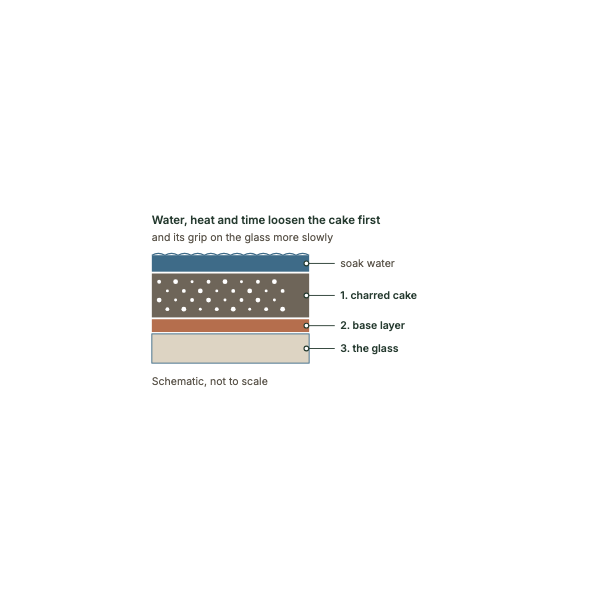
Whoever installed the door, or a glass company, can say what it is made of and what can be done with it. What strong alkaline cleaners do to ordinary glass is taken up in burnt cake in a glass baking dish.
The Homemade Chelator and the Other Replies
One long reply described a homemade spray built on disodium EDTA, a chelating agent, with alcohol and detergent, sprayed on and wiped off a day or two later. The laboratory work gives the idea some support, at least for soap curd.
Model soap scum dissolved best in a surfactant solution with disodium EDTA at high pH, on the order of 2,000 times its solubility in water. Without the chelating agent, raising the pH had the opposite effect (Itsadanont and colleagues 2013 and 2014, both cited from their abstracts).
This article gives no recipe. The reply’s spray combines several products, no test of it on shower glass was found, and each ingredient carries its own label. The lab result explains why a chelator can help with curd; it does not vouch for a mixture.
Steam cleaners, dryer sheets, dishwasher rinse aid, eraser sponges, citric acid in boiling water and a heated vinegar soak all had their advocates. No source read tested any of them on shower glass.
The nearest entry in the Idaho guide is lemon juice, which it says works much as vinegar does.
The poster also asked whether to rinse with scalding water or a hot shower. No source read addresses hot water on a shower door, or whether heat helps a weak acid on glass, so that question stays open.
Keeping It From Coming Back
The squeegee. The poster already squeegeed after every shower, and the film formed anyway. No source read tested squeegeeing, so how much it slows the buildup is not known.
Know the water. Nebraska’s guide classes water with 180 mg/L or more of hardness, counted as calcium carbonate, as very hard, and says a public supplier’s annual consumer confidence report may include hardness, or the supplier can be asked.
Ohio State’s Watershed Network gives a typical range of 40 to 160 mg/L of calcium alone in Ohio water, higher in the bedrock aquifers of northwestern Ohio. That is calcium, not total hardness, and the page gives no figure for the southwest.
Soften it. An ion exchange softener removes calcium and magnesium and adds sodium, Nebraska’s guide explains.
Virginia Tech suggests softening all the water entering a house if hard water leaves a soapy film after showering, and the Idaho guide’s own remedy table says a softener may be needed where water is extremely hard.
Devices that claim to manage scale magnetically or electrically do not change the water’s hardness, Virginia Tech notes, and Nebraska says their effect in homes has not been scientifically assessed. No source read covers a filter on the shower head.
Bar soap. One reply suggested switching from bar soap to a liquid. Soap combines with hardness minerals into curd, while some synthetic detergents are partly inactivated by hardness but stay dissolved (Skipton and Dvorak 2016).
By 1978, soap in the United States survived mainly as the bath bar, and tallow soap performs poorly in hard water (Linfield 1978, cited from its abstract).
No source read compared a bar with a body wash on shower glass, so whether switching keeps the door clearer has not been tested.
Coatings. Water-repellent coatings had many takers in the thread. In one laboratory study, a hydrophobic coating let a small drop of water slide off at a tilt of under 10 degrees (Zhang and colleagues 2010, cited from its abstract), which is the idea behind them.
No test of a coating on shower glass in hard water was found, nor of how long one lasts there. One reply warned that versions sold for cars carry cancer-causing ingredients; no source read addresses that, and a product’s hazards are stated on its label.
Local Regulations and Safety Advisory
If you use household chemicals, follow the label. Rules on them vary by country and locality, and your hazardous waste service can say what applies where you live. Use one product at a time and rinse between, never with bleach, follow the label of any strong acid cleaner, and keep steel wool, blades and sandpaper off a tempered door unless you accept the risk of scratching it. This article is general information, not legal or medical advice.
Authorities to consult:
- Public health department or hazardous waste service
- Each product's label, and whoever installed the door or a glass company for what the glass is
What Remains to Be Explored
No test of any cleaning method on a glass shower door was found: not detergent, vinegar, lime-scale removers, steam, chelators or coatings. The order in this article comes from what each kind of film is made of, not from a trial.
Nothing read gives a way to tell scale, soap curd and etched glass apart at home, or says how long hard water takes to etch a shower door. A study that sampled clouded doors and identified what was on and in them would settle the first question.
The safety question is open too. No study measured whether very fine steel wool, razor blades or eraser sponges scratch tempered shower glass, and nothing read ties a cleaning scratch to a later break.
A test of common scrubbing tools on tempered glass would change the advice here more than anything else.
Also not found: whether squeegeeing, a water-repellent coating, a shower head filter or a change of soap keeps the film away, and whether hot water helps. Each would turn a stated gap into an answer.
Sources
- Need Advice on Getting This Hardwater Off My Glass Shower Door — multiple community members. Reddit, r/CleaningTips. Undated.
- Drinking Water: Hard Water (Calcium and Magnesium), NebGuide G1274 — Sharon O. Skipton, Bruce I. Dvorak. University of Nebraska-Lincoln Extension. May 2016.
- Virginia Household Water Quality Program – Hardness in Household Water (BSE-258P) — Erin James Ling, Brian Benham. Virginia Cooperative Extension, Virginia Tech. 2024.
- Calcium – Ohio Watershed Network — Ohio State University, Ohio Watershed Network. The Ohio State University, College of Food, Agricultural, and Environmental Sciences. Undated.
- Household Cleaning Products (CIS 1010) — E. Porter. University of Idaho Cooperative Extension System. May 6, 1994.
- Cleaning Glass and Acrylic Display Cases – CCI Notes 1/2 — Canadian Conservation Institute. Canadian Conservation Institute, Government of Canada. 1996.
- Glass Surface Treatments: Commercial Processes Used in Glass Manufacture (Lecture 10) — Carlo G. Pantano. Lehigh University, International Materials Institute for New Functionality in Glass (course lecture). February 2015.
- A Review of Glass Corrosion: The Unique Contribution of Studying Ancient Glass to Validate Glass Alteration Models — Roberta Zanini, Giulia Franceschin, Elti Cattaruzza, Arianna Traviglia. npj Materials Degradation 7:38. May 20, 2023.
- Dissolution of Soap Scum by Surfactant Part I: Effects of Chelant and Type of Soap Scum — Sawwalak Itsadanont, John F. Scamehorn, Sukhwan Soontravanich, David A. Sabatini, Sumaeth Chavadej. Journal of Surfactants and Detergents. November 5, 2013. Cited from its abstract.
- Dissolution of Soap Scum by Surfactant. Part II: Effects of NaCl and Added Chelant on Equilibrium Solubility and Dissolution Rate of Calcium Soap Scum in Amphoteric Surfactant Solutions — Sawwalak Itsadanont, Darunrat Ratanalert, Sukhwan Soontravanich, John F. Scamehorn, David A. Sabatini, Sumaeth Chavadej. Journal of Surfactants and Detergents. March 29, 2014. Cited from its abstract.
- Soap and Lime Soap Dispersants — W. M. Linfield. Journal of the American Oil Chemists’ Society. January 1978. Cited from its abstract.
- Acetic Acid Demonstrates Greater Carbonate Dissolution Than Typically Expected — A.S. Metcalf, C.P. Parker, J.L. Boles. Journal of Canadian Petroleum Technology. December 1, 2005. Cited from its abstract.
- Room Temperature Processed Hard Easy Clean Coating Using Ammonia Treatment — Xiao Zhang, Min Qian, Yu Chan Liu, Hong Xie. Key Engineering Materials. September 2010. Cited from its abstract.
- 16 CFR Part 1201 – Safety Standard for Architectural Glazing Materials — US Consumer Product Safety Commission. Code of Federal Regulations, Title 16, Part 1201 (govinfo). January 1, 2012.
- Tempered Glass Safety Alert (Publication 1801) — US Consumer Product Safety Commission. February 2018.
- Reduce Your Risk of Toxic Gases: Never Mix Bleach With Other Cleaning Products (RA-62070) — Health Canada. Health Canada, Recalls and Safety Alerts. February 8, 2021.