Scale insects spend most of their lives fixed in one place under wax, so the first job is telling which kind you have: armored scale, under a hard cover separate from its body and making no honeydew, or soft scale, whose wax is part of its body and which makes sticky honeydew.
The stage that moves, and the one that is exposed, is the crawler, the tiny first stage that hatches from eggs under the female. Scraping removes the scales you can see.
The extension guides read add that eggs under a cover can survive, that treatments often need repeating, and that indoors soft scales can keep breeding through winter.
What This Article Covers
It covers telling armored from soft scale, checking whether a scale is alive, the crawler stage, why scale comes back on houseplants, and what removal and treatment can reach.
For bumps on a pothos stem that may be roots rather than scale, see brown bumps on a pothos stem, and for ants guarding scale, ants and scale on a young citrus tree.
For the related mealybugs, see why mealybugs keep coming back after treatment and soap or detergent for mealybugs on a parlor palm.
Armored or Soft
The guides agree on two main groups. Leanne Pundt of UConn Extension describes armored scales as protected by a hard, waxy cover, called a test, made of wax and the cast skins of earlier stages, and says they make no honeydew. Soft scales are covered only by wax and secrete honeydew, on which black sooty mold may grow.
Erin O. Quinn of Rutgers Cooperative Extension adds that the armored scale’s cover is separate from its body, which makes it less susceptible to sprays. David Held of the Alabama Cooperative Extension System says a soft scale’s waxy coating cannot be separated from the body.
Feeding explains the honeydew. Clifford S. Sadof of Purdue Extension writes that soft, kermes and bark scales feed on the plant parts that carry fluid and nutrients and excrete honeydew, while armored scales burst plant cells with a straw-like mouth and feed on their contents.
Honeydew is the outside sign. It drips onto anything below, draws ants, flies and wasps, and grows sooty mold that shades leaves.
So sticky leaves or black mold point to soft scale or mealybugs, and Sadof advises checking the leaves above, though Held notes that aphids and whiteflies make honeydew too. An armored scale gives no such sign, which makes it harder to find, Pundt notes.
Shape is a clue too. Pundt describes soft scales as convex, like a helmet, and armored scales as circular or rounded. Held puts soft scales at 1/10 to 1/4 inch, larger than other scale insects.
Their life histories differ as well: armored females lay fewer than 100 eggs, Pundt writes, and soft scale females more than 1,000.
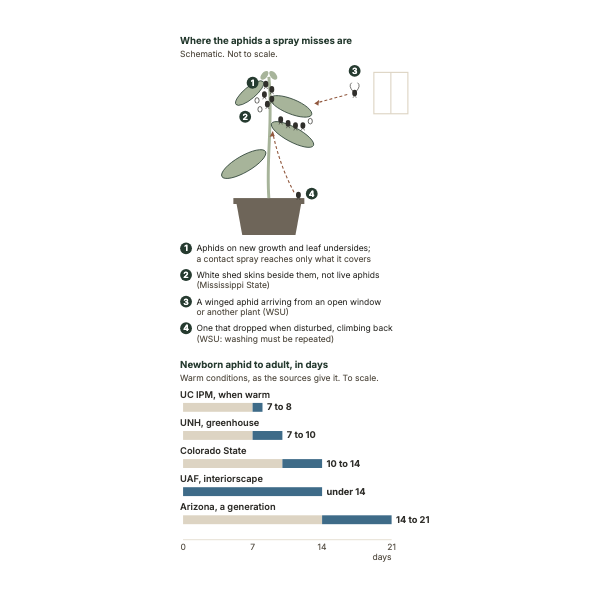
Scale insects hide under wax; only the crawlers are exposed
An armored scale’s cover is separate from its body and shields it from sprays; a soft scale makes honeydew. The newly hatched crawlers are the stage that moves.
UConn Extension (Pundt, 2024); Purdue Extension E-29 (Sadof); Rutgers (Quinn, 2025); Willard (1973), Australian Journal of Zoology.
Tell armored from soft scale first; any spray is aimed at the crawlers, and more than one round is often needed.
Is It Alive?
A dead scale can stay stuck to a plant. Sadof suggests flipping suspicious bumps with a thumbnail: if there is a soft body under a cover, the plant likely has live armored scale.
Pundt uses a needle or fingernail to pop off the cover and looks for a pink or orange body; colored liquid means alive, and a dry, shriveled or missing body means dead.
Held adds that small round holes in scale covers are a sign of natural enemies, since crawlers do not make holes; Pundt shows such a hole where a parasitic wasp came out.
Crawlers, the Exposed Stage
Every guide read points to the crawler. Sadof describes crawlers as smaller than 1/32 inch and flat, looking like dust on the plant, and says infestations spread when they walk or are blown by wind to nearby plants. Held adds that crawlers have no waxy coating yet, which makes them more susceptible to natural enemies and insecticides.
Once a crawler settles, it stays. Held writes that most scales lose their legs, or the use of them, at their first molt, and Quinn that armored scales do not move after the crawlers settle.
An armored crawler that starts feeding, Sadof writes, flattens under a clear wax shell that is hard for insecticides to get through.
The window is short. In laboratory work on California red scale, an armored scale of citrus, J. R. Willard found crawlers wandered 115.4 to 158.2 minutes on the leaves of fourteen kinds of citrus before settling.
In moving air meant to imitate wind, they survived a mean 5.7 to 17.1 hours, longer when cooler and more humid.
Scale can also suit its plant. Lawrence M. Hanks and Robert F. Denno found white peach scale survived better on the mulberry tree it came from than on other trees, though only between distant trees.
Why Scale Comes Back Indoors
Held writes that soft scales usually produce one or two generations a year on outdoor plants, but inside a home or greenhouse the same species can produce multiple generations during winter. Females produce hundreds to thousands of young, commonly without mating.
Pundt’s guide, written for greenhouse growers, advises removing heavily infested plants, not carrying infested plants over winter, and pruning out heavily infested branches. Sadof adds checking new plants, since an unusually bumpy twig with yellowing leaves may hold scale.
Removing and Treating
Removal works on what you can reach. Sadof suggests cutting out heavily infested branches on fast-growing plants so new, clean shoots can take over, and Quinn and Pundt advise getting rid of heavily infested plants. No study read tested scraping scales off by hand, or how many survive it.
Sprays reach the exposed stages. Sadof writes that conventional insecticides cannot get through a scale’s skin or waxy cover, and kill crawlers they cover or that walk over treated surfaces, so they are aimed at the start of the crawler period.
They also kill the natural enemies that give lasting control, Sadof warns, and Quinn adds that poor timing can make an infestation worse for that reason.
Horticultural oil works differently. Sadof writes that it smothers scales, can kill armored scales soon after they settle, and is not toxic to natural enemies once dry.
In a laboratory test on dormant fruit twigs, C. D. Pless and colleagues found oil dips killed most scales of both a soft and an armored species within two weeks, against 2 and 6 percent dead on untreated twigs.
Repeats are the rule. Held writes that oils can be very effective but often need more than one application, because eggs under the female may stay alive and the population can rebound.
Pundt says crawler sprays are repeated because not all eggs hatch at once and generations overlap, and that systemic insecticides may kill soft scales more effectively than armored ones.
Both call for repeat treatments, and they describe hatching differently: Held says most species outdoors hatch their crawlers together, while Pundt, writing for greenhouses, says not all eggs hatch at once. Any product is used only as its label directs.
Natural enemies matter outdoors. Sadof notes that lady beetles and tiny wasps can keep scales quite low in a natural woodland, and Quinn lists lacewings, lady beetles and parasitic wasps.
A review by Apostolos Kapranas and Alejandro Tena names a family of parasitic wasps as among the most important natural enemies of soft scales, used widely in biological control.
Local Regulations and Safety Advisory
If you use pest control products, follow the label. Rules on them vary by country and locality, and your pesticide regulator can say what applies where you live. This article is general information, not legal advice.
Authorities to consult:
- Pesticide regulatory authority or environmental protection agency
What Remains to Be Explored
No study read tested scraping, wiping or other home methods on scale indoors, or timed crawler hatches on houseplants. The crawler times come from one armored scale on citrus, and the oil result from dormant fruit twigs, not potted plants.
Sources
- Scale Insects on Shade Trees and Shrubs (E-29-W) — Clifford S. Sadof. Purdue University Extension, Department of Entomology. January 2018.
- Managing Scale Insects in the Greenhouse — Leanne Pundt. UConn Extension, Integrated Pest Management. June 2024.
- Armored Scales — Erin O. Quinn. Rutgers Cooperative Extension, Nursery IPM. May 13, 2025.
- Controlling Scale Insects and Mealybugs (ANR-2423) — David Held. Alabama Cooperative Extension System. October 2019.
- Wandering Time of the Crawlers of California Red Scale, Aonidiella Aurantii (Mask.) (Homoptera, Diaspididae), on Citrus — J.R. Willard. Australian Journal of Zoology. 1973. Cited from its abstract.
- Survival of Crawlers of California Red Scale, Aonidiella aurantii (Mask.) (Homoptera, Diaspididae) — J.R. Willard. Australian Journal of Zoology. 1973. Cited from its abstract.
- Local Adaptation in the Armored Scale Insect Pseudaulacaspis Pentagona (Homoptera, Diaspididae) — Lawrence M. Hanks; Robert F. Denno. Ecology. 1994. Cited from its abstract.
- Vegetable Oil Applications Control Scale Insects on Dormant Apple and Peach Trees — C.D. Pless; D.E. Deyton; C.E. Sams. HortScience. 1993. A meeting abstract, not a full paper.
- Encyrtid Parasitoids of Soft Scale Insects: Biology, Behavior, and Their Use in Biological Control — Apostolos Kapranas; Alejandro Tena. Annual Review of Entomology. 2015. Cited from its abstract.