A coffee plant grows from a fresh coffee seed, not from the roasted beans in a bag. Growers plant seed still in its parchment skin, because milling it to green coffee injures it, and even fresh seed takes 50 days or more to germinate in a nursery.
Arabica, the common coffee, is self-fertile and comes true from seed, so a seedling should resemble its parent. It needs years, not months: an arboretum record puts first flowers at 3 to 4 years.
What This Article Covers
It covers what a coffee bean is, why roasted and green beans are the wrong start, how to plant a fresh seed, how long it takes, whether the plant will be like its parent, and growing coffee indoors until it flowers.
For other fruit grown from a seed or pit, see growing an avocado from a pit, how to grow a mango tree from seed and growing a pomegranate from seed.
What Is in a Coffee Bean
A coffee bean is a seed. UF/IFAS Gardening Solutions describes the red fruit, called a cherry, as holding two seeds that look like the beans sold in stores but paler, with a green or yellow tint.
The University of Arizona’s arboretum record describes berries that start green and turn yellow, red or purple, each with a sweet, pulpy outer layer around two pale brown seeds up to half an inch long.
For the drink, the record says, the pulp is removed and the seeds are dried in the sun, then roasted and ground.
Each seed sits in a skin called parchment. Hawaii’s growing guide (Bittenbender and Smith, 2008) explains that seed from pulped and fermented cherries is parchment coffee at that stage, and that milling takes it on to the green-bean stage.
Roasted and Green Beans
The sources agree that planting starts with fresh, unroasted seed. University of Arkansas Extension (Klingaman, 2010) says coffee plants can be grown from fresh seed, non-roasted of course.
Hot water harms the seed in testing. Wibowo and colleagues (2023) compared soaking water at 25, 50, 75 and 90°C for arabica seed at the Indonesian Coffee and Cocoa Research Institute. At 75 and 90°C the embryo was damaged and the seeds rotted.
Water at 50°C did less harm in that test: shoot and root growth of the seedlings did not differ significantly from the room-temperature control. A three-day soak in room-temperature water still gave the best germination, sprout length and vigor.
Green beans fall short for a different reason. Hawaii’s guide tells growers not to mill seed for planting to the green-bean stage, because milling injures the seed.
Coffee seed also keeps poorly. Wibowo and colleagues (2020) class it as an intermediate seed that needs high moisture in storage and has a short shelf life, and Guimarães and colleagues (2020) studied why arabica seed is sensitive to drying, pointing to unsaturated fats in the endosperm as a possible source of damage.
Seed of nine varieties in that 2020 test, stored six months at a controlled temperature, still germinated above 85 percent. How long green coffee from a store has been dried and stored is not on the bag, and no source read here tested it.
Planting a Fresh Seed
Hawaii’s guide takes seed from ripe cherries picked off consistently heavy-bearing plants, and says not to use seed picked up from the ground. It removes the pulp, and if the seed is not planted at once it dries it in the shade for about 10 days.
Grow coffee from fresh seed, not a roasted bean, and expect to wait
Growers plant fresh seed still in its parchment skin; milling injures it and heat damages it. Even fresh seed takes weeks to months in a nursery.
Bittenbender and Smith (2008), University of Hawaii CTAHR; University of Arkansas Extension (Klingaman, 2010); Wibowo and colleagues (2020, 2023), Pelita Perkebunan.
Start from fresh, unroasted seed, ideally still in parchment, and expect the first leaves in months, not days.
The guide sows in soil free of weed seeds or in equal parts vermiculite, perlite and peat. It covers the seed with half an inch of soil or a vermiculite and perlite mix, and keeps the flat moist but not saturated by regular misting, in direct sunlight.
Seedlings from a flat are moved before their seed leaves open, into a pot or bag about 3 inches across and 8 inches tall, with care not to bend the taproot. Seed can also go straight into pots, two or three to a pot, thinned to one after they come up.
The guide checks the roots of 10 plants at random at least 4 weeks before planting out. Taproots bent into a J or Z shape, it says, later restrict sap and water flow in young bearing trees, which may die back or fall over.
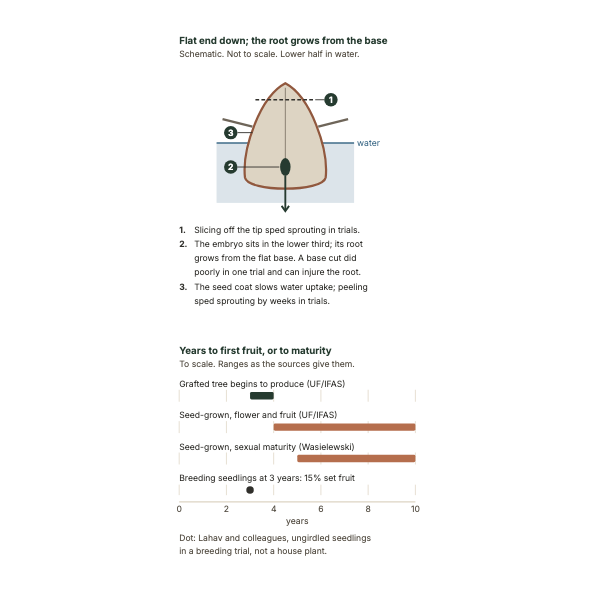
Seed coverings slow germination too. Irmansyah and Irsal (2022), testing arabica seed at the University of Sumatera Utara, say germination takes a long time because the seed’s skin is semi-permeable to water. Stripping the skin raised the germination rate and speed and lowered deaths compared with untreated seed.
Arkansas suggests planting three to five seedlings together. The branches grow out at right angles, it explains, so a single plant tends to look open.
How Long It Takes
In a nursery, Hawaii’s guide says coffee seeds take 50 or more days to germinate, with seedlings coming up 70 to 90 days after planting. The seed leaves harden over the first 3 to 4 months, and several pairs of true leaves follow after 6 to 8 months.
Raising seedlings in nursery beds is seldom done, the guide says, but those that are raised that way are normally 18 to 24 inches tall at 14 to 20 months, the size the guide calls ideal for planting out in an orchard.
Laboratory figures are faster. In the 2020 petri-dish test, the nine varieties took 6 to 12 days to germinate. That test measured germination in a laboratory, not a seedling rising through soil in a nursery, so its days and the nursery’s count different things.
Will It Be Like the Coffee You Drank?
For arabica, likely yes. UF/IFAS says arabica flowers are self-fertile and arabica plants grow true to type from seed, while robusta needs cross-pollination and robusta plants and hybrids often do not come true.
The Arizona arboretum record calls arabica the only self-fertile species in its genus, itself a hybrid of two other coffee species. The record names seed as the usual way to propagate it, and budding, grafting and cuttings as others.
Growing It Indoors
Arkansas calls coffee plants good houseplants and gives them a bright window in winter and a shaded patio in summer. UF/IFAS gives ideal conditions of 59 to 75°F, high humidity and shelter from wind, and says coffee does not tolerate freezing.
The Arizona record gives a daytime optimum of 70 to 80°F and 60 to 65°F at night. It says growth slows above about 77°F, leaves can drop below 55°F, and frost kills both leaves and fruit.
Size is manageable in a pot. The Arizona record puts container plants indoors at about 4 to 6 feet and says the plant grows in shade or full sun and can be pruned to size. UF/IFAS prunes garden plants to 4 to 6 feet, though they can reach 50 feet.
Arkansas describes coffee as a small evergreen understory shrub that reaches 25 feet in the wild, which growers prune back severely after each harvest to 8 to 10 feet.
Water needs care. The Arizona record keeps the soil moist but not soggy, Hawaii’s guide calls coffee sensitive to waterlogging, and UF/IFAS warns that lawn sprinklers can overwater coffee planted in a yard and cause root rot.
When It Flowers and Fruits
The Arizona record puts first flowers and fruit at 3 to 4 years of age and full production at 6 to 8, with fruit ripening 7 to 9 months after flowering. It says plants usually flower and fruit once a season, on new growth only.
Arkansas says arabica prefers cool, moist, lightly shaded mountainside habitat and is native to the highlands of Ethiopia and southern Sudan. The Arizona record places it in the Ethiopian highlands at 4,500 to 6,000 feet.
What Remains to Be Explored
No source read here tested whether green coffee from a store will germinate at home, or how long a seed-grown plant takes to flower indoors rather than outdoors in a coffee region. The nursery and laboratory figures come from growers and testing rooms, not windowsills.
Sources
- Growing Coffee in Hawaii (Revised Edition) — H. C. Bittenbender; Virginia Easton Smith. University of Hawaii at Manoa, College of Tropical Agriculture and Human Resources. March 2008.
- Coffee (Plant of the Week) — Gerald Klingaman. University of Arkansas Cooperative Extension. January 22, 2010.
- Coffee — UF/IFAS Gardening Solutions. Undated.
- Coffea arabica (Find Trees and Learn) — University of Arizona Campus Arboretum. Undated.
- Seed Germination Performance of Nine Arabica Coffee (Coffea arabica L.) Varieties Under the Laboratory Condition After Six Months of Storage Period — Ari Wibowo; Dwi Nugroho; Ucu Sumirat. Pelita Perkebunan (a Coffee and Cocoa Research Journal). 2020. Cited from its abstract.
- Germination and Early Seedling Growth of Three Arabica Coffee Varieties at Four Seed Soaking Water Temperatures — Ari Wibowo; Stefani Aprillia Wijaya; Suharjono. Pelita Perkebunan (a Coffee and Cocoa Research Journal). 2023. Cited from its abstract.
- Effect of Dormancy Treatment on Germination of Arabica Coffee (Coffea arabica L.) — Irmansyah; Irsal. Jurnal Agroteknologi. 2022. Cited from its abstract.
- Total Lipid and Fatty Acid Profiles of Coffea arabica Endosperm and Embryo Tissues and Their Relationship to Seed Desiccation Sensitivity — Cristiane Carvalho Guimarães; Sttela Dellyzete Veiga Franco da Rosa; Mayara Holanda de Carvalho; Marcelo Ribeiro Malta; Roseane Maria Evangelista Oliveira. Seed Science and Technology. 2020. Cited from its abstract.