This article will not tell you whether the plant by your sidewalk is purslane, and no article should. What it can tell you is what common purslane is: a vegetable grown for thousands of years and a summer weed that a few plants turn into a carpet, for the same reasons.
Before anyone eats it, two things matter more than the plant. One is identification, which belongs to a person who can look at it. The other is the soil beside a road, which can hold lead that only a test can measure.
The question comes from a thread on r/PlantIdentification. Someone found a low, fleshy plant with reddish stems beside a sidewalk and asked what it was, adding that the red on their fingers was juice from something else.
Replies named purslane, then argued over eating it: a superfood with more omega-3 than any vegetable, or an oxalate load worse than spinach; eat it, or never from a sidewalk; save its seed, or expect it forever once it seeds. A fair share of the thread never got past the fingers.
What This Article Covers
This article covers common purslane once a plant has been named, and leaves the naming to people who can examine the plant. Several replies warned of lookalikes, naming moss rose, a spurge and a desert plant called horse purslane, and the thread’s poster had already tried an identification app and wanted people to check it. That instinct was right.
NC State’s Plant Toolbox lists prostrate knotweed and moss rose as plants common purslane is often confused with, and sixteen common names for it, one of them moss rose, which is also the name of a plant it is confused with. UC IPM puts moss rose, miner’s lettuce and redmaids in the same plant family.
So the features for telling purslane from anything else are left to someone who can examine the plant itself; the advisory at the end lists where to ask. Everything below is about common purslane, Portulaca oleracea, once it has been named.
The Sidewalk Question Is a Soil Question
One reply said not to eat it from the sidewalk; another, writing from Italy, eats it when it comes up among the lettuce and tomatoes and never near asphalt. Both were drawing the line the soil sources draw, and the sources say why.
The Cornell Waste Management Institute, in a 2009 guide to soil contaminants, says a property’s distance from roads and traffic affects the amount of some chemicals in its soil, lead above all.
Lead compounds were used in gasoline until the late 1970s, and “the highest concentrations of lead in soils are still generally found adjacent to busy roadways.”
The same guide puts the lowest contamination farthest from traffic and the highest lead right beside old painted buildings, falling off with distance from the wall. Polycyclic aromatic hydrocarbons, the residues of burned fuel, may also run higher in high traffic areas.
The deposit is old but not gone. Rosalie Sharp and Daniel Brabander sampled urban garden soils in two Boston neighborhoods and found that the finest soil fractions, the ones linked with blowing dust and raised blood lead, still carried the isotopic signature of leaded gasoline and leaded paint decades after either was deposited (cited from the abstract).
How far the roadside reaches was measured while the gasoline was still leaded. In 1971 William H. Smith sampled white pine twigs and needles at increasing distances from an interstate carrying about 24,000 vehicles a day.
Lead “decreased regularly with increasing distance from the highway edge,” and samples within 15 m (about 50 feet) often held more than 100 ppm, much of it, the author presumed, on the outside of the plant (cited from the abstract).
Purslane itself takes lead up. Thalassinos and colleagues grew it in pots of soil spiked with lead at up to 900 mg per kg and found the added lead “did not cause any adverse effects on plant growth” (cited from the abstract).
The plants took up more lead when nitrogen was added, and grew as well as ever. In that test, at least, a thriving plant was no sign of what it held.
Part of the lead on produce from such soil washes off and part does not. In an urban garden contaminated to about 200 mg per kg of lead by gasoline emissions and other diffuse sources, Attanayake and colleagues found that removing surface dust cut the lead in leafy vegetables by 40 to 50 percent and that peeling halved it in radishes.
The rest was inside the vegetables. Eating the lettuce and root crops from that garden would have kept daily lead intake below the Codex Alimentarius limits and about 1.5 times above the interim reference level proposed by the U.S. Food and Drug Administration (cited from the abstract).
None of this measures the soil beside any particular sidewalk, which is the point. The Cornell guide to soil testing says plainly that there is no clear line of what counts as safe, and that food gardens and children’s play areas are where testing matters most.
If you want to grow or gather food where the soil’s history is unknown, a lead test is the step the sources give.
University of Illinois Extension’s Rhonda Ferree describes the sampling: lead sits mostly in the top 1 to 2 inches, so take thin slices from at least eight scattered spots, mix them, send about a pint to a laboratory, and ask specifically for a lead test.
Ferree gives 400 ppm of total lead as the level above which EPA recommends not growing vegetables, and the Cornell guide prints the same 400 ppm as the federal hazard level for bare soil where children play, against a New York State background of about 18.7 ppm.
EPA itself says it has no screening level written for gardening and sends gardeners to their state agency or extension service.
Where a test comes back high, or no test is possible, EPA’s urban gardening fact sheet gives the practices: locate food gardens away from heavily trafficked roads and old painted buildings, and grow in raised beds over landscape fabric with clean soil.
It adds washing produce under running water, throwing away the outer leaves of greens, and keeping small children from eating soil. Ferree’s raised bed is 8 inches deep over fabric, filled with potting mix.
That is testing guidance, not clearance. No source read clears a roadside, and this article does not either. For the same test applied to a vegetable bed, see regrowing lettuce from a stump, where the soil question comes up in a kitchen garden.
Superfood or Oxalate Load: What Was Measured
The two nutrition claims traded in the thread come out differently against the measurements. Take the omega-3 first.
Purslane does carry alpha-linolenic acid, the plant form of omega-3. A 2014 review by Uddin and colleagues gives about 4 mg of it per gram of fresh weight, which is 400 mg per 100 g, along with potassium, magnesium and calcium (cited from the abstract). University of Wisconsin horticulture calls the plant unusually high in omega-3 fats, and NC State says the same.
How much depends on the plant and the day it is picked. U. Palaniswamy and colleagues, in a greenhouse study reported as a meeting abstract, found leaf fatty acids 30 to 52 percent higher at the 6- and 14-leaf stages than at the 10-leaf stage, and an upright cultivated type with 35.2 percent more alpha-linolenic acid than the sprawling wild type.
Mortley and colleagues harvested a golden purslane cultivar at 20, 40 and 60 days after transplanting and watched the ratio of omega-6 to omega-3 move from 0.44 to 1.1 across the three harvests (cited from the abstract). The plants were biggest at 60 days and had the most omega-3 relative to omega-6 at 20.
What the sources read do not settle is the superlative. No table read for this article ranks vegetables by omega-3.
The U.S. Department of Agriculture’s FoodData Central record for raw purslane lists no fatty acid values at all, where other vegetables in the same database do. The claim that purslane beats every vegetable is left unchecked here, not confirmed.
The same record does list vitamins: per 100 g of raw purslane, 1,320 IU of vitamin A, 21 mg of vitamin C and 1.99 mg of iron, with no vitamin K value given.
Boiling and draining roughly halves the vitamin C and cuts the iron to 0.77 mg in the cooked record.
The oxalate reply holds up better. In a 1999 review in the Asia Pacific Journal of Clinical Nutrition, SC Noonan and GP Savage tabulated oxalate in common foods in milligrams per 100 g fresh weight.
Purslane ran 910 to 1,679 with a mean of 1,294, spinach 320 to 1,260 with a mean of 970, and beet leaves, which is chard, 300 to 920 with a mean of 610. The figure shows the three ranges to scale.
By those means purslane carries about a third more oxalate than spinach and about twice as much as chard, though the ranges overlap and the review compiles older measurements rather than new ones.
The Uddin review’s abstract gives a lower purslane figure, 671 to 869 mg per 100 g, so the sample matters.
What that means for a person is not this article’s to say. Wisconsin’s page says purslane holds high amounts of oxalates, as spinach does, “so should not be consumed excessively by those susceptible to forming kidney stones.” NC State says its oxalates can be toxic if eaten in high amounts.
Noonan and Savage conclude that diets low in calcium and high in oxalate are not recommended, while occasional high-oxalate foods as part of a nutritious diet, in their words, “does not pose any particular problem.” Anyone with a stone history has a clinician to ask, not a gardening article.
Cooking changes the figure. Noonan and Savage write that soaking and cooking high-oxalate foods reduces their oxalate by leaching it into the water, and Zherkova and colleagues found blanching and pickling both lowered the oxalate in purslane, pickling the most (cited from the abstract; its units are not explained there, so no amount is given here).
Why It Comes Back, Part One: The Seed
One reply said that letting purslane flower means never being rid of it. The seed sources are on that reply’s side, with one measurement that cuts the other way.
UC IPM’s pest note on common purslane, by D.W. Cudney, C.L. Elmore and R.H. Molinar, says a single plant may produce 240,000 seeds, borne in a small pod “with a top that comes off like the lid on a cookie jar.”
Turn over a mat in late summer, the note says, and thousands of seeds show on the soil surface.
The seed comes fast. University of Maryland Extension says a plant can bloom as soon as a month after it germinates and ripen seed as soon as a week after blooming, and Wisconsin notes that the plant is self-fertile, so almost every flower sets seed.
Where purslane comes back from, and how its oxalate compares
Three places a pulled plant starts again, one where it does not, and the one published table that sets purslane beside spinach and chard.
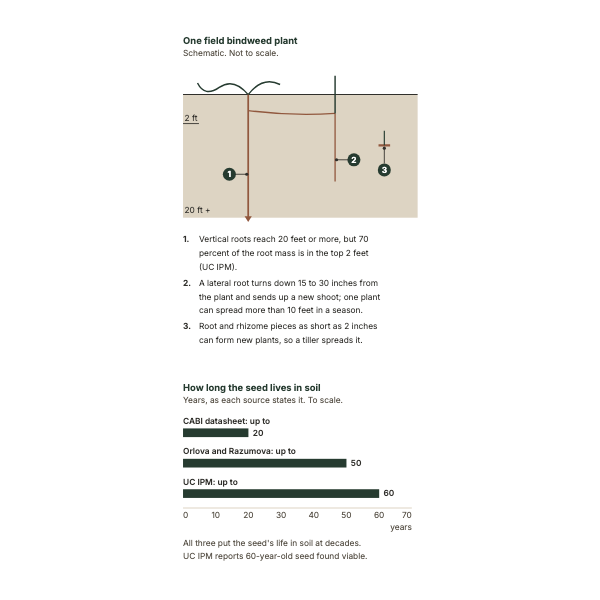
| 1. Seed on the surface | A plant may set 240,000 seeds, in pods whose lid comes off; it can bloom as soon as a month after it sprouts, ripen seed a week after bloom, and keep ripening seed for a week after it is pulled (UC IPM; Maryland; Wisconsin). The seed needs light and germinates at or near the surface in flushes after rain or watering; none emerged from 2 cm down in one test (Chauhan and Johnson 2009; Reger and Yates 1978; UC IPM). |
| 2. Seed in the soil | UC IPM gives 5 to 40 years and Maryland and Wisconsin decades; in one Mississippi burial study 10 percent of purslane seed was alive at 2.5 years and no more than 6 percent at 5.5 (Egley and Chandler 1978, 1983). Digging brings buried seed back to the light (UC IPM). |
| 3. A piece with a node | Stem pieces with a node survived in 70 percent or more of cases in a greenhouse, more with leaves on, and in most plots hoed or tilled stands grew back as dense as untouched ones (Proctor and colleagues 2011; Miyanishi and Cavers 1981). Cut stems stay alive for days and root when watered (UC IPM). |
| 4. A piece between nodes | None survived in the same greenhouse test (Proctor and colleagues 2011). The sources give two answers for hoed plants: take them off the site, or let them dry fully before any watering (UC IPM; Wisconsin; Maryland). |
Top: red-brown, stems and roots; green, leaves; gray, the seed capsule; black dots, seed. No count, depth or length is drawn. Bottom: bars are the published ranges, dots the means; the ranges overlap.
Two routes back: seed that germinates at the surface and stays alive in soil for years, and any stem piece with a node. In the one table read, purslane’s oxalate range sits above spinach’s, and the two overlap.
Pulling does not stop a flowering plant from finishing. UC IPM says seeds “may continue to ripen a week later even after a plant is pulled,” Wisconsin that the pods mature even on a plant left roots-up, and Maryland that plants which have begun to flower should be disposed of rather than left on the soil or in a passive compost pile.
The seed then waits at the surface, because it needs light. Reger and Yates showed in 1978 that purslane seed kept in the dark makes almost no protein and starts to germinate about 12 hours after it is exposed to light (cited from the abstract).
Chauhan and Johnson, working with the weed in rice systems, found germination low in the dark at every temperature they tried, most emergence from seed lying on the surface, and “no seedlings emerged from the depth of 2 cm,” about three-quarters of an inch.
In their fields, more purslane came up where the soil was not tilled, which left seed on top in the light (cited from the abstract).
That is why UC IPM says it germinates “very near to or at the soil surface in large numbers after an irrigation or rain,” and why the same note warns that cultivating to kill seedlings can bring a fresh supply of seed up from deeper soil for the next flush.
On how long the buried seed lasts, every source read says years; the figures spread. UC IPM says seed may germinate after 5 to 40 years; Maryland and Wisconsin say decades.
In a buried-seed study begun in 1972 at Stoneville, Mississippi, Egley and Chandler found 10 percent of purslane seed still viable after 2.5 years, and their 5.5-year report put purslane among the species with no more than 6 percent left (both cited from abstracts).
Those two pictures fit together only if the number of seeds is kept in view. Ten percent of the 240,000 seeds UC IPM allows one plant is 24,000, our arithmetic on their two figures, and 6 percent is still 14,400.
A small surviving fraction of a very large seed set is a lot of purslane. UC IPM gives its 40-year figure without the study behind it, so how long the last few seeds last is left open here.
Why It Comes Back, Part Two: The Pieces
The second route is the one that makes hoeing feel futile. UC IPM says the fleshy stems “can remain moist and viable for several days after cultivation and hoeing” and then reroot into new plants once the garden is watered, so that hoeing without cleanup “becomes a transplanting operation.”
Which pieces root was tested by Christopher Proctor and colleagues in a greenhouse. Stem cuttings that carried a node, the joint where leaves attach, survived 21 days in 70 percent or more of cases, and more than 20 points more often when leaves were still attached.
Cuttings taken between nodes never survived, and where on the stem a piece came from made no difference (cited from the abstract).
The authors drew the gardener’s conclusion themselves: mechanical control that chops and spreads purslane stems “might not be effective and could ultimately increase weed populations.”
Maryland’s page agrees in part, saying a stem broken into fragments may root at the nodes while intact stems lying on the ground tend not to.
Whole stands behave the same way. Miyanishi and Cavers hoed and rototilled two naturally established pure stands of purslane on five schedules, and in most disturbed plots the stands that grew back were not significantly thinner than the untouched ones.
They were rebuilt three ways: from seed, from severed stems that rooted, and from shoots off root and stem bases.
Timing mattered to the seed. Disturbing the stands early in the season cut seed capsule production significantly; disturbing them late had minimal effect on seed set (cited from the abstract). For a plant with the same two routes back in an ornamental bed, see Russian sage.
Why This Was a Purslane Summer
A reader in central Italy said it came up all over in a hot summer, unlike other years, and others said it simply pops up everywhere. Heat is the part of that the sources explain.
Purslane seed waits for warm soil. UC IPM puts germination at soil temperatures of about 60°F, and Maryland at surface temperatures of at least 75 to 86°F, which in Maryland means late May through early August.
Chauhan and Johnson had the best germination of the three regimes they tested at 30°C by day and 20°C by night, which is 86 and 68°F.
Wisconsin adds that young plants stay small and stunted while the weather is cool and that the first freeze kills them.
Once up, the plant is built for heat. It runs the C4 form of photosynthesis, and under drought it can switch to a second system, crassulacean acid metabolism, in which, as Wisconsin describes it, the leaf pores open at night instead of by day.
Ferrari and colleagues found that in purslane the switch takes days to come on under drought and reverses within hours of rewatering, and Mazen induced it with short days and water stress while well-watered plants on long days never showed it (both cited from abstracts).
Wisconsin notes the culinary side of this: leaves picked early in the day, when the overnight acid is highest, taste tartest.
NC State lists it as tolerant of heat, drought and poor compacted soil, and Maryland names the crevices between pavers and the cracks in driveways among the places it grows.
A hot, dry summer that stresses lawn and vegetables is, by every source above, the summer that suits purslane. For the crack between pavers, see weeds in paver joints.
If You Want It, Grow It on Purpose
One reply suggested collecting the seed from the sidewalk plant and sowing it somewhere safer. That is the gardening sources’ answer too, with two conditions.
The first is the soil. The whole point of moving the plant is to grow it where the soil has been tested, or in a raised bed of bought mix, as the lead sources above describe.
Geiger and Norton, in one greenhouse test on a lead-contaminated calcareous soil, found that water-soluble inorganic fertilizer raised both the available lead in the soil and the lead in radish tissue, one more reason to know what is in the ground before feeding anything (cited from the abstract; no rate is given here, and any fertilizer’s label governs its use).
The second is that seed from a wild plant gives a wild plant. Palaniswamy’s cultivated upright type had more omega-3 and more leaf than the prostrate wild type, and James M. Stephens of UF/IFAS notes that cultivated varieties are rare in seed catalogs (cited from the abstract). Wisconsin names three cultivars with a more upright habit for easier harvest.
Wisconsin gives the growing: sow in fertile, well-drained soil, thin to 4 to 6 inches apart, and expect a harvest in 6 to 8 weeks.
Harvest the whole plant, or cut the stems back to within 2 inches of the crown and let it regrow, which gives leaves for most of the summer; successive sowings give more tender ones.
Water it. Wisconsin says moisture-stressed leaves are less palatable than those from well-watered plants. In Mortley’s greenhouse, the plants were largest at 60 days after transplanting and had the most favorable omega-6 to omega-3 ratio at 20, so when you cut depends on what you want.
UC IPM notes that purslane has been cultivated in India and the Middle East, has been eaten in Europe since the Middle Ages, and is a minor crop in the United States, known in Spanish as verdolaga; Wisconsin puts its history as a food and medicinal plant at more than 4,000 years.
Readers in the thread gave it names in Italian, Spanish and Turkish and put it in salads, omelets, stews and pickles.
If You Do Not Want It
No trial of purslane control in a home bed was found, so the steps below follow UC IPM, Maryland and Wisconsin, in the order the plant’s two routes suggest.
- Get seedlings while they are small. UC IPM recommends cultivating after an irrigation while the seedlings are tiny, and checking again after each watering, because germination comes in flushes.
- Pull before flowers, taproot and all. Maryland says hand removal, including the thick taproot, works best early and on young plants, and is easier when the soil is moist. Bloom can start a month after germination.
- Take flowering plants off the site. Maryland says not to leave them on the soil or in a passive compost pile, because the pods keep ripening; UC IPM gives a week.
- Dry what you hoe. UC IPM says to remove hoed plants or let them dry thoroughly before any watering, so the stem pieces cannot root; Wisconsin says the same of cut stems from larger plants.
- Do not dig deep. Cultivation brings buried seed back into the light (UC IPM), and seed on the surface is the seed that germinates (Chauhan and Johnson).
- Cover the soil. UC IPM says organic mulch at least 3 inches thick, or a fabric or plastic mulch that excludes light, controls purslane in beds and gardens. For a trial that planted purslane under landscape fabric, see weeds in gravel.
- Solarize an empty bed. UC IPM gives clear plastic over moist soil for 4 to 6 weeks in July to August, before planting, and no digging afterward.
- In lawns, grow grass. UC IPM says purslane is usually not a problem in dense, well-kept turf, and Maryland lists mowing high, overseeding and aerating as the ways to keep it out.
Herbicides exist for it, preemergent kinds that act on the seed and postemergent kinds that act on the plant, selective and nonselective.
UC IPM says chemical control is generally not necessary in a home landscape, and Maryland calls it a last resort and notes that some counties and cities restrict lawn herbicides.
If you use one, the label sets what, where and when, and local rules may add to it; this article names no product, rate or interval. UC IPM adds that a purslane sawfly feeds on the weed but builds up too late in the season to prevent seed.
Dogs, Cats, Horses and Children
NC State’s Plant Toolbox rates common purslane as a plant of low poison severity, with soluble calcium oxalates as the toxic principle, and tags it a problem for cats, dogs and horses.
The symptoms it lists are kidney failure, rare in dogs and cats, tremors and salivation, and it adds that the plant is harmful to livestock in high amounts.
That entry stands alone here; an ASPCA or poison center rating for purslane would add to it, and none is cited.
If a pet or child may have eaten some, the advisory below says who to call. Wisconsin, for what it is worth, lists purslane among plants fed to poultry.
For a child, the plant’s oxalate is the smaller question beside the soil it came from. Cornell’s contaminants guide notes that young children swallow more soil than adults through ordinary hand-to-mouth play, which is why it puts children’s play areas and food gardens first in line for testing.
Local Regulations and Safety Advisory
If you use fertilizer or pest control products, follow the label. Rules on them vary by country and locality, and your agriculture department or pesticide regulator can say what applies where you live. This article identifies no plant, so eat nothing on its strength; ask an extension office to name what you found. Soil beside roads and old paint can hold lead that only a soil test measures. This article is general information, not medical or veterinary advice.
Authorities to consult:
- Local agriculture department
- Pesticide regulatory authority or environmental protection agency
- Plant identification service or extension office, and a soil testing laboratory that tests for lead
- Poison control service
- Veterinarian or animal poison control service
If a child or pet may have eaten part of a plant, contact a poison control service or a veterinarian, because toxicity depends on the species, the amount and the individual.
What Remains to Be Explored
Whether a particular roadside plant carries lead cannot be known without a test of that soil, and no study read measured purslane picked beside a real road. The one uptake study spiked pot soil with lead; the one garden study grew lettuce and root crops, not purslane.
No table read ranks vegetables by omega-3 content, and FoodData Central lists no fatty acids for purslane, so the thread’s superlative is neither confirmed nor refuted here. A measured comparison across common greens, by the same method, would settle it.
The 40-year seed figure and the Mississippi decline to a few percent within six years describe different things, a last survivor and a population, and UC IPM gives the 40 years without its study. How long the last purslane seeds in a garden bed stay alive is open.
No trial compared hoeing, pulling and mulching in a home vegetable bed, and no study timed how long cut stems stay able to root in garden conditions rather than a greenhouse.
A toxicity rating for pets from a poison center or the ASPCA, and the oxalate removed by cooking purslane in grams, were not found.
Sources
- Found this Next to the Sidewalk. What Is It? — multiple community members. Reddit, r/PlantIdentification. Undated.
- Pest Notes: Common Purslane (UC ANR Publication 7461) — D.W. Cudney, C.L. Elmore, R.H. Molinar. University of California Statewide Integrated Pest Management Program (UC IPM). August 2007.
- Common Purslane, Portulaca oleracea — Susan Mahr; last update Bruce Spangenberg, 2025. Wisconsin Horticulture, Division of Extension, University of Wisconsin-Madison. 2025.
- Common Purslane: Identification and Management — University of Maryland Extension, Home and Garden Information Center. November 4, 2026.
- Portulaca oleracea (Common Purslane), Plant Toolbox — North Carolina State University Extension Gardener Plant Toolbox. Undated.
- Reusing Potentially Contaminated Landscapes: Growing Gardens in Urban Soils (EPA 542/F-10/011) — U.S. Environmental Protection Agency, Office of Superfund Remediation and Technology Innovation. 2011.
- Sources and Impacts of Contaminants in Soils — Hannah Shayler, Murray McBride, Ellen Harrison. Cornell Waste Management Institute, Department of Crop and Soil Sciences, Cornell University. April 15, 2009.
- Guide to Soil Testing and Interpreting Results — Hannah Shayler, Murray McBride, Ellen Harrison. Cornell Waste Management Institute, Department of Crop and Soil Sciences, Cornell University. April 15, 2009.
- Food Garden Safety Begins With a Lead Test Soil — Rhonda Ferree. University of Illinois Extension (ILRiverHort blog). May 19, 2017.
- Purslane, Raw (FDC 169274, SR Legacy) — U.S. Department of Agriculture, FoodData Central. April 1, 2019.
- Oxalate Content of Foods and Its Effect on Humans — SC Noonan, GP Savage. Asia Pacific Journal of Clinical Nutrition. 1999.
- Purslane Weed (Portulaca oleracea): A Prospective Plant Source of Nutrition, Omega-3 Fatty Acid, and Antioxidant Attributes — Md. Kamal Uddin, Abdul Shukor Juraimi, Md Sabir Hossain, Most. Altaf Un Nahar, Md. Eaqub Ali, M. M. Rahman. The Scientific World Journal. 2014. Cited from its abstract.
- 305 Omega-3 Fatty Acid Concentration of Purslane (Portulaca oleraceae L.) Is Influenced by the Stage of Harvest and the Variety — U. Palaniswamy, R. McAvoy, B. Bible. HortScience (meeting abstract). June 1999. A meeting abstract, not a full paper.
- Influence of Harvest Intervals on Growth Responses and Fatty Acid Content of Purslane (Portulaca oleracea) — Desmond G. Mortley, Jun-Hyun Oh, Damicca S. Johnson, Conrad K. Bonsi, Walter A. Hill. HortScience. March 2012. Cited from its abstract.
- Seed Germination Ecology of Portulaca oleracea L.: An Important Weed of Rice and Upland Crops — B.S. Chauhan, D.E. Johnson. Annals of Applied Biology. July 13, 2009. Cited from its abstract.
- Protein and Nucleic Acid Syntheses in Dark-Dormant Common Purslane (Portulaca oleracea) Seed — Bonnie J. Reger, Ida E. Yates. Weed Science. November 1978. Cited from its abstract.
- Germination and Viability of Weed Seeds After 2.5 Years in a 50-Year Buried Seed Study — G. H. Egley, J. M. Chandler. Weed Science. May 1978. Cited from its abstract.
- Longevity of Weed Seeds After 5.5 Years in the Stoneville 50-Year Buried-Seed Study — G. H. Egley, J. M. Chandler. Weed Science. March 1983. Cited from its abstract.
- Vegetative Reproduction Potential of Common Purslane (Portulaca oleracea) — Christopher A. Proctor, Roch E. Gaussoin, Zachary J. Reicher. Weed Technology. December 2011. Cited from its abstract.
- Effects of Hoeing and Rototilling on Some Aspects of the Population Dynamics of Pure Stands of Portulaca oleracea L. (Purslane) — KIYOKO MIYANISHI And, PAUL B.CAVERS. Weed Research. April 1981. Cited from its abstract.
- A Matter of Time: Regulatory Events Behind the Synchronization of C4 and Crassulacean Acid Metabolism in Portulaca oleracea — Renata Callegari Ferrari, Aline Bastos Kawabata, Sávio Siqueira Ferreira, James Hartwell, Luciano Freschi. Journal of Experimental Botany. April 19, 2022. Cited from its abstract.
- Changes in Levels of Phosphoenolpyruvate Carboxylase With Induction of Crassulacean Acid Metabolism (CAM)-Like Behavior in the C4 Plant Portulaca oleracea — A. M. A. Mazen. Physiologia Plantarum. September 1996. Cited from its abstract.
- Lead Contamination of Roadside White Pine — William H. Smith. Forest Science. June 1, 1971. Cited from its abstract.
- Lead (Pb) Bioaccessibility and Mobility Assessment of Urban Soils and Composts: Fingerprinting Sources and Refining Risks to Support Urban Agriculture — Rosalie M. Sharp, Daniel J. Brabander. GeoHealth. December 2017. Cited from its abstract.
- The Response of Purslane (Portulaca oleracea) to Soil-Added Pb: Is It Suitable as a Potential Phytoremediation Species? — Georgios Thalassinos, Spyridon A. Petropoulos, Vasileios Antoniadis. Toxics. February 6, 2023. Cited from its abstract.
- Phytoavailability of Lead for Vegetables in Urban Garden Soils — Chammi P. Attanayake, Ganga M. Hettiarachchi, Monica Palomo, Gary M. Pierzynski, Blanca Calderon. ACS Agricultural Science and Technology. April 8, 2021. Cited from its abstract.
- Effects of Garden Amendments on Soil Available Lead and Plant Uptake in a Contaminated Calcareous Soil — Tara Geiger, Urszula Norton. Applied Sciences. June 22, 2021. Cited from its abstract.
- Purslane – Portulaca oleracea L. (EDIS MV118) — James M. Stephens. University of Florida IFAS Extension, EDIS. 1994.
- Assessment of Purslane (Portulaca oleracea L.) Total Oxalate Content, Ascorbic Acid, and Total Organic Acids Using Near-Infrared Spectroscopy — Zornitsa Zherkova, Mima Todorova, Neli Grozeva, Milena Tzanova, Antoniya Petrova, Petya Veleva, Stefka Atanassova. Plants. November 9, 2025. Cited from its abstract.