A spider plant whose roots have filled and broken its pot can be repotted or split into several plants now, without waiting for spring. The advice to keep it crowded so it makes more babies comes from extension pages that cite no study.
The two controlled trials of its runners tie them to light, and the trials of cutting up root balls, all on other plants, found that cutting did no better than leaving the ball whole.
The question came from an r/houseplants post asking whether to repot now or wait. The replies made clear that the waiting was mostly over: the roots had packed the pot so tightly that it had cracked, and replies asked where the soil had gone.
Under the jokes sat a real argument. Some readers said a crowded spider plant makes more babies, so leave it. Others said to slice an inch or two off the bottom, shave the sides, split the clumps into several pots, or move it into a much bigger pot with plenty of fresh mix.
Still others worried that cutting the roots would stunt or shock the plant, and one suggested vitamin B1 or a seaweed extract for a fussier plant. Another asked whether it was a spider plant at all. Each of those claims can be checked, and most of the checking points the same way.
Repot Now, or Wait for Spring?
The extension guides prefer spring but do not forbid other seasons. University of Illinois Extension says repotting “is best accomplished when the plant is actively growing”, typically in spring or early summer. Colorado State University Extension says houseplants respond best to transplanting in springtime, when they start active growth.
Iowa State’s Aaron Steil, in the university’s houseplant guide, goes further: potting and repotting “can be done any time of the year,” though most gardeners have the best success in late winter or early spring. None of the three warns that repotting in another season harms the plant; spring is a preference, not a rule.
A plant in a broken pot has already decided the question.
Illinois lists the signs that a plant needs a bigger home: roots growing through the drainage holes, roots on the soil surface, a soil mass filled with roots, new leaves smaller than normal, and wilting between normal waterings. A root ball that has split its container shows several of them at once.
A plant in that state meets the extension services’ own test for repotting, and Iowa State’s guide allows it in any season. Repotting in late fall and winter, and what the research says about it, is covered in our article on repotting houseplants in winter.
How often a spider plant needs this is a separate question. UF/IFAS Extension says a potted spider plant will “thrive with repotting once a year while the plant is young and then every other year once it matures.”
Wisconsin Extension’s Susan Mahr adds that spider plants grow quickly and their roots easily become too crowded, so “they need frequent repotting to do their best.”
Does a Crowded Spider Plant Make More Babies?
The belief is not a myth invented online; two extension services state it. Mahr writes that spider plants “grow and produce plantlets best when slightly pot bound.” Illinois’s spider plant page says, under special requirements, that spider plants “will produce plantlets when potbound.”
Neither page cites a study, and no trial testing pot size against runner or plantlet numbers in spider plants was found. The rule may be right, but nothing read shows where it came from, and no measurement of it has been published.
What is known about pot size in general cuts both ways. Hendrik Poorter and colleagues pooled 65 studies and found that doubling the pot raised plant mass by 43 percent on average, mainly through photosynthesis per unit of leaf area (cited from the abstract). A cramped plant grows less overall.
Less growth does not have to mean less reproduction. In a field trial reported as a 2000 meeting abstract, R. E. Byers and colleagues grew apple trees in root-restricting bags; the bags cut trunk growth and shoot growth and increased flowering and fruit numbers.
That is an apple tree’s flowers, not a spider plant’s runners, and nobody has tested whether the same shift happens in a pot.
Mahr’s own wording also matters: slightly pot bound, not bursting. Her page pairs the crowding line with the advice to repot often. A plant whose roots have broken their pot is beyond slightly pot bound, so even on the rule’s own terms it is time to move it.
Two other things on the extension pages bear on babies. NC State’s Plant Toolbox says not to over-fertilize, “as this decreases plantlet formation,” and Mahr writes that heavily fertilized plants “may not form as many plantlets.”
Neither cites a study. Mahr adds that the cultivar ‘Variegatum’, with white leaf edges, tends to produce fewer plantlets than other types.
What the Trials Say Makes Runners
Spider plant babies grow on runners, the long wiry stems botanists call stolons. Small white flowers open at the stem ends, and plantlets form there afterward, according to Mahr. So the question that has been tested is what makes a plant send up runners, and two studies from the 1970s tested it with light.
P. Allen Hammer, writing in HortScience in 1976, found that days of 12 hours or less “greatly reduced the time required to form visible stolons” (cited from the abstract).
Three weeks of 8-hour days was the minimum that shortened the wait. Variegated ‘Vittatum’, the plant with a white stripe down each leaf, responded more than an all-green plant, which Hammer named Chlorophytum capense.
R. D. Heins and H. F. Wilkins, in the Journal of the American Society for Horticultural Science in 1978, worked with all-green Chlorophytum comosum.
Lighting the plants during the night “increased the mean number of stolons formed per plant,” and a break in the middle of the night worked better than light before sunrise or at sunset (cited from the abstract).
The two results are not the same finding, and they do not obviously agree. Hammer measured how soon the first runner appeared, in a variegated and an all-green plant, and short days hurried it.
Heins and Wilkins counted runners on all-green plants over 25 weeks, and breaking up the long night raised the count. Plants in all of their treatments still made runners and flowered.
The extension advice follows Hammer. NC State says stolons and plantlets develop when the mother plant gets “less than 12 hours of light a day” for at least three weeks, and Mahr gives the same three weeks of short days.
Mahr adds the caveat that matters for a living room: indoors, runners “may appear at any time of year.”
For a reader who wants babies, then, the tested levers are light, not crowding. Which of the two results applies in a living room has not been tested: neither trial was run in a home, and neither tested pot size.
Cutting the Root Ball
The extension guides agree that a tangled root ball should be loosened and disagree only on how hard. NC State’s Extension Gardener Handbook says roots “so intertwined they retain the shape of the old pot do not develop properly,” and to tease them apart or cut vertically along the side of the root ball.
Colorado State says to tease the roots apart, and to score them in a couple of places with a sharp knife only if they are too tightly bound.
Illinois says to cut and/or unwind circling roots. Iowa State says to loosen the root mass, break up the soil lightly, and remove limp, brown or dead roots.
None of these guides tells a reader to slice off the bottom inch or two of the root ball, and none suggests sawing away all but a stub. Those were replies in the thread, and no source read supports cutting that much from a spider plant or from any houseplant.
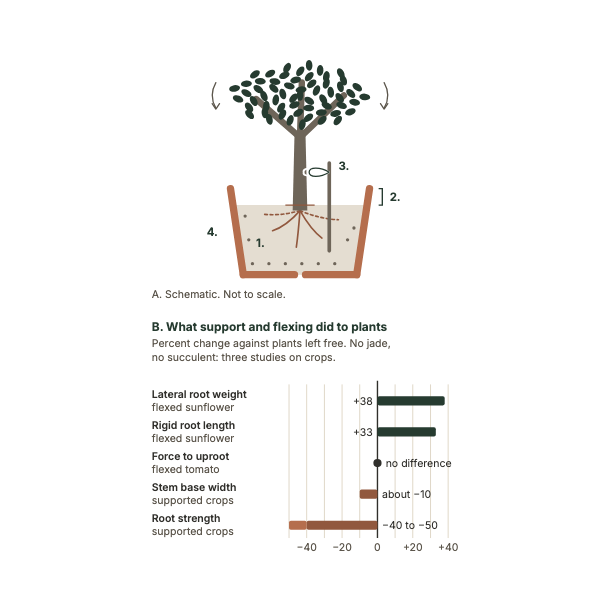
The trials that tested cutting found no gain from it, and none used a spider plant.
Begonias planted root-bound with the bottom centimeter of the root ball removed did no better than uncut root-bound plants (S. M. Scheiber and Richard C. Beeson, 2006, abstract). Halving, scuffing or washing root-bound tomato starts did not significantly change total yield (Marisa Thompson and colleagues, 2025, abstract).
Pot-bound linden and willow trees were scored, sliced in half or teased before planting at the University of Minnesota’s nursery in St. Paul, Minnesota. No method did significantly better than an undisturbed root ball (Patrick J. Weicherding and colleagues, 2007, abstract).
An earlier report of the same kind of trial found that none let roots escape the old mass better than no treatment (Jeffrey H. Gillman and colleagues, 2005, a meeting abstract).
The one clear benefit came from shaving. Edward F. Gilman and colleagues removed the outer and bottom inch of container-grown trees’ root balls when moving them to bigger containers; trunk size and height did not change, and the shaved trees had fewer kinked and circling roots (cited from the abstract).
Those trials, with their details, are set out in our article on what to check before you repot. For a spider plant, the honest reading is that teasing apart circling roots and trimming dead ones is what the guides ask for, and that heavy cutting has not been shown to help any plant that was tested.
Will trimming roots stunt it? No study has cut spider plant roots and measured the plant afterward. In the begonia trial, plants with the bottom removed caught up with the others within 12 weeks.
Mahr describes spider plant roots as thick and fleshy, with rhizomes “evolved to store water”, so cutting through them removes some of that store; how much that costs the plant has not been measured.
Splitting the Clusters
Replies suggested separating the clusters, the separate leafy rosettes, or crowns, that rise from the base.
Splitting them apart is division, and both Wisconsin and Illinois give it as a way to propagate the plant. Mahr says larger plants “can also be divided,” and NC State lists division alongside plantlets.
Illinois describes the method for any clump-forming houseplant. Take the plant out of its pot and pry the stems apart so that each piece keeps “a fair amount of roots.”
A tough root ball, like the one asparagus fern makes, may need cutting apart with a sharp knife. Then repot each piece immediately, Illinois says, “so that the roots do not dry out.”
A root-bound spider plant, and what each piece of advice is for
The roots, the runners, the plantlets, the clusters and the bottom of the root ball, with what has been tested on each.
| 1. Storage roots | Spider plants have thick, fleshy roots and rhizomes that store water (Wisconsin). Roots through the drainage holes or on the surface, a pot full of roots and wilting between waterings are among the signs to repot (Illinois). |
| 2. Runners | Tested: days of 12 hours or less shortened the wait for the first runner, more in variegated ‘Vittatum’ than in an all-green plant (Hammer 1976); light during the night raised runner numbers in all-green plants (Heins and Wilkins 1978). No trial of pot size on runners was found. |
| 3. Plantlets | A plantlet draws on the mother through the runner until it can feed itself: cut off at the earliest of four stages, none survived 8 days; at the last, all did (Soni and colleagues 2026, n = 9). Wisconsin’s method roots a plantlet in a pot of mix before the runner is cut. |
| 4. Clusters | A clump with several crowns can be pried or cut apart, each piece keeping roots, and potted at once so the roots do not dry out (Illinois; Wisconsin). |
| 5. Bottom and sides | In trials on other plants, cutting off the bottom or slicing the root ball did no better than leaving it whole, in growth (begonia), yield (tomato) or roots growing out of the old ball (linden and willow). Shaving improved root shape in container-grown trees. No trial on a spider plant was found. |
Pale ovals: storage roots. Dashed red-brown lines: where the thread’s replies said to split or cut. No length, depth or pot size is drawn.
No trial has tested whether a crowded pot makes more plantlets. Two trials tested light: short days hastened the first runner in one, and light during the night raised runner numbers in the other.
Division also answers the pot-size worry that ran through the thread. Several smaller pots, each holding one or two crowns, give every piece fresh mix and a pot sized to it. No source read compares divided spider plants with undivided ones, so how fast the pieces recover is not known.
A divided plant left outdoors is a different matter where the climate suits it. UF/IFAS Extension reports that its assessment of non-native plants “recently predicted spider plant to become invasive in Florida,” and UF/IFAS Extension no longer recommends it there.
Other regions were not checked, so before planting spare divisions outdoors in a warm climate, check local invasive plant guidance.
How Big a Pot
The reply calling for a much bigger pot with lots of mix at the sides and bottom runs against every guide read.
Colorado State says to choose a pot “only one to two inches larger in diameter than the current one.” NC State says one pot size larger, and two sizes for vigorously growing species; Mahr describes spider plants as fast growers.
Steil puts it most bluntly: houseplants “do not benefit from moving from super cramped quarters to enormous pots.”
What pot size does and does not change about wet roots is the subject of our article on root rot and pot size, and a big plant’s choice of pot is covered in does a big plant need a bigger pot.
The mix matters too. NC State’s handbook says perlite “contains some fluoride, so do not include it in the potting mix used to grow fluoride-sensitive species such as spider plants.” UF/IFAS calls spider plant particularly sensitive to fluoridated water, and fluoride is one of the causes discussed in our article on brown leaf tips.
The Babies, and When to Cut Them Off
A plantlet on a runner is not yet an independent plant.
Vineet Soni and colleagues, in Discoveries Reports in 2026, found that plantlets first became able to make their own food by photosynthesis and only later able to take up water and minerals, and that until then they drew on the mother plant through the runner (cited from the abstract).
Their test was blunt. Runners were cut at four stages of plantlet development and survival followed for 8 days: none of the plantlets cut at the earliest stage survived, and all of those cut at the last stage did.
The abstract gives the sample as n = 9 without saying what was counted, so this is one small study, but its direction is clear.
Mahr’s method fits that result. Set the plantlet, still attached, on the surface of a pot of soilless mix, hold it in contact with a bent paper clip or wire, and cut the runner only after it has rooted.
The alternative she gives is to pot up a plantlet that has already started making roots of its own.
A reply in the thread said spider plants root in a glass of water. Mahr’s methods both use mix, and whether roots formed in water carry over to soil is the subject of our article on water roots and soil roots.
Vitamin B1 and Seaweed
Vitamin B1 for transplants is an old idea with a real piece of science behind it, though not the piece people assume. Roots cut from a plant and grown alone in culture need thiamine supplied.
H. E. Street, reviewing that work in 1957, wrote that excised tomato roots have “absolute requirements for thiamine,” which he attributed to roots making it too slowly (cited from the abstract).
A spider plant being repotted is a whole plant, not a root grown alone in culture. No trial of vitamin B1 on a repotted houseplant was found.
In one recent trial on cocoa seedlings, Fitri Sauda Harahap and Novalina Novalina found that B1 had no significant effect on height, leaf number or leaf area, and changed only stem diameter at 6 weeks (cited from the abstract).
Seaweed extract has a larger test, also not on houseplants. Sebastien Comin and colleagues grew 6,400 seedlings of five woody species at a regional forest nursery in Curno, Italy, in mix amended with 0, 1, 2 or 3 times the label dose of an Ascophyllum nodosum extract, and followed them through transplanting.
The extract raised stem and whole-plant weight for one year, and only at three times the label dose.
The authors put that down to a nutritional boost and found no lasting change in the traits that would help a plant tolerate transplanting (cited from the abstract). Anyone who uses such a product on a houseplant should follow its label.
Fresh potting mix usually carries some fertilizer already. Steil notes that most potting soil contains a small amount, so feeding immediately after repotting “is typically unnecessary.” Given the extension warnings that heavy feeding cuts plantlet formation, there is no case in the sources for adding anything at repotting.
Spider Plant, or Liriope?
One reply suggested the plant was liriope. NC State’s Plant Toolbox lists Liriope muscari among the plants spider plant is often confused with, along with a relative, Chlorophytum laxum, and Ophiopogon intermedius.
The quick identification hint NC State gives for spider plant is its long stolons carrying plantlets and flowers. A plant in a pot that has made runners with babies on them is behaving like a spider plant. One without runners is harder to name from the leaves alone, and this article does not try.
What to Do With the Plant in Front of You
- Take it out of the broken pot. If roots cling to the pot, NC State says to run a straight knife between the root ball and the container wall.
- Look at the roots. Colorado State says healthy roots are white and firm; cut out any that are black and mushy. Iowa State says to remove limp, brown or dead roots.
- Decide whether to split it. If it has several crowns, pry or cut them apart so each piece keeps a fair share of roots, and pot each one at once (Illinois).
- Loosen, do not carve. Tease apart circling roots, or cut down the sides of the root ball where they are too tight (NC State; Colorado State). No source read supports removing the bottom inches.
- Choose a pot one size up, one to two inches wider than the old one (Colorado State), or two sizes for a vigorous plant (NC State), in a mix without perlite (NC State).
- Plant at the same depth it grew before and water immediately (Illinois).
- Hold off on feeding. Fresh mix usually carries a little fertilizer (Iowa State), and the extension pages say heavy feeding means fewer plantlets (NC State; Wisconsin).
- Leave plantlets attached until they root, or root them in mix beside the mother before cutting the runner (Wisconsin; Soni and colleagues).
Local Regulations and Safety Advisory
If you use fertilizer products, follow the label. Rules on them vary by country and locality, and your agriculture department can say what applies where you live. This article is general information, not legal advice.
Authorities to consult:
- Local agriculture department
What Remains to Be Explored
The central claim in the thread, that a crowded spider plant makes more babies, has no published test. A simple trial would grow matched plants in small and large pots under the same light and count runners and plantlets. Until someone runs it, the rule is growers’ experience, and the evidence that exists points at light.
The two light trials also leave a gap between them. Hammer timed the first runner in mostly variegated plants under short days; Heins and Wilkins counted runners on all-green plants with night lighting.
A 1977 paper by Hammer titled Flower formation in Chlorophytum may bear on this, but only its title was read, so what it found is not known here.
No study has cut spider plant storage roots and followed the plant afterward, and none has timed how long a divided spider plant takes to recover.
No trial of vitamin B1 or seaweed extract on a repotted houseplant was found. The plantlet result rests on one small study whose sample is described only as n = 9.
Sources
- Chlorophytum comosum (North Carolina Extension Gardener Plant Toolbox) — NC State Extension. Undated. A plant database page from NC State Extension; it cites no studies.
- Spider Plant, Chlorophytum comosum — Susan Mahr. University of Wisconsin-Madison Extension, Wisconsin Horticulture. January 6, 2025. An extension fact sheet; it cites no studies.
- Spider Plant (Gardening Solutions) — University of Florida IFAS Extension. Undated. A gardening page from UF/IFAS Extension; it cites no studies.
- Spider Plant (Houseplants) — University of Illinois Extension. Undated. An extension page; it cites no studies.
- Division (Houseplants) — University of Illinois Extension. Undated. An extension page; it cites no studies.
- Repotting (Houseplants) — University of Illinois Extension. Undated. An extension page; it cites no studies.
- 1316 – Houseplants: Repotting — Colorado State University Extension, PlantTalk Colorado. Undated. A PlantTalk Colorado page from Colorado State University Extension; it cites no studies.
- Plants Grown in Containers, Chapter 18, North Carolina Extension Gardener Handbook — NC State Extension. Undated. A chapter of the NC State Extension Gardener Handbook.
- How to Care for Houseplants — Aaron Steil. Iowa State University Extension and Outreach, Yard and Garden. October 2023. An Iowa State University Extension page; it cites no studies.
- Stolon Formation in Chlorophytum — P. Allen Hammer. HortScience (American Society for Horticultural Science), 11(6):570-572. 1976. Cited from its abstract.
- Influence of Photoperiod and Light Quality on Stolon Formation and Flowering of Chlorophytum comosum (Thunb.) Jacques — R. D. Heins, H. F. Wilkins. Journal of the American Society for Horticultural Science, 103(5):687-689. 1978. Cited from its abstract.
- Physiological and Biochemical Indicators of Stolon-Mediated Maternal Support in Chlorophytum comosum — Vineet Soni, Upma Bhatt, Yashwant Sompura. Discoveries Reports, 9(2):e53. 2026. Cited from its abstract.
- (55) Root Pruning Techniques Do Not Help Pot-Bound Plants — Jeffrey H. Gillman, Chad P. Giblin, Gary R. Johnson. HortScience (American Society for Horticultural Science), 40(4):996C, meeting abstract. 2005. A conference abstract.
- Mechanical Root-Disruption Practices and Their Effect on Circling Roots of Pot-Bound Tilia cordata Mill. and Salix alba L. ‘Niobe’ — Patrick J. Weicherding, Chad P. Giblin, Jeffrey H. Gillman, David L. Hanson, Gary R. Johnson. Arboriculture and Urban Forestry, 33(1):43-47. 2007. Cited from its abstract.
- Establishment and Growth of Begonias in the Landscape as Affected by Root Ball Condition at Transplanting — S.M. Scheiber, Richard C. Beeson. Journal of Environmental Horticulture, 24(4):213-217. 2006. Cited from its abstract.
- Transplanting Root-Bound Tomato Starts Using Methods With High Levels of Root Disturbance Offers No Advantages — Marisa Thompson, Israel Joukhadar, Stephanie Walker, Charles Havlik, Dawn VanLeeuwen. HortTechnology, 35(3):337-342. 2025. Cited from its abstract.
- Root Ball Shaving Improves Root Systems on Seven Tree Species in Containers — Edward F. Gilman, Maria Paz, Chris Harchick. Journal of Environmental Horticulture, 28(1):13-18. 2010. Cited from its abstract.
- Pot Size Matters: A Meta-Analysis of the Effects of Rooting Volume on Plant Growth — Hendrik Poorter, Jonas Bühler, Dagmar van Dusschoten, José Climent, Johannes A. Postma. Functional Plant Biology, 39(11):839-850. 2012. Cited from its abstract.
- 162 The Influence of Root Restriction on Flowering, Fruiting, Tree Growth, Yields, and Fruit Quality of Apple Trees — R.E. Byers, D.H. Carbaugh, L.D. Combs. HortScience (American Society for Horticultural Science), 35(3), meeting abstract. 2000. A conference abstract.
- Growth, Physiology, and Root Development in Seedlings of Woody Species Treated With a Seaweed Extract — Sebastien Comin, Gloria Brocca, Noemi Valsecchi, Simone Fumagalli, Irene Vigevani, Denise Corsini, Francesco Ferrini, Giovanni Ravanelli. Arboriculture and Urban Forestry, 51(1):46-64. 2024. Cited from its abstract.
- Excised Root Culture — H. E. Street. Biological Reviews. 1957. Cited from its abstract.
- The Effect of Vitamin B1 Application on The Growth of Cocoa Seedlings — Fitri Sauda Harahap, Novalina Novalina. Jurnal Agroteknologi (Universitas Sumatera Utara). 2025. Cited from its abstract.
- R/Houseplants Thread, Should I Repot Now or Wait? — multiple community members. Reddit, r/houseplants. Undated.