Digging a hole in finished compost, dropping fresh scraps in and covering them back up is a sound way to feed a home bin. It is close to what the EPA and extension services already tell home composters to do.
The cover does two jobs. It keeps food away from flies and animals, and the compost around buried food can trap and break down the smells from the small airless pockets it makes.
The one study of home bins found for this article measured them a few degrees warmer than the air around them, nowhere near the heat of a hot pile, which is why a bin like this can fill with worms.
What decides whether it keeps working is how much goes in at once, how wet it is, what goes in, and the weather around the bin.
The question comes from a thread on r/composting. The poster showed a short video of their routine: scoop out some finished compost, tip kitchen scraps into the hole, cover them with that compost, and pick a new spot next time.
The bin was so thick with worms that much of the thread was about them. Some replies said the burying hides food from rats and other animals.
One asked whether covering the scraps would starve them of air and make the bin stink, and several said it needed more browns.
Others said this was really a worm bin rather than a proper compost pile, because a hot pile would be too hot for worms in the middle.
A side argument broke out over whether citrus is bad for worms, and someone added onions to the list. The poster’s hand tool for poking air into the bin drew its own fans.
What the Cover Does
Burying food is standard advice, not a quirk. The EPA’s home composting guide tells readers to “cover and bury your food scraps in your pile,” and lists it among its steps for keeping rodents away.
Elsewhere on the same page it asks for four to eight inches of dry leaves or other browns over food scraps.
A 2005 fact sheet from the Cornell Waste Management Institute, by Ellen Z. Harrison and Jean Bonhotal, says to put food scraps in the center of the pile and cover them with grass, leaves, wood chips, soil or sawdust. It calls covering all food scraps the best defense against unwanted insects and other pests.
Worm bin guidance says the same at a smaller scale. NC State Extension’s worm composting guide, by solid waste specialist Rhonda Sherman, has readers cover each feeding with one to two inches of bedding “to prevent fruit flies from finding the food.”
Its troubleshooting table blames both smells and flies on food left exposed to air, and gives one fix for each: “Bury food completely.” If flies are already in the kitchen, our article on fruit fly traps and what they cannot do covers where they breed.
Finished compost is a good cover for a reason beyond hiding the food. Cornell’s teaching page on compost physics explains that when the average oxygen in a pile falls below about 5 percent, airless (anaerobic) pockets form.
While those pockets stay small, “the compost pile acts as a bio-filter to trap and degrade the odorous compounds” they produce.
Compost can serve as filter material for exactly this. In a 2011 laboratory study, Chanee Wongwutthi and Wongpun Limpaseni at Chulalongkorn University passed hydrogen sulfide, the rotten-egg gas, through a filter made mostly of compost and removed all of it at the highest level they tested.
That was an engineered filter, not a bin, and is cited from its abstract.
So the reply worried about smell had a point: a buried load of scraps can run short of air inside, though no one has measured how short. What it missed is that the compost around the pocket is the kind of material that cleans up after that. Cornell adds the limit: once anaerobic activity passes a certain threshold, smells get out anyway.
When a Buried Pocket Does Start to Smell
If your bin smells, the cover has been overwhelmed, and the smell says which way. A rotten-egg smell means too little air: Cornell’s chemistry page traces it to hydrogen sulfide from anaerobic conditions. An ammonia smell means too much nitrogen for the carbon, which Cornell says is lost as ammonia gas.
For a rotten smell, the UC guide below names one cause, too much moisture. Cornell puts the comfortable moisture range at 50 to 60 percent and says that above 65 percent decomposition slows and odors come from anaerobic pockets.
That guide, from the UC Master Gardeners of Orange County, gives the fix: turn the compost or mix in dry, porous material such as straw.
The other cause is too much food at once. NC State says that if you add more than the worms can eat, it “will start to rot and become smelly,” and advises waiting until the last feeding is gone before adding more. For a bin that already smells, its table says to stop feeding for two weeks.
In practice that means checking the last pocket before digging a new one. If the scraps there are still recognizable, skip a feeding.
For a wet patch, NC State’s fix is to mix in dry bedding and leave the lid off for a while. More finished compost on top adds little carbon, as the section on browns below explains.
For an ammonia smell, the UC guide’s answer is more high-carbon material mixed in, such as straw, sawdust or wood chips. Kansas State’s guide to the composting process adds that a bad smell from a pile usually means it needs more oxygen.
Why the Bin Is Full of Worms, and Why It Does Not Get Hot
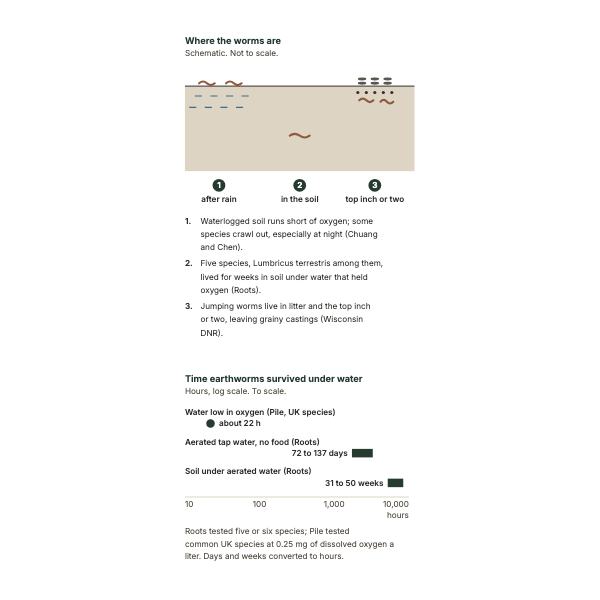
The thread’s sharpest argument was whether a bin full of worms is really composting. Both sides were describing something real. A well-built pile, the EPA says, “can reach temperatures of 130° to 160° F” at its center. A worm bin is kept far below that.
Worms cannot stay in that heat. Kansas State’s guide says worms “may move away from the excessive heat at the center of the pile, and then move back again when the pile cools.”
Cornell says compost invertebrates get through the hot stage by moving to the edges of the pile or going dormant.
UF/IFAS Extension in Sarasota County is blunter: “Hot temperature composting will kill earthworms.” Its page reads worms in compost as a sign that bacterial activity and temperatures are low, which can mean the compost is ready or that the pile is not heating.
Red worms, the species sold for worm bins (Eisenia fetida), like it much cooler. NC State and the EPA both say to keep a worm bin at 59 to 77°F (15 to 25°C).
The EPA adds that the worms can survive 32 to 95°F if they have at least four inches of bedding.
In a 1992 study of container populations in southern Africa, A. J. Reinecke, S. A. Viljoen and R. J. Saayman found that this species tolerated a wider range of temperatures than two other worms used for composting. That comparison is cited from the abstract, which gives no lethal limit inside a bin.
The deciding fact is how warm a home bin gets in the first place. The one measured set found for this article comes from a 2010 paper in Waste Management, in which J. K. Andersen and colleagues ran six home composting units on household food waste for a year.
Inside, the units ran “only a few degrees (2-10 °C) higher than the ambient temperature.”
Feeding them harder did not change that: with loads of up to 44 pounds (20 kilograms) every two weeks, emissions rose, but “the temperature development did not change significantly.” The abstract, the source here, does not give the bins’ size or location, or say whether they held worms.
Read together, these sources explain the thread. A home bin like the ones in that study stays far below the 130°F of a hot pile, so nothing drives the worms out. That is our reading of the studies side by side, not a finding any one of them reports.
It also suggests the weather sets the limits more than the bin does. A bin 4 to 18°F (2 to 10°C) above a winter day near freezing sits below the range NC State recommends.
NC State warns never to put a worm bin in direct sun, which can overheat and kill the worms, and the EPA says to insulate an outdoor bin in cold months.
What the cover does, and how warm the bin gets
Schematic, not to scale. Fresh scraps buried under finished compost in a home bin, and the temperatures that decide whether worms can live in it.
The cover keeps food away from flies and animals and holds back smell. The one measured set of home bins ran only a few degrees above the air, nowhere near a hot pile, so the weather around the bin largely sets whether worms can live in it.
Hot Pile or Worm Bin: Which One You Have, and Whether It Matters
The bin in the thread is a worm bin in all but name, and that is a choice with a cost. Cornell says the hot stage, 40 to 60°C (104 to 140°F), destroys disease organisms, fly larvae and weed seeds. A bin that never gets there does none of that.
Washington State University Extension, in written answers to questions after a worm composting talk, says worm composting is not a way to reduce pathogens, and that anyone who needs that should run a hot compost above 130°F for a period.
The same answer puts the thread’s argument plainly: “A hot compost is not compatible with vermiculture,” vermiculture being the raising of worms.
In a cool bin, what goes in matters more. The EPA already keeps meat, dairy and greasy food out of a home pile.
No source read for this article gives a rule for seeding weeds or diseased plants in a cool bin, so the safe reading is that a bin which never heats will not kill them.
Researchers have tried running both in sequence. J. Nair, V. Sekiozoic and M. Anda found in 2006 that nine days of hot composting before worms improved the worm stage for kitchen waste, helping reduce its mass, manage its moisture and reduce pathogens. That and the next study are cited from their abstracts.
J. Frederickson and colleagues reported in 1997 that the worm Eisenia andrei turned fresh green waste into more stable material than a turned windrow, a long heap of compost, did over the same eight weeks.
Worms grew and bred less on waste with less organic matter left, so the authors advised keeping any hot phase as short as sanitizing allows. Neither study used a home bin.
More Browns?
Several replies told the poster to add more browns: leaves, paper, straw. They are right when a bin is wet or smells of ammonia.
The EPA’s rule of thumb is two to three times as much brown material as green by volume, and Cornell’s aim is about 30 parts carbon to one part nitrogen by weight.
One point is easy to miss: finished compost is not a brown. Cornell says the carbon-to-nitrogen ratio falls from about 30:1 to 10 to 15:1 by the time compost is finished, because microbes breathe off much of the carbon.
Covering scraps with finished compost hides them and filters smell, but it adds little carbon.
In a worm bin, the bedding is the brown. NC State’s guide uses shredded paper, cardboard, dead leaves or coconut fiber, says the worms eat it along with the food, and says to add more within a couple of months.
By NC State’s account, that bedding gets eaten, so a bin fed only scraps and its own compost runs short of it unless more is added.
Citrus, Onions and Garlic
On citrus, the EPA tells worm composters to avoid citrus fruits and “odorous foods like onions and garlic.”
NC State’s guide says not to add citrus fruits or peels, “as they can cause the bin environment to become too acidic,” and never to add onions or garlic.
Washington State’s written answers say the opposite: worms can be fed onions and onion peels, “or citrus peels in small quantities.” The same answers add that worms simply will not eat some foods, and that anything sitting uneaten should go to a backyard compost pile instead.
None of these guides cites a test, and no study of citrus peel or onion in a worm bin at household amounts was found for this article.
The two positions are closer than they look. NC State’s own guide suggests a backyard bin for citrus, onions and garlic, which is roughly the bin in the thread.
The practical middle ground is the one the guides share: small amounts, buried, and taken back out if the worms leave them alone. Food the worms will not touch also counts as uneaten food under NC State’s overfeeding rule, and can start to smell.
Do You Need to Turn It or Poke Air Into It?
The thread’s aerating tool drew plenty of praise, and one reply suggested that with that many worms it was not needed. The evidence leans toward the second view, though nobody has tested a hand aerator in a worm bin.
NC State is direct: “Do not agitate, turn, or stir the contents of the worm bin. It does not need to be aerated like a compost pile, and earthworms can be killed if handled roughly.”
Cornell says turning a hot pile brings the heat back up because it replenishes the oxygen, which a worm bin is not meant to do.
The measured home bins point the same way. Andersen and colleagues found that the units mixed every week gave off the most methane and nitrous oxide, two greenhouse gases, and the units never mixed gave off the least. Mixing also released a burst of methane each time, 8 to 12 percent of the total, according to the abstract.
So in a cool, worm-filled bin, the sources point to loose structure for air: dry bedding, not too much food at once, and no standing water. That is our reading of these sources, not a tested result, and no study has tested whether poking holes in a bin like this helps or harms it.
Rodents
Burying helps, but it is one layer of defense, not the whole thing. Cornell’s fact sheet points out that animals come to compost both for food and for a dry, undisturbed place to live, so a well-buried meal does not stop a rat from moving into the bin.
The EPA’s rodent advice starts with the bin: a lid, possibly a floor, and no holes or gaps larger than a quarter inch.
Cornell lists half-inch hardware cloth around or under the bin, mesh over the vents and a secure, tight-fitting lid, and keeps out meat, fish, cheese, oils and heavily seasoned leftovers.
The UC guide’s answer to rodents, dogs and insects in a pile is the poster’s method, scraps in the center and covered, plus closed, rodent-proof bins, or composting with worms. The reply that said burying works only for food rodents do not want was pointing at the same list of exclusions.
What to Keep Doing, and What to Change
- Keep burying, and keep moving the spot. Washington State’s answers describe feeding one side of a bin until it is full, then the other: as the worms finish the first side they move to the second, and the first can be scooped out as finished compost.
- Feed again only when the last pocket is gone. Dig into it before adding more. If the scraps are still recognizable, wait, as NC State advises for any food the worms have not finished.
- Keep a supply of browns beside the bin. Mix dry shredded leaves, paper or cardboard into each pocket when the bin runs wet or smells of ammonia, following the EPA and UC guides. Finished compost on top does not count as one.
- Keep meat, dairy and greasy food out. The EPA and Cornell both name them among what draws animals. A cool bin does not get hot enough to kill weed seeds or disease, so leave seeding weeds and sick plants out too.
- Treat citrus and onions as a trial. Bury small amounts and check later. If they sit uneaten, take them out, as Washington State suggests, or send them to another pile, as NC State does.
- Protect the bin from the weather. Shade it in summer, because sun can overheat a worm bin (NC State), and insulate it with straw or blankets in winter (EPA).
- Close the gaps. A lid, a floor or hardware cloth beneath, and no openings over a quarter inch (EPA, Cornell) back up the burying.
For other kitchen leftovers in the same bin, our articles on eggshells in compost and moldy coffee-ground compost cover what happens to each.
What Remains to Be Explored
No one has measured oxygen, temperature or smell inside a pocket of scraps buried in a home bin. The account here joins Cornell’s general description of small airless pockets with a laboratory compost filter, and the bin itself has not been tested.
No study found compares finished compost with leaves, soil or paper as a cover against fruit flies or rodents. The covering advice from the EPA, Cornell and NC State is practical guidance, and none of it cites a trial.
Whether citrus peel or onion harms worms at household amounts is unresolved. The EPA and NC State say keep them out, Washington State says small amounts are fine, and no test at home-bin scale was found. A feeding trial with peel added to a working bin would settle it.
The only measurement of home bin temperatures found here is one study, read from its abstract, which does not say where the bins stood, how big they were or whether worms lived in them.
Measurements from warmer climates, larger bins or heavily fed bins would show where a home bin stops being a worm bin. Nobody has tested hand aerating tools in one either.
Sources
- I’d Love to Get Your Opinion on My Way Of… — multiple community members. Reddit, r/composting. Undated.
- Composting At Home — US Environmental Protection Agency. December 8, 2025.
- Worms Can Recycle Your Garbage (AG-473-18) — Rhonda Sherman, Extension Solid Waste Specialist. NC State Extension. March 29, 2017.
- Compost Physics — Cornell Waste Management Institute. Cornell Waste Management Institute, Cornell University. Undated.
- Compost Chemistry — Cornell Waste Management Institute. Cornell Waste Management Institute, Cornell University. Undated.
- Preventing Animal Nuisances in Small Scale Composting — Ellen Z. Harrison, Director; Jean Bonhotal, Extension Associate. Cornell Waste Management Institute (fact sheet, with Tompkins County Cooperative Extension). 2005.
- The Composting Process (MF3369) — Ward Upham, Horticulturist. Kansas State University Agricultural Experiment Station and Cooperative Extension Service. August 2017.
- Compost Troubleshooting Guide — UCCE Master Gardeners of Orange County. UC Cooperative Extension Master Gardeners of Orange County, UC ANR. November 2024.
- Questions From Sustainability Speakers Series: Feeding Your Garden: Vermicomposting, March 24Th, Rhonda Sherman — WSU Extension Snohomish County (written answers to audience questions; individual answerers not named). Washington State University Extension, Snohomish County. March 2021.
- Composting Organisms — UF/IFAS Extension Sarasota County. Undated.
- Greenhouse Gas Emissions From Home Composting of Organic Household Waste — J. K. Andersen, A. Boldrin, T. H. Christensen, C. Scheutz. Waste Management 30(12). 2010. Cited from its abstract.
- The Suitability of Eudrilus eugeniae, Perionyx excavatus and Eisenia fetida (Oligochaeta) for Vermicomposting in Southern Africa in Terms of Their Temperature Requirements — A. J. Reinecke, S. A. Viljoen, R. J. Saayman. Soil Biology and Biochemistry 24(12). 1992. Cited from its abstract.
- Effect of Pre-Composting on Vermicomposting of Kitchen Waste — J. Nair, V. Sekiozoic, M. Anda. Bioresource Technology 97(16). 2006. Cited from its abstract.
- Combining Vermiculture With Traditional Green Waste Composting Systems — J. Frederickson, K. R. Butt, R. M. Morris, C. Daniel. Soil Biology and Biochemistry 29(3-4). 1997. Cited from its abstract.
- Removal of Hydrogen Sulfide Using a Compost-Based Biofilter — Chanee Wongwutthi, Wongpun Limpaseni. Advanced Materials Research 356-360. October 7, 2011. Cited from its abstract.