Used coffee grounds belong inside the compost pile as a nitrogen-rich “green”, mixed with carbon-rich “browns” such as dry leaves, and Washington State University Extension’s limit is no more than 20 percent of the pile by volume.
Spreading them raw over vegetable beds is the step the sources warn against, because fresh grounds hold back plant growth.
Acidity is the smaller worry. Decomposing grounds have measured anywhere from mildly acidic to somewhat alkaline. The more useful surprise concerns nitrogen: in one 100-day soil test, grounds left less nitrogen available to plants than soil with nothing added, holding nitrogen back rather than adding to it.
The question comes from a thread on r/composting. A gardener in South Africa had a full wheelbarrow of used grounds and a plan for the summer: sprinkle them over the compost through the summer, and top-dress the raised vegetable beds with them.
The replies pulled in different directions. Replies said used grounds are close to neutral, that unused grounds are the acidic ones and that composting evens it out anyway, while in one household every ground goes in the bin as too acidic.
Others called grounds a green that needs carbon, warned that too much nitrogen stops fruiting and put a ceiling of about a fifth of the pile for air.
Spread on top, one reply said, grounds form a crust that sheds water. Worms and soldier flies came up too, as creatures the grounds draw in.
What This Article Covers
This article covers used coffee grounds in a home compost pile and on vegetable beds: whether they count as green or brown, how much of a pile they should be, whether they are too acidic, what happens when they go on beds raw, the crust, nitrogen and fruiting, worms and soldier flies, and which plants like them.
Moldy coffee-ground compost in a houseplant pot, and how long grounds need to age before they are safe for plants, are covered under moldy coffee-ground compost.
This article gives no application rate, depth or schedule for grounds as a soil amendment; the sources that print one tie it to a soil test.
Green, Not Brown
Compost microbes need carbon for energy and nitrogen to build their cells, and Cornell’s composting page puts the ideal mix at roughly 30 parts carbon to 1 part nitrogen by weight. Below that, nitrogen is lost as ammonia and the pile smells; above it, the pile stays cool and slow.
Cornell’s table, taken from a 1991 guide to small-scale composting, puts coffee grounds at 20:1. That sits beside vegetable scraps (15 to 20:1) and grass clippings (15 to 25:1), not beside autumn leaves (30 to 80:1), straw (40 to 100:1) or cardboard (560:1).
The EPA’s home composting guide files “coffee grounds and paper filters” with the nitrogen-rich greens, and lists dry leaves, shredded paper, shredded cardboard and untreated wood chips among the browns. Its rule is a balance of the two, with water and air.
So the reply that called grounds a green needing carbon has the sources behind it.
One wrinkle: WSU’s fact sheet, by Linda Chalker-Scott, reports that the ratio changes as grounds break down, from about 25 or 26 to 1 at the start to about 10 to 1, which still leaves fresh grounds below the 30:1 a pile works best at.
Where coffee grounds sit in a compost pile
Used coffee grounds count as a nitrogen-rich green, below the carbon-to-nitrogen ratio a pile aims for, and the extension limit on how much of a pile they should be.
Panel A: Cornell’s Compost Chemistry page, from a 1991 small-scale composting guide. WSU’s review gives grounds 25 to 26:1 at the start, falling to about 10:1 as they break down. Panel B: WSU Extension fact sheet FS207E; the 30 percent line is the Arizona summary’s wording of the same author’s review.
Grounds are a green, so they go in with browns, and WSU’s limit is no more than 20 percent of the pile by volume.
How Much of the Pile
The thread’s ceiling of about a fifth matches the one extension limit found. WSU’s fact sheet says to use no more than 20 percent by volume of coffee grounds in a compost pile, and to keep the feedstock diverse so the microbes stay diverse.
The same sheet warns that excessive grounds in compost can be phytotoxic, that is, harmful to plants.
The University of Arizona’s summary of the same review adds a second line: more than 30 percent has often been detrimental. It does not say to what, and neither page reports a home pile measured at each share, so 20 percent is guidance, not a tested dose.
The reasons the sources give are not quite the thread’s. WSU ties its limit to microbial diversity and to the risk of a phytotoxic compost, and does not mention air there. Air and compaction do come up, but in WSU’s advice on grounds as mulch, covered below.
WSU also asks for grounds to cool before they go on the pile, because heat can kill the beneficial microbes that do the work.
Are Used Grounds Too Acidic?
“Many gardeners assume that coffee grounds are acidic, but this does not hold true experimentally,” WSU’s fact sheet says. Arizona’s summary gives the range from the studies it reviewed: decomposing grounds from pH 4.6, mildly acidic, to 8.4, somewhat alkaline, with the value changing over time.
Measured on their own, used grounds have come out mildly acidic. Ragauskaitė and Šlinkšienė found 10 percent solutions of spent grounds at pH 5.2 to 5.8 and called them “not very acidic” (2020, abstract). Sinclair and colleagues found raw grounds acidic and composted grounds neutral in their glasshouse substrates (2024, abstract).
In soil, the direction can still be down. Khan and colleagues mixed grounds into an urban soil in Krakow, Poland, and three months later soil pH was 14 percent lower at the higher of their two doses (2023, abstract). WSU’s point is that any change stays near the grounds, not through the whole soil profile.
Inside a pile, acidity is a stage, not an end state. Cornell’s page says organic acids often build up early in composting and usually break down as it goes on; a pile that turns anaerobic can sink to pH 4.5, and aeration usually brings it back.
The thread’s claim that unused grounds are the acidic ones could not be checked: no source read measured unbrewed grounds. The sources read give no reason to bin grounds for acidity: the measured range runs from mildly acidic to somewhat alkaline, and WSU says any change stays near the grounds.
Why Not Spread Them Raw on the Beds
Raw grounds are where the evidence turns against the plan. WSU’s fact sheet calls fresh grounds “demonstrably phytotoxic to a variety of plants” and does not recommend them as an amendment or a mulch.
It also advises against grounds wherever plants are being grown from seed, because germination and growth suffered in experiments.
A review by Pérez-Burillo and colleagues gives two reasons. Mixed into soil, grounds inhibited plant growth at concentrations as low as 1 percent, first because they feed soil microbes that then compete with roots for nitrogen, and second because they carry plant-toxic compounds such as polyphenols (2022, abstract).
Composting or aging changes that. In Sinclair’s glasshouse work, raw grounds at 35 percent or more of the substrate sharply cut sunflower germination and growth, while grounds composted for 6 months were not toxic to the seedlings (2024, abstract).
The most direct test of the thread’s plan is a pot trial by Horgan and colleagues on radish and tomato seedlings. Grounds aged up to 7 months held back growth when mixed into the soil, and grounds aged 14 months helped it (2023, abstract).
Laid on top as a 1 cm top-dressing, grounds aged 7 months helped growth, and the authors concluded that partly decomposed grounds, aged up to about 8 months, work as a top-dressing. The abstract does not report fresh grounds used that way.
In the field, the growth-stopping effect has been tried as weed control. In a field converted from rice paddy in western Japan, Hirooka and colleagues found large applications of grounds, plowed in or spread as a mulch, cut the growth of grass weeds, while other weeds were not significantly affected (2022, abstract).
WSU’s advice for beds starts with a soil test. If nutrients are already adequate or high, add no grounds in any form.
If they are low, lay a thin layer of composted grounds on top, not dug in, and cover it with a thicker layer of coarse organic mulch such as wood chips.
The Crust
The water-shedding crust has an extension warning behind it but no measurement. WSU’s fact sheet says not to use thick layers of grounds as a stand-alone mulch: they are finely textured and easily compacted, and can interfere with the movement of water and air in soil.
Arizona’s summary puts it as a barrier to moisture and air, “especially when applied in thick layers”. That is also WSU’s reason for covering grounds with coarse mulch: to protect them, and the soil under them, from compaction.
Mixed into soil, grounds did the opposite in one test. Khan and colleagues found grounds raised water content and storage in their urban soil and shortened the water drop penetration time, a measure of how long a drop of water sits on soil before soaking in (2023, abstract).
No source read measured a layer of grounds lying on the surface.
Too Much Nitrogen and No Fruit?
The worry is real for nitrogen in general. Alabama Extension’s sheet on tomato blossom drop says too much nitrogen fertilizer can cause excessive leafy growth, “resulting in blossom drop or delays in flower development”.
WSU’s tomato nitrogen sheet, by Buajaila and Miles, says excessive nitrogen gives thick, curly leaves and compact growth, and plants produce fewer flowers.
One soil test suggests grounds are an unlikely cause, at least over the first months. Birnbaum and colleagues incubated composted and uncomposted grounds in a fine sandy loam for 100 days, and plant-available nitrogen stayed lower in both than in soil with nothing added, the whole time (2025, abstract). The soil showed more microbial activity with grounds, which the authors read as microbes working to break them down.
That fits the review’s account of microbes competing with roots for nitrogen, and the WSU tomato sheet’s general note that soil microbes can tie nitrogen up so it is not available to a crop.
The Birnbaum test had no plants in it, and it ran for 100 days, so it says nothing about later seasons.
If tomatoes on the beds drop flowers in summer, Alabama’s sheet points first at heat: flowers often abort when days pass 85°F and nights pass 72°F, and short spells of a week or less should not cause much trouble.
Worms and Soldier Flies
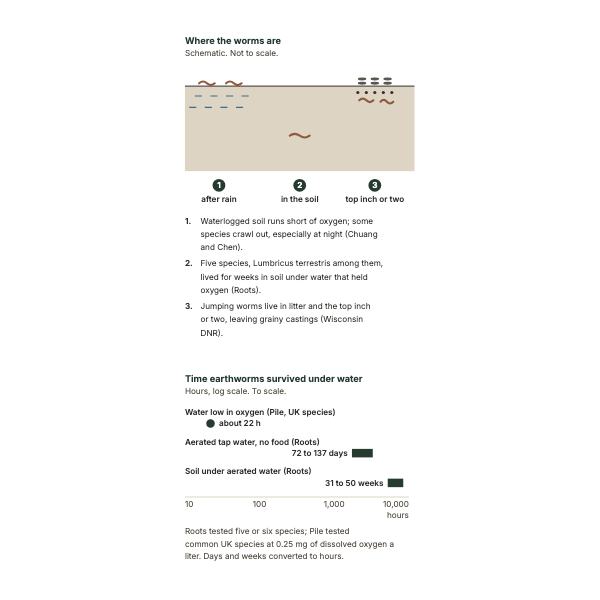
On worms, WSU’s fact sheet says there is no science-based information on whether grounds attract them, though worms use grounds as food in the soil.
Its advice is to keep grounds out of worm bins, where, it reports from Liu and Price’s 2011 study, they can injure or kill earthworms in the confined space.
A laboratory study by González-Moreno and colleagues found a middle ground. Worms of the species Eisenia andrei fed horse manure with grounds did best when grounds were about a quarter of the mix, and the finished vermicompost showed no toxicity (2020, abstract).
The review by Pérez-Burillo and colleagues names vermicomposting as one process that removes the plant-toxic compounds.
For black soldier fly larvae, the feeding trials show grounds are a poor food on their own. Sideris and colleagues found larvae developed adequately on every diet tested except grounds alone (2021, abstract).
Khaekratoke and colleagues found fermented grounds slowed larval development, an all-grounds diet hurt survival, and grounds at a fifth of a fruit and vegetable pulp, by weight, gave the highest waste reduction and feed conversion, close to pulp alone (2022, abstract).
No source read measured whether worms or soldier flies are drawn to grounds in a garden pile. Whether grounds are good or bad for them depends on the share: on the trials read, grounds alone were a poor food for soldier fly larvae, and worms did best with grounds as a minority of their food.
Which Plants Like Coffee Grounds?
No source read names plants that like coffee grounds. The trials read each grew one or two crops, and in each the result turned on how old the grounds were or how much went in. None compared one plant against another.
Lettuce did best with a little. In a greenhouse pot trial, Cruz and colleagues (2012) grew lettuce in soil with 0 to 20 percent spent grounds by volume. Plants made more growth at 2.5 to 10 percent and less above that, and every treated plant held less organic nitrogen than the untreated ones, which the authors read as possible stress.
The radish, tomato and sunflower trials described above point the same way. Fresh or young grounds mixed into the soil held the seedlings back, while aged or composted grounds helped them grow or did no harm (Horgan and colleagues, 2023; Sinclair and colleagues, 2024).
Acid-loving plants get no special support from the sources read. Washington State University’s fact sheet says grounds are not reliably acidic, their pH changes over time and only near the grounds, and fresh grounds harm a variety of plants. No trial read tested grounds on blueberries, azaleas or other acid-loving plants.
What to Do With the Wheelbarrow
- Let fresh grounds cool before they go on the pile (WSU).
- Add them as a green, with browns such as dry leaves, shredded paper or cardboard, and keep water and air in the pile (EPA; Cornell).
- Keep grounds to no more than about a fifth of the pile by volume (WSU). With a full wheelbarrow, that means adding grounds as the pile grows, as the poster planned, not all at once.
- Keep raw grounds off beds where seeds are being sown, and do not dig them in fresh (WSU; Pérez-Burillo; Sinclair).
- Before putting grounds or coffee compost on the beds, get a soil test. If nutrients are low, use composted grounds as a thin layer on top under coarse mulch; if they are adequate or high, add none (WSU).
- For a worm bin, WSU’s advice is to keep grounds out; the one laboratory trial read found worms did best with grounds at about a quarter of a manure mix (González-Moreno).
Related reading: what to do with a bag of moldy coffee-ground compost, how burying scraps in a worm bin works, and what happens to eggshells in a compost pile.
Local Regulations and Safety Advisory
Coffee grounds carry no label, and this article gives no amount for them; Washington State University Extension's advice is to have the soil tested before adding grounds to garden beds, and to add none where nutrients are already adequate. This article is general information, not site-specific advice.
Authorities to consult:
- A soil testing laboratory
What Remains to Be Explored
No study read tested a home compost pile at different shares of coffee grounds, so the 20 percent limit and the 30 percent warning are a reviewer’s reading of the literature, not a measured threshold.
No source read measured unbrewed grounds, so whether they are more acidic than used ones is open.
The crust is a warning without a measurement: no study read put a layer of grounds on a bed’s surface and timed water soaking in. The nitrogen result comes from a laboratory incubation with no plants, and the top-dressing result from pots of radish and tomato. No trial read compared grounds across many garden plants, acid-loving kinds among them.
What would change this article: a vegetable-bed trial of raw and composted grounds as a top-dressing over a full season, a home-pile trial at a range of shares, or a measurement of water entry through a surface layer of grounds.
Sources
- How Much Coffee Is Too Much Coffee — multiple community members. Reddit, r/composting. Undated.
- Using Coffee Grounds in Gardens and Landscapes (Home Garden Series) — Linda Chalker-Scott. Washington State University Extension. December 2021.
- Using Coffee Grounds in the Garden (Backyard Gardener 140) — Jeff Schalau. University of Arizona Cooperative Extension, Yavapai County. January 15, 2024.
- Composting At Home — US EPA. US Environmental Protection Agency. Undated.
- Compost Chemistry — Cornell Waste Management Institute. Cornell Waste Management Institute, Cornell Composting. 1996.
- Spent Coffee Grounds Applied as a Top-Dressing or Incorporated Into the Soil Can Improve Plant Growth While Reducing Slug Herbivory — Finbarr G. Horgan, Dylan Floyd, Enrique A. Mundaca, Eduardo Crisol-Martínez. Agriculture (MDPI). 2023. Cited from its abstract.
- Spent Coffee Grounds (SCGs) as a Soil Amendment: The Effects of Composting Time on Early Sunflower Development — Catherine L. Sinclair, Peter J. Irga, Gabrielle Duani, Fraser R. Torpy. Environments (MDPI). 2024. Cited from its abstract.
- Why Should We Be Concerned With the Use of Spent Coffee Grounds as an Organic Amendment of Soils? A Narrative Review — Sergio Pérez-Burillo, Ana Cervera-Mata, Alejandro Fernández-Arteaga, Silvia Pastoriza, José Ángel Rufián-Henares, Gabriel Delgado. Agronomy (MDPI). 2022. Cited from its abstract.
- Mineralization Potential of Spent Coffee Grounds and Other Nutrient Sources — Amanda L. Birnbaum, Julie Howe, Ryan Earp, Joseph Burke, Benjamin Wherley, Amit Dhingra. Soil Science Society of America Journal (Wiley). 2025. Cited from its abstract.
- Short-Term Impact of Different Doses of Spent Coffee Grounds, Salt, and Sand on Soil Chemical and Hydrological Properties in an Urban Soil — Muhammad Owais Khan, Anna Klamerus-Iwan, Dawid Kupka, Ewa Słowik-Opoka. Environmental Science and Pollution Research (Springer). 2023. Cited from its abstract.
- Evaluation of Spent Coffee Grounds Application in Organic Fertilizers Industry — Dovilė Ragauskaitė, Rasa Šlinkšienė. Žemės ūkio mokslai (Lithuanian Academy of Sciences). 2020. Cited from its abstract.
- Effects of Different Application Methods of Spent Coffee Grounds on Weed Growth — Yoshihiro Hirooka, Shintaro Kurashige, Koji Yamane, Misako Kakiuchi, Taku Miyagawa, Kazuya Iwai, Morio Iijima. Weed Technology (Cambridge University Press). 2022. Cited from its abstract.
- Feasibility of Vermicomposting of Spent Coffee Grounds and Silverskin From Coffee Industries: A Laboratory Study — M.A. González-Moreno, B. García Gracianteparaluceta, S. Marcelino Sádaba, J. Zaratiegui Urdin, E. Robles Domínguez, M.A. Pérez Ezcurdia, A. Seco Meneses. Agronomy (MDPI). 2020. Cited from its abstract.
- Effect of Processed Beverage By-Product-Based Diets on Biological Parameters, Conversion Efficiency and Body Composition of Hermetia illucens (L) (Diptera Stratiomyidae) — Vassilios Sideris, Maria Georgiadou, Georgios Papadoulis, Konstantinos Mountzouris, Antonios Tsagkarakis. Insects (MDPI). 2021. Cited from its abstract.
- Use of Fermented Spent Coffee Grounds as a Substrate Supplement for Rearing Black Soldier Fly Larvae, Hermetia illucens (L), (Diptera Stratiomyidae) — Kanyanat Khaekratoke, Parichart Laksanawimol, Anchana Thancharoen. PeerJ. 2022. Cited from its abstract.
- Blossom Drop in Tomato (ANR-2717) — Alabama Cooperative Extension System. June 2023.
- Petiole Sap Nitrate-N Quick Test for Determining Nitrogen Status of Tomato (FS319E) — Fairuz Buajaila, Carol Miles. Washington State University Extension. January 2019.
- Carotenoids of Lettuce (Lactuca sativa L.) Grown on Soil Enriched With Spent Coffee Grounds — Rebeca Cruz; Paula Baptista; Sara Cunha; José Alberto Pereira; Susana Casal. Molecules. 2012. Cited from its abstract.