No. If the soil already crumbles, leave the tiller in the shed: rake the plot, plant it, and keep your feet off it. One tilling is a reasonable way to start a new bed, and the losses researchers measure belong to years of repeating it. That evidence comes from farm fields, because nobody has measured a backyard plot.
A reader posted their first dug plot on r/gardening, turned with a tiller bought for this one job. The advice split at once.
One reply wanted the ground worked a foot deeper before any boards went down. Another wanted tilling dropped almost entirely, on the grounds that it kills off soil bacteria. Both arrived after the digging was done.
Each reply holds part of the truth, and neither describes the situation the poster was actually in. The useful question is not whether tilling is good or bad. It is what one pass did, what a second pass would add, and what the plot needs from here.
What One Tilling Does to Soil Life
The closest test we found comes from eastern Nebraska. Wortmann and colleagues plowed long-term no-till grain fields a single time and tracked the soil microbes against untouched plots, in work published in Agronomy Journal in 2008 and read from its abstract.
Microbial groups did fall after the plowing, so the idea that tilling is harmless to soil life is wrong too. But all of them except one returned to no-till levels within 1 to 3 years.
The exception was arbuscular mycorrhizal fungi, the fungi that partner with plant roots, whose marker sat 22 percent lower in the second year.
The same team reported back after five years, again in an abstract. At one site, bacteria, actinomycetes and mycorrhizal fungi were still higher on the plots left unplowed.
At the other site the plowing made no difference. Grain yield generally did not change, and neither did the mass of soil organic carbon in the top 30 centimeters (about 12 inches).
Their conclusion was that one-time tillage “can be done without measureable effects on yield or soil properties.” So the claim that tilling wipes out soil bacteria is too strong for a single pass. A dip with a slow, uneven recovery fits the data, and in the first study the slowest group to return was a fungus rather than a bacterium.
Read that with its limits in view. Those were grain fields turned with a moldboard plow, which flips the soil, and they had been no-till beforehand.
A rotary tiller on a former lawn is a different job, and no study we found follows one. Oregon State’s vegetable guide also says tilling changes which microbes are present but not their total biomass, which is looser than the Nebraska result.
Earthworms Are the Stronger Argument
If a reader wants a measured reason to go easy on the soil, earthworms supply it better than bacteria do.
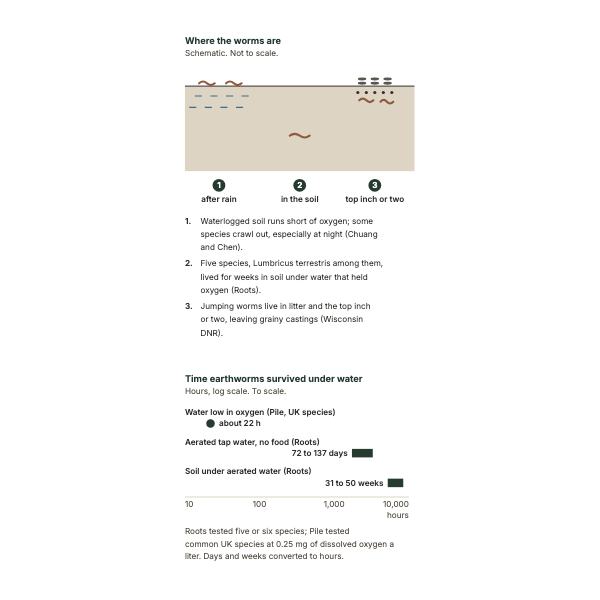
Briones and Schmidt pooled 215 studies from 40 countries in Global Change Biology in 2017. No-till plots averaged 137 percent more earthworms by number and 196 percent more by biomass than plots under conventional plowing.
Depth mattered as well. The analysis found a negative relationship between plowing depth and earthworm numbers, and the large deep-burrowing worms were among the groups most sensitive to plowing.
That bears directly on the advice to go a foot down, although a farm plow returns year after year, and a gardener’s first dig happens once.
The response was stronger after more than 10 years of reduced tillage, which again points at the long run rather than the first season.
How fast worms return is unsettled: the literature the authors review runs from recovery within a few months to numbers still very low after 25 to 30 years of cultivation.
What Repeated Tilling Costs
The case against routine tilling is mostly a list of slow losses. Iowa State names them: it breaks apart soil aggregates, the crumbs that hold air and water, speeds the loss of organic material, promotes crusting, raises erosion risk, and brings weed seeds to the surface. Illinois Extension adds that the boost in plant nutrients from tilling is usually short-lived.
University of Nebraska educator Sarah Browning describes the pattern gardeners notice. They work in organic matter every fall, the soil stays heavy, and routine fall and spring tilling “could be the culprit.” That is an extension educator’s reading, stated as a possibility, and not a measured result in a home garden.
No-till is not a free win either, and the farm evidence is less one-sided than the online argument. A meta-analysis in Nature covering 5,463 paired yield observations found that no-till reduces yields overall, with the penalty minimized when residue is kept and crops are rotated.
A Nature Climate Change analysis found much of the apparent carbon gain under no-till is carbon sitting at a different depth. Both are cited from their abstracts.
Garden soil also may not behave like farm soil. Illinois Extension makes the wider point plainly: much gardening advice is “borrowed from industrial-scaled agriculture research.”
A Second Pass, a Foot Down
Nothing we read asks a home gardener to take a tiller a foot deep. Iowa State says most garden plants keep most of their roots in the upper six inches, and that turning the soil deeper “has minimal returns in increased plant growth.” Illinois gives 6 to 10 inches for preparing a new bed, and Colorado State gives six to eight for compacted clay.
Oregon State’s advice for a new garden is narrower still: till “just deep enough to shatter the sod and root clumps,” and do anything deeper with a spade or spading fork. It says mechanical tilling works the top 5 to 6 inches, and warns that tilling too deeply can seal off the subsoil.
Virginia Cooperative Extension names the same risk more precisely. Rotary tilling can form a compaction layer just beyond the reach of the tines.
A second pass with the same machine works the same depth, so it does nothing about a layer below it. Virginia’s suggested remedies are deep-rooted cover crops or double digging.
Double digging is the one method here that goes a foot down. It means trenching by hand and loosening the bottom of each trench, and Oregon State reserves it for initial preparation and severely compacted soil. It is a fix for a specific problem rather than a general upgrade.
The softness of fresh tilling is also temporary. Oregon State notes that newly loosened soil can sink back after the first watering.
Hao and colleagues measured that in tilled sandy soil in Thailand, reported in an abstract, where bulk density rose from 1.38 to 1.57 grams per cubic centimeter under rainfall or flooding alone.
They say sandy soils appear especially prone, so clay may differ. A plot that feels soft this week has not yet shown how it will behave.
What to Do With the Plot You Have
Start from what you can see. The table sorts the common situations after a first dig, and each row is explained below. It is built from extension guidance for home gardens, so treat it as the best available advice and not as the result of a trial.
What the plot needs after the first dig
Find your situation in the left column. Each row is extension guidance for home gardens, not a tested comparison.
| If you find | Do this | Because |
|---|---|---|
| Soil crumbles, nothing hard below | Stop. Rake it and plant. | Iowa State: most garden roots sit in the upper six inches. |
| A squeezed handful holds a ball | Wait for it to dry out. | Worked wet, clods can last for years. |
| A hard layer just below the tines | Break it once, by fork or spade. | A tiller can leave that layer and cannot reach it. |
| Grass regrowing from root pieces | Dig the pieces out by hand. | Tilling can break them into more plants. |
| A flush of small weed seedlings | Hoe shallow, or cover the bed. | Turning soil again lifts more seed. |
| Heavy clay, and no more digging | Compost on top, or a raised bed. | It can work, but the change comes slowly. |
| A bed ready to plant | Set paths and stay on them. | Foot traffic on moist soil compacts it. |
None of these situations calls for a second deep pass with the tiller.
Check the Moisture Before Any Tool Goes In
The extension sources agree on this more than on anything else in the argument. Squeeze a handful of soil. If it stays in a ball that will not break, it is too wet. If it falls apart when you press it with your thumb, it is ready. If it will not form a ball at all, Oregon State says it is too dry.
Virginia Cooperative Extension suggests sampling at the surface and at 2 to 3 inches down, in several places across the plot. Another sign of wet soil is that it sticks to the shovel, or that the turned surface looks shiny and smooth.
This matters most on clay. Colorado State warns that clods made by tilling wet clay “may last for years,” and that some clay soils offer only a few days, or even hours, between too wet and too dry. Waiting costs a little time. Working the soil wet can undo the reason you dug.
Keep Off the Soil You Loosened
Compaction is the part of the thread that deserved more attention, and several readers raised it. Colorado State calls traffic the major contributor, and gives this example: a moist soil can reach 75 percent of maximum compaction the first time it is stepped on, and 90 percent by the fourth. The page does not give a source for those figures.
The fix is layout, and it costs less effort than tilling. Nebraska suggests planting beds narrow enough to work without stepping in them, and says 4-foot beds work well.
Colorado State says raised beds with set walkways eliminate compaction in the growing area, and that a thick layer of wood or bark chips on a path reduces the effect of foot traffic.
Readers in the thread suggested boards laid across the plot to walk on. That follows the same logic, keeping feet to a fixed line, but we found no test of boards. Permanent paths are the version the sources describe.
The Weeds You Just Woke Up
A freshly turned plot often greens over with weeds, and the reason is well studied. Scopel, Ballaré and Sánchez, in a 1991 abstract, showed that a short period of burial made seeds of the weed Datura ferox about 10,000 times more sensitive to light, and that millisecond exposures to sunlight could trigger germination in the field.
Every pass with a tiller is another brief exposure for whatever seed it lifts. In a later Weed Science abstract, moldboard plowing by day raised emergence by as much as 200 percent over plowing at night, though the size of the effect varied and was occasionally nil.
Do not take up night tilling on the strength of that: a Canadian review for organic growers tells them not to expect much from it.
The practical rule is Clemson’s, to move as little soil as possible. Hoe shallowly, since most vegetable roots sit near the surface.
If you want to clear the seedlings before planting, Illinois Extension describes covering a tilled bed with plastic so the germinating seeds die, then removing it before you plant.
There is farm-scale support for that idea. Across 10 experiments in New York and Maine, reported in a HortScience abstract, black tarps left on for three weeks or more lowered weed biomass, with no further gain from longer periods. Tarped no-till and reduced-till beets gave results similar to conventional tillage.
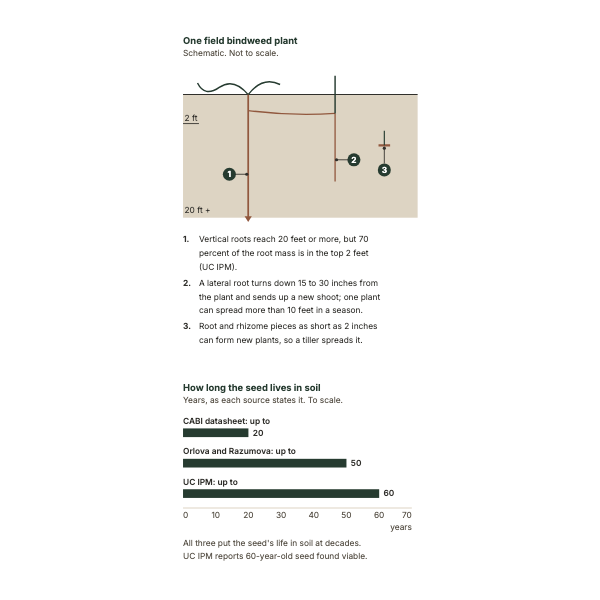
Grass is a separate problem. The poster shook out the big clumps and churned in the smaller bits, which matters if the grass spreads by rhizomes, its underground stems.
Wisconsin Extension says tilled quackgrass rhizomes will not die, and that broken pieces regrow into more plants. Clemson warns of the same with perennial weeds generally.
For a small plot, Wisconsin’s advice is to dig them out by hand, while admitting that getting all of a rhizome is difficult. Not every lawn grass behaves this way.
Cornell notes that tall fescue is a clump-forming grass with no rhizomes. Cornell also says that controlling a severe quackgrass infestation without herbicides largely requires repeated or intensive tillage, but that is a farm job, timed with care.
Heavy Clay and the No-Dig Question
One reader asked whether no-dig could ever work on compacted clay, and the sources do not fully agree. Colorado State leans toward working it once: it says that in compacted or clayey soils, amendments left shallower than six to eight inches can lead to shallow rooting, and that breaking up surface compaction pays off over the long term.
The same page then says to avoid cultivating clayey soil except to add amendments and prepare a seedbed, and that a fork, broad fork or shovel disturbs soil less than a rototiller.
Read together, that is a case for one careful start and then restraint, which is roughly what Iowa State means by a light turning with a fork, shovel, hoe or rake.
Saskatchewan’s guide says converting to no-till can be hard on very damaged soil or heavy clay, and offers compost laid on top or framed raised beds.
It expects improvement over time, without saying how long that takes. No comparison of the two routes on clay turned up, so the choice comes down to your back and your patience.
How much compost to add is a separate question, and we are not setting a number here. Iowa State calls a soil test essential for making appropriate changes, and Colorado State warns that application rates should fall as soil organic content builds. If you are buying compost, our piece on moldy compost covers what mold on a bag does and does not mean.
Before You Go Deeper, or Plant Food in It
Digging deeper also has a safety side. Utility lines can sit in the way, and calling rules differ by state. Nevada, for example, says homeowners must always call 811 before digging with mechanical equipment, and before digging more than 12 inches with hand tools. Check your own state’s rule before any machine goes in the ground.
A new vegetable plot on old ground has one more question that tilling cannot answer. Illinois Extension says all vegetable garden soils should be tested for lead, and warns against siting a food garden next to a busy road or a pre-1940 home with a painted wooden exterior.
A reply in the thread said contamination matters for leafy crops and not fruiting ones. Illinois is more careful: fruiting vegetables are less likely to carry high lead than leafy and root crops, which is a matter of degree.
What you water with raises a similar question, as our article on gutter rainwater sets out. Only a lab test tells you what is in your own soil, and Illinois says both private and university labs can run one.
Local Regulations and Safety Advisory
Rules on locating buried utility lines before digging differ by state, so contact your local utility-locating service before you dig, and use a soil testing laboratory if you are unsure whether the ground is suitable for food. This article is general information, not legal advice.
Authorities to consult:
- Local utility-locating service, and a soil testing laboratory
What Remains to Be Explored
Nobody has run the trial this argument needs. We found no controlled study comparing one tilling, repeated tilling and no-dig on a home vegetable plot. We also found none that follows a lawn converted to a garden, and none on a rotary tiller at garden scale. Illinois Extension acknowledges the same shortage of small-scale research.
So the recovery times here are borrowed. The Nebraska figures describe plowed grain fields, and they may not apply to a backyard lawn on different soil. We found no measure of how long a garden’s mycorrhizal fungi or earthworms take to return, and no test of how deep a home gardener should go on clay.
A side-by-side trial on real garden plots, measuring soil structure and yield over several seasons, would change this answer. Until then, the direction is reasonably clear and the size of the effect is not. Do the first dig if you need it, and make it hard to justify the second.
Sources
- Soil Microbial Community Change and Recovery After One-Time Tillage of Continuous No-Till — C. S. Wortmann, J. A. Quincke, R. A. Drijber, M. Mamo and T. Franti. Agronomy Journal 100:1681-1686. 2008. Cited from its abstract.
- One-Time Tillage of No-Till Crop Land Five Years Post-Tillage — C. S. Wortmann, R. A. Drijber and T. G. Franti. Agronomy Journal 102:1302-1307. 2010. Cited from its abstract.
- Conventional Tillage Decreases the Abundance and Biomass of Earthworms and Alters Their Community Structure in a Global Meta-Analysis — M. J. I. Briones and O. Schmidt. Global Change Biology 23(10):4396-4419. 2017.
- Productivity Limits and Potentials of the Principles of Conservation Agriculture — C. M. Pittelkow and colleagues. Nature 517:365-368. 2014. Cited from its abstract.
- Limited Potential of No-Till Agriculture for Climate Change Mitigation — D. S. Powlson and colleagues. Nature Climate Change 4:678-683. 2014. Cited from its abstract.
- Induction of Extreme Light Sensitivity in Buried Weed Seeds and Its Role in the Perception of Soil Cultivations — A. L. Scopel, C. L. Ballare and R. A. Sanchez. Plant, Cell and Environment. 1991. Cited from its abstract.
- The Effect of Light During and After Soil Cultivation With Different Tillage Implements on Weed Seedling Emergence — A. L. Scopel and C. L. Ballare and colleagues. Weed Science 46(3):351-357. 1998. Cited from its abstract.
- Black Plastic Tarps Advance Organic Reduced Tillage II: Impact on Weeds and Beet Yield — H. Rylander, A. Rangarajan, R. M. Maher, M. G. Hutton, N. W. Rowley, M. T. McGrath and Z. F. Sexton. HortScience 55:826-831. 2020. Cited from its abstract.
- Slumping Dynamics in Tilled Sandy Soils Under Natural Rainfall and Experimental Flooding — H. Hao and colleagues. Soil and Tillage Research 114(1):9-17. 2011. Cited from its abstract.
- Managing Garden Soil — Iowa State University Extension and Outreach. Undated.
- Soil Compaction — Colorado State University Extension. Undated.
- Soil Preparation (426-313) — A. X. Niemiera. Virginia Cooperative Extension. 2015.
- An Educator’s Guide to Vegetable Gardening (EM 9032) — Oregon State University Extension Service. 2024.
- Prepare the Soil — University of Illinois Extension. Undated.
- Smart Gardening: Converting to No-Till for Home Gardeners — Sarah Browning. University of Nebraska-Lincoln Extension. Undated.
- Why No-Till: Pros and Cons — University of Saskatchewan Gardening. Undated.
- Controlling Weeds by Cultivating and Mulching (HGIC 1253) — Clemson Cooperative Extension. 2016.
- Quackgrass, Difficult to Deal With — University of Wisconsin-Madison Extension. Undated.
- Quackgrass — Cornell University, Weed Science. Undated.
- Photocontrol: Tilling in the Dark? — E. Johnson. Organic Agriculture Centre of Canada, Dalhousie University. 2002.
- Lead in Soil Fact Sheet — University of Illinois Extension. 2019.
- Homeowner Guide to Safe Digging — Public Utilities Commission of Nevada. Undated.
- First Post on R/Gardening, I Just Dug up My First… — multiple community members. Reddit, r/gardening. Undated.