Earwigs in a house have come in from outside. They live by day in the damp shelter of leaves, debris and mulch along the foundation, wander indoors through gaps, mostly in summer, and do not breed inside. The guides’ remedy is to clear that shelter, seal the gaps and dry damp rooms. They are not dangerous: the pinch is mild, and the ear story is a name, not a habit.
The extension guides read for this article agree on that picture. They give the forceps at the tail different jobs.
What This Article Covers
This article covers why earwigs come indoors, where they hide there, whether they bite or harm a house, the ear story and the smell, and what keeps them out. It leaves insecticides to the guides cited and names no product.
For the same earwigs outdoors, see earwigs in the garden, pest or predator. For an indoor insect that does breed inside, see German cockroaches and the compost pile.
Is It an Earwig?
The forceps at the tail settle it. Colorado State University (CSU) Extension’s fact sheet 5.533 describes the European earwig as about 5/8 inch long, brown with a reddish head, with a pair of prominent forceps at the rear; the young look like small adults without fully developed wings.
The University of Nevada, Reno (UNR; Burls, Hanson Mazet and Kratsch, 2021) says the adults have wings but are not known to fly, and UNH Cooperative Extension that the wings are very short and seldom used. CSU notes a second species, the ring-legged earwig, with a band on the front legs, in the far south of Colorado.
The European earwig is a newcomer. CSU says it was established in the eastern United States around 1907 and spread across the country; the University of Arizona’s Backyard Gardener (2023, adapted from Jeff Schalau) says it is common through much of it.
Why Earwigs Come Indoors
They are outdoor insects that stray. UNH calls them chiefly outdoor insects, and Arizona says they enter homes during summer and can keep migrating in all summer long.
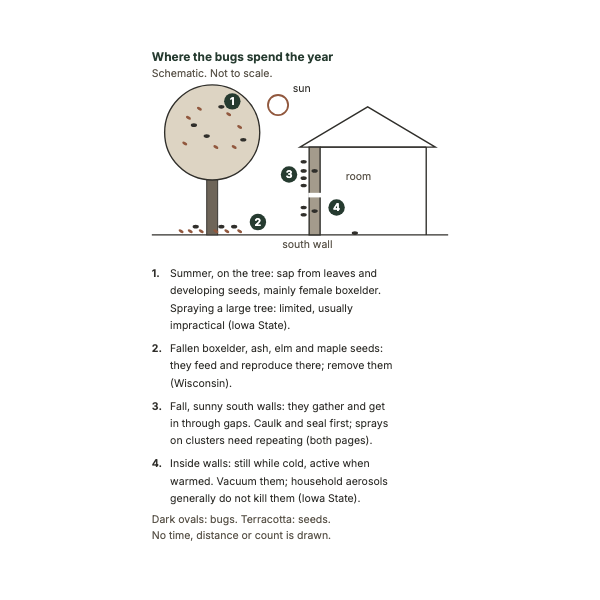
Their outdoor shelter is close to the walls. CSU says they hide by day in almost any dark, confined space, particularly a moist one, outdoors under rocks, stacked wood and debris. UNH adds leaves and debris next to the house, woodpiles, loose boards, the base of trees and shrubbery.
Their year runs on a set calendar. Arizona says earwigs mate in the fall and spend the winter in nests, the females lay eggs in early spring, the young leave the nest from late May to early June, and they become adults by late June or early July. CSU says problems in Colorado tend to come from mid-July through mid-September.
Moisture matters indoors too. UNH says that if a basement is damp, reducing its humidity may make it less inviting and cause those that do enter to die.
Earwigs indoors come from outside
They live in the damp shelter by the foundation and wander in through gaps. They do not breed indoors.
Colorado State University Extension (fact sheet 5.533); UNH Cooperative Extension; University of Arizona Extension (Backyard Gardener 57, 2023).
Clear the shelter by the wall, seal the gaps and dry the damp places (CSU; UNH; Arizona).
Earwigs gather where others have been. Benoît Sauphanor (1992) found that young and adult European earwigs, given a choice, grouped in shelters other earwigs had already visited, through a scent laid down from glands on the legs. Gagandeep Kaur Hehar (2007), in a thesis, found females, males and young all produce and respond to an airborne gathering scent in the laboratory.
Where They Hide Indoors
The same dark, damp places as outside. CSU lists the spaces under rugs and potted plants and in stacks of newspapers; UNH adds wet mops and flower pots, and says they often turn up around kitchens and bathrooms.
Do Earwigs Breed or Do Damage Indoors?
No. Arizona says earwigs do not damage property, eat our food or reproduce indoors, and that a single earwig does not live long inside a house.
Their nests are outside. UNH says they spend the winter as adults, and that in early spring the female lays her eggs in a nest in the ground and guards them until they hatch. The female keeps caring for the young until they can fend for themselves, and a brood usually runs to about 30.
That family life shows in the gathering scent too. Sauphanor found that traces left by newly hatched young still in the nest, and by nesting females, drew older young to a shelter.
Do Earwigs Bite or Pinch?
The sources agree they are not a danger to people. UNR says earwigs can pinch with their jaws if handled but are not known to be aggressive or harmful to humans. CSU says they can give a mildly painful bite when sat on or handled.
The forceps at the tail have several jobs in the sources. UNH says they serve in defense and mating, CSU that males use them to fight rival males or other insects, Arizona that they protect the earwig and grab and hold prey, and UNR that they are used mainly for mating.
The two sexes look different. Arizona says males have stout, strongly curved forceps, widely separated at the base, and females slender, straight ones close together.
Do Earwigs Crawl Into Ears?
The name comes from the story, not the habit. CSU says the name comes from the superstition that earwigs burrow into people’s ears, and that such tales have little basis in fact.
Arizona puts it more exactly: earwigs have been found in people’s ears on rare occasions, but this is very uncommon and is not normal behavior.
Why Earwigs Smell
The odor is likely a defense. UNH says earwigs have a foul odor, and Arizona that they can release a foul-smelling liquid from the abdomen.
Its chemistry is known. Thomas Eisner (1960) describes two pairs of small glands on the back of the abdomen whose secretion is mainly two benzoquinones, compounds that in other insects are strong repellents against predators.
How to Keep Earwigs Out
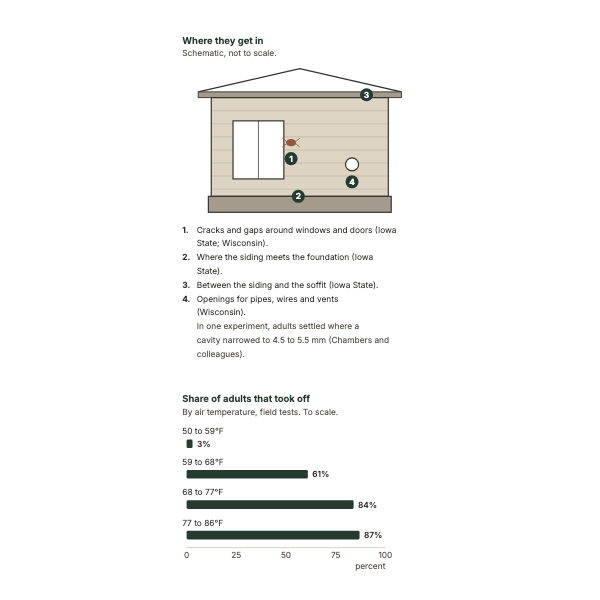
The guides start outside the house. CSU clears sheltering debris, mulches included, from beside the home, especially near doorways and window wells, and says this works best if that strip is also kept fairly dry. UNH removes leaves and debris next to the house.
Then the gaps. CSU seals small gaps along doors, windows and vents with caulk. Arizona caulks gaps around the outside at ground level, especially around doors and windows and where the siding meets the foundation, and UNH wants basement and ground floor doors and windows tight fitting.
Arizona is frank about the limit: some earwigs will still get in. For those, it removes them with a vacuum or a broom and dustpan.
Drying may help indoors. UNH’s advice for a damp basement is to reduce its humidity.
Traps by the foundation catch some. CSU says many earwigs can be trapped, which may help reduce numbers, in rolled corrugated cardboard or newspaper that copies a daytime shelter, collected every 2 to 3 days. In stone fruit orchards, though, Aldo Hanel and colleagues (2023) found mass trapping with rolled cardboard did not lower earwig numbers.
Outdoors, earwigs also do some good. Robert J. Orpet, David William Crowder and Vincent P. Jones (2019) write that they generally do more good than harm in apple and pear orchards, where they eat pests, and in an apple orchard in the Netherlands, T. F. Mueller and colleagues (1988) found far fewer shoots infested with woolly apple aphids where earwigs were plentiful.
What Remains to Be Explored
No source read measured how many earwigs enter a house, how long one survives indoors, or how much sealing or drying cuts their numbers. The gathering-scent work was done in laboratories and fields, not houses.
No study read compared the forceps’ uses, and no case series of earwigs in human ears was found.
Sources
- European Earwigs (Fact Sheet 5.533) — Colorado State University Extension. Undated.
- Earwigs [Fact Sheet] — UNH Cooperative Extension. Undated.
- Earwigs (FS-21-108) — K. Burls, W. Hanson Mazet and H. Kratsch. University of Nevada, Reno Extension. 2021.
- Earwigs (Backyard Gardener 57) — Adapted from Backyard Gardener publications by Jeff Schalau. University of Arizona Cooperative Extension. January 15, 2023.
- Biology and Management of European Earwig in Orchards and Vineyards — Robert J. Orpet, David William Crowder and Vincent P. Jones. Journal of Integrated Pest Management. 2019. Cited from its abstract.
- Earwig (Forficula auricularia) Predation on the Woolly Apple Aphid, Eriosoma lanigerum — T. F. Mueller, Leo H.M. Blommers and P.J.M. Mols. Entomologia Experimentalis et Applicata. 1988. Cited from its abstract.
- Turning a Pest Into a Natural Enemy: Removing Earwigs From Stone Fruit and Releasing Them in Pome Fruit Enhances Pest Control — Aldo Hanel and colleagues. Insects. 2023. Cited from its abstract.
- Une Phéromone D’agrégation Chez Forficula auricularia — Benoît Sauphanor. Entomologia Experimentalis et Applicata. 1992. Cited from its abstract.
- Pheromonal Communication in European Earwigs, Forficula auricularia L. (Dermaptera: Forficulidae) — Gagandeep Kaur Hehar. Simon Fraser University (Summit). 2007. A thesis; cited from its abstract.
- Defense Mechanisms of Arthropods. II. The Chemical and Mechanical Weapons of an Earwig — Thomas Eisner. Psyche: A Journal of Entomology. 1960. Cited from its abstract.