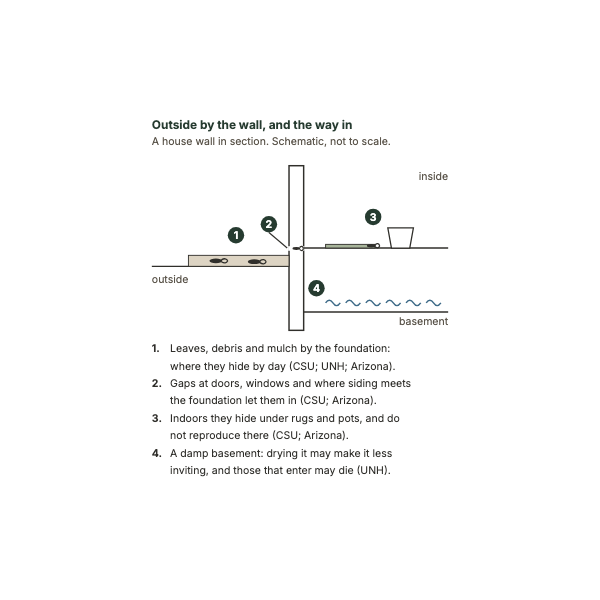
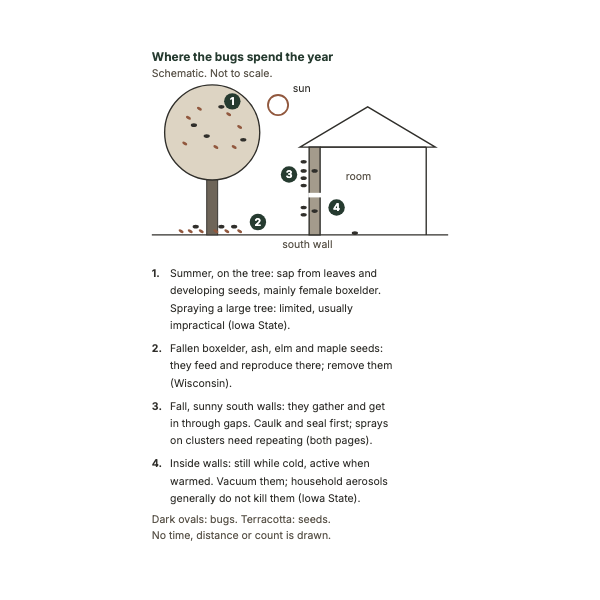
Stink bugs in the house are brown marmorated stink bugs looking for a place to spend the winter. Iowa State Extension says every one found indoors walked or crawled in through cracks and gaps in fall, so the fix is to seal those gaps before they arrive and vacuum up the ones already inside.
They are a nuisance, not a danger to the house. Iowa State says they do not bite or sting, do not feed on the structure, its contents or the people in it, and cannot reproduce indoors.
What This Article Covers
This article covers why stink bugs come into houses, whether they bite, breed or feed indoors, what crushing one does, how to keep them out, what traps have been tested indoors, and what they eat outdoors. It names no product.
Other insects come in for the winter the same way; see boxelder bugs on a maple and earwigs in the house.
Why Stink Bugs Come Into the House
To overwinter. Iowa State says the brown marmorated stink bug spends the winter as an adult hiding in houses and other protected places, and enters buildings in fall to find sheltered spots to hibernate.
They are not after warmth. Iowa State says they cannot predict colder weather or know that a house will be heated, and that they come in usually from late September to October. Illinois Extension gives September through October for the search.
Trap catches abroad fit that window. In a hazelnut orchard in Samsun Province, Türkiye, Baş and colleagues (2026) found pheromone trap catches peaked between the end of September and the first week of October, then fell as the bugs moved to overwintering sites, which they had fully retreated to by early November.
They look for tight spaces. Chambers and colleagues (2020) gave overwintering adults cavities with a sloping lid, and the bugs tended to settle where the cavity narrowed to 4.5 to 5.5 mm, heads toward the entrance.
In a laboratory arena, Song and Lee (2020) found more females than males crawled into a 5 mm gap, and 69.1 percent of the bugs settled alone, not touching another bug.
Stink bugs walk in through gaps in fall, so sealing comes first
Iowa State and Wisconsin list the same kinds of entry points. In field tests, temperature affected whether adults took off: 3 percent did at 50 to 59°F.
Iowa State University Extension (Lewis, reviewed 2022); University of Wisconsin-Madison (Guédot, Jensen and Liesch, 2026); Chambers and colleagues (2020); Lee and Leskey (2015), bands converted from 10 to 30°C.
Iowa State: every stink bug found indoors walked or crawled in through cracks and gaps in fall.
Do Stink Bugs Bite, Breed or Feed Indoors?
No, on all three. Iowa State says stink bugs do not bite, cannot sting, and do not feed on structures, house contents or occupants, and that while inside they neither feed nor reproduce. University of Wisconsin-Madison Extension calls them harmless indoors to people and structures.
Breeding waits for spring. Iowa State says females cannot reproduce until early spring. In northern Greece, Koutsogeorgiou and colleagues (2022) found overwintering females did not lay eggs as soon as they left their shelters but needed extra time to finish diapause, a mean 29.0 days for females moved from their winter sites into laboratory conditions in December.
Many died over winter in one long study. Over four winters in South Tyrol, Italy, Fischnaller and colleagues (2026) found 35.2 to 58.9 percent of field-collected adults died overwintering outdoors under shelter, and 48.0 to 65.0 percent under laboratory conditions.
Their state going in mattered. Among adults reared in the laboratory, those induced into diapause died at 20.6 percent, while reproductively active ones died at 99.3 percent, the same study found. Papa and Negri (2020) also reported cannibalism among overwintering adults, which they tie to the demands of surviving the winter.
Numbers vary. Wisconsin says problems in its structures usually involve fewer than 100 bugs, though some infestations run to thousands. Iowa State says they annoy because they are large, can come in large numbers, and fly.
Does Squashing a Stink Bug Attract More?
Crushing one does release the smell. Wisconsin says crushed adults give off a strong odor and can stain light-colored materials such as curtains. Iowa State describes the odor as cilantro-like.
The signal that gathers them is a separate thing. The aggregation pheromone is produced by adult males, Wu and colleagues (2023) note, while Finetti and colleagues (2021) name (E)-2-decenal as an alarm pheromone component, one young nymphs responded to in their behavioral test.
None of these sources says which compounds a crushed bug releases, or tests whether the smell draws others. For bugs already inside, Iowa State says to vacuum or sweep up stink bugs indoors and remove and discard the vacuum bag promptly.
How to Keep Stink Bugs Out
Seal before fall. Iowa State calls sealing cracks, gaps and entry points the first step, with caulk or weather-stripping, and windows, screens and doors kept in good repair. It lists gaps around windows and doors, between the foundation and siding, between the siding and soffit, and around chimneys.
Wisconsin lists gaps in siding near corners, doors and windows, vents, and holes for pipes and wires, sealed with caulk, expanding insulation foam, backer rod or weather stripping. It calls this physical exclusion and says it keeps out other pests too.
Indoor sprays do not help. Iowa State says indoor insecticide sprays, bug bombs included, are not recommended, because they do not prevent entry and only reach bugs out in the open at the time.
Wisconsin adds an outdoor option: a repellent-type insecticide sprayed in thin bands around access points in fall, around or just before the time the bugs try to get in, or treatment by a pest management professional. This article names no product; the reader advisory covers labels.
Weather affects when they move. In field tests, Lee and Leskey (2015) found 3 percent of adults took off at 10 to 15°C (50 to 59°F), against 61, 84 and 87 percent in warmer bands up to 30°C.
In their wind tests, 83 percent took off in still air and fewer than 10 percent at 0.75 meters a second or more.
Do Stink Bug Traps Work Indoors?
One home trial is among these sources. Aigner and Kuhar (2014) had citizen scientists test indoor light traps in houses in Virginia through late winter and early spring, and the most effective was an aluminum foil water pan trap, developed by one of the volunteers.
Light draws them in other settings too. In a Turkish-language study, Göktürk (2020) caught 753 adults in a light trap and 618 in a pheromone trap over 27 weeks, by our translation of the Turkish abstract.
Rondoni and colleagues (2022) found traps with ultraviolet and visible LEDs attracted up to about eight times more bugs than traditional sticky or small pyramid traps outdoors.
Wisconsin adds a limit for homes: research is evaluating traps in commercial settings, but options for homeowners are lacking, it says.
Repellents have only laboratory data. Bulgarini and colleagues (2021) found ginger, clove, vetiver and turmeric essential oils repellent to adults at concentrations above 3 percent in a two-choice test. No study here tested them at a window or wall.
What Stink Bugs Eat Outdoors
Many plants. Iowa State says the bugs leave their winter hiding places in May to feed on plant sap, and lists damage in the eastern U.S. on field crops, fruit, vegetables, trees and shrubs. Illinois says the bug is known to feed on over 300 plants.
Fruit and vegetables show it most. Wisconsin says damage to landscape plants tends to be minor and the greatest threat is to fruits and vegetables. Illinois describes white, spongy areas on green tomatoes and peppers, yellowish on ripe fruit, and cat-facing and corky spots on apples and peaches.
Local damage varies. Iowa State says damage in Iowa has been limited to the nuisance of bugs entering buildings, and Wisconsin says pressure there has been relatively low, with minor plant damage in home yards and gardens.
Generations per year depend on place. Iowa State and Wisconsin give one generation a year in their states, Wisconsin adding two or more in warmer places, while Illinois says most of the Midwest has two.
Where the Brown Marmorated Stink Bug Came From
East Asia. Iowa State says it is native to China, Japan, Korea and Taiwan and was first identified in fall 2001 in Allentown, Pennsylvania, the year Wisconsin gives for the first U.S. confirmation, with unconfirmed reports back to 1996.
All three place the first U.S. find in or near the 1990s. Illinois gives 1998 for the first Allentown report, and Wisconsin says the bug likely arrived in the 1990s.
It has spread widely. Iowa State says it has been found in 47 states, and Wisconsin says that by 2025 it had been found in most states of the contiguous United States. Wisconsin adds that adults are good hitchhikers.
Local Regulations and Safety Advisory
If you use pest control products, follow the label. Rules on them vary by country and locality, and your pesticide regulator can say what applies where you live. This article is general information, not legal advice.
Authorities to consult:
- Pesticide regulatory authority or environmental protection agency
What Remains to Be Explored
None of the studies here tested whether crushing a stink bug indoors draws others to the same room. The one indoor trap trial was a citizen-science comparison in Virginia, not a measure of how much a trap reduces bugs in a home.
No study here compared sealing methods or measured how many bugs a sealed house keeps out. How long a bug survives indoors in a heated house is not given in these sources.
Sources
- Brown Marmorated Stink Bug — Donald Lewis. Iowa State University Extension and Outreach (Yard and Garden). March 2022.
- Brown Marmorated Stink Bug — Christelle Guédot; Bryan Jensen; PJ Liesch. University of Wisconsin-Madison Division of Extension (Wisconsin Horticulture). January 23, 2026.
- Brown Marmorated Stink Bug — Karuna Kafle; Kacie J. Athey. University of Illinois Extension. Undated.
- Using Citizen Scientists to Evaluate Light Traps for Catching Brown Marmorated Stink Bugs in Homes in Virginia — John Aigner; Thomas Kuhar. Journal of Extension. 2014. Cited from its abstract.
- Cavity Tightness Preferences of Overwintering Halyomorpha halys (Hemiptera: Pentatomidae) — Benjamin D Chambers; Tracy C Leskey; John P Cullum; Annie R Pearce; Thomas P Kuhar. Journal of Economic Entomology. 2020. Cited from its abstract.
- Formation of Overwintering Aggregation of Halyomorpha halys (Hemiptera: Pentatomidae) in Laboratory Conditions — Hyunsung Song; Doo‐Hyung Lee. Entomological Research. 2020. Cited from its abstract.
- Flight Behavior of Foraging and Overwintering Brown Marmorated Stink Bug, Halyomorpha halys (Hemiptera: Pentatomidae) — D.-H. Lee; T.C. Leskey. Bulletin of Entomological Research. 2015. Cited from its abstract.
- Overwintering Mortality in Halyomorpha halys (Hemiptera: Pentatomidae): Insights From Laboratory and Field Studies — Stefanie Fischnaller; Giacomo Bulgarini; Angelika Gruber; Clara Frasconi Wendt; Peter Neulichedl; Manfred Wolf. Environmental Entomology. 2026. Cited from its abstract.
- Females of Halyomorpha halys (Hemiptera: Pentatomidae) Experience a Facultative Reproductive Diapause in Northern Greece — Eleni I. Koutsogeorgiou; Nikos A. Kouloussis; Dimitrios S. Koveos; Stefanos S. Andreadis. Insects. 2022. Cited from its abstract.
- Cannibalism in the Brown Marmorated Stink Bug Halyomorpha halys (Stål) — Giulia Papa; Ilaria Negri. Insects. 2020. Cited from its abstract.
- Exploration of Candidate Genes Involved in the Biosynthesis, Regulation and Recognition of the Male-Produced Aggregation Pheromone of Halyomorpha halys — Chunyan Wu; Feng Zhang; Youssef Dewer; Jinping Zhang; Fengqi Li. Insects. 2023. Cited from its abstract.
- Characterization of Halyomorpha halys TAR1 Reveals Its Involvement in (E)-2-Decenal Pheromone Perception — Luca Finetti; Marco Pezzi; Stefano Civolani; Girolamo Calò; Chiara Scapoli; Giovanni Bernacchia. Journal of Experimental Biology. 2021. Cited from its abstract.
- The Response of the Brown Marmorated Stink Bug to Different Pheromones and Determination of Its Overwintering Timing — Furkan Harun Baş; İslam Saruhan; İzzet Akça. Black Sea Journal of Agriculture. 2026. Cited from its abstract.
- Halyomorpha halys (Stål) Mücadelesinde Işık Ve Feromon Tuzaklarının Etkinliliklerinin Araştırılması — Temel GÖKTÜRK. Artvin Çoruh Üniversitesi Orman Fakültesi Dergisi. 2020. Cited from its abstract (in Turkish, translated by us).
- Improved Captures of the Invasive Brown Marmorated Stink Bug, Halyomorpha halys, Using a Novel Multimodal Trap — Gabriele Rondoni; Elena Chierici; Elisa Marchetti; Stefano Nasi; Roberto Ferrari; Eric Conti. Insects. 2022. Cited from its abstract.
- Repellent Activity of Essential Oils on Adults of Halyomorpha halys (Heteroptera: Pentatomidae) in Different Physiological-Behavioural Phases — Giacomo Bulgarini; Sara Bortolini; Lara Maistrello. Journal of Applied Entomology. 2021. Cited from its abstract.