Getting rid of agapanthus for good means digging out the whole clump, rhizome and all, because any piece left behind can regrow, and cutting the flower heads off before they set seed.
Every council and herbarium page read agrees on both. Florabase rates agapanthus as moderately resistant to herbicides, and the job is rarely done in one visit, so plan to come back for regrowth and seedlings.
The question comes from a thread on r/GardeningAustralia. A new homeowner wanted two dense clumps, each about 2 by 2 m, out of a front yard.
Replies split between digging, with tips to soak the soil, cut the tops off, saw or chop the root mass into sections and lever it out, or hire a small excavator, and spraying or solarizing, with one reply saying the ground stays a mass of roots either way.
Replies said every rhizome piece left would regrow, one that pieces left on a driveway still sprouted, and others urged cutting the flower heads. Some called it an invasive weed that states list or are considering listing, others loved it and suggested giving the plants away, and one warned that the sap is toxic and to keep pets away.
What This Article Covers
This article covers removing established garden agapanthus: why it comes back, digging, spraying and the alternatives, the seed heads, the sap, and what to do with the plants once they are out.
It names no herbicide or product and gives no rate, and it states no rule as applying everywhere, because weed rules differ by place.
Why Pieces Come Back
Agapanthus grows from rhizomes, thick underground stems. Florabase, the Western Australian Herbarium’s flora database, describes them as dense, fleshy, crowded, strong and aggressive, forming large clumps that keep extending, and says the plant spreads mainly by seed and also by rhizomes.
Its management notes say all of the rhizome must be removed and destroyed off-site, because any rhizome left will regrow, even if it ends up upside down.
Bay of Plenty Regional Council in New Zealand says plants often resprout from rhizomes and need follow-up until all are killed. Murray Dawson and Kerry Ford, writing in the New Zealand Garden Journal in 2012, call the rhizomes extremely difficult to dig out and say any left behind will regrow.
Every piece and every seed head
Where a dug-out agapanthus clump comes back from, and how much seed one flower head holds.
Places 1, 2 and 4: Western Australian Herbarium, Yarra Ranges Council and Auckland Council. Place 3 and panel B: Dawson and colleagues, counts on plants in Auckland and Canterbury.
Digging removes the clump; what brings it back is the piece left behind, the seed head left on, and the soil or waste moved elsewhere.
No study read measured how small a piece of agapanthus rhizome can regrow or from how deep. Trials on other rhizomatous weeds show why the pieces matter, and are borrowed here as other species, not as agapanthus.
In coltsfoot, rhizome pieces only 6 cm long came up and grew normal leaves from 42 cm down, in two soils (Dalbato and colleagues 2014, abstract). In goldenrod (Solidago canadensis), pieces 5 and 10 cm long sprouted from every depth tested, to 30 cm, though fewer survived deeper (Rosef and colleagues 2019, abstract).
In yarrow, longer pieces survived deeper burial, and none survived lying on the soil surface (Bourdôt 1984, abstract).
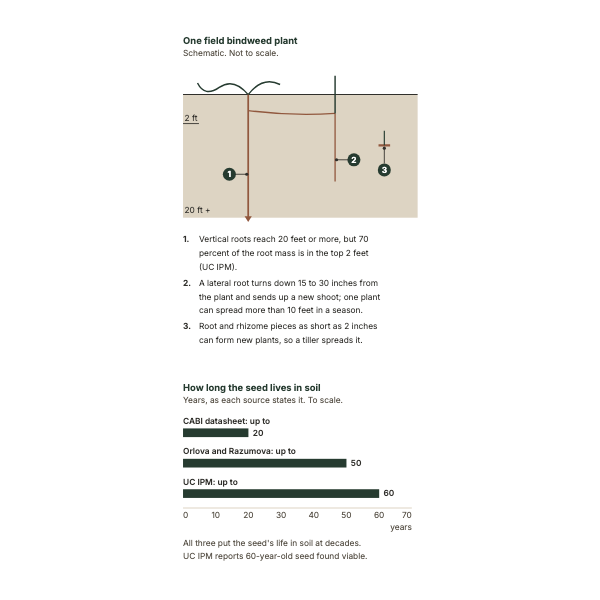
Drying is not a quick fix either. In hedge bindweed, rhizomes dried for 12 or 24 hours made shoots as usual, and only 48 or 96 hours of drying cut growth significantly (Rask and Andreasen 2007, abstract).
That fits the thread’s report of pieces sprouting on a driveway, but agapanthus itself was not tested.
Digging It Out
Digging is the first method on every council and herbarium page read. Yarra Ranges Council in Victoria says hand pulling is practical only for small clumps, that digging must remove all the root material, and that the dug soil should not be dumped elsewhere, because that spreads the weed.
Florabase says small infestations can be dug out and younger plants removed as early as possible. Auckland Council’s guidance is to dig out the plants and cut off the seed heads, then follow up on treated areas three times a year.
Bay of Plenty says to make sure the whole rhizome comes out and not to replant until all the agapanthus is controlled. On a bank, it advises starting at the top and working down.
None of the sources read compares ways of breaking up a large clump, such as soaking the soil first, cutting it into sections or using a machine, so the replies’ methods are untested here. What the sources agree on is the outcome they need: every piece of rhizome out of the ground and off the site.
Spraying, Cutting and Smothering
Florabase rates agapanthus as moderately resistant to herbicides and says a surfactant may help spray get through its waxy leaves. Dawson and Ford write that it has resistance to some herbicides and that no biological control is available.
Bay of Plenty says it can survive mowing, grazing, insects and spraying.
Where councils do describe spraying, they pair it with cutting. Yarra Ranges says to cut, brushcut or mow the leaves to stimulate new growth, then spray the new growth with a registered product, following its label. Florabase gives the same cut-then-spray sequence and says follow-up weeding of seedlings and rhizome shoots will be necessary.
This article gives no product or rate; any herbicide goes by its label and local rules, as the advisory below says.
Cutting alone works on stored reserves, slowly. In a 1968 trial on couch grass, D. J. Turner found that removing shoots every 14 days lowered the dry weight and stored carbohydrate of the rhizomes and stopped new rhizome growth (abstract). That is a grass, not agapanthus, and no source read says how many cuts an agapanthus clump would take.
No source read tested covering or solarizing agapanthus, so the replies’ disagreement on smothering is left open here.
The Seed Heads
Seed is the other route, and it is large. Dawson and colleagues counted seed on wild-type plants in Auckland and Canterbury and estimated 640 presumed viable seeds per flower head, against a possible 4,200. Plants carried 13 to 40 flower heads a season, which put a clump at 12,880 to 86,160 seeds.
They found that seed from highly fertile plants can come close to 100 percent germination, sprouts as soon as it is ripe and appears to have no dormancy. They did not test how long it stays viable in soil.
Dawson and Ford add that the seed spreads by wind and especially along drains and waterways, and Massey University notes that dead flower heads last for many months still holding seed.
Cutting the flower heads before they set seed is in every control guide read: Yarra Ranges puts the best removal time before seeds form, Bay of Plenty says to remove the heads in early summer, and Florabase and Auckland both say to cut them off.
Dawson and Ford also note that deadheading is tedious for large plantings and impractical in many areas.
NC State Extension’s plant record says that plants grown from seed can take up to 5 years to bloom.
The Sap
The reply about the sap has support: for people, every source read describes it as an irritant, and the question for pets has less behind it. NC State rates agapanthus a low-severity poison, causing irritation of the skin and eyes from the sap and irritation and ulceration of the mouth if eaten. Another field on the same record says it does not cause contact dermatitis, so the record is not consistent with itself.
Massey University’s poisonous plants page says swallowing the sap causes severe mouth ulceration and stomach inflammation, and that skin contact may cause burning, irritation and rashes, which tend to clear on their own.
Florabase lists the leaves, roots and sap as poisonous and irritant, and Auckland Council says contact can cause rashes, burning and mouth ulcers, especially in children.
Dawson and Ford report that agapanthus is among the ten poisonous plants most often reported to New Zealand’s national poison center and is regularly involved in childhood poisonings, citing an earlier review.
For animals, the only source read is Massey’s livestock entry, which says the underground parts are poisonous to livestock and the leaves do not seem to be. No source read rates agapanthus for dogs or cats.
Disposal, Giving Plants Away and the Rules
Dumped garden waste is one of the ways agapanthus reaches bushland, according to Yarra Ranges, Auckland and Florabase. Yarra Ranges lists landfill and the green waste bin as disposal routes and excludes seed heads and plants that spread vegetatively from home composting.
Auckland says small amounts can be rotted down in a covered water barrel, or taken to green waste or landfill.
Whether the plants can be given away depends on where you live. In the Auckland region, the regional pest management plan bars breeding, distributing, releasing or selling agapanthus and planting it anywhere except moving an existing plant within the same property.
The only exemption there is for cultivars tested to produce less than 2 percent viable seed, which Auckland Botanic Gardens lists.
Yarra Ranges lists agapanthus among its environmental weeds and warns buyers about plants sold at markets, nurseries, fetes and club fund-raising sales. No Australian state list was read, so the replies’ claim about state listings is not confirmed here. For other plants that come back from roots or pieces, see porcelainberry overrunning a yard, tree of heaven between a house and a driveway and thistle returning through a rock bed.
What to Do Now
- Wear gloves, and keep the sap off skin and away from eyes and mouths (NC State, Massey, Auckland).
- Cut off any flower heads first and dispose of them with the rhizomes (Yarra Ranges, Florabase, Auckland).
- Dig out the clumps, taking every piece of rhizome you can find (Yarra Ranges, Florabase, Bay of Plenty).
- Get the rhizomes off the site, to landfill or green waste, or rot small amounts in a covered barrel (Yarra Ranges, Auckland); do not compost them at home or dump the soil elsewhere.
- Check before giving plants away, because selling and distributing agapanthus is banned in some places (Auckland), as the advisory below explains.
- Come back for regrowth and seedlings, which Auckland plans for three times a year, and do not replant until it is gone (Bay of Plenty).
Local Regulations and Safety Advisory
If you use pest control products, follow the label. Rules on them vary by country and locality, and your pesticide regulator can say what applies where you live. Rules on agapanthus as a weed, including whether it may be sold, given away, planted or dumped, differ by council, region and state, so check yours before giving plants away or disposing of them. This article is general information, not legal, medical or veterinary advice.
Authorities to consult:
- Pesticide regulatory authority or environmental protection agency
- Local council or regional weed management office
- Poison control service
- Veterinarian or animal poison control service
If a child or pet may have eaten part of a plant, contact a poison control service or a veterinarian, because toxicity depends on the species, the amount and the individual.
What Remains to Be Explored
No study read measured how small or how deep a piece of agapanthus rhizome can regrow, how long its pieces survive drying, or how long its seed lasts in the soil. Those answers here come from other rhizomatous weeds.
No trial read compared digging, spraying, repeated cutting or covering on agapanthus, or measured how many seasons a removed clump keeps sending up shoots and seedlings. No Australian state weed list was read.
What would change this article: a trial of agapanthus rhizome fragments by size and depth, or a follow-up count of regrowth after removal, which would turn the councils’ agreed advice into numbers a gardener can plan around.
Sources
- Best Way to Get Rid of These Agapanthus? — multiple community members. Reddit, r/GardeningAustralia. Undated.
- Agapanthus praecox subsp. orientalis — Western Australian Herbarium. Florabase, Western Australian Herbarium (Department of Biodiversity, Conservation and Attractions). Undated.
- Agapanthus — Yarra Ranges Council. Undated.
- Agapanthus praecox — Auckland Council. Auckland Council, Tiaki Tamaki Makaurau. Undated.
- Agapanthus — Bay of Plenty Regional Council. Undated.
- Agapanthus in New Zealand — Murray Dawson, Kerry Ford. New Zealand Garden Journal (Royal New Zealand Institute of Horticulture). 2012.
- Assessing Fertility in Horticultural Selections of Agapanthus — M. Dawson, E. Bodley, R. Stanley, I. Duncalf, E. Morgan. Auckland Botanic Gardens (hosted copy). Undated.
- Agapanthus — Massey University. Massey University, Poisonous Plants of New Zealand. Undated.
- Agapanthus (African Lily) — NC State Extension. NC State Extension Gardener Plant Toolbox. Undated.
- Agropyron repens (L.) Beauv. – Some Effects of Rhizome Fragmentation, Rhizome Burial and Defoliation — D. J. Turner. Weed Research. December 1968. Cited from its abstract.
- Regeneration of Yarrow (Achillea millefolium L.) Rhizome Fragments of Different Length From Various Depths in the Soil — G. W. Bourdôt. Weed Research. December 1984. Cited from its abstract.
- Effect of Rhizome Fragment Length and Burial Depth on Emergence of Tussilago farfara — A L Dalbato, T Alfredsson, L M Karlsson, L Andersson. Weed Research. March 24, 2014. Cited from its abstract.
- Vegetative Propagation of Solidago canadensis – Do Fragment Size and Burial Depth Matter? — L Rosef, H H Ingebrigtsen, E Heegaard. Weed Research. December 2, 2019. Cited from its abstract.
- Influence of Mechanical Rhizome Cutting, Rhizome Drying and Burial at Different Developmental Stages on the Regrowth of Calystegia sepium — A M Rask, C Andreasen. Weed Research. January 16, 2007. Cited from its abstract.