Yes, a moth orchid can grow and flower in a mix that contains peat. In greenhouse trials, moth orchids grew bigger in bark with some peat than in bark alone, and made more leaves still in sphagnum moss. Peat is not poison to an orchid.
What fails is a medium so fine and so decomposed that its pores stay full of water, because orchid roots rot when they are kept soggy. So an orchid blooming in peat moss needs its roots checked and a coarser mix once the flowers finish, not an emergency repot.
The question came from an update on r/plantclinic, where a grower showed a moth orchid that, by their account, had not stopped flowering in the two years they had owned it. The longest spike needed two sticks taped together to hold it up.
Replies saw what looked like soil in the pot and said it would suffocate the roots. One said to take the plant out at once, rinse and trim the roots, and give up the flowers to save it.
The grower answered that most of what the plant was rooted in was peat moss, with potting soil only on top. Another reply warned that changing anything while it bloomed could make it drop every flower. Both sides have part of it right, and the research says which part.
Why Orchid Roots Need Air
Moth orchids are epiphytes, which Iowa State defines as plants that grow on trees, shrubs or rocks rather than in soil. The University of Connecticut’s extension service describes them growing “high in the trees above the soil”, and its advice for a potted one is blunt: “Orchid roots like air and will rot if kept soggy and wet.”
The root is unusual too. It is wrapped in a velamen, which Gerhard Zotz and Uwe Winkler, writing in Oecologia in 2013, describe as a spongy coat of dead cells. In their tests, cited from the abstract, it took up water within seconds and took several hours to dry.
They tie that to rain on a branch: the velamen catches the first water of a shower, which carries the most nutrients. Most of the other jobs credited to the velamen, they add, still wait to be tested.
A pot that stays wet works against roots in a general way. The University of Maryland Extension states the rule for houseplants: “Excess water reduces oxygen in the soil, which damages fine roots and renders the plant unable to take up water.”
Wet mix also favors disease. Iowa State University Extension names Pythium, Phytophthora, Rhizoctonia and Fusarium as root rot organisms that “thrive in wet, poorly drained soils and potting mix”, infecting roots of plants that are already stressed or weakened.
Not every orchid is built the same way. Iowa State notes that some orchids, especially those from temperate climates, are terrestrial and grow in the soil of grasslands and forests.
A 2025 study in AoB PLANTS by T. Y. Gao and colleagues compared the anatomy of 24 Cymbidium species. From the abstract, the tree-growing species had a thicker velamen and more potential for drought tolerance, while the ground-growing species showed more resistance to waterlogging.
The moth orchid sold in supermarkets is an epiphyte, so the air rule applies to it. The question is which potting materials leave room for that air, and that is where “soil” turns out to be the wrong word.
Peat Moss, Sphagnum Moss and Potting Soil Are Not the Same
Three materials get called soil or moss in orchid advice, and they behave differently in a pot. North Dakota State University Extension puts the first distinction plainly: peat moss “is decomposed moss”, and “peat moss is not the same as Sphagnum moss”, which is sold dried as long strings.
Peat forms in bogs, where low oxygen and cool temperatures slow decay, so it builds up over hundreds or thousands of years. The same NDSU column calls peat moss the main ingredient in many soilless potting mixes, which is why bagged mixes for houseplants are often peat-based.
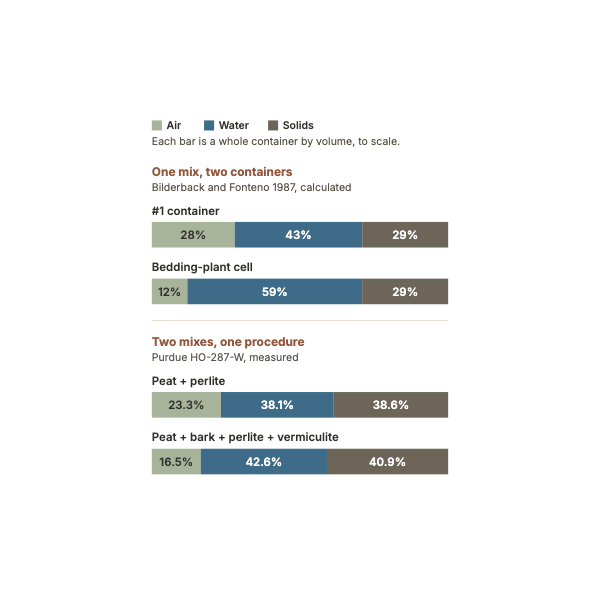
Peat itself varies. In a 1972 talk for greenhouse growers at the University of Minnesota, R. E. Widmer wrote that partly decomposed sphagnum peat “is usually preferred by horticulturists”, and that it is 89 to 96 percent pore space by volume.
At field capacity, the point where a drained pot holds all the water it can, Widmer gave that peat roughly 54 percent of its pore space in water and 40 percent in air. So good peat is not airless. The trouble starts as it gets finer and more decomposed.
Long-strand sphagnum is the third material, and the one many store orchids arrive in. Iowa State notes that moth orchids from retailers are often grown in coarse sphagnum moss, which “stays wetter longer” than bark.
What the Trials Found
Most of the useful evidence comes from Yin-Tung Wang’s moth orchid trials in the United States, published from the 1990s to the 2000s. They were greenhouse experiments rather than homes, but they set potting media side by side, including peat.
Wang and Konow, in the Journal of the American Society for Horticultural Science in 2002, grew moth orchids in fir bark alone or in 7 parts bark to 3 parts sphagnum peat.
After a year, from the abstract, plants in the bark-peat mix had more leaves, more weight and more leaf area. Root weight was similar in both media.
An earlier trial pointed the same way. In HortScience in 1998, Wang reported that plants in bark alone had fewer flowers and less leaf area than those in 80 percent bark with 20 percent sphagnum peat, again from the abstract.
Sphagnum moss made more leaves still in a later comparison. Wang’s 2007 HortScience paper, cited from its abstract, found plants in Chilean sphagnum moss made four to five new leaves in eight months, against two to three in a bark mix that itself held some peat.
The trade-off showed up in a related trial. Wang and Tsai reported in 2006, in a conference abstract, that flower spikes appeared up to four weeks earlier in the bark mix than in the moss, even though the moss plants made more leaves.
A Polish trial, read in full, adds a second case for moss, this time against clay pellets.
Tomasz Trelka, Włodzimierz Breś and Agata Kozłowska, in Acta Scientiarum Polonorum Hortorum Cultus in 2010, grew two moth orchid cultivars in New Zealand sphagnum moss, in clay pellets, and in the two mixed half and half.
The moss plants had the most mass in both leaves and roots, and in the paper’s tables 85 and 90 percent of them flowered. In clay pellets alone, only 25 and 35 percent of plants flowered, and the half-and-half mix fell in between.
Even a bagged potting mix has grown moth orchids. Wang and Gregg, in HortScience in 1994, flowered plants for two seasons in a commercial mix, Metro-Mix 250, cut with equal parts perlite and charcoal.
A version with a larger share of the potting mix grew roots the abstract calls “inferior”, as did a perlite and rockwool mix. The abstract does not say why, and in the second flowering season the media made little difference.
None of this is a recipe for home use. Sphagnum moss is a standard commercial medium for moth orchids in countries such as Japan and Taiwan, according to a 2008 HortScience paper by Huan-Ying Yao and colleagues, cited from its abstract.
These were greenhouse plants on a research schedule of watering and feeding, and the Polish greenhouse held humidity at 70 to 80 percent. No trial found has tested how far these results carry to a windowsill.
It is the pores, not the word “soil”
Moth orchids have grown well in bark, in sphagnum moss and in bark with some peat. What fails is a mix so fine that its pores stay full of water.
Peat as a minority in a coarse mix helped in trials. A pot of fine, decomposed peat on its own is the case the sources warn against.
When Peat Does Fail
The failure the replies feared is real, but it belongs to a particular kind of peat.
Trelka and colleagues, citing a 2008 review by Schmilewski, call highly decomposed black peat “totally unusable for the cultivation of orchids because its structure is too fine and its air capacity is too low”.
Widmer explains the physics behind that. “Small pores fill with water and large pores are needed to retain air,” he wrote. With a highly decomposed peat, or one “milled too fine”, it “will be much easier to overwater”.
He called an air content below 10 percent undesirable, writing about greenhouse crops in general. Blending such peat with perlite or similar materials, he added, improves its air content and drainage.
Orchid mixes reach that state with age as well. Iowa State’s guide to repotting orchids, reviewed in January 2026, says that coarse media break down over time, “holding too much water and increasing the risk of root rot”.
How long bark lasts before that happens is covered separately.
So whether the thread’s orchid is in trouble depends on what its peat is like now and how long the pot stays wet.
No study found tested a moth orchid in peat moss alone. For that pot, the roots are the evidence, and the next section covers how to read them.
The potting soil on top is a smaller unknown. No source we read tested a layer of fine mix over an orchid’s medium.
How to Tell Whether the Roots Are in Trouble
Start by looking, not repotting. Root rot begins with wilting lower leaves and is easy to mistake for thirst, Iowa State warns, “so it is very important to examine the root system and potting mix moisture level before adding more water.”
Check how wet the pot is first. Iowa State says dry media are lighter in color and weight, and a wooden chopstick pushed into the pot comes out completely dry when it is time to water.
Maryland suggests lifting the pot and comparing its weight with how it felt just after watering. A mix that stays wet is the condition Iowa State ties to rot. The signs that a houseplant needs water are covered in more detail separately.
Roots tell you the rest. When Iowa State’s guide has you repot, it says to “cut out any soft, dead, brown, black, or hollow roots”, and its root rot page calls rotted roots “mushy”. Healthy root tissue, the same page says of houseplants in general, is firm.
Why a soaked pot rots roots whatever its size is explained in the article on root rot, which covers the saturated zone at the bottom of a pot.
Should You Repot an Orchid That Is in Bloom?
The sources agree on the normal answer: wait. The American Orchid Society’s repotting guide says, “If the plant is in bloom, wait until the plant comes out of bloom. If absolutely necessary, one can repot a plant in spike or bloom, but risks losing the flowers prematurely.”
Iowa State puts the best time after flowering, “just as new leaf and root growth are starting”, and Connecticut says right after flowering. The AOS gives the reason in terms of roots: repot as new roots begin to form, and they establish themselves in the new medium very rapidly.
The AOS plays down the fear that a repot at the wrong time will kill the plant: that is “highly unlikely”, it says, unless more than half the roots are damaged. By its account, the flowers, not the plant, are what a mid-bloom repot puts at risk.
What no source settles is when rot makes the repot “absolutely necessary”. We found no test of repotting a moth orchid in bloom, and no rule for how much root loss justifies giving up the flowers.
If the roots you can see are firm, the sources point to waiting. If they are mushy, the choice is the grower’s.
The reply warning that change could drop the flowers has some support. Connecticut notes that large swings in temperature can make flower buds fall early. No source read tested a move or a change of pot on its own.
Choosing the New Mix
The AOS frames the choice around the grower, not the orchid. “If you have wetter conditions or simply water frequently, then you will want a coarser medium,” its guide says.
If you are “stingy with water or forgetful or simply growing indoors, you will want a medium that retains more water.” Trelka and colleagues cite work by Kohara and colleagues making the same point from the other side: results depend on finding the right watering frequency for each material.
That matches Iowa State’s trade-off. Bark mixes “offer excellent drainage, dry quickly, and are forgiving of overwatering”, but break down quickly. Sphagnum “retains more moisture, making it easier for beginners, but it also risks overwatering and root rot”. Some growers mix the two.
The AOS adds a practical warning about moss: sphagnum holds water when wet but repels it once dry, so it suggests moistening the surface and watering again about five minutes later.
Whatever the mix, it says to use a pot with drainage holes, and Connecticut calls holes a must.
Does the moss have to come from New Zealand? The Polish trial used New Zealand moss and Wang’s moss trials used Chilean moss, and plants did well in both. We found no study comparing moss by country of origin, so that rule has no evidence behind it either way.
Clay pellets were the worst medium in the Polish trial, though it was a greenhouse trial in plastic pots and the paper describes no water reservoir.
Iowa State lists clay pellets among media for advanced growers. Mixing clay pellets into potting soil is a separate question with its own article.
Two other points from the thread have articles of their own: watering orchids with ice cubes, and what happens when a moth orchid’s spike ends in a flower.
What to Do for an Orchid in Peat or Soil Now
1. Check the mix before you change anything. Push a wooden chopstick into the pot and lift the pot after watering, as Iowa State and Maryland describe. A mix that stays wet is the condition Iowa State ties to root rot.
2. Water only as the mix dries. Iowa State says to water a moth orchid “just as the media dries”, running water through until it drains, emptying any saucer or outer pot within 30 minutes, and never letting the plant sit in water.
3. Leave a healthy plant in bloom alone. If the visible roots are firm, wait until the flowers finish, as the AOS advises. If roots are soft or mushy, the AOS allows repotting in bloom at the risk of the flowers, and the call is yours.
4. Repot as new roots start. After flowering, when new leaves and root tips appear, take the plant out and pull all the old medium from the roots, as Iowa State describes. If the roots are dry, it says to soak them in water for a few minutes first.
5. Trim and size the pot. Cut out soft, dead, brown, black or hollow roots, with pruners sterilized as Iowa State advises. It sizes the pot by the root mass, not the leaves, which often means the same pot or one size larger, with drainage holes.
6. Choose a mix for your habits and fill it in. Pick a coarser mix if you water often and one that holds more water if you forget, as the AOS says. Work it between the roots with a chopstick until the plant stands up on its own, then water thoroughly.
What Remains to Be Explored
No trial found grew a moth orchid in peat moss alone or in bagged potting soil, so the thread’s exact case is untested.
The peat evidence comes from mixes in which peat was the minority, and the warning about decomposed peat comes from potting-media science rather than an orchid experiment.
No study found waterlogged a moth orchid’s roots to measure how quickly they fail, and none tested repotting in bloom against waiting.
No comparison of sphagnum moss by origin was found. Every trial here was a greenhouse, and all but one of the nine journal papers cited here are known only from their abstracts.
A trial of store moth orchids kept in peat moss, potting mix, sphagnum and bark under home watering, with root health recorded over two flowering seasons, would answer the question this thread asked.
Sources
- Fertilizer Source and Medium Composition Affect Vegetative Growth and Mineral Nutrition of a Hybrid Moth Orchid — Yin-Tung Wang, Elise A. Konow. Journal of the American Society for Horticultural Science 127(3):442-447. 2002. Cited from its abstract.
- Impact of Salinity and Media on Growth and Flowering of a Hybrid Phalaenopsis Orchid — Yin-Tung Wang. HortScience 33(2):247-250. 1998. Cited from its abstract.
- Potassium Nutrition Affects Phalaenopsis Growth and Flowering — Yin-Tung Wang. HortScience 42(7):1563-1567. 2007. Cited from its abstract.
- Effect of Potassium Concentration on a Hybrid Phalaenopsis Grown in a Bark Mix or Sphagnum Moss — Yin-Tung Wang, Amy Ching-Jung Tsai. HortScience 41(4):980A. 2006. Cited from its abstract.
- Medium and Fertilizer Affect the Performance of Phalaenopsis Orchids During Two Flowering Cycles — Yin-Tung Wang, Lori L. Gregg. HortScience 29(4):269-271. 1994. Cited from its abstract.
- Phalaenopsis Cultivation in Different Media. Part I. Growth and Flowering — Tomasz Trelka, Włodzimierz Breś, Agata Kozłowska. Acta Scientiarum Polonorum Hortorum Cultus 9(3):85-94. September 30, 2010.
- Adapting the Pour-Through Medium Extraction Method to Phalaenopsis Grown in Sphagnum Moss — Huan-Ying Yao, Ren-Shih Chung, Sheng-Bin Ho, Yao-Chien Alex Chang. HortScience 43(7):2167-2170. 2008. Cited from its abstract.
- Aerial Roots of Epiphytic Orchids: The Velamen Radicum and Its Role in Water and Nutrient Uptake — Gerhard Zotz, Uwe Winkler. Oecologia 171(3):733-741. 2013. Cited from its abstract.
- Differentiation in Water Adaptation Strategy Between Epiphytic and Terrestrial Species of Cymbidium, Orchidaceae — T. Y. Gao, W. Zhang, S. B. Zhang. AoB PLANTS 17(4):plaf030. 2025. Cited from its abstract.
- Moss Peat – For Propagation and Plant Growth — R. E. Widmer. University of Minnesota Agricultural Experiment Station (talk, Commercial Flower Growers’ Short Course, 1972); PDF hosted by NC State. 1972.
- Dakota Gardener: For Peat Moss Sake — Carrie Knutson. NDSU Extension. February 21, 2023.
- Repotting — American Orchid Society. Undated.
- Growing Orchids Indoors — Iowa State University Extension and Outreach, Yard and Garden. Undated.
- How to Repot an Orchid — Aaron Steil. Iowa State University Extension and Outreach, Yard and Garden. Last reviewed January 2026.
- What Is the Proper Care for a Moth Orchid? — Iowa State University Extension and Outreach, Yard and Garden. January 21, 2025.
- Orchid Care and Repotting — University of Connecticut Home and Garden Education Center. Undated.
- Root Rots of Houseplants — Erika Saalau. Iowa State University Extension and Outreach, Yard and Garden. February 14, 2014.
- Overwatered Indoor Plants — University of Maryland Extension, Home and Garden Information Center. March 13, 2023.
- Asked You for Help With My Orchid About 2 Months… — multiple community members. Reddit, r/plantclinic. Undated.