For most houseplants in most homes, yes: stop feeding over the winter. But the rule is not about the month. It stands in for light, and warmth behind it, so the test that settles it is whether your plant is making anything new, not what the calendar says.
A plant under a grow light in January may still be growing. A plant on a dim bookshelf in July may not be.
The calendar gets both wrong, and the evidence below shows why: in a year-long indoor trial, extra fertilizer had no effect on growth at a dim light level and a large effect at a brighter one.
What the Winter Rule Is Standing in For
The extension services that publish the rule state its reason first. University of Maryland Extension puts it in one sentence: “during the winter months, indoor plants don’t need fertilizer because reduced light and temperature result in reduced growth.” A line later, the same page says to “fertilize from March through September.”
That is a mechanism followed by a date, and the date only works where the mechanism holds. Iowa State University Extension’s answer to the question gives the reason as growth, not the month: fertilizing “is generally not necessary during the winter months as most houseplants are not growing during this time.”
Sarah Browning, a Nebraska Extension educator, names the variable directly: “plants require less fertilizer under low light conditions and for houseplants, almost all indoor winter locations are ‘low light’.” On her fertilization page she lists what sets the amount a plant needs, including its “growth rate” and “available light”.
New Mexico State University’s Southwest Yard and Garden column, in 2004, put it in terms of weather rather than dates.
Some houseplants slow or go dormant in winter, it said, so feed less or stop, and “when it is cloudy and during the shorter days, fertilize less.” When days lengthen and growth begins, feeding can go back up, never beyond the label.
How Much Light a Winter Takes Away
The quantity that matters is the daily light integral, or DLI. A Purdue Extension guide for greenhouse growers, by Ariana P. Torres and Roberto G. Lopez, defines it as “the amount of PAR received each day as a function of light intensity” and duration. PAR is the band of light plants use for photosynthesis.
Their analogy is a rain gauge: DLI is the day’s total, not the brightness at any one moment. A short bright day and a long dim one can deliver the same amount. The same guide says plants grown with too little of it “typically have delayed growth and development.”
Pamela C. Korczynski, Joanne Logan and James E. Faust mapped outdoor DLI across the contiguous United States from 30 years of solar data at 216 sites.
Their abstract gives a mean of 5 to 10 moles per square meter per day across the northern states in December, against 55 to 60 in the Southwest from May through July.
The change is fast around the equinoxes. In many places, they report, DLI rises by more than 60 percent from February to April.
Their maps also show that from October through February the differences are mainly between north and south, so a southern winter and a northern one are not the same winter.
Those are outdoor totals, and indoors is lower. The Purdue guide says greenhouse values “seldom exceed 25” and obstructions can bring a greenhouse down to “as low as 1 to 5”.
No comparable figure for a living room was found. Browning’s judgment, quoted above, is that almost every indoor winter spot is low light.
Light and Warmth: What the Trials Separate
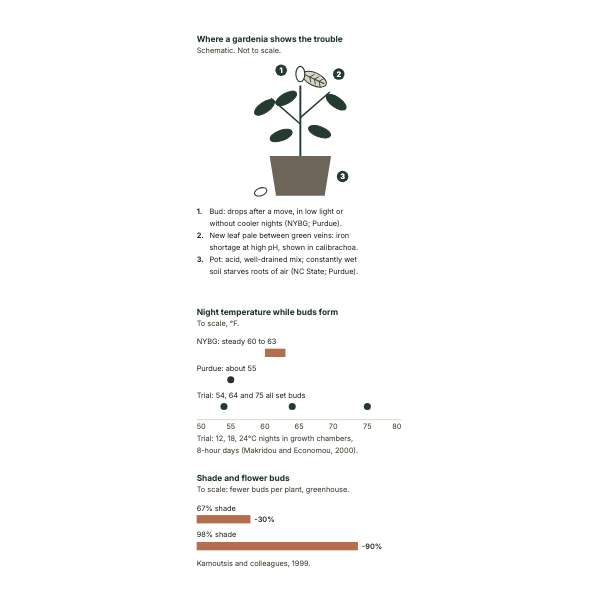
Maryland names light and temperature together, and most advice never pulls them apart. A few controlled trials have. The clearest for a houseplant is on African violet, where growth chambers held temperature and daily light at fixed combinations and the researchers recorded when each new leaf unfolded.
James E. Brown-Faust and Royal D. Heins grew violets at 15, 20, 25 and 30°C (59 to 86°F) and at daily light of 1, 4, 7 and 10 moles.
In their 1991 abstract, leaves unfolded faster as temperature rose from 15 to 25°C, then slower above it, and faster as light rose from 1 to 4 moles, with no significant gain above 4.
A 1993 paper by Faust and Heins modeled the same response. The fastest predicted rate was 0.27 leaves a day at 25°C and 10 moles, about one leaf every 3.7 days.
At 1 mole, the best rate fell to 0.18, about one every 5.6 days, and the best temperature dropped to 23°C.
So in this one plant both levers move growth, and less light lowers the ceiling that warmth can reach. Both results are cited from abstracts. They describe violets in chambers, and the numbers are not a guide to another species or to a room.
Warmth does not rescue a dim spot either. Astrid Kubatsch, Heiner Grüneberg and Christian Ulrichs kept dwarf schefflera for six months at three light levels and three temperatures.
Less light cut fresh and dry weight, and the plants’ quality and life span suffered at the two lowest levels, “especially at higher temperatures.”
Their reading, from the abstract, is that the plants could not scale back their energy use to match the smaller supply of light. In that species, a warm room did not make up for a dim one; it made things worse.
What Extra Feed Does in Dim Light
This is the trial the winter rule needs. C. A. Conover and R. T. Poole grew schefflera and dumb cane for a year indoors under fluorescent light at 0.5, 1.0 or 2.0 kilolux, about 46, 93 and 186 foot-candles, with different rates and kinds of fertilizer.
Growth rose with light. And, in their abstract’s words, increasing the fertilizer rate “had no effect on growth at 0.5 klx, but a large effect at 2.0 klx.” The dimmest level is below the 75 foot-candles that a 1992 study by the same authors called common in homes and offices.
A second year-long trial points the same way. Melanie A. Turner, David L. Morgan and David Wm. Reed kept weeping fig, a second fig species, dieffenbachia and schefflera at 149 foot-candles for three months, then 89 for nine, on soluble feed, slow-release feed or none. After a year, they report, the effects of fertilizer were minimal.
The soluble feed did show some improvement on several measures, so “minimal” is not “none”. What neither trial supports is the idea that feeding a plant in a dim room will make it grow.
Both are cited from abstracts, and both ran under steady lamp light, not a winter that ends in spring.
One finding sets a limit on the argument. Krishna S. Nemali and Marc W. van Iersel grew begonia and petunia seedlings under three greenhouse light levels with six fertilizer strengths. More light doubled or tripled growth, yet the strength that gave the most growth was the same at every light level.
So what fell with the light in that trial was how much the plants grew, not the fertilizer strength they did best on. Those were seedlings in far brighter light than a home, and the abstract does not say how much fertilizer each light level used in total.
Fertilizer Does Not Restart a Stalled Plant
A plant stops growing, and the reflex is to feed it. When the shortage is light, the trials above found little or no growth to show for it.
Maryland frames the goal modestly: “add just enough nutrients so that the new growth compensates for leaf loss,” and “the purpose should not be to encourage quick growth of a large plant.”
If you want a stalled plant moving, the trials point to light, and in violets to warmth as well. Why no houseplant actually likes low light covers what dim light does to growth, and what a grow light label tells you covers adding light with a lamp.
Why No One Can Give You a Light Number for Your Room
The common indoor light unit is the foot-candle, and the Purdue guide is plain about it: foot-candles are based on light “detected by the human eye (primarily green light). That means foot-candles are focused on people and not appropriate for indicating plant photosynthesis.”
It offers a conversion, with the warning that “the conversion factor from foot-candles to PAR depends on the light source.” Richard W. Thimijan and Royal D. Heins set out separate conversion constants for sunlight and nine kinds of electric lamp, because the same meter reading means different plant light under each.
A room in winter is lit by daylight through glass and by whatever bulbs are on, in proportions that change through the day. Turning a light-meter reading into a DLI for that room needs a factor nobody can choose without knowing the mix, so this article does not print one.
Studies do describe typical indoor light as brightness at a moment. Svoboda V. Pennisi and Marc W. van Iersel set growth chambers to about 10, 20 and 30 micromoles per square meter per second as the range met indoors. Over 10 weeks most species gained dry mass, while snake plant and a dracaena lost it.
Conover and Poole, in their 1992 study of six foliage plants, called 75 and 150 foot-candles levels “commonly found in the home or office.” Growth was better at the higher one for three of the six.
None of these gives a daily total for a home, because that depends on how many hours the light lasts.
The Check That Does Work
Browning supplies the test. “Look for new leaves being produced, flower buds or flowers. These all indicate the plant is still active and not resting (dormant).” If you see none of those, she treats the plant as resting, and her instruction for a resting plant is not to feed it.
The test needs no instrument and no month. Look at the growing tips, and at the center of a rosette plant (one whose leaves grow from a single central point, like an African violet), for leaves or buds that were not there before. The growth you find reflects the light and warmth the plant has actually had, which no calendar can tell you.
Feed or hold, without consulting a calendar
Every row is decided by what the plant is doing and where its light
comes from. The month appears in none of them.
| What the plant is doing | What the evidence says | Feed or hold |
|---|---|---|
| New leaves, flower buds or flowers in any month, including January |
Growing. Over a year indoors, extra feed raised growth at the brightest of three light levels | Feed, at the label’s rate |
| Nothing new for weeks, in a dim spot any season, no lamp |
Resting. At the dimmest level, extra feed did nothing; what the plant does not use stays in the mix as salt | Hold |
| Nothing new, under a lamp or in a very bright window the light has not dropped |
Still resting by the same test. In African violet trials, new leaves came more slowly in a cool room | Hold, and check how warm it is |
| In bud or flower in midwinter a holiday cactus |
Four extension services address it: three say stop for buds or bloom, one says feed. None cites a trial | Three of four: stop |
| Just repotted, unrooted, or wilted any month, any light |
Excluded by Nebraska Extension whatever the season or the window | Hold |
| Growing, in a mix sold with feed in it slow-release granules in the bag |
It may already be feeding. The bag states for how long | Check the bag first |
Row one can say feed in January, and row two can say hold in July. The one
row the sources cannot settle is the holiday cactus in flower.
plants and the slow-release check: S. Browning, Nebraska Extension, 2021. Feed and light
indoors: Conover and Poole 1981. Temperature and new leaves: Brown-Faust and Heins 1991, Faust
and Heins 1993. Holiday cactus: Nebraska Extension against Colorado State Extension, New Mexico
State University and UC Cooperative Extension. Journal results cited from their abstracts. No
row states a rate, a dilution or an interval; those are set by the product’s label.
Browning’s own examples run both ways. Croton, a plant that wants high light, is “often dormant during winter.” Jade plants “typically do not grow actively in winter due to low light,” though a caption on the same page shows one getting enough light to keep growing. An African violet in flower is active.
Row three of the table needs a word. A plant that is making nothing new under a lamp or in a bright window is still resting by Browning’s test, so it is not fed.
The violet trials name the next thing to check: at 15°C, new leaves came more slowly than at 25°C.
If You Have Already Been Feeding All Winter
Nothing dramatic happens after one feeding. The trouble builds, because fertilizer is salt. Browning: “Fertilizer dissolved in water becomes a soluble salt. When water evaporates from the soil, minerals or salts stay behind.”
She warns that feeding dormant plants “could cause a harmful buildup of fertilizer salts in the soil,” and lists the signs: reduced growth, brown leaf tips, dead root tips and wilting, which she notes can have other causes too.
R. T. Poole and A. R. Chase report that excessive fertilization raises soluble salts, causing root damage and poor foliage.
The visible sign is a yellow to white crust on top of the mix, or a white crusty ring around the rim of a clay pot or the drainage hole, in Browning’s description.
The crust is the excess salt itself, which she says builds up on the surface over time. Maryland adds leggy growth as another result of too much fertilizer.
The remedy Browning gives is to flush the pot with plenty of water at a sink or tub where it can drain freely, or to repot into fresh mix.
The volumes and method are set out in whether pots really need drainage holes, which also explains why a pot with no hole cannot be flushed.
Where the Calendar Rule Gets It Wrong
A lamp or a very bright window. Browning: “if you have a very brightly lit south or west window, or have provided your plant with supplement[al] light, it may still be actively growing even in winter. In that case, treat it as an actively growing plant.” Note “may”: the test, not the window, decides.
A dim spot in summer. The rule’s months say feed from spring, but Conover and Poole’s dimmest plants gained nothing from extra fertilizer over a full year under steady lamps, so the season was never the variable there. A plant making nothing new in July is resting by the same test, whatever the date.
Holiday cacti are the one case with two answers. A caption on Browning’s page says Christmas cacti “normally bloom in winter and need fertilization to grow and flower well.” Colorado State Extension says otherwise on two pages: “There’s no need to feed it during blossom,” and “You don’t need to fertilize during flowering.”
New Mexico State University’s Marisa Y. Thompson writes: “Do not apply fertilizer during flowering. Wait until spring, when new growth appears, to fertilize and replant.” Ed Perry, for UC Cooperative Extension, says to reduce feeding through fall and early winter, and “During flower bud formation, stop fertilizing.” None of these pages cites a trial.
So with a holiday cactus in bud, the published advice does not agree, and no study was found that settles it. Three of the four services say to hold through bud or bloom. For the plant’s other needs, see a Christmas cactus not repotted in decades.
How Much, and How Often
This article gives no rate, dilution or interval. Those belong to the product, whatever the bottle calls itself, fertilizer or plant food, and the label is the binding document. A concentrated liquid, a dilute one and slow-release granules carry three different sets of instructions.
The extension sources agree on that much. Browning says each product “should be used according to label instructions regarding frequency of application and dilution,” and Maryland says to “mix according to label directions.” New Mexico State’s 2004 column says the same, and adds never to go beyond the label’s recommendation.
Check the bag before you mix anything. Browning advises finding out whether the potting mix already contains slow-release fertilizer and following its package, noting that one common mix says it feeds plants for up to six months. A plant potted into such a mix may need nothing extra for some time.
When to Start Again
Not on a date. Use the same signal, read the other way: when new leaves start to appear, the plant is growing again. New Mexico State ties the restart to the same thing: “When the days lengthen and growth begins, you can increase application of fertilizer.”
The spring dates in extension advice sit where outdoor light climbs steeply, from February to April on Korczynski’s maps, and a plant under a lamp may never have stopped, in Browning’s account. Readers in the southern hemisphere should flip the months; the test does not change.
Some plants wait whatever the season. Browning: “Newly repotted, unrooted, dormant and wilted plants should not be fertilized.” If you repotted this winter, whether winter repotting is a problem covers what the roots need first.
Local Regulations and Safety Advisory
If you use fertilizer products, follow the label. Rules on them vary by country and locality, and your agriculture department can say what applies where you live. This article is general information, not legal advice.
Authorities to consult:
- Local agriculture department
What Remains to Be Explored
No measured daily light integral for a home interior was found. Indoor studies give brightness at a moment, and a daily total needs the hours and the light source, which vary from room to room.
Until someone logs light at real windowsills through a winter, the plant’s own growth is the better guide.
The light-by-fertilizer evidence for houseplants is thin and old. Two year-long trials, from 1981 and 1987 and both read from abstracts, cover six species between them, under fluorescent lamps rather than daylight. Neither abstract gives values, so how much growth extra feed added at the brighter level is not stated here.
Light and temperature have been separated for African violet and dwarf schefflera, not for most plants people grow. Whether a cool, bright room or a warm, dim one holds a pothos back more is unmeasured. The violet result says both matter in violets, and it cannot be carried to other species.
No study of feeding a holiday cactus in bud or flower was found, and the extension pages answer it both ways. A trial comparing fed and unfed plants through bud set and bloom would answer what the advice cannot. Until then, both answers stand.
Sources
- Fertilizer for Indoor Plants — University of Maryland Extension, Home and Garden Information Center. March 10, 2023. Unsigned.
- Should Houseplants Be Fertilized in Winter? — Yard and Garden, Iowa State University Extension and Outreach. February 26, 2022. Unsigned FAQ answer.
- Success With Houseplants – Fertilization — Sarah Browning, Nebraska Extension Educator. Nebraska Extension in Lancaster County, University of Nebraska-Lincoln. January 17, 2021.
- Winter Care of Indoor Plants — Sarah Browning, Nebraska Extension Educator. Nebraska Extension in Lancaster County, University of Nebraska-Lincoln. December 8, 2018.
- Fertilize Houseplants in Winter (Southwest Yard and Garden, December 11, 2004) — New Mexico State University, Southwest Yard and Garden. December 11, 2004.
- Christmas Cactus Care (Southwest Yard and Garden, December 12, 2020) — Marisa Y. Thompson, Extension Horticulture Specialist. New Mexico State University, Southwest Yard and Garden. December 12, 2020.
- Re-Blooming Christmas Cactus (PlantTalk Colorado 1353) — Colorado State University Extension, PlantTalk Colorado. Undated. Unsigned, undated.
- Take Care of Your Holiday Christmas Cactus — Colorado State University Extension, Pueblo County. Undated. Unsigned, undated.
- The Christmas Cactus — Ed Perry, emeritus Environmental Horticultural Advisor, UC Cooperative Extension. UC Cooperative Extension, University of California Agriculture and Natural Resources (Stanislaus Sprout blog). December 14, 2020.
- Measuring Daily Light Integral in a Greenhouse (HO-238-W) — Ariana P. Torres and Roberto G. Lopez. Purdue Extension, Department of Horticulture and Landscape Architecture. Undated.
- Mapping Monthly Distribution of Daily Light Integrals Across the Contiguous United States — Pamela C. Korczynski, Joanne Logan, James E. Faust. HortTechnology 12(1):12, American Society for Horticultural Science. 2002. Cited from its abstract.
- Modeling Saintpaulia ionantha Temperature and Irradiance Driven Leaf Unfolding and Flower Development Rates — James E. Brown-Faust, Royal D. Heins. HortScience 26(6):744e, American Society for Horticultural Science (annual meeting abstract). 1991. A meeting abstract, not a full paper.
- Modeling Leaf Development of the African Violet (Saintpaulia ionantha Wendl.) — James E. Faust, Royal D. Heins. Journal of the American Society for Horticultural Science 118(6):747. 1993. Cited from its abstract.
- The Effect of Low Light Intensity and Temperature on Growth of Schefflera arboricola in Interior Landscapes — Astrid Kubatsch, Heiner Grüneberg, Christian Ulrichs. HortScience 42(1):65, American Society for Horticultural Science. 2007. Cited from its abstract.
- Influence of Light and Fertilizer Levels and Fertilizer Sources on Foliage Plants Maintained Under Interior Environments for One Year — C. A. Conover, R. T. Poole. Journal of the American Society for Horticultural Science 106(5):571. 1981. Cited from its abstract.
- The Effect of Light Quality and Fertility on Long Term Interior Maintenance of Selected Foliage Plants — Melanie A. Turner, David L. Morgan, David Wm. Reed. Journal of Environmental Horticulture 5(2):76, Horticultural Research Institute. 1987. Cited from its abstract.
- Light Intensity and Fertilizer Concentration: II. Optimal Fertilizer Solution Concentration for Species Differing in Light Requirement and Growth Rate — Krishna S. Nemali, Marc W. van Iersel. HortScience 39(6):1293, American Society for Horticultural Science. 2004. Cited from its abstract.
- Photometric, Radiometric, and Quantum Light Units of Measure: A Review of Procedures for Interconversion — Richard W. Thimijan, Royal D. Heins. HortScience 18(6):818, American Society for Horticultural Science. 1983. Cited from its abstract.
- Quantification of Carbon Assimilation of Plants in Simulated and In Situ Interiorscapes — Svoboda V. Pennisi, Marc W. van Iersel. HortScience 47(4):468, American Society for Horticultural Science. 2012. Cited from its abstract.
- Water Utilization of Six Foliage Plants Under Two Interior Light Intensities — C.A. Conover, R.T. Poole. Journal of Environmental Horticulture 10(2):11, Horticultural Research Institute. 1992. Cited from its abstract.
- Response of Foliage Plants to Fertilizer Application Rates and Associated Leachate Conductivity — R. T. Poole, A. R. Chase. HortScience 22(2):317, American Society for Horticultural Science. 1987. Cited from its abstract.