A fresh mound of dirt shaped like a crescent or a fan, with a plugged hole off to one side, is the sign of a pocket gopher. Moles leave rounder mounds with the plug in the middle, and the University of California says they are not usually found in much of the state’s Central Valley.
The fix the evidence supports is the one several replies offered: find the main tunnel with a probe beside the plug and set traps in it, one facing each way. Smoke cartridges, chewing gum, repellents and scare devices have nothing behind them, and poison baits carry a risk of poisoning children, pets and wildlife that traps do not.
Most of the research behind this advice comes from one University of California researcher and colleagues, and the trapping figures the extension guides report come from crop fields and forest plantings, not home lawns.
What is known about gophers and their burrows still answers most of the remedies the thread proposed, and where it does not, this article says so.
The question comes from a thread on r/landscaping. A homeowner in Sacramento, California, posted a short video of fresh, dark soil heaped through a lawn and asked what animal was digging it.
Several replies said pocket gopher and told the poster to trap the most recent main tunnel. Others guessed a groundhog, a mole, a skunk or an armadillo, and one pointed out that moles do the same thing in Britain. The remedies ranged further than the guesses.
One reply had used smoke bombs dropped into an open hole and killed a few. Another suggested covering every hole but one and running a hose into it, and a third recommended chewing gum, on the theory that it blocks a gopher’s gut and leaves nothing poisonous for whatever eats the gopher later.
A terrier was proposed as the real answer. One reply warned that poison reaches pets, snakes, owls and hawks, and that gophers chew through buried cables, irrigation lines and pond liners, ruin gardens without wire under the beds, and wash out slopes when their tunnels fill with rain. Each of those can be set against what is known about gophers.
Gopher, Mole or Something Else?
UC IPM, the University of California’s pest management program, calls fresh mounds of soil the best sign of a gopher. Seen from above, a gopher mound is crescent- or horseshoe-shaped, and its hole sits off to one side, usually plugged with earth (Baldwin 2025).
New Mexico State University’s trapping guide describes the same mound as fan-shaped with one flat side, because soil pushed up from a slanting tunnel spills down the far side; the tunnel runs away from that flat side (Smallidge).
One gopher can push up several mounds in a day, and in a watered lawn they can appear in any season (Baldwin 2025).
Moles make a different mound. UC IPM describes it as more circular, with a plug in the middle that may not show, volcano-shaped from the side, and often joined by raised ridges where a mole tunnels just under the surface to feed (Baldwin 2025).
Where you live narrows it further. UC IPM’s mole guide says moles live in the Sierra Nevada, the coast ranges and their foothills and the whole coastal zone, but are not usually found in much of the Central Valley, except moist, humus-rich ground such as riverbanks (Baldwin 2024).
The same guide notes that when roots and bulbs are chewed, rodents such as pocket gophers are almost always the cause, not moles. A ground squirrel leaves an open hole with no mound and no plug, according to UC IPM’s summary page.
No source read here describes a groundhog’s burrow, so this article cannot set one beside a gopher’s.
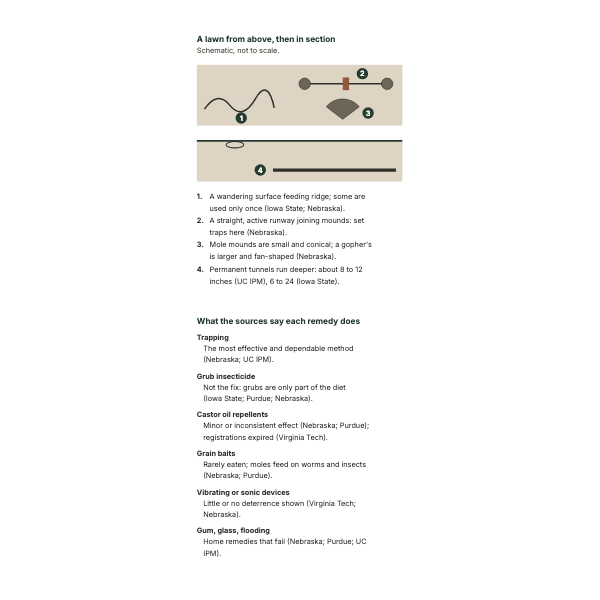
What it can say is that a fresh fan or crescent of soil with a plugged hole to one side is the sign UC IPM and New Mexico State describe. The drawing below shows both mounds from above and the burrow beneath.
Read the plug, then find the main tunnel
From above, where the plug sits tells a gopher mound from a mole’s. Below ground the burrow is closed, and the main tunnel is where a trap goes.
| 1. Gopher mound | Crescent- or horseshoe-shaped from above, with the hole off to one side and usually plugged; one gopher can push up several in a day (UC IPM). A ground squirrel’s hole has no mound and no plug (UC IPM). |
| 2. Mole mound | More circular, with a plug in the middle that may not show, volcano-shaped from the side, often with raised ridges where a mole tunnels just under the surface (UC IPM). UC IPM says moles are not usually found in much of California’s Central Valley, except moist, humus-rich ground such as riverbanks. |
| 3. Plug and side tunnel | Gophers push soil up short side tunnels and seal the openings with earth plugs (UC IPM). A side tunnel usually runs less than about 18 inches to the main tunnel, leaving the mound away from its flat side (NMSU). |
| 4. Main tunnel | Found by probing 4 to 12 inches from the plug side of a fresh mound, usually 4 to 12 inches down, felt as a sudden drop of about 2 inches (UC IPM). Traps go in facing each way, because the gopher may come from either side (NMSU). |
| 5. Nest and food store | Can be as deep as 6 feet, depending on the soil; feeding tunnels run 6 to 12 inches down (UC IPM). |
| 6. Smoke | Gophers seal off the burrow when they detect smoke or gas, which is why smoke or gas cartridges usually fail (UC IPM). |
Drawn from extension descriptions, not measurements. Depths and lengths are as the sources give them.
The plug matters twice: a gopher keeps its burrow sealed, so an opened tunnel brings it to the trap, and smoke let in is shut out.
Why the Hole Is Always Plugged
One reply in the thread said gophers keep their holes covered because they do not like air getting into the burrow. The sources agree on the habit.
UC IPM says gophers seal the openings to the burrow system with earthen plugs, and New Mexico State calls gopher burrows closed systems (Baldwin 2025; Smallidge).
UC IPM gives one reason the habit pays. When a snake comes down a tunnel, a gopher can escape by rapidly pushing up an earthen plug to block it. The same note says that when gophers feed above ground, they venture only a body length or so from the opening (Baldwin 2025).
The habit is the key to both the method that works and the one that fails.
A gopher that finds its tunnel opened comes to plug it, which is why UC IPM says an open trap set encourages the gopher to visit, and why New Mexico State says the open tunnel itself acts as the attractant.
The same habit is why smoke usually fails. UC IPM says fumigation with smoke or gas cartridges usually is not effective, because gophers quickly seal off the burrow when they detect smoke or gas (Baldwin 2025).
What One Gopher Does in a Yard
A pocket gopher usually lives alone in a burrow system covering 200 to 2,000 square feet, according to UC IPM. Its feeding tunnels run 6 to 12 inches down, and its nest and food store can lie as deep as 6 feet, depending on the soil.
Gophers do not hibernate and are active at any hour, all year. They mature at about a year, live up to 3 years, and in watered sites such as lawns can raise up to 3 litters a year, averaging 5 to 6 young (Baldwin 2025).
Most of what a gopher eats is roots and the fleshy parts of plants it meets while digging, and it can pull whole plants down into the tunnel from below. UC IPM says a single gopher moving down a garden row can do a lot of damage in a short time.
The reply about buried lines is borne out for some of them. UC IPM says gophers gnaw flexible plastic water lines and irrigation systems, drip lines especially, and that their tunnels can divert and carry off irrigation water, which leads to soil erosion.
That is the nearest any source read here comes to the slope warning. None mentions pond liners, and none gives the volume of soil a gopher moves in a lifetime, so the reply’s estimate cannot be checked.
Trapping, and What the Studies Found
UC IPM calls trapping a safe and effective method. New Mexico State adds that it avoids the primary and secondary poisonings tied to some baits, removes the animal for certain, and rarely catches anything else (Smallidge).
The work starts with finding the main tunnel. UC IPM says to look for fresh mounds of dark, moist soil and probe about 4 to 12 inches from the plug side.
The main tunnel is usually 4 to 12 inches deep, and the probe drops suddenly, by about 2 inches, when it breaks through.
A purpose-made gopher probe helps, but UC IPM notes that many people use a long screwdriver. New Mexico State says to work from the freshest mound, because gophers backfill old tunnels with soil from new ones and trapping a backfilled tunnel is not effective. Fresh soil is darker than old.
The side tunnel from a mound to the main tunnel is usually less than about 18 inches long, New Mexico State says. Trapping the main tunnel works better than trapping the side tunnel, because a gopher may not come back to a side tunnel (Baldwin 2025).
Open the main tunnel with a trowel or shovel, and set traps in every tunnel that meets the hole, since you cannot know which way the gopher is.
New Mexico State’s main-tunnel set uses two traps, one facing each way. Wire each trap to a stake so it can be pulled out, and so nothing carries it off.
UC IPM describes two common kinds. Two-pronged pincer traps fire when the gopher pushes a flat pan or wire; box traps choke it. Some people find box traps easier to learn, but they need more digging, which matters in a lawn. Most experienced trappers find pincer traps easier, UC IPM says.
UC IPM also reports that one pincer design caught larger, mature gophers better than another. A newer choker-style trap pushed straight down into the burrow, which several replies recommended, has little known about its efficacy so far, according to the same note.
Bait is not needed. UC IPM says UC Davis researchers saw no benefit from bait behind the trap, and no effect of human scent. In a trial of four attractants, none had a direct effect on visits or captures (Baldwin, Meinerz and Orloff 2014, cited from its abstract).
With no attractant, that trial caught more gophers per 100 trap nights in uncovered sets than in covered ones. Covered sets baited with peanut butter caught heavier gophers.
The authors call that key, given how hard older, more experienced gophers are to catch, and New Mexico State says heavier gophers are typically the older ones.
Covering, then, is mostly about safety. UC IPM says to always cover trap sets where people and pets go, and New Mexico State says the same for children, pets and livestock. A cover of cardboard, plywood or sod, with soil sifted around its edges, keeps out the light.
Check traps often. If nothing is caught within 1 to 2 days, UC IPM says to reset them somewhere else, and its summary page says to keep trapping until no new mounds appear.
Because gophers are territorial, New Mexico State says one capture should leave the burrow empty, except in the breeding season or while young are still in it (Smallidge).
Trapping is quicker to learn than replies about season-long battles suggest. Novice trappers reached 94 percent of an expert’s efficiency within 3 days, though their capture rate was 77 percent of the expert’s (Baldwin 2014, cited from its abstract). New Mexico State says a weekend may be enough for a small area.
Over time, trapping also came out cheapest. A study comparing trapping with two burrow fumigants found trapping and aluminum phosphide more effective than a pressurized exhaust machine, and trapping the most cost-effective once costs were spread over time (Baldwin, Meinerz and Orloff 2016, cited from its abstract).
The same abstract notes that several rounds of treatment were needed to get the most from any method, which matches New Mexico State’s advice to keep watching for fresh mounds after a trapping session ends.
Smoke Bombs, Gum, Flooding and the Rest of the Thread
The smoke cartridges sold for burrows, which replies call smoke bombs, usually fail for the reason above: the gopher seals the tunnel against the smoke (Baldwin 2025). The University of Arizona Extension says smoke and explosive devices are not supported by research and may be dangerous (Sullivan and Schalau 2023).
Gas explosive devices, which ignite a propane mixture in the burrow, are only somewhat effective, according to UC IPM. It warns of damage to property, injury to users and bystanders, fires in dry places and torn turf, and says the noise makes them unsuitable in residential areas.
Chewing gum has nothing behind it. UC IPM names placing chewing gum or laxatives in burrows as an ineffective control method, and Arizona Extension says there is no scientific evidence that repellents work on gophers, listing gum, human hair, pet waste and laxatives among them.
The same goes for repellent plants and noise. UC IPM says no repellent has proven effective, that gopher purge, castor bean and garlic have not been shown to work, and that vibrating stakes, ultrasonic devices and wind-powered pinwheels have not worked in research trials.
Flooding has some support. UC IPM says gophers easily withstand normal garden irrigation, but flooding can sometimes force them out of the burrow.
Arizona Extension says flood irrigation can make gophers move where predators such as great blue herons can reach them. No study of a flooded hole in a yard was found.
A dog or cat may catch some. UC IPM lists owls, snakes, cats, dogs and coyotes among gopher predators, but says predators rarely remove every animal and instead move on.
It calls barn owls unreliable over small areas such as a yard, because they hunt widely and go where prey is most plentiful.
No source read compares dog breeds, so the terrier suggestion cannot be weighed. UC IPM’s advice is not to wait for a predator when a single gopher is doing damage, but to act at once, usually by trapping or perhaps baiting.
Poison, Pets and Hawks
The reply warning about poison has support. UC IPM’s summary page says toxic baits can threaten wildlife, pets and children, especially in backyards, and Arizona Extension does not recommend baiting for home gardeners because of the risk of secondary deaths and deaths of animals other than gophers.
Bait is allowed only inside the burrow. UC IPM says applying gopher bait above ground is illegal and ineffective and may expose pets and wildlife, that spilled bait must be cleaned up, and that bait should not go in gardens with root vegetables, which could touch it.
The baits UC IPM describes for gophers, strychnine and zinc phosphide, are restricted-use materials in California, which normally need an applicator’s certificate or license, with exemptions for home use (Baldwin 2025; Hornbaker and Baldwin 2010). The anticoagulant baits once sold for gophers are no longer legal for residential use in California; old ones go to a household hazardous waste facility.
Aluminum phosphide, a fumigant (a product used to fill the burrow with gas), needs a state license and may be used only in burrows more than 100 feet from any building where people or domestic animals are or may be, so UC IPM says it likely won’t be available on most residential properties. Any product used is governed by its label.
The secondary route the reply described is real. Predators that eat poisoned prey are exposed in turn, which Hornbaker and Baldwin, citing the Environmental Protection Agency, say is seen in hawks and in coyotes, foxes, mountain lions and bobcats (2010).
They add that children under 6 are particularly at risk of accidental exposure to rodenticides used around homes.
A federal risk assessment of strychnine baiting by trained staff, drawing on several studies, says most poisoned gophers die underground, out of reach, but that animals which dig them up, such as badgers, and small animals that eat bait and die above ground can pass it on (USDA APHIS 2021).
Protecting Lines, Beds and Trees
For buried lines, UC IPM suggests 6 to 8 inches of coarse gravel, in pieces 1 inch or more across, around underground flexible sprinkler lines or utility cables. No source read tested gravel against gnawing, and none covered conduit.
For beds, the reply was right. UC IPM says to lay hardware cloth or wire mesh under the soil of raised vegetable and flower beds.
Around valuable shrubs or trees already in the ground, UC IPM says to bury hardware cloth or mesh of 1/2 to 3/4 inch at least 2 feet deep, bend 6 more inches outward, and run it at least 1 foot above ground.
UC IPM calls that fence imperfect, because a persistent gopher can burrow under it, and warns that wire can restrict and damage tree roots. Galvanized or stainless wire lasts longer.
For young shrubs and trees, it suggests wire baskets put in at planting, made of light, non-galvanized 3/4 inch wire that rusts away after several years so it does not strangle the roots, and big enough for several years of root growth.
A Plan for the Lawn, in Order
- Confirm the mound: fresh soil in a crescent or fan, with a plug to one side (Baldwin 2025).
- Rake the mounds level and look for new ones a day or two later, so you work from the freshest soil (Smallidge).
- Probe 4 to 12 inches from the plug side until the probe drops into the main tunnel (Baldwin 2025).
- Open the tunnel, set a trap facing each way, stake them, and cover the hole wherever children or pets go (Baldwin 2025; Smallidge).
- Check often, and move the traps to a fresh mound if nothing is caught within 1 to 2 days (Baldwin 2025).
- Keep trapping until no new mounds appear, then level the old ones and keep watching (UC IPM).
- Put mesh under new raised beds and baskets around new shrubs and trees (Baldwin 2025).
- Expect gophers back if the yard borders vacant lots or wild land, and act at the first fresh mound (Baldwin 2025).
On the legal side, UC IPM says California’s Fish and Game Code classifies pocket gophers as nongame mammals: no trapping license is needed, and they can be controlled at any time and in any legal manner. Arizona Extension says trapping and baiting are legal there. Other states set their own rules.
If gophers have already damaged a lawn, the skunk and raccoon article covers repairing dug turf, and the turkey article covers late seeding.
Local Regulations and Safety Advisory
If you use pest control products, follow the label. Rules on them vary by country and locality, and your pesticide regulator can say what applies where you live. Rules on trapping, baiting and fumigating gophers differ by state, so ask your wildlife or pesticide agency, and call your utility-locating service before burying wire. Gas explosive devices can start fires; this article does not recommend them. This article is general information, not legal, medical or veterinary advice.
Authorities to consult:
- Pesticide regulatory authority or environmental protection agency
- State wildlife or pesticide agency, and your local utility-locating service
- Poison control service
- Veterinarian or animal poison control service
If a child or pet may have been exposed to a product, contact a poison control service or a veterinarian.
What Remains to Be Explored
No study read here was done in a home lawn. The trapping, attractant and fumigation studies are cited from their abstracts, and the trapping figures New Mexico State reports come from croplands and reforested areas.
Two papers that bear on the thread are cited here by title only, so their findings are not reported: a trial of potential repellents for Botta’s pocket gopher and a conference paper on trapping as a tool. A study of what makes gophers plug their burrows (light, openings and temperature, by its title) was found only as a record with no abstract.
No source read gives how much soil a gopher moves, says whether gophers chew pond liners, or describes a groundhog’s burrow. No study was found that tests flooding a single hole, a dog, or a gas explosive device in a yard, or gravel around a buried line.
What would change the answer: a trapping or exclusion trial in home lawns, a measured comparison of gravel and conduit around buried lines, or a study of how quickly gophers return to a trapped-out yard beside open land.
Sources
- What Is This Animal Digging up My Lawn? — multiple community members. Reddit, r/landscaping. Undated.
- Pest Notes: Pocket Gophers (Publication 7433) — Roger A. Baldwin. University of California Statewide IPM Program (UC ANR). April 2025.
- Pocket Gophers (Home and Landscape, Quick Tips and Pest Notes Web Page) — University of California Statewide IPM Program (UC ANR). Undated.
- Pest Notes: Moles (Publication 74115) — Roger A. Baldwin. University of California Statewide IPM Program (UC ANR). November 2024.
- Roles of Training and Experience in Pocket Gopher Control Studied (UC IPM 2011 Highlights) — University of California Statewide IPM Program (UC ANR). July 10, 2014.
- Pocket Gopher Biology and Management — Larry Sullivan and Jeff Schalau. University of Arizona Cooperative Extension. April 10, 2023.
- How to Trap Pocket Gophers (Guide L-117) — Sam Smallidge. New Mexico State University Cooperative Extension Service. Undated.
- Burrow Fumigation Versus Trapping for Pocket Gopher (Thomomys Spp.) management: A Comparison of Efficacy and Cost Effectiveness — Roger A. Baldwin, Ryan Meinerz and Steve B. Orloff. Wildlife Research (CSIRO Publishing). 2016. Cited from its abstract.
- The Impact of Attractants on Pocket Gopher Trapping — Roger A. Baldwin, Ryan Meinerz and Steve B. Orloff. Current Zoology. 2014. Cited from its abstract.
- Determining and Demonstrating the Importance of Training and Experience for Managing Pocket Gophers — Roger A. Baldwin. Wildlife Society Bulletin. 2014. Cited from its abstract.
- Impact on Vertebrate IPM Practices From EPA’s Rodenticide Risk Mitigation Decision — Victoria L. Hornbaker and Roger A. Baldwin. Proceedings of the 24th Vertebrate Pest Conference (University of California, Davis), via the California Department of Food and Agriculture. 2010.
- Human Health and Ecological Risk Assessment for the Use of Wildlife Damage Management Methods by USDA-APHIS-Wildlife Services, Chapter XIX: The Use of Strychnine in Wildlife Damage Management — USDA APHIS Wildlife Services. September 2021.