Wild fennel growing along a road is a weed in much of the world because it comes back three ways: from its crown, from pieces of root and from seed that lasts in the soil for years. The weed fact sheets read advise taking out the crown before seed is set and pulling seedlings for years afterward.
Whether a roadside plant is fit to eat is a separate question, and no look at the plant answers it. Soil beside busy roads generally holds the most lead, dust settles on roadside leaves, and the signs people use to spot fennel’s deadly relative may be missing.
The question comes from a thread on r/whatsthisplant. Someone in Melbourne, Australia, found a plant growing by the hundreds beside a road and asked whether it was dill. Within the thread it was settled as fennel, and the poster marked the question solved.
The replies then turned to two other things. One warned against picking it there, saying fennel soaks up pollution and roadside plants carry diesel residue.
Others said the roots are nearly impossible to dig, that it has to be cut before it seeds, and that Australia has several poisonous lookalikes.
One reply said a sniff of a leaf would settle what it is. This article takes those claims in turn: why fennel comes back, how people get rid of it, what the evidence says about plants by roads, and why a sniff is not an identification.
What This Article Covers
This article covers how fennel spreads and comes back, and what the evidence says about plants beside roads. Naming a plant, and telling fennel from anything else, is left to someone who can examine it. The article is not a guide to picking or eating a wild plant, so it gives no recipe or use for fennel found growing anywhere.
The thread’s count of Australian lookalikes is left out, because no source read gives one, and the poison center’s advice below is that even the usual signs of fennel’s deadly relative can be absent.
Why Fennel Is a Weed in so Many Places
The same species people buy as an herb is a recorded weed on several continents. A 2020 CABI Compendium datasheet by Datiles and Popay, cited from its abstract, calls it a common kitchen herb that is also a highly invasive weed able to damage ecosystems.
The datasheet lists it as invasive, mostly in natural habitats rather than farmland, in California, New Zealand, significant parts of Australia and parts of the Pacific.
It calls fennel a common weed in Argentina, Australia, Hawaii and Spain, and notes that it forms dense stands that crowd out native plants.
The Washington State Noxious Weed Control Board’s 2006 findings, citing a 1997 Western Australian weed guide, say that in Australia fennel is a weed of roadsides and wastelands and has invaded disturbed wetlands. The same document finds it in roadsides, embankments and vacant lots in Washington.
The California Invasive Plant Council rates fennel Moderate, meaning substantial but generally not severe effects on the plant communities it invades.
Its assessment form, citing a 1973 book on the noxious weeds of Victoria, describes fennel as usually a weed of waste places and roadsides in temperate regions, Australia among them.
The fennel grown for food is a less settled case. The council’s profile says it is still unclear whether culinary varieties of fennel are invasive, and the Washington board and Washington State University Extension both say bulbing fennel, the vegetable grown for its swollen base, does not appear to be invasive.
A reply mentioned a farm that harvests fennel grown without chemicals; none of the sources read addresses fennel grown as a farm crop. This article does not cover fennel’s legal status in Victoria.
Why It Comes Back After Cutting
Fennel reproduces through seed and through its root crown, the Washington board writes, citing a 2000 account by Klinger of fennel in California’s wildlands. The crown, as WSU defines it, is the upper 3 to 6 inches of the root.
The board adds that cutting the tops can backfire, “because the taproots can regenerate new shoots”. It notes that repeated cutting at short intervals may wear down the reserves stored below ground, again citing Klinger, though no trial of how often or for how long is given.
Washington State University Extension’s fact sheet (EB2034, by Yenish, Johnson and Halpern, 2008) gives the timing. Cutting alone will not control fennel “unless it is repeated numerous times throughout the growing season for at least 4 continuous years,” it says.
The same fact sheet warns that mowing too early in the year, or before flowering, can increase the sprouts coming off the crown and make the stand denser. Mowing or cutting when the plant holds seed simply spreads the seed over a wider area.
Roots matter beyond the crown. WSU says plants establish from buds on small pieces of root, and that plant parts with buds move easily with water and soil. The California council’s assessment form marks fennel as resprouting readily when cut, grazed or burned.
The two sources agree except on one point. The California form answers “no” to whether fragments easily establish elsewhere, while WSU describes plants starting from small root pieces. The sources read do not settle how readily root pieces start new plants, so both statements are reported as they stand.
Where roadside fennel comes back from
Four places that decide whether a roadside fennel patch comes back and what lands on it, and the depth of the crown against the taproot, from one fact sheet.
| 1. Seed heads | A plant can make thousands of seed in its first year and more than 100,000 in later years, and the seed stays viable in the soil for many years (Washington State University Extension). Water, machinery, animals, boots and tires carry it (WSU; Washington State Noxious Weed Control Board). |
| 2. The crown | Taproots regrow shoots after the tops are cut (Washington board, citing Klinger 2000), and plants also grow from buds on small root pieces (WSU). Where a root breaks, WSU says to remove its upper 3 to 6 inches; cutting the crown just before seed set reduces sprouts from the root left behind. |
| 3. The taproot | It can reach 10 feet (WSU). Mature plants are hard to dig out; a shovel or pick may be needed, and works best in moist soil. Cutting alone does not control fennel unless repeated many times a season for at least 4 years (WSU). |
| 4. The road edge | Lead in soil is still generally highest beside busy roads (Cornell Waste Management Institute 2009). On roadside ginkgo leaves in Osaka, the mass of traffic-related elements tracked heavy-vehicle traffic and distance from the road (Kitajima and colleagues 2015, cited from the abstract). No source read measured fennel there. |
Top: green, the stem and seed head; red-brown, the crown and taproot; black dots, seed; black strip, the road. No height, depth, distance or count is drawn. Bottom: the taproot figure is a stated maximum, so it is one mark, not a range.
Fennel comes back from its crown, from root pieces and from seed. If the root breaks, the part one fact sheet says to be sure of is the top 3 to 6 inches, not the whole taproot. The road edge is where the contamination sources point, though none measured fennel.
The Seeds, and Why Digging Is Never the Whole Job
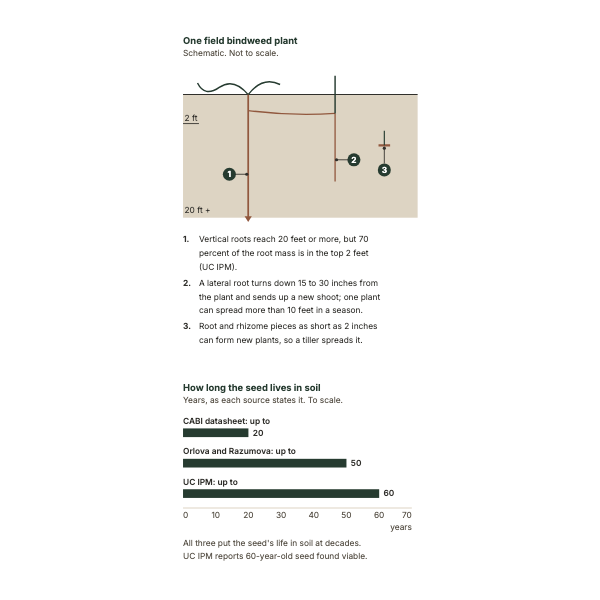
A single plant can make thousands of seed in its first year and more than 100,000 in later years, WSU says, and the seed stays viable in the soil for many years.
The California assessment, citing a 2004 dissertation by Erskine Ogden, puts output in the tens of thousands, then the hundreds of thousands.
No source read gives a measured number of years that fennel seed survives in soil. The California form answers yes to seed lasting three or more years, and WSU says dormant seed lets infestations come back on ground where no plants have stood for several years.
Seed travels by water, on machinery, attached to animals and mixed with crop seed and forage, WSU says. The Washington board adds birds, rodents, clothing, dirt carried on boots, and tires. How a seed bank decides where a weed returns is covered separately for common mullein.
This is why the reply about cutting before it seeds is right in substance. WSU’s advice is to remove ripe seed heads or flower heads and destroy them, and to cut the crown just before the plant sets seed, which it says reduces the sprouts that come from root left in the ground.
It also bears on the reply about weeks spent digging. Digging removes the plants standing, while WSU says dormant seed in the soil lets infestations return, and its sequence ends with a monitoring plan to destroy seedlings and regrowth as they appear.
Getting Rid of It
WSU’s fact sheet sets out the manual method in order of plant size. Small seedlings can be pulled by hand, and trowels or hoes uproot larger ones. Mature plants are difficult to remove because of their large crown and deep taproot, which can reach 10 feet.
For mature plants, WSU says shovels or picks may be needed and work best when the soil is moist. If the root breaks, the fact sheet says to be sure to remove its upper 3 to 6 inches, the part it calls the crown.
After digging, WSU advises replanting the ground with plants you want, because bare, disturbed soil lets fennel seed germinate. A study on California’s Santa Cruz Island shows why what is planted matters.
Power and colleagues (2014, cited from the abstract) followed plots for five years after fennel was removed there.
Plant cover rose in seeded and unseeded plots alike, but at one site native plants increased only where native seed had been sown, and the unseeded plots there were dominated by weedy annual grasses. The authors call seeding a critical step where the native seed bank is poor.
Herbicides are the other route, and trials exist for them. Bell, Easley and Goodman (2008, cited from the abstract) ran three field experiments in coastal California natural areas with glyphosate and triclopyr, alone and together.
Most treatments controlled fennel well six weeks and one year later, except the lowest glyphosate rate. Spot spraying individual plants was less effective, and used more herbicide per area, than spraying the whole patch. Those trials were in wildland, not on a road verge or in a garden.
WSU lists spot treatment with an herbicide, applied before the plant sends up a flower stalk, and says to use a product only where both the weed and the site are on its label.
This article gives no product or rate. Any herbicide is used by its label, which is the legal instruction.
A roadside stand like the one in the thread may not be on the finder’s land. This article does not cover the rules for road verges in Melbourne, or whether fennel there must be controlled. Cutting that brings back more growth is covered separately for the empress tree.
Is Roadside Fennel Fit to Pick
That reply made two claims about contamination: that fennel draws pollution into itself, and that roadside plants carry traffic residue. The sources read support the second far better than the first.
On soil, the Cornell Waste Management Institute’s 2009 guide says lead compounds were used in gasoline until the late 1970s.
“Even though the use of leaded gasoline has now been discontinued, the highest concentrations of lead in soils are still generally found adjacent to busy roadways,” it says.
Cornell adds that polycyclic aromatic hydrocarbons, combustion compounds often called PAHs, may also be higher near heavy traffic. The U.S. Environmental Protection Agency’s 2011 urban gardening fact sheet lists high traffic areas as a source of lead, zinc and PAHs, and advises growing food away from roads with heavy traffic.
On leaves, the evidence is about what settles on the surface. Smith (1971, cited from the abstract) found lead on roadside white pine fell regularly with distance from a busy interstate, with much of it presumably on the outside of the needles. That was during the leaded-gasoline era.
A 2015 study by Kitajima and colleagues, cited from the abstract, washed particles off ginkgo leaves along major roads in Osaka, Japan. The mass of traffic-related elements on the leaves correlated with heavy-vehicle traffic and with distance from the road, and the mix of road-dust elements on them was close to that of road dust itself.
How much of that dust washes off has been measured once in the sources read. In one urban garden contaminated by gasoline emissions, Attanayake and colleagues (2021, cited from the abstract) found that removing surface dust reduced lead in leafy vegetables by 40 to 50 percent. Half or more of the lead stayed after washing.
The bioaccumulator claim fares worse. The one study read that measured fennel itself, by Angelova, Ivanova and Ivanov (2003, cited from the abstract), grew five plants of the carrot family at different distances from a metal works near Plovdiv, Bulgaria.
It sorted them by how much heavy metal they took up: fennel and dill were low accumulators, coriander and caraway moderate, and anise high.
That was beside a smelter, not a road, and the abstract gives no values, so it says nothing about how much lead a roadside fennel holds.
No source read measured fennel beside a road, or diesel residue on any roadside plant. What the evidence does support is the replies’ practical advice.
Roadside soil and dust are where the contamination sources point, washing removed only part of the lead in the one test read, and the EPA’s advice is to grow food away from heavy traffic. The same evidence on lead beside roads is set out for another weed people eat in purslane by the sidewalk.
The thread’s poster said they had no plan to pick it. Picking also raises the identification question, which the poison center calls difficult and which a smell may not settle.
The Lookalike Problem
The carrot family holds food plants and deadly ones. The National Capital Poison Center, a U.S. poison control service, says poison hemlock belongs to the same family as carrots, parsnips, fennel and dill.
The poison center says modern poisonings are often the result of misidentification, and that people rarely eat hemlock on purpose. “At some phases of the life cycle, common characteristics of poison hemlock, such as spotting or bad smell, might not be present,” its page says.
That line answers the reply about a sniff: by the poison center’s account, the sign a smell test relies on may not be there. It adds that the concentration of the poison varies between plants and with growing conditions.
The U.S. Department of Agriculture’s Poisonous Plant Research Laboratory says all parts of poison hemlock are poisonous: leaves, stem, fruit and root.
It grows at roadsides, field edges, creek beds and ditches, and poisoning often follows mistaking its root for wild parsnip, its leaves for parsley or its seed for anise.
The poison center describes symptoms that start with nausea, vomiting, salivation, sweating and muscle weakness, and can progress to tremors, seizures, paralysis and trouble breathing.
A person usually recovers with hospital treatment, it says, but severe symptoms can develop quickly, so it is not safe to treat at home.
It summarizes a published case in which two adults ate “wild celery” picked in a park. Both felt unwell soon after, and one stopped breathing about two hours after eating and needed a ventilator before recovering.
Its advice for anyone interested in foraging is to join an experienced local group or use a field guide with clear pictures, and never to eat an unknown plant without that verification.
Someone who may have eaten poison hemlock should act immediately and go to an emergency department, the poison center says.
For the thread, that means an identification agreed on a forum is not the verification the poison center describes, which is an experienced person or a clear field guide checking the plant itself.
What to Do With a Fennel Stand
For a patch on your own land, the sources read point to this order.
- Eat nothing identified only on a forum, and treat roadside plants as carrying road dust (poison center; Cornell; EPA).
- Pull seedlings by hand, and use a trowel or hoe on larger young plants (WSU).
- Dig mature plants when the soil is moist; if the root breaks, make sure the top 3 to 6 inches come out (WSU).
- Remove flower and seed heads and destroy them so the seed cannot germinate, and do not mow plants carrying seed (WSU).
- Do not rely on mowing alone; WSU says it takes many cuts a season for at least four years.
- Replant the cleared ground, and watch for seedlings for years (WSU; Power and colleagues).
- Use any herbicide only as its label directs, on a site the label lists (WSU).
Local Regulations and Safety Advisory
If you use pest control products, follow the label. Rules on them vary by country and locality, and your pesticide regulator can say what applies where you live. This article identifies no plant, so eat nothing on its strength. Plants beside roads can carry lead and traffic dust that washing only partly removes, and a deadly relative of fennel can be mistaken for it. This article is general information, not medical or veterinary advice.
Authorities to consult:
- Pesticide regulatory authority or environmental protection agency
- Plant identification service or extension office
- Poison control service
- Veterinarian or animal poison control service
If a child or pet may have eaten part of a plant, contact a poison control service or a veterinarian, because toxicity depends on the species, the amount and the individual.
What Remains to Be Explored
No source read measured lead, other metals or traffic residue in fennel growing beside a road.
The one fennel metal study was beside a smelter, and the leaf studies used pine and ginkgo, so how much a roadside fennel holds, and how much washing removes from its fine leaves, is unknown.
No measured lifespan of fennel seed in soil was found; the sources say many years, or three or more. No trial compared digging with repeated cutting, or tested how often cutting must be done to exhaust a crown, beyond WSU’s at least four years.
Victoria’s weed listing, the rules for road verges in Melbourne and Australian guidance on fennel control are not covered here. A Victorian or Australian weed agency’s advice, or a council’s verge policy, would change the local advice.
No source gives a count of fennel lookalikes in Australia. Even with one, the poison center’s point stands: the signs used to spot the deadly ones may be missing.
Sources
- Dill Weed? — multiple community members. Reddit, r/whatsthisplant. Undated.
- Common Fennel (Foeniculum vulgare), Noxious Weed Fact Sheet EB2034 — Joe Yenish, Rick Johnson, Alison Halpern. Washington State University Extension. June 2008.
- Written Findings of the Washington State Noxious Weed Control Board, Foeniculum vulgare — Washington State Noxious Weed Control Board. May 2006.
- Foeniculum vulgare (Profile) — California Invasive Plant Council. Undated.
- Foeniculum vulgare Plant Assessment Form — California Invasive Plant Council. Undated.
- Foeniculum vulgare (Fennel) — Marianne Jennifer Datiles, Ian Popay. CABI Compendium. December 18, 2020. Cited from its abstract.
- Effective Fennel (Foeniculum vulgare) Control With Herbicides in Natural Habitats in California — Carl E. Bell, Todd Easley, Kari Roesch Goodman. Invasive Plant Science and Management. January 2008. Cited from its abstract.
- Native Plant Recovery in Study Plots After Fennel (Foeniculum vulgare) Control on Santa Cruz Island — Paula J. Power, Thomas R. Stanley, Clark Cowan, James R. Roberts. Monographs of the Western North American Naturalist. January 2014. Cited from its abstract.
- Heavy Metals in Plants and Oils From Family Apiaceae — V. Angelova, R. Ivanova, K. Ivanov. Bulgarian Journal of Agricultural Science. 2003. Cited from its abstract.
- Relation of Particle Matter on Roadside Tree Leaves With Traffic Density and Road Dust — Ikumi Kitajima, Toshihiko Matsui, Sho Sakai, Miwa Shigeyoshi, Akira Kondo, Katsumi Saitoh. International Journal of PIXE. January 2015. Cited from its abstract.
- Lead Contamination of Roadside White Pine — William H. Smith. Forest Science. June 1, 1971. Cited from its abstract.
- Phytoavailability of Lead for Vegetables in Urban Garden Soils — Chammi P. Attanayake, Ganga M. Hettiarachchi, Monica Palomo, Gary M. Pierzynski, Blanca Calderon. ACS Agricultural Science and Technology. April 8, 2021. Cited from its abstract.
- Sources and Impacts of Contaminants in Soils — Hannah Shayler, Murray McBride, Ellen Harrison. Cornell Waste Management Institute, Department of Crop and Soil Sciences, Cornell University. April 15, 2009.
- Reusing Potentially Contaminated Landscapes: Growing Gardens in Urban Soils (EPA 542/F-10/011) — U.S. Environmental Protection Agency, Office of Superfund Remediation and Technology Innovation. 2011.
- Can Poison Hemlock Be Deadly? — Pela Soto. National Capital Poison Center (Poison Control). October 26, 2026.
- Poison Hemlock (Conium maculatum) — USDA Agricultural Research Service, Poisonous Plant Research Laboratory. June 26, 2018.