Dark water around a cutting is not, by itself, a sign of rot. The sources describe at least three ways water can darken: compounds leaking from the cut and darkening as they oxidize, bacteria multiplying on what the stem releases, and decay without oxygen that makes black iron sulfide.
The cutting tells you more than the water does. A firm stem with no foul smell does not match the description of rot; a soft, mushy one that smells bad does.
No study of the water around a Monstera cutting was found, so everything below is borrowed from nearby research and says so.
The question came from a thread on r/houseplants. A Monstera cutting, taken from new growth high on the plant, went into a jar of water, and within days the water had turned black.
The grower had run the jar through the dishwasher first, which ruled out one theory and started several more.
Replies blamed residue in the jar feeding bacteria, with too little oxygen lower down; rot, and a black-staining mold; the colored fertilizer the grower adds to propagation water a few drops at a time; dye from commercial growers leaching out; and oxygen-free bacteria building a black film.
One reply argued that a plant could not do this at all without iron, iodine or some other reagent.
The grower had already rinsed the cutting, moved it to fresh water in a new jar and found the roots looking fine, with only a darker patch at the base of the stem that the grower thought might be staining rather than rot.
This article does not diagnose that cutting. It checks each explanation against what the sources say.
Check the Cutting Before the Water
Rot is a change in the plant, not in the water, so start with the stem. The University of Wisconsin–Madison Extension describes bacterial soft rot as starting with “water-soaked spots,” which “enlarge over time and become sunken and soft.”
Then, “Interior tissues beneath the spots become mushy and discolored, with the discoloration ranging anywhere from cream to black. Seepage from affected areas is common.” Soft rots, the fact sheet by Tobias Lunt adds, “are known for a strong, disagreeable odor.” The bacteria break down pectate, the material that binds plant cells together, which is why the tissue falls apart.
Two details matter for a jar. Wisconsin says rot “is particularly severe when oxygen is limited,” and that the bacteria can be spread by contaminated water.
Black tissue on its own settles nothing, because rotting tissue can be cream or black. The same page puts the limit plainly: “Very few diseases can accurately be diagnosed by eye.”
So the useful test is what the stem feels and smells like, not its color. Lift the cutting out and press the base gently.
Firm tissue with no bad smell does not match that description; soft, sunken or mushy tissue with a foul smell does. No source we found separates a stained stem from a rotted one by color, so this article does not offer a color test.
Christa Carignan of the University of Maryland Extension adds one warning about the cutting itself: “Thicker stems can take longer to strike out new roots, and they may rot before rooting.” For a soft stem base in other rooting media, our article on rooting cuttings in perlite and LECA covers what has been studied.
Route One: Compounds From the Cut
The first route starts at the wound. In a 2024 review of browning in plant tissue culture, Chen Liu and colleagues explain that living cells keep two things apart: “Typically, phenolics are stored in the vesicles, while oxidative enzymes are located in the cytoplasm.” Phenolics are a large family of plant compounds, and the review names tannins among them.
Cutting breaks that separation. “Stress or damage to plant tissues can disrupt this cellular arrangement, causing contact and reaction of substrate and enzyme,” the review continues, and the products, called quinones, “further dehydrate and polymerize into black-brown substances.” In other words, cut plant tissue can make its own dark pigment, with no mold or bacteria involved.
The review’s example involves the growing medium itself. Guava pieces grown in culture “experienced browning or blackening of explants during in vitro culture due to the leaching of phenolics,” explants being the small pieces of plant placed on a growing medium.
How strongly a plant browns, the authors add, varies with which phenolics it holds and how much of them.
That is tissue culture, not a cutting in tap water, and no measurement of what a Monstera cutting releases into water was found.
But it fits one report in the thread, from a grower whose water turned dark the day after a leaf broke off and did not darken again after one change. A single release from a fresh wound would look like that; nobody has tested it.
Iron is where the reply about reagents had a point. The Illinois Department of Public Health, writing about well water, says that “tannins can stain water a tea color. In coffee or tea, tannins produce a brown color and react with iron to form a black residue.” Iron in tea, it says, “produces an inky, black appearance.”
Illinois notes that organic iron and tannins turn up more often in shallow wells and wells under the influence of surface water.
Whether the iron in a given tap is enough to blacken plant tannins in a jar has not been measured. Our article on what water to use for houseplants covers what is known about tap, well and filtered water for plants.
Route Two: Bacteria in the Water
One reply blamed residue in the jar, and the grower answered that it had been through the dishwasher. Research on cut flowers says a clean container does not keep bacteria out. Yen-Hua Chen, William B. Miller and Anthony Hay at Cornell cleaned and rinsed their vases with purified water before filling each with tap water and twelve stems of rose, gerbera or one of two lilies.
Over the following week, the bacterial communities in the water and on the stems grew richer and more varied.
The authors put the rising diversity down, “likely in part,” to “the growth of bacteria on flower exudates in water,” exudates being what a cut stem releases. The paper cites earlier work finding that bacteria affecting cut flowers came “mainly from the stems, water, or soil.”
Some of the bacteria that increased are the kind a grower would worry about. “Pseudomonas veronii, implicated in soft rot of calla lily, increased in both whole stem samples and water samples from Gerbera jamesonii,” the authors write, and Erwinia, a group that includes plant pathogens, also rose in the water.
Cut flowers are not rooting cuttings, so this shows what water around a cut stem can do, not what a propagation jar will do.
Bacteria in large numbers also block stems. The paper’s introduction cites earlier work in which more than 10 million colony-forming units per milliliter, a standard count of live bacteria, lowered the stem’s ability to carry water.
Maryland’s advice for rooting in water draws the same link: “Bacterial growth in the water can lead to rotting.”
Route Three: Decay Without Oxygen
Cuttings need oxygen to root, and still water can run short of it right at the stem. Hillel Soffer and David W. Burger rooted cuttings of weeping fig (Ficus benjamina) and chrysanthemum at dissolved oxygen levels from saturation down to none, and found that “dissolved oxygen is essential to root formation and root growth.”
Less oxygen, in their 1988 study, “increased the time required to form adventitious roots, reduced rooting percentages, reduced numbers of roots formed per cutting, and reduced average root lengths.” Adventitious roots are roots that grow from a stem rather than from an existing root. The paper is cited from its abstract.
Their comparison of stirred and unstirred water “suggested the development of an area of depleted oxygen concentration (boundary layer) at the stem-water interface on cuttings immersed in unstirred water.” Cuttings in constantly stirred water rooted sooner and formed more roots. Neither species is a Monstera, and their chambers were not jars.
That puts the oxygen shortage in a different place from the thread’s theory. A reply suggested the lower part of the jar ran out of oxygen; the shortage the study pointed to sat against the stem itself.
No source we found measured oxygen at different depths in a jar, so the figure below does not draw one.
Where the dark color can come from
Three routes to dark water around a cutting, each from a different body of research. None has been measured in a propagation jar.
The color alone does not show rot. A stem that has turned soft, mushy and foul-smelling does.
Where oxygen runs short, a different route makes what water-quality sheets call black water. Purdue Extension’s well-water sheet by Adel L. Pfeil explains that “certain non-disease-producing bacteria use the oxygen in the sulfate to form hydrogen sulfide,” the gas that “causes the ‘rotten-egg’ or sulfur water smell.”
With iron present, that gas forms “ferrous sulfide or ‘black water,’” in Purdue’s words. The Minnesota Department of Health traces hydrogen sulfide to decay and to sulfur bacteria, and lists as signs bacterial slime, which can be white, gray or black, and “black stains on silverware and plumbing fixtures.”
A lake study shows the same chemistry at a larger scale. Qiushi Shen and colleagues simulated the black blooms of China’s Lake Taihu, marked by “a black color and offensive odor,” and found that they formed only where dissolved iron and sulfide were both high, not where either was low. Iron rose as oxygen fell, and sulfide decided when the water turned.
That study, cited from its abstract, was a lake with algae, and Purdue and Minnesota write about wells. The chemistry is general, but nobody has measured sulfide in a propagation jar.
What it does give a grower is a sign to check: the rotten-egg smell is what these sources tie to hydrogen sulfide and decay without oxygen, and the color alone is not.
Mold, Fertilizer and Dye
The mold theory has a narrow basis. Pushya Pradeep and colleagues describe a strain of Aspergillus niger, isolated from the coast near Mumbai, that “secretes water-soluble melanin.” So at least one mold can release a dark pigment into water.
No source we found links a mold to black propagation water.
Fertilizer is the open question. The grower often adds a few drops to propagation water and had never seen this before.
No study of fertilizer in propagation water was found, so whether it feeds bacteria or darkens the water is unknown. If you add fertilizer to water, follow the product label; this article gives no amount.
Dye is real in the trade, for flowers. Iowa State University Extension explains that vivid blue moth orchids are “typically white flowers dyed,” with a food-grade dye “injected into the base of the flower scape (stem)” and carried up with the water; reblooms come back white.
No source we found describes dye or so-called chlorophyll inhibitors used on Monstera, and the cutting in the thread came from fairly new growth high on the plant. That leaves the dye theory without evidence either way.
What to Do With the Jar You Have
Each step below comes from one of the sources above. None gives a time for how fast dark water should clear, so no time is given here.
- Lift the cutting and check the stem. Press the base and smell it. Soft, sunken or mushy tissue with a foul smell matches Wisconsin’s description of soft rot; firm tissue with no smell does not.
- Remove rotted tissue. Wisconsin says there is no treatment once soft rot bacteria have infected tissue, and to “immediately remove and discard infected plants or plant parts.”
- Start again with fresh water. Maryland’s advice is to “change water at least twice a week or when it starts to look cloudy,” so that the water “stays clean and provides oxygen.”
- Smell the water. A rotten-egg smell is hydrogen sulfide, which Purdue and Minnesota tie to sulfur bacteria and decay.
- Move it on once it roots. Maryland suggests letting new roots grow in water “for another week or two” and then potting the cutting “into a small, well-draining container with potting medium.” Our article on water roots and soil roots covers what changes in the move.
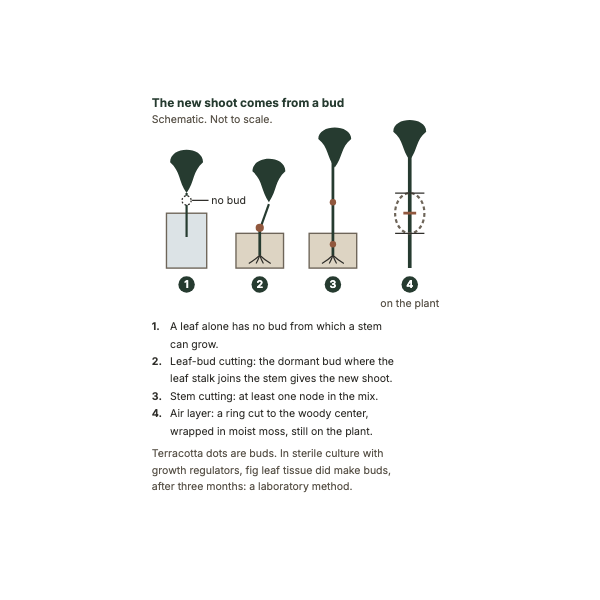
A Monstera cutting is a stem with a node, the point where leaves and roots grow from; if yours is a single leaf with roots and no node, our article on leaf cuttings without a node covers what is known about whether it can become one, whatever color its water is.
Local Regulations and Safety Advisory
If you use fertilizer products, follow the label. Rules on them vary by country and locality, and your agriculture department can say what applies where you live. This article is general information, not legal advice.
Authorities to consult:
- Local agriculture department
What Remains to Be Explored
No study was found of the water around a Monstera cutting in a jar: what it releases, how fast bacteria grow there, or how much oxygen the water holds.
The browning route comes from tissue culture, the bacterial route from cut flowers, and the sulfide route from wells and a lake, each borrowed by inference.
No test of fertilizer added to propagation water was found, and no source separates a stained stem from a rotted one by color.
Whether the iron in ordinary tap water is enough to blacken what a cutting releases is also unmeasured. A simple trial of cuttings in jars, with and without iron, fertilizer and water changes, would answer most of this.
Sources
- Combating Browning: Mechanisms and Management Strategies in in Vitro Culture of Economic Woody Plants — Chen Liu, Hongrui Fan, Jiaqi Zhang, Jianing Wu, Mingbing Zhou, Fuliang Cao, Guiyun Tao, Xiaohong Zhou. Forestry Research 4:e032 (Maximum Academic Press). September 26, 2024.
- Postharvest Bacterial Succession on Cut Flowers and Vase Water — Yen-Hua Chen, William B. Miller, Anthony Hay. PLOS ONE 18(10):e0292537. October 10, 2023.
- Effects of Dissolved Oxygen Concentrations in Aero-Hydroponics on the Formation and Growth of Adventitious Roots — Hillel Soffer, David W. Burger. Journal of the American Society for Horticultural Science 113(2):218-221. March 1988. Cited from its abstract.
- The Limiting Factor to the Outbreak of Lake Black Bloom: Roles of Ferrous Iron and Sulfide Ions — Qiushi Shen, Chengxin Fan, Cheng Liu, Chao Chen. CLEAN – Soil, Air, Water 46(9). August 19, 2018. Cited from its abstract.
- The Genome of Aspergillus Niger Strain Melanoliber — Pushya Pradeep, Rakshita Sukruth Kolipakala, Deepesh Nagarajan. Microbiology Resource Announcements 14(3). March 11, 2025. Cited from its abstract.
- Make More Plants From Cuttings: 5 Plants That Root Easily in Water — Christa Carignan. University of Maryland Extension, Maryland Grows blog (Home and Garden Information Center). 2017-11-20, updated 2021-04-12.
- Bacterial Soft Rot (UW Plant Disease Facts D0010) — Tobias Lunt. University of Wisconsin-Madison Division of Extension, Wisconsin Horticulture. Last revised 2024-02-28.
- Iron in Drinking Water — Illinois Department of Public Health, Private Water fact sheets. Updated Dec 2010.
- Hydrogen Sulfide and Sulfur Bacteria in Well Water — Minnesota Department of Health, Well Management. 2023-06-15 (revision mark on the sheet).
- Sulfur Water Control (Rotten Egg Odor in Home Water Supplies), WQ-11 — Adel L. Pfeil. Purdue University Cooperative Extension Service. December 1990.
- How Are Blue Orchids Made? — Iowa State University Extension and Outreach, Yard and Garden. Undated.
- R/Houseplants Thread (Posted Title Not Reproduced): A Monstera Cutting’s Propagation Water Turned Black — multiple community members. Reddit, r/houseplants. Undated.